
How the Brain Achieves 79% Energy Efficiency
·July 20, 2026
Summary: Moving past traditional models that view memory and computation as static synaptic states or isolated neuronal action potentials, the team modeled local functional circuits as parameterized digital neural ensembles within a multi-scale “neural sphere.”
Their findings reveal that information is encoded in collective spatio-temporal electrical patterns governed by nonlinear dynamics, chaos, and fractal theory. Crucially, the framework demonstrates that brain computation requires only about 1.26 times the Landauer limit, operating at up to 79% energy efficiency, while predicting a maximum memory storage capacity of 7.48 times 1018 bytes.
Key Facts
- Near-Landauer Computational Efficiency: Energy consumption for neural computation and communication was calculated at approximately 1.26 times the Landauer limit (the theoretical minimum physical energy required to erase one bit of information), yielding an operational energy efficiency of 79%.
- Dramatic Contrast with Silicon AI: While the human brain operates near thermodynamic physical limits, modern semiconductor AI hardware exceeds the Landauer limit by a factor of 10^9 (1,000,000,000 times), highlighting immense potential for neuromorphic chip optimization.
- Revised Memory Bounds: The model estimates the human brain’s theoretical maximum storage capacity at $7.48 times 10^18 bytes, roughly three orders of magnitude higher than conventional estimates based on linear synaptic summations.
- Massive Equivalent Compute: Brain computational throughput was modeled at up to 6.24 times 10^18 floating-point operations per second (FLOPS), equivalent to roughly 78,000 high-performance modern graphics processing units (GPUs).
- Spatio-Temporal Pattern Encoding: Rather than storing information in isolated synapses or single neurons, the brain uses initial conditions of neural ensembles to generate periodic potential waveforms that serve as dynamic physical carriers of information.

Source: Science China Press
The human brain is one of the most energy-efficient intelligent systems in nature. With only about 20 watts of metabolic power, it supports perception, memory, learning, thinking and motor control. Yet how the brain performs such complex information handling at such low energy cost remains a fundamental question.
In a recent study published in National Science Review, Ma and Guo from Nanjing University of Aeronautics and Astronautics proposed a new theoretical framework called highly energy-efficient information-handling dynamics of the brain.
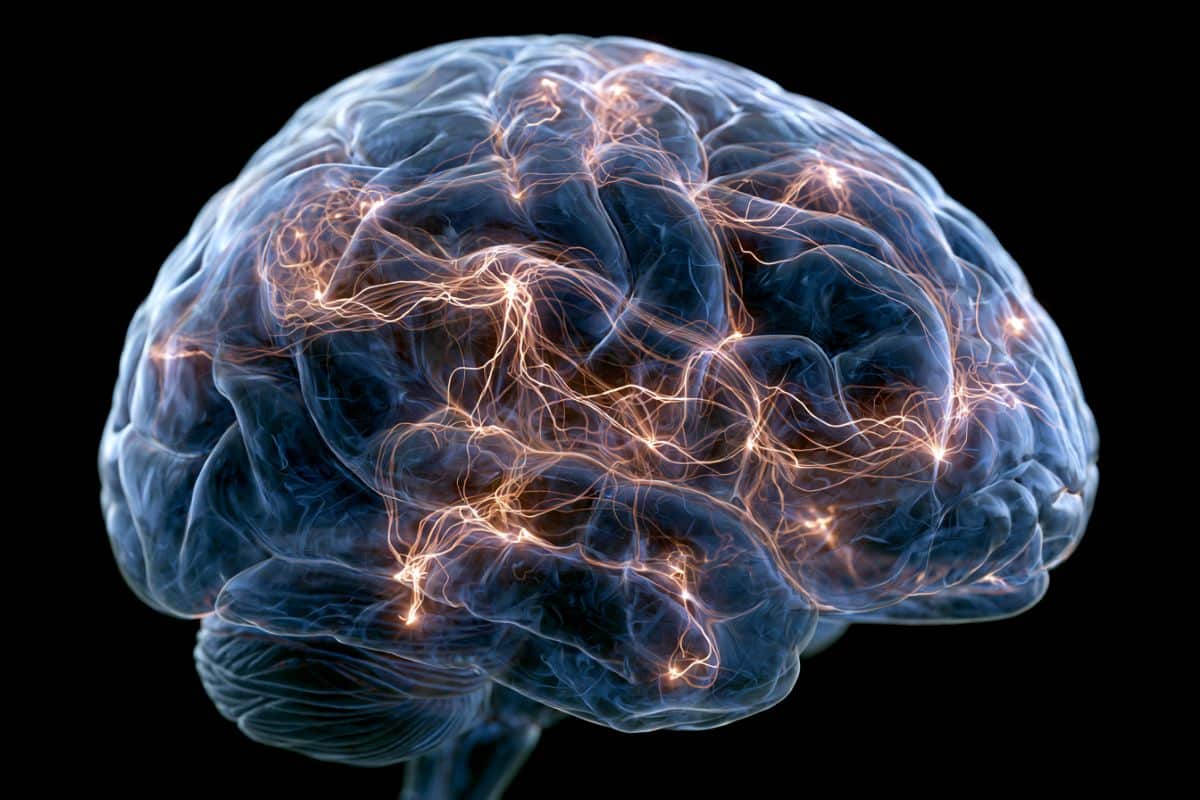
The work offers a physical perspective on how neural systems may store and process large amounts of information through Dynamic electrophysiological activities.
Traditional descriptions of brain function often focus on how individual neurons generate action potentials, how synapses transmit signals, or how brain regions interact. These approaches have greatly advanced neuroscience, but they do not fully explain why the brain is so energy efficient. The new study shifts attention from isolated neural events to the spatio-temporal organization of neural ensembles.
In the study, local functional neural circuits were abstracted as neural ensembles. Biological neurons were further parameterized as digital neurons containing both morphological and electrophysiological information. Based on an energy-minimization principle, the researchers constructed a neural sphere model that unifies structure and function, allowing simulation of local brain activity under metabolic constraints. Through systematic simulations, the team examined neural ensembles with different topological connections, initial potential states and neuronal scales.
They found that neuronal populations can generate rich electrophysiological activities with periodic features. These results suggest that information in the brain may not be stored only in single neurons or synapses. Instead, it may be encoded in dynamic electrical patterns formed by the cooperation of many neurons.
To explain these results, the researchers introduced concepts from nonlinear dynamics, chaos theory and fractal theory. In their framework, different inputs correspond to different initial conditions of a neuronal ensemble. These initial conditions can evolve into periodic potential waveforms, which act as dynamical carriers of information. Such waveforms can both preserve information and participate in further processing.
The framework also led to striking quantitative estimates. The maximum storage capacity of the human brain was predicted to reach 7.48 × 1018 bytes, about three orders of magnitude higher than previous estimates based on the linear summation of synaptic states.
The maximum computational power was estimated to be 6.24 × 10¹⁸ floating-point operations per second, equivalent to approximately 78,000 modern graphics processing units. Even more remarkably, the energy required for computation and communication in the human brain was estimated to be only about 1.26 times the Landauer limit, the physical lower bound for information erasure.
This corresponds to an energy efficiency of up to 79%, suggesting that the brain may operate close to a thermodynamic limit for information processing. However, the energy consumption of the current advanced artificial intelligence chips exceeds the Landauer limit by 109 times. Compared to the elegant natural intelligent systems, there is a significant potential for improvement in energy efficiency in current semiconductor chip technology.
The authors provided an inspiring physical picture: the brain’s efficiency may arise not only from its biological components, but also from the way information is organized in time, space and collective dynamics. This theory may open new directions for brain science and provide inspiration for more energy-efficient brain-inspired computing architectures.
Key Questions Answered:
Q: What is the Landauer limit and why is its application to brain science significant?
A: The Landauer limit is a fundamental principle in physics that defines the minimum possible amount of energy required to erase one bit of information. By showing that brain computation operates at just 1.26 times this physical limit, the study demonstrates that neural networks operate near the absolute thermodynamic boundary for information handling.
Q: How does this model achieve a storage estimate three orders of magnitude higher than previous models?
A: Traditional models calculated memory capacity by adding up isolated, static synaptic connections linearly. This new framework treats neural ensembles as dynamic, nonlinear systems where information is encoded in multi-dimensional spatio-temporal electrical patterns and fractal waveforms, exponentially increasing the available state-space for information storage.
Q: How can these biological findings improve future artificial intelligence hardware?
A: Modern AI silicon chips require massive power supplies because their architectures exceed the Landauer physical limit by nearly a billion times. By mimicking how the brain uses sparse, collective spatio-temporal wave dynamics rather than high-voltage brute-force clock cycles, engineers can design brain-inspired neuromorphic chips that cut power consumption drastically while scaling compute capacity.
Editorial Notes:
- This article was edited by a Neuroscience News editor.
- Journal paper reviewed in full.
- Additional context added by our staff.
About this neuroscience and information processing research news
Author: Bei Yan
Source: Science China Press
Contact: Bei Yan – Science China Press
Image: The image is credited to Neuroscience News


