
United States’ $39 trillion national debt will mean fewer jobs at lower wages for Gen Z, according to think tank

By
Senior Reporter, Economics and Markets
July 14, 2026, 7:17 AM ET
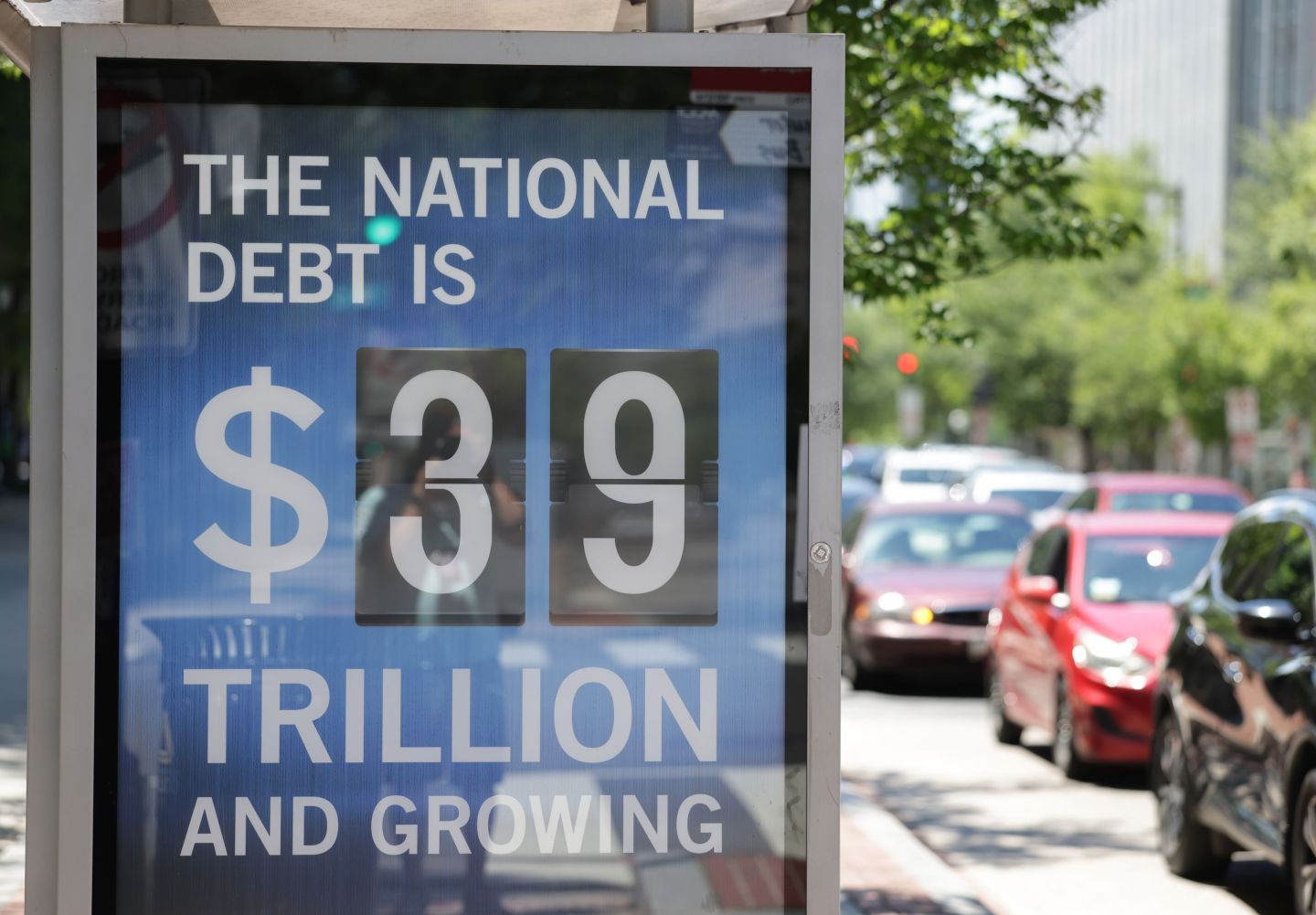
A Peterson Foundation bus stop sign displays the national debt on June 12, 2026 in Washington, DC.Tasos Katopodis – Getty Images for the Peter G. Peterson Foundation
In the debate about the level of threat the U.S. national debt poses to the economy, most people can agree that any crisis will be felt most sharply by the youngest people in the economy.
For example, Citadel CEO Ken Griffin has previously warned that surging debt is an issue the government cannot afford to ignore, writing in his 2023 letter to shareholders that “It is irresponsible for the U.S. government to incur a deficit of 6.4% when unemployment is hovering around 3.75%. We must stop borrowing at the expense of future generations.”
A report published yesterday by the Peter G Peterson Foundation suggests that Gen Z, in particular, will face a smaller job market with lower wages if the fiscal trajectory of the country continues to persist.
“Rising interest costs not only crowd out resources for public investments within the budget, but also deter private investment in businesses, which slows economic growth and negatively impacts the labor market,” the report says.
One might argue that the Peter G Peterson Foundation would issue such a warning—after all, the organization was founded to find solutions to get America on a more sustainable fiscal path.
However, the think tank has outsourced some of its data analysis—most notably to EY’s Quantitative Economics and Statistics (QUEST) practice, which found this spring that the rising debt path will reduce the number of jobs in the U.S. by 1.2 million by 2035, compared to a scenario in which lawmakers stabilize the debt.
By 2055, on an annual and cumulative basis, this adds up to 2.7 million jobs, and a loss of 3.6 million jobs by 2075. Of course, 50 years into the future it is Gen Z and Gen Alpha who will make up the bulk of the workforce—meaning these are the generations which will be most impacted by the shrinkage.
Of course, an optimist might suggest that by 2075 the economy could survive with fewer jobs thanks to the efficiencies provided by artificial intelligence—JPMorgan Chase CEO Jamie Dimon, for example, believes that economically developed nations will end up with workweeks of 3.5 days.
But Dimon is also in the camp of individuals worried about how America’s borrowing habit may come home to roost. He sees a bond market crisis as the most likely outcome, saying in April that while the U.S. economy will navigate the upheaval, it’s not the right way to deal with the issue. Speaking on a live podcast with Nicolai Tangen, CEO of Norges Bank Investment Management (NBIM), Dimon said: “I just think maturity should say you should deal with it as opposed to let it happen.”
Lower wages
The EY analysis commissioned by the Peterson Foundation also found that take-home pay shrinks over time if policymakers don’t slow the pace of debt accumulation. The annual difference in wages compared to a stabilized debt baseline drops by 0.6% by 2035, 3% by 2055 and 5.3% by 2075.
The service payments to manage the debt are accumulating at speed. Recent research from the Congressional Budget Office (CBO) found net interest on public debt for the fiscal year has hit $857 billion: roughly $23.8 billion a week.
In fact, interest payments on the debt are now $20 billion larger than the outlays for the Departments of Defense, Commerce, Homeland Security, Education, the Environmental Protection Agency, the Small Business Administration, and the U.S. Coronavirus Refundable Credits scheme—combined.
The Peterson Foundation urged younger people—those it believes will be most impacted by debt—to ensure policymakers take action. The report concludes: “The growing national debt will both shrink the labor market and drive down wages, contributing to an uncertain economic future for millions of younger Americans. The decisions that today’s leaders make about America’s fiscal future are extremely consequential to the next generation.

Paid Content
How PMI is investing in America’s smoke-free future
From PMI U.S.
“The good news is that young Americans can play a critical role in ensuring a more prosperous economic future by making their voices heard.”
Subscribe to Fortune Gulf Brief. Every Tuesday, this new newsletter delivers clear-eyed, authoritative intelligence on the deals, decisions, policies, and power shifts shaping one of the world’s most consequential regions, written for the people who need to act on it. Sign up here.
About the Author
By Eleanor PringleSenior Reporter, Economics and Markets
Eleanor Pringle is an award-winning senior reporter at Fortune covering news, the economy, and personal finance. Eleanor previously worked as a business correspondent and news editor in regional news in the U.K. She completed her journalism training with the Press Association after earning a degree from the University of East Anglia.


