
Reconsidering the Causes of Schizophrenia
Discovering a sensory quirk in patients sent Robert Freedman on a decades-long quest for genetic and biological clues
Spring 2026
- by Molly McDonough
- 4 minute read
- Profile
Robert Freedman
Photo: Timothy Archibald
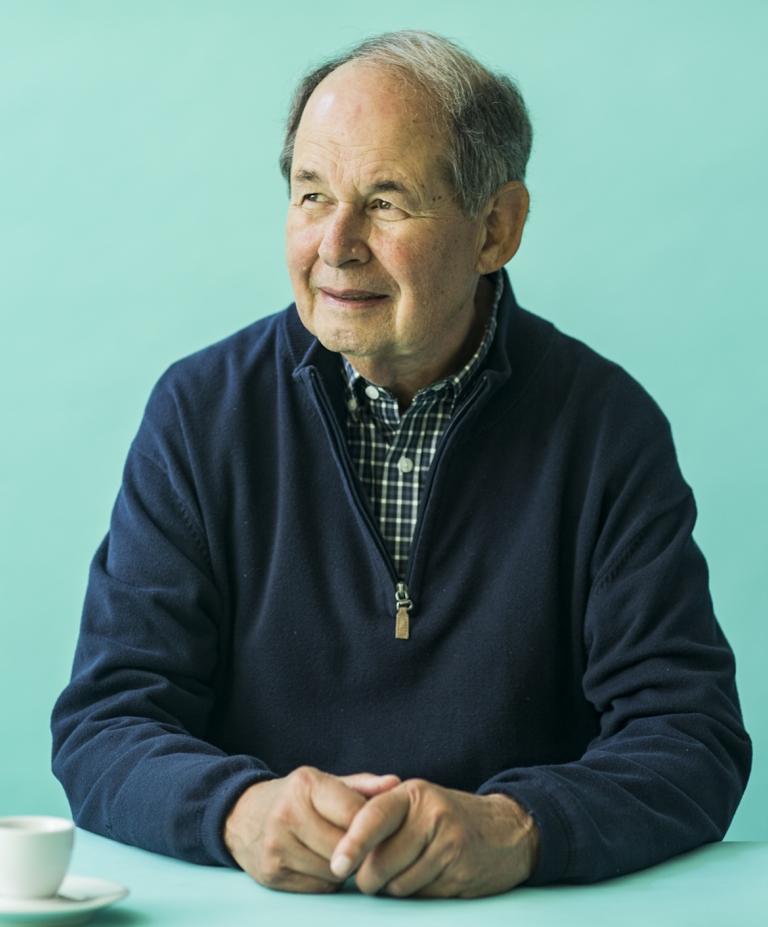
Robert Freedman, MD ’72, was standing in front of his psychiatry class, and he was floundering.
The assignment was to present a case study of his patient with schizophrenia, who was sitting just a few feet away, to his HMS classmates and professor. The professor pressed Freedman for details about the patient’s parents — this was the early 1970s, after all, when schizophrenia was largely understood as the legacy of insensitive or even cruel parenting. But Freedman didn’t know the answers, and he was mortified.
Afterward, Freedman asked the patient how he’d felt during the ordeal. The man’s response came as a surprise: “The air conditioner was very interesting.” While the professor was probing his family history, Freedman’s patient was focusing on voices he heard in the drone of the unit overhead.
“I realized for the first time that we had overlooked an interesting sensory problem,” recalls Freedman. It was a moment that foreshadowed the arc of his career: a shift away from searching for answers in family narratives and toward uncovering the brain circuitry that shapes how people with schizophrenia filter the world.
Freedman originally wanted to be a lawyer. But a social science requirement at Harvard College landed him in the classroom of cognitive psychologist George Miller, who fascinated Freedman by framing schizophrenia as some kind of psychedelic mind experiment. “I decided then and there to go into medical school instead,” he says.
At HMS, working under psychiatrist John Allan Hobson, MD ’59, and neurophysiologist Stephen Kuffler, Freedman was introduced to electrophysiology, the study of the brain’s electrical signals. After a research stint at the NIH and a psychiatric residency at the University of Chicago, he joined the faculty at the University of Colorado and began applying skills he’d honed at HMS to clinical research on schizophrenia.
As he got to know more patients, the romantic view that first captivated him gave way to an understanding that the delusions of schizophrenia are more terrifying than mind-expanding, but his interest only increased. “People with schizophrenia have enormous creative abilities,” Freedman says. “I admire them for what they struggle against when the world around them is threatening and they just keep plugging away.”
Early on, Freedman figured out a way to measure the sensory issues he’d suspected: a test consisting of two clicking sounds. In a neurotypical brain, the first click evokes a slew of electrical activity as the person directs attention to the sound — but subsequent clicks evoke less. The brain, constantly exposed to more information than it can process, must weed things out. But people with schizophrenia tend to show as much electrical activity in response to the second click as the first, indicating possible deficiencies in that weeding process.
The idea we could prevent schizophrenia is far out there, but it essentially just fell out of the science.
Freedman traced this phenomenon to the hippocampus, where a neurotransmitter called acetylcholine activates receptors that help dampen repeat signals. If that circuitry was malfunctioning, he wondered, could the issue be genetic?
To find out, he hopped in a van and crisscrossed Utah and Colorado searching for large families with multiple cases of schizophrenia. He traced the faulty click response through those family trees, making it a genetic clue: By comparing the DNA of relatives who failed the test with those who didn’t, he zeroed in on a gene called CHRNA7, which encodes the receptor that acetylcholine triggers in the brain’s filtering process.
Freedman tried using different drugs to manipulate that receptor in patients, but results were modest. Then, one day in the shower, he had a realization: Babies of parents with schizophrenia are more likely to fail click tests within weeks of birth. Perhaps by the time a person is born, the hardware is wired, and intervening in adults is too late.
In the fetal hippocampus, receptors for acetylcholine are abundant, but the neurotransmitter itself doesn’t surge until just before birth. Until then, the fetus relies on choline, a nutrient from the mother’s diet, to activate the receptors. But many women are choline deficient, and some fetuses have impaired CHRNA7 function. If mothers don’t get enough choline to activate the fetus’s receptors at the right time, could the circuitry fail to form properly?
In clinical trials, Freedman and colleagues found that newborns whose mothers received extra choline — including newborns with impaired CHRNA7 function — had improved results on the click test compared to those whose mothers did not. As they grew into toddlers, they demonstrated improved attention and social engagement. The work suggests that supporting the brain at the right moment could reduce biological risks for traits linked to schizophrenia, as well as for related conditions like autism and ADHD.
While more trials are ongoing, demonstrating that choline prevents schizophrenia would take decades, as the illness is usually diagnosed in young adulthood. But choline has many benefits for developing fetuses, is relatively safe, and doesn’t require a prescription. It’s a departure from the traditional pharmacology of schizophrenia, which relies on dopamine- blocking drugs with severe side effects.
“I’ve kind of been out in the wilderness looking at acetylcholine and this strange receptor,” Freedman says. “The idea we could prevent schizophrenia is far out there, but it essentially just fell out of the science.”
Despite focusing on just one of many genes that could raise the risk of schizophrenia, Freedman has played a central role in linking the condition to biology. That contribution made him a main character in the 2020 book Hidden Valley Road, which follows the Galvins, a family he met on his Colorado van trips. Six of 12 Galvin children developed schizophrenia, offering an extraordinary opportunity to study the genetics of the disease. Freedman says he’s grateful for the attention the book brought, if only because it helped him spread the word about prenatal choline.
These days, another role competes for his time. He recently moved to San Francisco to be closer to his four grandchildren. After decades studying how brains are built early in life, the subject now feels personal. His greatest pleasure has been “the really great kids in our studies and in our families,” he says. “That’s what it’s all about.”
Molly McDonough is the associate editor of Harvard Medicine.
Topics Covered:

 canisgallicus