Life without the internet in Iran
Islamic Republic officials blocked internet access in late February, forcing citizens to improvise solutions to avoid poverty and isolation
Aresu Eqbali
Teherán – MAY 17, 2026 – 06:05 CEST
Share on Twitter Desplegar Redes Sociales
“And suddenly one morning, we felt lost from one another.” This is how Mehrnoosh Shahhosseini, a 52-year-old fashion designer from Tehran, remembers the hours following Israel and the United States’s first aerial attacks on February 28, the same day that Iranian officials blocked internet access out of “security concerns.”
The blackout continues to this day, and it is forcing a country of more than 90 million people to find alternative ways to stay informed, stay in touch with loved ones, study, and keep their businesses afloat. The digital shutdown has meant that Google Maps isn’t working, that data and emails are lost, that paying a taxi driver through an app has become a real challenge.
Like many Iranians, Shahhosseini reinstalled an old satellite dish at home, since TV set-top boxes and smartphones were no longer helping her stay informed about the situation in Tehran.
“We needed to know where there had been a bombing and where the next could be!” she says, referring to the satellite television news programs that shared occasional warnings from Israel on future attack targets. At the same time, the sale of illegal VPN configurations has soared, as has a more costly service called Internet Pro, used by business owners, other professionals, and academics.
Shahhosseini wakes up in the middle of the night, when the VPN connection is less congested, and she can respond more quickly to clients. “I get up at dawn to respond to emails from people who also can’t connect during the day. If I’m late, I can lose those clients,” she says.
In her house, the internet blackout has had some positive collateral effects: one of her teen daughters is reading more, another has started a beginner’s sewing class, and is considering learning to play an instrument. “Because they can’t play video games anymore,” explains Shahhosseini.
“Before, I was always short on time, and now, my life goes at a tortoise’s pace, and I spend quality time with my family,” she adds. “But it is hard to keep up the spirits of two 14 and 16-year-old teenagers, with no internet and after the trauma caused by the war.”
Government differences
Amirhossein Jalali-Nadoushan, the spokesperson for the Iranian Psychiatric Association, believes that being deprived of the internet could have serious consequences for young people. “It could also gradually snuff out the voice of the Iranians, or make it so that other voices substitute those voices in the future who no longer represent the Iranian population,” he warned, as quoted by the ILNA news agency.
Since April 8, a ceasefire between the United States and Iran has been in place, but it is threatened almost daily by attacks from one side or by disagreements in the ongoing negotiations. Although government statements suggest the internet blackout will not last forever, differences of opinion among Iranian authorities are also evident. “What we are experiencing today, including the general disconnection of internet, is not acceptable, nor is it to the president’s liking,” Mehdi Tabatabaei, presidential adviser on public relations, said May 5, according to ISNA, a semi-official, state-supported news agency in Iran. “With the country’s return to normalcy, which is also coming soon, the internet will return to its normal state,” he said.
These remarks from President Masoud Pezeshkian’s adviser came after a conservative‑leaning member of parliament, Amirhossein Sabeti, said there was no such prospect in the near future. “If the internet is reconnected, there is a possibility that some of the mercenaries whose actions we witnessed on January 8 and 9 will organize gatherings through these social networks,” he said in recent days, according to the online newspaper Hamshahrionline.ir.
Sabeti was referring to the anti‑government protests in January, in which messaging apps like Telegram played a key role in organizing and mobilizing citizens. Iranians took to the streets to denounce the economic crisis, and the movement — which gained momentum and called for an end to the Islamic Republic — was crushed by a brutal crackdown that left at least 3,000 people dead, according to the official tally, though human‑rights organizations say the total number of victims is double that figure.
Ironically, the Tehran Electronic Commerce Association said in an IRNA statement in late April that the most serious cyberattacks to have taken place in Iran, including the hacking of several major banks, actually took place during periods of total internet shutdown.
Ruin for small businesses
The livelihood of more than 10 million Iranians depends on a stable internet connection, and the abrupt blackout has been a disaster for many small businesses. Alireza, 35, runs a kitchen and bathroom furniture company in the northeastern city of Mashhad. “I have been diligently promoting the business on Instagram since 2022. The result was clear in my annual earnings, which went from 15 billion rials [$11,380] four years ago to 40 billion [$30,500] in 2025-2026,” he says in a telephone interview.
But his last Instagram video was posted two days before the start of the war. “I have a showroom in the city center, but I don’t even have a sign on the door,” he says, explaining that her marketing strategy is based on social media.
Since the war began, he has used Iranian messaging apps to make up for his absence on Instagram. But “90% of our followers aren’t on them,” and he has yet to find a viable strategy to keep the business going. As a result, he has had to let go of 17 workers because he has no orders. “Some of the people who were let go have families to feed. At the same time, the price of our raw materials has nearly doubled. I don’t understand why they cut off the internet,” he says.
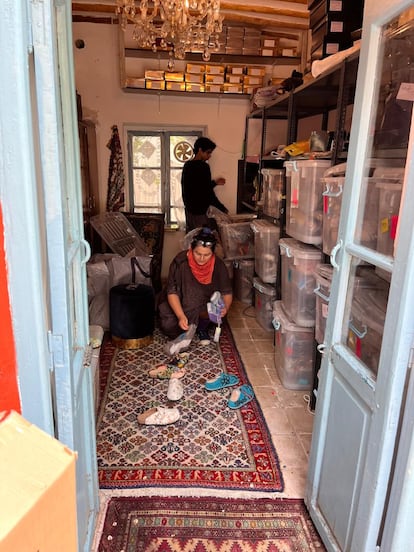
In Shahhosseini’s case, the image that best captures the impact of the internet blackout on her life as a small business owner is a room in her home filled with shoeboxes she has been unable to sell. Her income has fallen by two‑thirds because of the commercial isolation caused by the digital blackout. Like Alireza, her Instagram account was her storefront, and her more than 28,000 followers were her business card. “But if you don’t post anything new and you don’t respond, in a matter of days, the algorithm punishes you,” she explains.
Sabeti, the conservative lawmaker, laments that Iran’s existing digital infrastructure has been too weak to cushion the impact of the shutdown. “We should have prepared our national infrastructure previously, so that so many businesses wouldn’t collapse in moments like this one. Like in China, which has a very solid national network,” he said.
In Iran, things are different. For example, schools and universities are using intranet networks developed during the coronavirus pandemic. According to academics, this precarious setup is already degrading the quality of education.
And then there are the invisible harms this isolation inflicts on citizens. For example, Elham, 56, spends her days figuring out how she can speak with her son Taha, 23, who studies in Italy. She had planned to spend the Iranian New Year holidays with him, but the war derailed her plans. It also left her unable to communicate with him through video calls or WhatsApp messages, and she feared dying in a bombing without hearing his voice again. Distressed, she asked a friend who had managed to get a VPN connection whether they could send Taha a message from her home. “I went with my husband, and we were almost like people who had never used a telephone in their lives,” she jokes.
As the days passed, Elham learned through her son’s friends that there was a local messaging and video calling app that could be used between Iran and Italy. “At first it worked, then it started to fail. When we were online, Taha couldn’t get on. Other times, he was waiting, and we weren’t able to connect,” she sighs.
The internet blackout, the resilience of Iranians, and the struggle to use local apps have become a source of inspiration for some artists. In a music video that has racked up thousands of views, two Iranian rappers sing: “My Telegram works. The [Iranian] super app Bale is down… Even if I starve to death, I will buy a VPN. My content is on Insta, it’s to make my public laugh, because we really don’t deserve this. Every night, I see if you are able to connect again. Internet is your right in 2026.”
Sign up to EL PAÍS US Edition bulletin
International El País in English on Facebook
International El País in English on Twitter