
Academic rigour, journalistic flair
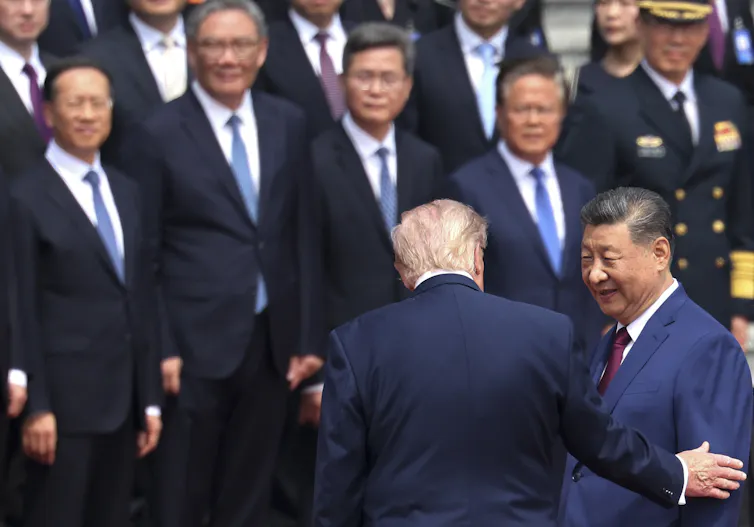
The opening headlines from the summit between Donald Trump and Xi Jinping in Beijing signal an openness on the Chinese side towards stabilising relations with the US. In his opening remarks, the Chinese president noted that China and the US “should be partners not rivals”. But he warned Trump that a crisis over Taiwan could lead to “clashes and even conflicts”.
With Xi also indicating that there will be more opportunities for US companies to do business in China, the stage is set for a relatively successful summit. Both sides can claim it as a success because it offers some concrete benefits in the form of a trade war avoided and at least the prospect of cooperation on global issues such as the Iran war. It also sets a generally more positive tone for relations between the two countries.
Such an outcome is particularly troubling for Russia’s president, Vladimir Putin, who will see his relevance and leverage diminished by more stable and predictable US-China relations. Putin’s aspirations to position Russia as a great power depend on Moscow either being strategically useful to Washington and Beijing, or gaining leverage with them by demonstrating a capacity to be disruptive.
However, on both counts, Putin’s hand has been substantially weakened. His war against Ukraine is no longer a priority issue for the US, with the two main American interlocutors in peace talks, Steve Witkoff and Jared Kushner, focused on negotiations with Iran.
Putin’s latest phone call with Trump on April 29 will have been disappointing for the Russian leader. His offer to take Iran’s highly enriched uranium to Russia was reportedly rebuffed by Trump, who told him to focus on “ending the war with Ukraine”. And days later the Kremlin was forced to scale back its annual military parade in Moscow, due to concerns that it could be targeted by Ukrainian forces.
On the Chinese side, things are possibly even more troubling. The last face-to-face meeting between Xi and Putin took place in September 2025. They have only held one video conference since then. A Kremlin statement during the Trump-Xi summit that Putin will visit China soon smacks more of desperation than confirmation.
Our mission is to share knowledge and inform decisions.
About us
Putin’s leverage
While Putin appears sidelined in the US-China relationship, he is not without cards of his own. Major global issues – including wars in Ukraine and Iran, energy security and the future of the international order – are still connected to Russia. This provides Putin with a degree of leverage in his relations with both Xi and Trump.
But exercising this leverage comes with significant risks, especially in areas where Chinese and US interests are more aligned with each other than with Russia. Take the case of the Iran war as an example.
Russia benefits most from this conflict continuing.
While Russian support is unlikely to enable Iran to win the war, it will give the regime in Tehran more time to avoid defeat and increase the costs for the US, its regional allies and the global economy. This is not going to play well with Trump, who is under mounting domestic pressure to wind down the war in Iran.
Beijing has offered Iran some support throughout the war, for example by helping it bypass western sanctions on the export of its oil. But there are clear limits to how far China will go. For China, its relationship with the US is far more important than the one with Iran. This tilts the balance of preferences in Beijing towards an end of the conflict rather than towards its continuation.
This does not mean that China and the US will now align against Russia. Relations between Russia and China are longstanding and deep across a range of issues. Their “no-limits partnership” may be increasingly asymmetric, but there is still a great deal of anti-American and anti-western alignment between them.
The US under Trump is also more ambivalent about its stance on Russia than under previous administrations. Trump’s transactional foreign policy – and his urge to make deals rather than pursue a consistent strategy – is something Russia will continue to try to leverage to its own advantage.
Ahead of the Trump-Xi summit, Kremlin spokesman Dmitry Peskov released a statement in which he said “the path to the implementation of a whole range of economic projects will be open” if the White House agrees to decouple trade from the war in Ukraine. This indicates that Moscow is fully aware of this opportunity – as well as the challenge to offer the US something China cannot.
The Xi-Trump summit is a party to which Putin was not invited. The fact that the US and China seem to be heading towards a period of better-managed relations indicates that his efforts to make his presence felt have largely failed. This does not bode well for his aspirations to restore Russia to its Soviet-era status as a great power – but it does not imply that he will give up.
Author
- Stefan Wolff Professor of International Security, University of Birmingham
Disclosure statement
Stefan Wolff is a past recipient of grant funding from the Natural Environment Research Council of the UK, the United States Institute of Peace, the Economic and Social Research Council of the UK, the British Academy, the NATO Science for Peace Programme, the EU Framework Programmes 6 and 7 and Horizon 2020, as well as the EU’s Jean Monnet Programme. He is a Trustee and Honorary Treasurer of the Political Studies Association of the UK and a Senior Research Fellow at the Foreign Policy Centre in London.
Partners
University of Birmingham provides funding as a founding partner of The Conversation UK.
The Conversation UK receives funding from these organisations
DOI

We believe in the free flow of information
Republish our articles for free, online or in print, under Creative Commons licence.Republish this article
The Conversation meets a real need in the information ecosystem. Our authors are subject-matter experts who offer clarity and insight into the issues facing the world. An outlet where you can find real expertise from authors without axes to grind, published by an organisation with no agenda to push. Thousands of media organisations worldwide republish our content for their readers. But the same business model that has freed us from the influence of billionaire owners or big business advertisers comes with its own challenges. Universities are under enormous financial pressure, their income streams squeezed in every direction. Your support as our readers is crucial to securing The Conversation’s future. Donations are an essential bulwark against unexpected loss of income. Around 2,000 of our readers give monthly to support our work. If you’re not among them but value what we do, please consider giving today.
I’ll support you

Stephen Khan
Editor-in-Chief, The Conversation UK


