
Gen Z Is Turning Against AI in an Incredible Way
They’ve had enough.
Published May 1, 2026 8:56 AM EDT
Add Futurism(opens in a new tab)More information
Sign up to see the future, today
Can’t-miss innovations from the bleeding edge of science and tech Email address Sign Up
For years now, tech leaders have warned that AI will usher in a technological revolution on an unprecedented scale, wiping out countless jobs. If you’re lucky enough to survive sweeping layoffs continuously roiling the tech industry, bosses say their employees will have to adopt the tech to keep their jobs — whether they like it or not.
In other words, it’s not hard to see why there’s been a surge in resentment towards AI, which has encroached almost every aspect of our daily lives, from the never-ending slop in our social media feeds to flawed chatbots poorly assuming the roles of human customer service agents.
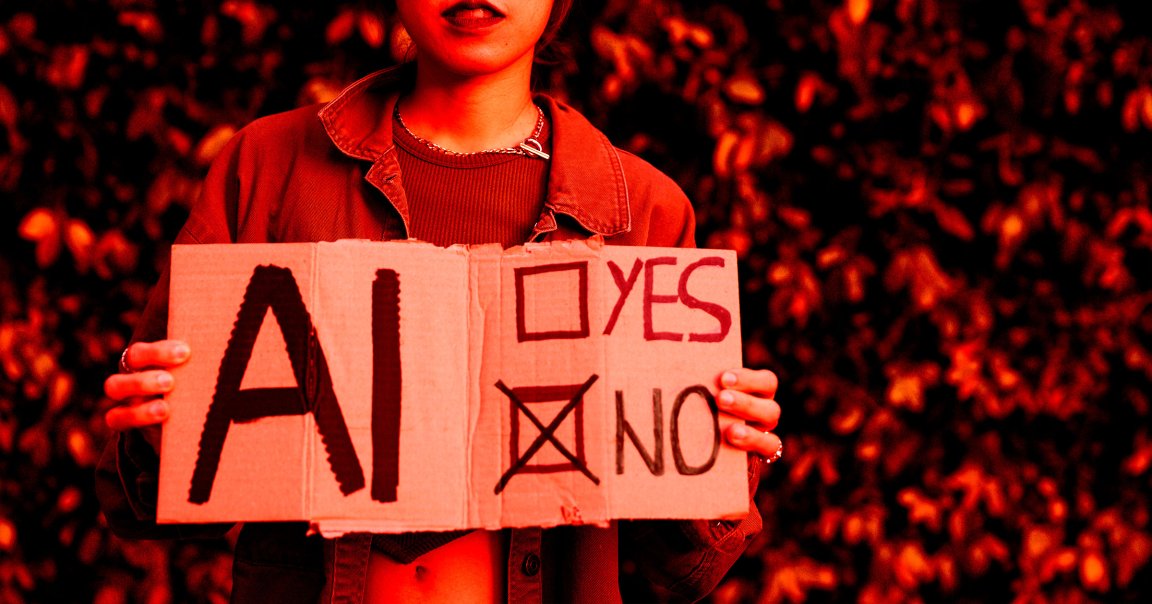
As The Verge reports, the backlash is particularly apparent among Gen Z, a demographic that’s at the epicenter of the industry’s push for AI adoption. The generation is facing a dire post-graduation job market after losing much of its youth to the COVID-19 pandemic.
Usually, young people love new innovations. But for Gen Z, a tech inherently designed to replace human agency is strikingly unwelcome — and inspiring a growing rebellion.
“I think everyone in my immediate peer group is not using AI and is actively against it, besides my friends who are in computer science and are essentially mandated to use it,” Sharon Freystaetter, who left her Silicon Valley tech job over ethical concerns, told The Verge.
Young people certainly have plenty of valid concerns. The numerous negative side effects of society’s infatuation with generative AI are becoming increasingly harder to miss. Massive data centers are deteriorating the environment on a shocking scale, while the widespread use of AI chatbots is eroding critical thinking skills and driving some into dangerous spirals of delusions.
Recent polling data paint a damning picture of young people’s rapidly deteriorating opinion of AI. One recent Gallup poll showed that only 18 percent of Gen Zers said they felt “hopeful” about AI, a drop of nine percent compared to 2025.
AI’s recent incursions into academia have them particularly incensed.
“AI cannot coexist with education — it can only degrade it,” reads a recent, scathing editorial titled “Penn has an AI problem,” published by the University of Pennsylvania’s student newspaper last month. “As technology advances and workers are replaced by machines, schools are some of the only places we have left to explore and wrestle with human thought.”
A major reason for the disillusionment among young people is their ability to identify the many shortcomings of the tech, from rampant hallucinations to the dangers of “cognitive offloading,” the term for when people start to outsource mental tasks to AI.
The situation has gotten to the point where a baffling proportion of Gen Zers are going as far as to intentionally undermine their bosses’ AI initiatives. According to a recent report by the AI company Writer and research firm Workplace Intelligent, 44 percent of polled Gen Z workers said they’re “sabotaging their company’s AI strategy in at least one way,” from entering proprietary company information into chatbots to refusing to use AI tools outright.
More on AI and Gen Z: Usually, Young People Embrace New Technology. Gen Z’s Attitude Toward AI Should Worry the Entire Tech Industry
Victor Tangermann
Senior Editor
I’m a senior editor at Futurism, where I edit and write about NASA and the private space sector, as well as topics ranging from SETI and artificial intelligence to tech and medical policy.


