
Advertisement

- NEWS
- 30 May 2024
Japan’s push to make all research open access is taking shape
Japan will start allocating the ¥10 billion it promised to spend on institutional repositories to make the nation’s science free to read.
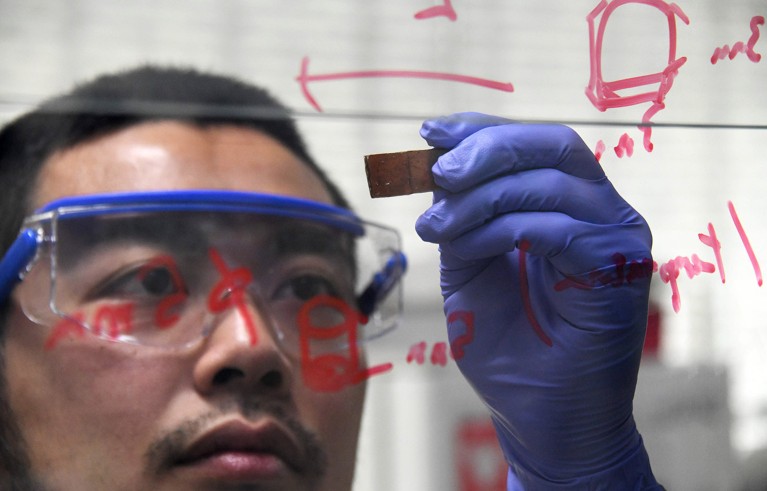
The Japanese government is pushing ahead with a plan to make Japan’s publicly funded research output free to read. In June, the science ministry will assign funding to universities to build the infrastructure needed to make research papers free to read on a national scale. The move follows the ministry’s announcement in February that researchers who receive government funding will be required to make their papers freely available to read on the institutional repositories from January 2025.
The Japanese plan “is expected to enhance the long-term traceability of research information, facilitate secondary research and promote collaboration”, says Kazuki Ide, a health-sciences and public-policy scholar at Osaka University in Suita, Japan, who has written about open access in Japan.
The nation is one of the first Asian countries to make notable advances towards making more research open access (OA) and among the first countries in the world to forge a nationwide plan for OA.
The plan follows in the footsteps of the influential Plan S, introduced six years ago by a group of research funders in the United States and Europe known as cOAlition S, to accelerate the move to OA publishing. The United States also implemented an OA mandate in 2022 that requires all research funded by US taxpayers to be freely available from 2026.
Institutional repositories
When the Ministry of Education, Culture, Sports, Science and Technology (MEXT) announced Japan’s pivot to OA in February, it also said that it would invest ¥10 billion (around US$63 million) to standardize institutional repositories — websites dedicated to hosting scientific papers, their underlying data and other materials — ensuring that there will be a mechanism for making research in Japan open.
Among the roughly 800 universities in Japan, more than 750 already have an institutional repository, says Shimasaki Seiichi, director of the Office for Nuclear Fuel Cycles and Decommissioning at MEXT in Tokyo, who was involved with drawing up the plan. Each university will host the research produced by its academics, but the underlying software will be the same.
In 2022, Japan also launched its own national preprint server, Jxiv, but its use remains limited, with only a few hundred preprint articles posted on the platform so far. Ide says that publishing as preprints is not yet habitual for many researchers in Japan, noting that only around one in five respondents to his 2023 survey1 on Jxiv were even aware that it existed.
Green OA
Japan’s move to greater access to its research is focusing on ‘green OA’ — in which authors make the author-accepted, but unfinalized, versions of papers available in the digital repositories, says Seiichi.
Seiichi says that gold OA — in which the final copyedited and polished version of a paper is made freely available on the journal site — is not feasible on a wide scale. That’s because the cost to make every paper free to read would be too high for universities. Publishers levy an article-processing charge (APC) if the paper is made free to read, rather than being paywalled, a fee that covers a publisher’s costs.
APCs are increasing at an average rate of 4.3% per year, notes Johan Rooryck, a scholar of French linguistics at Leiden University in the Netherlands, and executive director of cOAlition S.
Rooryck says that Japan’s green OA strategy should be applauded. “It’s definitely something that one should do,” he says. “Especially for all the content that is still behind the paywall.”
Kathleen Shearer, executive director of the Confederation of Open Access Repositories in Montreal, Canada, says that the Japanese plan is “equitable”.
“It doesn’t matter where you publish, whether you have APCs or not, you are still able to comply with an open-access policy,” she says.
She adds that the policy will mean that Japan has a unified record of all research produced by its academics, because all institutional repositories are hosted on the same national server. “Japan is way ahead of the rest of us,” Shearer says. “More countries are moving in this direction but Japan really was one of the first.”
Focusing on institutional repositories will have another benefit: it will not discriminate against research published in Japanese, Shearer says. “A big part of their scholarly ecosystem is represented in Japanese.”Japanese research is no longer world class — here’s why
The plan to move to OA and support Japanese universities’ repositories comes as Japan grapples with its declining standing in international research.
In a report released last October, MEXT found that Japan’s world-class research status is declining. For instance, Japan’s share in the top 10% of most-cited papers has dipped from 6% to 2%, placing it 13th on the list of nations, despite Japan having the 5th-highest research output.
In March, Japan vowed to triple its number of doctorate holders by 2040, after another report found that the country’s number of PhD graduates is also declining, making it an outlier among the major economies.
doi: https://doi.org/10.1038/d41586-024-01493-8

 canisgallicus