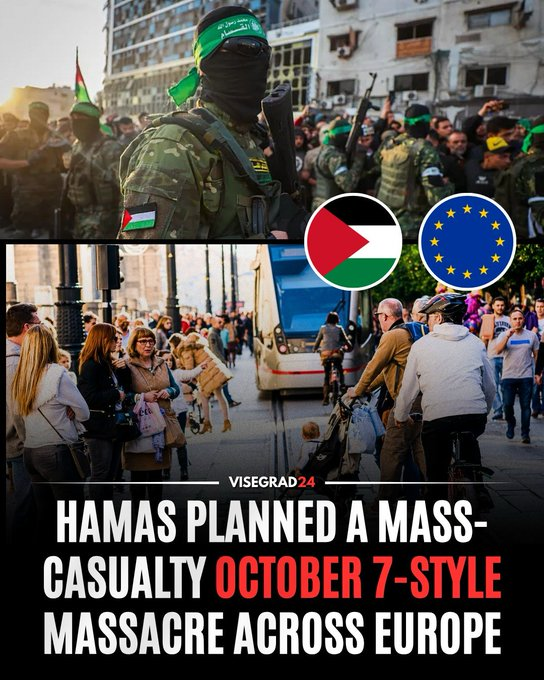
A major investigation by Switzerland’s Neue Zürcher Zeitung reveals that Hamas spent years building an operational terrorist network across Europe, including weapons caches, bomb-making capabilities and sleeper cells preparing attacks against Jewish, Israeli and Western targets.
Investigators believe the network had even selected October 7, 2025, the second anniversary of the Hamas massacre in Israel, as the planned date for an attack. The latest arrests began in Greece and Cyprus. Greek special forces detained a 37-year-old Egyptian man of Palestinian origin, identified by some local media as Motasem, after investigators reportedly found chemicals, a precision scale and equipment that could be used to manufacture explosives in his Athens apartment. Authorities believe the Greek-Cypriot cell was preparing to attack an Israeli cruise ship that regularly docks in Greece.
The suspect and another Palestinian traveled through Switzerland, Qatar and Indonesia to Malaysia in 2025, where investigators believe they received bomb-making training. The investigation connects the plot to a wider network spanning Germany, Austria, Denmark, Britain, Poland, Bulgaria, Cyprus and Greece.
Since October 2025, Germany’s federal prosecutor has ordered the arrests of nine men in Germany and abroad. The network transported at least 13 handguns, an AK-47 and more than 900 rounds of ammunition through Scandinavia, Germany and Austria. Five Glock pistols were moved from Denmark through Berlin to Vienna, where Austrian intelligence later discovered a weapons cache.
German investigators say Hamas had been creating weapons depots in Europe since at least 2019.In December 2023, Bulgarian police uncovered a suitcase containing weapons and ammunition buried in woodland near Plovdiv after German authorities found photographs of the cache on a suspect’s phone.
In February 2023, eight months before the October 7 massacre, the German cell received orders from Hamas officials in Lebanon to prepare attacks against Jewish, Israeli or American targets.Suspects reportedly surveilled Ramstein Air Base, the Israeli Embassy in Berlin and Tempelhofer Feld. Investigators believe the operation was directed by Hamas commanders in Lebanon, including senior military figure Khalil al-Kharraz, who was killed in an Israeli strike in 2023.
Several members of the German cell were filmed attending his funeral in Lebanon. The investigation concludes that Hamas may no longer view Europe merely as a fundraising and logistical base, but as a potential battlefield for attacks designed to bring the Middle East conflict directly onto European soil.
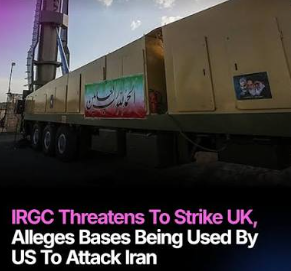
Match to the Powder Keg: Iran’s IRGC just issued a chilling warning directly to London: Any UK military base used by American forces to execute strike operations against Iran is now a “legitimate target” Singles out RAF Fairford in Gloucestershire, where U.S. B-1 Lancer bombers have been operating The Escalation Trap is expanding beyond the region
The Iran war expanded to a new front this week. The Houthis, an Iran-backed militia which controls most of Yemen, said they attacked two Saudi oil tankers in the Red Sea today as part of a blockade on shipping to and from Saudi Arabia through the Bab el-Mandeb Strait.
The consequences are far-reaching. Saudi Arabia, the world’s largest exporter of crude oil, has increasingly relied on the Red Sea while the Iran war disrupts shipping through the Strait of Hormuz. According to the trade analytics firm Kpler, the blockade could obstruct around 4% of the world’s oil from entering the market, piling fresh pressure on a global economy already rattled by the Iran war.
Given the stakes, we’re breaking down who the Houthis are and why they’re getting involved in the conflict now.
Who are the Houthis? The Houthis are an ultra-conservative Muslim religious group from northern Yemen rooted in Zaydism, a branch of Shia Islam. In the early 2000s, the Houthis launched an insurgency against the central government over what they viewed as widespread corruption and mismanagement.
During the Arab Spring in 2011, the grievances of the Yemeni people reached a fever pitch, and protests forced the country’s longtime authoritarian leader, Ali Abdullah Saleh, to resign. Saudi Arabia, Yemen’s northern neighbor, backed Abdrabbuh Mansur Hadi as the new leader – a move that the Houthis resented. They launched a military campaign against the new Saudi-backed government, ultimately triggering a grueling civil war.
That conflict, currently frozen, has left roughly 150,000 dead and spiraled into one of the world’s largest humanitarian crises.According to the United Nations, an estimated 4.5 million people, roughly 14% of the population, are displaced by the fighting.
What’s the Houthis’ link to Iran?Iran has supported the Houthis since at least 2009. Alongside Iranian proxies Hezbollah in Lebanon, Hamas in Gaza, and various Shia militia groups in Iraq, the Houthis are a key part of Tehran’s regional “Axis of Resistance” against US-allied countries and governments. In 2014, the year the Houthis captured Yemen’s capital city of Sanaa, experts say Iran’s financial support increased, with Tehran supplying the group with weapons – including drones and cruise and ballistic missiles.
How significant is the risk? The Houthis have disrupted shipping in the Red Sea before. Beginning in late 2023, they made headlines by attacking ships in the Red Sea with missiles, drones, and hijackings in response to Israel’s war with Hamas in Gaza. As a result, oil shipments going through the Bab el-Mandeb Strait fell from 9.3 million barrels per day in 2023 to just 4.1 million in 2024.
Avoiding the Bab el-Mandeb Strait will be costly for Gulf exporters and for the trade market. One option is routing ships around the Cape of Good Hope in South Africa, adding two or three weeks to journeys between Asia and Europe. Some Gulf states are looking at other export options with overland routes – Iraq, for example, is eyeing pipelines through Jordan, Syria, and Turkey. But the process is also proving expensive and, currently, inefficient – adding around $1 million in costs of rerouting per voyage.
How will Saudi Arabia respond? As Ian Bremmerexplained this week, Houthi attacks would “be bringing the Saudis directly into this war.” A forceful response from Saudi Arabia against the Houthis in Yemen could potentially reignite that country’s catastrophic civil war. We aren’t there yet, but the risk of the Iran war spreading directly into another simmering regional conflict is increasing.
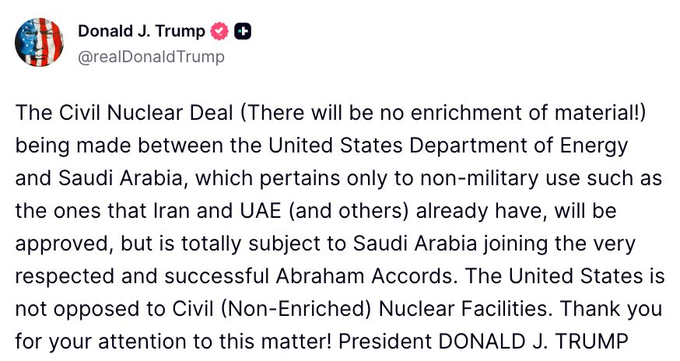
Trump says U.S.-Saudi Nuclear Deal will only be approved AFTER they join Abraham Accords:
“The Civil Nuclear Deal (there will be no enrichment of material!) being made between the U.S. and Saudi, which pertains only to non-military use… will be approved, but is totally subject to Saudi joining the Abraham Accords.
The U.S. is not opposed to civil nuclear facilities. Thank you for your attention to this matter!”
Bill Gates and Warren Buffett speak with journalist Charlie Rose at an event organized by Columbia Business School on January 27, 2017 in New York City. Gates and Buffett spoke on a range of topics including their friendship, business, philanthropy, global health, innovation, and leadership. Spencer Platt/Getty Images
Andrew Carnegie’s most famous line—”the man who dies thus rich dies disgraced“—was written as a threat, not a suggestion. Today, it lands with a different kind of sentiment, especially as Peter Thiel campaigns against giving, Warren Buffett scrambles to outpace his own compounding fortune, and Bill Gates absorbs criticism that his foundation model isn’t working. Carnegie’s argument in 1889 was simple: give it away yourself, on your own terms, before politics, heirs, or public anger takes the decision out of your hands.
Recommended Video
Citi CEO’s advice for Gen Z: “Give yourself a break”
NextStay
Carnegie’s Gospel of Wealth, published in 1889, argued that any surplus fortune held past death represents a moral failure, not a legacy. He framed the wealthy as mere “trustees” of their fortune, obligated to distribute it during their own lifetime specifically so they could witness and correct the results themselves, rather than trusting heirs or bureaucracies (like foundations, trusts or family offices) to interpret their wishes later.
The conditions that prompted that argument have returned, and in some respects surpassed them. The top 0.1% of Americans now hold over 14% of national wealth, a record high since Federal Reserve tracking began in 1989. According to economists Emmanuel Saez and Gabriel Zucman, whose landmark 2014 paper reconstructed U.S. wealth concentration back to 1913, the top 0.1% of Americans owned roughly 22% of national wealth, a level approaching the peaks of 1916 and 1929.
Nobel laureate Paul Krugman, who has studied the comparison extensively, calls the current era not a second Gilded Age but a “hyper-gilded age,” certainly comparable to Carnegie’s time.
The difference between Carnegie libraries and the Giving Pledge
A look at what Carnegie did, and how that compares to today, should make the point. The steel magnate didn’t consider handing money to a foundation an acceptable substitute for lifetime giving; he saw only three options for surplus wealth: give it to heirs, will it for later public use, or spend it while alive. He vigorously rejected the first two as wasteful.He practiced what he preached: over 18 years, he gave away roughly $350 million, about 90% of his fortune, personally funding 2,509 libraries, Carnegie Hall, and Carnegie Mellon University before his death in 1919.
On a straight inflation-calculation basis, Carnegie’s fortune would be worth roughly $6.8 billion today, which wouldn’t even crack the Bloomberg Billionaires Index top 500. But as a relative share of GDP, the University of Missouri has estimated it much higher, at up to $500 billion, which would put him between Elon Musk and the second-richest person alive, Google co-founder Larry Page. That means giving away 90% of his wealth would be philanthropy on a scale that dwarfs the biggest giver of the current era: MacKenzie Scott.
Gates and Buffett have openly credited Carnegie’s essay as the direct inspiration for their 2010 Giving Pledge, which asks billionaires to commit at least half their wealth to charity during their lifetime or at death. But the comparison exposes a gap on both of Carnegie’s core requirements.On quantity: Carnegie demanded nearly all of one’s fortune, the Pledge asks for half. On timing: Carnegie insisted on giving while alive, so you could see what worked, while the Pledge allows death bequests, foundations, and indefinite deferral.
Gates’s own vehicle, the Bill & Melinda Gates Foundation, is precisely the kind of professional-administrator structure that Carnegie thought was a cop-out; it has a 20-year sunset clause after Gates’s death, but it will continue operating long past the point where Gates can correct its mistakes himself. That’s a structural, rather than a philosophical difference.
Buffett has given away more than $60 billion since 2006—a real, record-setting total—but his Berkshire stake has kept growing faster than his gifts could offset it, forcing him to admit his original plan wasn’t “feasible” and to set a hard new target: full divestment by 2034. Scott faces a similar math: her giving has been more than offset by the surging value of Amazon stock she acquired in her divorce from Jeff Bezos, meaning her net worth has barely declined despite billions in gifts. Both cases illustrate a compounding trap that Carnegie’s model was designed to avoid: the longer you wait, the more you have to give.
Thiel’s rejection of the whole premise
Peter Thiel represents the sharpest challenge to Carnegie’s logic since the labor unions who fought Carnegie’s library grants in the 1890s, but with a crucial difference. The unions objected to how Carnegie’s wealth was made; Thiel objects to giving itself. He has actively urged billionaires to unsign the Giving Pledge, calling it an “Epstein-adjacent, fake boomer club,” and has pushed Musk specifically to abandon his own commitment.
Where Carnegie feared dying rich would bring disgrace, Thiel’s posture suggests the opposite calculation: that giving away wealth under public pressure is the real threat to a fortune’s legacy and the donor’s autonomy. That objection would have been nearly unrecognizable in 1889, when even Carnegie’s harshest critics accepted the premise that surplus wealth carried obligations.
Carnegie’s bet was that voluntary, lifetime giving was the only way billionaires could control the terms of their own wealth’s fate. His model succeeded partly because it was structurally irreversible—money spent building a library in 1903 can’t be reclaimed by heirs, taxed away, or parked indefinitely, unlike a pledge that can be unsigned or shares that can simply keep compounding in a family trust. Carnegie understood that the disgrace wasn’t just dying rich. It was dying with the decision still unmade.
For this story, Fortune journalists used generative AI as a research tool. An editor verified the accuracy of the information before publishing.
The Fortune 500 Innovation Forum will convene Fortune 500 executives, U.S. policy officials, top founders, and thought leaders to help define what’s next for the American economy, Nov. 16-17 in Detroit. Apply here.
Rubio on the impact of Houthis potentially joining this war… “a problem for the whole world”: “I hope the Houthis stop. They were smart and stayed out of all this throughout the conflict. They now apparently have gotten themselves suckered into this by going after Saudi Arabia and their ships. I was reading reports a few hours ago that there was actually a Saudi fuel ship that’s flagged Chinese. It’s a Chinese ship. Are they going to blow up the Chinese ship? Then this becomes a problem for China. This will become a problem for the whole world… Obviously, it’s not a positive development. We’ll see what happens.” Writer: Michael https://x.com/clashreport/status/2080215838330626141/video/1
Nvidia CEO Jensen Huang says the loudest warnings about AI are getting the story wrong. In a wide-ranging, exclusive conversation with Axios’ Mike Allen, Huang rejects predictions that artificial intelligence will eliminate half of American jobs or pose an imminent threat to humanity, calling some of the most extreme warnings “complete nonsense.” Huang also discusses competition with China, why American companies should be able to use Chinese AI models, what Wall Street is getting wrong, President Trump’s approach to technology and when useful humanoid robots could arrive.
Timestamps: 0:00 – Intro: Mike Allen and Jensen Huang on what’s next for the AI revolution 0:29 – The fight over Chinese AI 2:17 – Should the U.S. restrict Chinese AI models? 3:36 – Should American companies use Chinese AI? 4:38 – When AI regulation makes sense 5:21 – The rules for competing with China 6:02 – Why trust Nvidia on China and the market? 6:59 – Why Chinese AI models help Nvidia 8:58 – Nvidia’s open-source AI strategy 10:45 – Can open-source AI threaten OpenAI and Anthropic? 12:27 – Using open and closed AI models 13:55 – How Nvidia protects its technology 15:09 – The most astonishing thing Huang has seen AI do 17:57 – What about AI gives Haung pause 19:53 – Could Nvidia’s success happen again? 21:11 – Nvidia’s toughest headwinds 22:12 – Has China caught up to the U.S. on AI? 23:20 – Why fearing AI could cost America jobs 24:22 – Huang rejects the AI doom narrative 26:10 – Are OpenAI and Anthropic in trouble? 27:41 – What Wall Street gets wrong about AI buildout 29:29 – Why the AI buildout has barely begun 31:21 – Is the semiconductor industry heading for a bust? 32:53 – When Nvidia starts worrying about AI spending 34:01 – When will AI investments pay off? 35:15 – Why AI tokens could become more profitable 36:19 – The real danger of an AI bubble 37:45 – Would Jensen Huang use Chinese AI model Kimi? 39:36 – Why Asia is more optimistic about AI 40:00 – Are AI CEOs scaring the public? 41:25 – Why America could get left behind 42:51 – Violence and hostility toward AI 43:23 – Why AI could close the technology divide 44:37 – Could anti-AI politics shape 2028? 45:10 – Huang says the jobs narrative is wrong 46:35 – Huang’s relationship with President Trump 48:16 – What the Trump administration gets wrong on AI 50:22 – Who Huang trusts in Trump’s Cabinet 50:58 – His warning to the White House 52:32 – Should the government own part of Nvidia? 53:33 – Should powerful AI be available to everyone? 55:23 – Can AI companies learn from rival models? 57:18 – AI investment in Israel and the Middle East 57:51 – Why Huang remains bullish on the UAE 58:41 – Why Nvidia wants to stay relatively small 1:00:19 – Which jobs and tasks will AI eliminate? 1:01:10 – Don’t mistake your task for your job 1:02:40 – The ChatGPT moment for robots 1:03:54 – A future with one trillion AI agents 1:05:18 – Why pain and suffering create greatness 1:07:09 – Huang’s message to young immigrants 1:08:47 – Why Jensen Huang does not wear a watch 1:09:15 – His perfect Saturday with his family
How this was made
Auto-dubbed
Audio tracks for some languages were automatically generated. Learn more