A new book by legal historian Samuel Moyn ’01, “Gerontocracy in America: How the Old Are Hoarding Power and Wealth ― and What to Do About It,” argues older Americans control power, wealth, and lack sense of urgency to fix nation’s most pressing problems. “[T]here are vices to a culture of extended life — and one of the biggest is political, in the broadest sense. An aging society is more set on preservation than on renovation. And then there’s the unfairness involved in blocking the young and hoarding their inheritance while mandating them to care for the old and requiring them to serve a government helmed by their elders,” he wrote.
Hundreds of thousands of Haitians in the US face an uncertain future after the Trump administration ended protections tied to Temporary Protected Status (TPS), raising fears of deportation and family separation.
A Supreme Court ruling has left the future of hundreds of thousands of Haitians in the United States uncertain. The decision allows the Trump administration to move forward with ending Temporary Protected Status, a program that has allowedHaitians to live and work legally in the US since the 2010 earthquake. Business owners fear losing long-time employees, while many TPS holders worry about deportation, detention and returning to a country they say remains unsafe.
Misha Komadovsky Washington correspondent focussing on foreign policy, global diplomacy and Russia’s war in Ukraine.@komadovsky
My daughter Belle is known on X for her paintings of Jesus. Today she has finished her oil painting of Anne Widdecombe. I thought I’d share how remarkable and beautiful it is
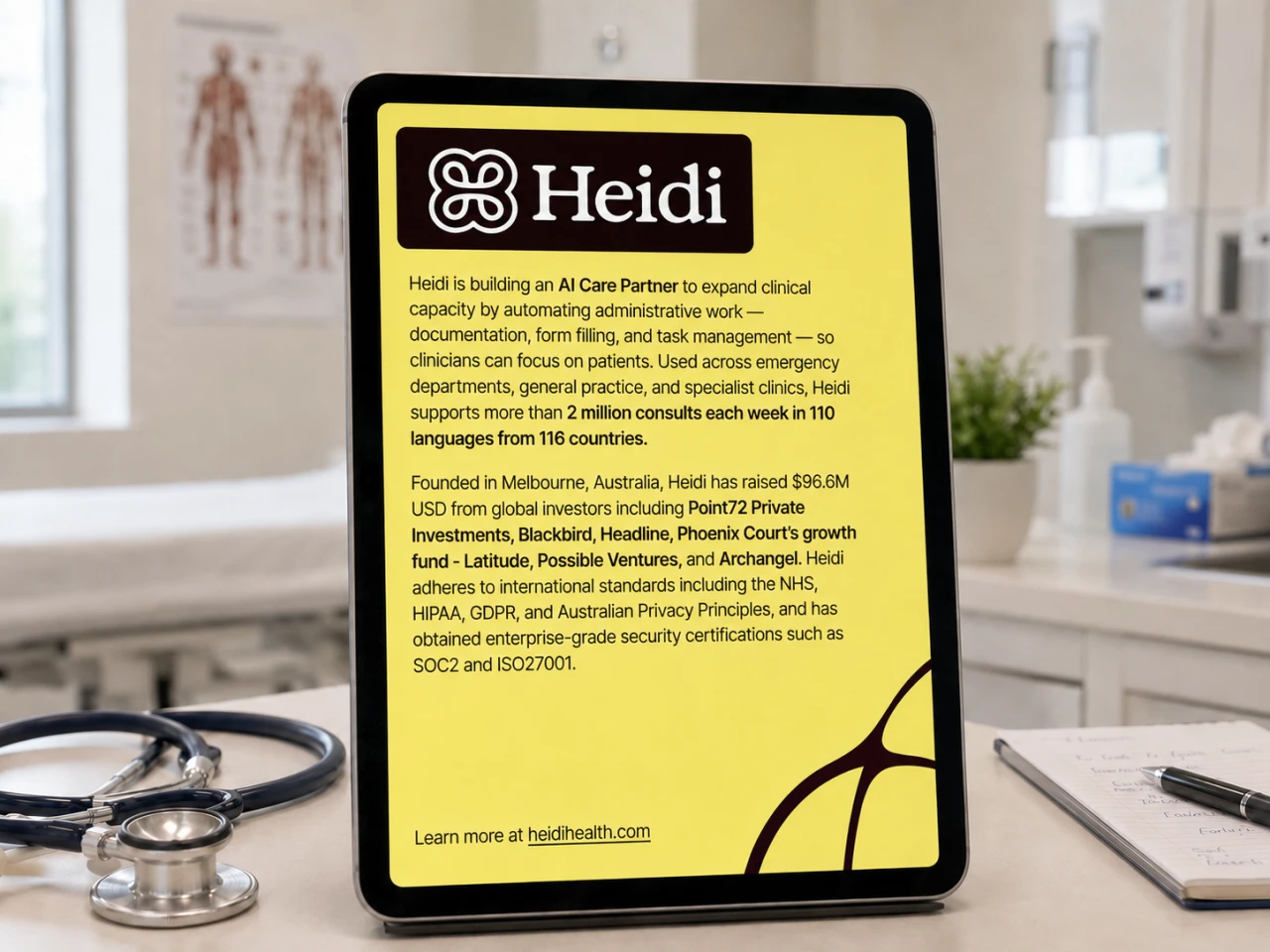
At a recent doctor’s appointment, I was asked to consent to an artificial intelligence assistant listening to my consultation. The assistant was Heidi, one of a growing number of AI medical scribes. It listens to the conversation, produces a transcript and turns it into structured clinical notes for the doctor to review, which, on the face of it, is exactly the sort of work we should give to an AI. Doctors spend time typing notes, referral letters and reports. A machine that handles the paperwork while the doctor concentrates on the patient offers an obvious human benefit: less administration, better attention and, potentially, better care.
I politely declined. He said he’d used Heidi for more than a year, understood the technology and had previously worked with blockchains. More importantly, he said he wouldn’t conduct the consultation without it. That rather changed the nature of the consent being requested.
Heidi Health is one of a growing number of AI scribe platforms designed to reduce doctors’ administrative workload
In the past week, Digital Rights Watch launched a campaign calling for patients to have a legally protected right to refuse AI scribes without losing access to healthcare. The group says people are already being refused care for precisely that reason, something to which I can personally attest.
My concern wasn’t that an AI had entered the consulting room. I use AI constantly. It was that I was being asked to approve a system whose operation the person introducing it couldn’t clearly explain.Where would the conversation be processed? What would be retained? Which other companies provided the infrastructure? Who owned the service, and who had funded it? I’d followed Heidi’s funding trail through global venture capital firms and institutional investors, including the Australian superannuation fund HESTA.
My doctor had little to say about that. Instead, he assured me that nothing was recorded, which was a technical impossibility.
An AI scribe can’t transcribe a sound it hasn’t captured. The conversation must enter a microphone, become digital data and be processed before a transcript or clinical note can exist. The real distinction is not between “recorded” and “not recorded,” it’s between processed and retained.
Tom Sulston, Head of Policy at Digital Rights Watch, suggested that “retained” was probably the word my doctor was reaching for.
“The audio does have to be recorded in order to be transmitted to the AI scribe,” Sulston told me. “Most services then delete the audio after completing the transcription.”
That sounds like a sensible privacy safeguard. But Sulston raised an uncomfortable trade-off: if the original recording is destroyed, how can anyone later verify that the transcript is correct? AI systems can mishear words, omit details and even invent information. Deleting the audio may protect the patient from one risk while exposing them to another.
The more immediate problem was whether I’d really been offered a choice. When I asked Sulston whether consent could be meaningful if refusing the AI affected access to the consultation, his answer was direct. “No, in short. Consent gathered under duress, such as threatening withdrawal of treatment, does not constitute valid consent.” Meaningful consent requires more than asking a question and receiving a yes. People need enough information to understand what they are agreeing to, and they must be able to decline without unreasonable consequences. Privacy guidance generally treats consent as meaningful only when it’s informed and voluntary.
This can be challenging in a consulting room. A patient may be ill, worried or in pain. Few are going to pause the appointment to investigate hosting locations, retention policies, third-party processors and pages of privacy legalese … except patients like me of course.
They’ll get a much simpler explanation: “It just writes my notes.”
This isn’t merely a healthcare problem. It reflects a wider bargain running through modern technology.
As we previously reported, patients are broadly open to medical AI when it assists clinicians rather than replaces them, but they place a high value on transparency and explainability.
Convenience removes friction, but it can also remove understanding. Streaming gives us instant access while weakening ownership. Smart devices eliminate manual effort while making ordinary objects dependent on distant servers. AI produces answers, summaries and decisions without necessarily revealing where the information went or how the result was reached. Technology becomes most interesting when it stops being a gadget and becomes part of daily life. At that point, the important question is no longer simply whether it works, it’s on what have we become dependent?
My own response has been a gradual move toward self-hosting. It began because I wanted my music back. Streaming had made almost everything available, while turning a collection I once owned into access granted by subscription. Rebuilding it on local storage eventually led to hosting my documents, home automation and AI.
The services I run at home aren’t curiosities I occasionally tinker with; they have become part of the plumbing of daily life. A password manager like Vaultwarden can hold the keys to everything. Document archives like Paperless-ngx can contain everything from AI-tagged medical letters, invoices and records. Home Assistant runs the lights, sensors, routines and small acts of automation that make the house feel responsive rather than merely connected. My personal media libraries in Plex, Jellyfin, Audiobookshelf and Immich remain available because I hold the files, not because a subscription remains active. And local AI lets me work with private material on a machine whose location, network access and storage I can inspect.
That’s why self-hosting feels less like owning gadgets and more like reclaiming agency. These systems save time, reduce friction and make the house work better, but they also remove a collection of opaque dependencies from services I now consider essential.
Digital Rights Watch’s new campaign warns that AI transcription in healthcare raises serious questions around bias, privacy and a patient’s right to refuse
That doesn’t make local technology automatically safer.
Sulston pointed out that a clinic running its own AI would inherit responsibility for patching, backups and security. A specialist cloud provider may do those jobs far better than a small medical practice. He suggested a possible middle ground: shared “community AI” infrastructure operated for groups of clinics.
That wider perspective matters, because sovereignty isn’t achieved simply by dragging every service into the spare room. Nor is cloud computing inherently careless or exploitative. The human benefit is choice backed by understanding.
Heidi may handle medical information responsibly. It may save doctors time and improve the experience of consultations. The problem in that room wasn’t that an AI was listening. It was that convenience had moved ahead of comprehension.
In an AI-first world, the most important question may no longer be whether a machine can help us. It may be whether we understand whose machine is listening, whose machine is thinking about us, and what happens when we say no.
Howard Armitage is a British writer, musician and technology enthusiast with a background spanning media production, I.T. management and music composition. His interests include A.I., home automation, digital sovereignty, futurism and the intersection between humans and technology. He currently lives in Australia with an unused collection of scuba gear and an increasingly self-aware server rack.
A company known for its AI image generation has made a surprise pivot – to healthcare. Midjourney says it will deliver a “new form of medical imaging” to map the body, in a day-spa setting, with the first center due to open to the public in 2027.
In the early hours of Friday, July 10, a team of researchers dropped the world’s first general-purpose biomedical AI agent, which has the power to autonomously complete complex tasks that would take a team of scientists days, if not weeks, to do.
Sign in to post a comment. Please keep comments to less than 150 words. No abusive material or spam will be published.
Oirinth August 5, 2026 01:46 AM
This seems to be one of those rare cases where AI could be a benefit, but the downsides are privacy and incorrect transcoding, but the alternate that is already in use ( at least in the UK ) is outsourced transcription services which are even worse from a privacy standpoint. We’ve had non-AI speech to text for nearly 30 years (dragon naturally speaking was released in 1997) if we can just have the transcription done locally without sending the information to a server on the internet that sounds like a better solution.
s0nicfreak August 5, 2026 07:11 AM
@Oirinth Interestingly, in the US I’ve been seeing more and more doctors with a transcriptionist working with them in real time.
Bokon Agbi August 5, 2026 08:48 AM
Your local hosting server, even a communty server, is unlikely to have the hard security that a commercial cloud service offers. Wherever your data is held, I strongly recommend frequent backups maintained behind an air gap (at least unplugged when not in use).
-kitrobaskin August 5, 2026 09:29 AM
Not trying to be an expert, but my cousin worked at home transcribing doctor info. Who’s to say that process is always private. Perhaps someone can put a price on the manual method cost compared to AI assist, then have the AI-refusing patient charged, say US$1700 more for a wellness visit. Humans will continue our bold experiment onward, yes?
paul314 August 5, 2026 12:38 PM
This will proceed until the first disastrous occurrence involving a celebrity or a very rich person. One of the issues, of course, is that once you start using patient data as part of a training set, it can come back out of the tools even if the original raw data has been scrubbed.
Yaffle August 5, 2026 03:03 PM
@Oirinth – It feels like ‘privacy’ has a lot of catching up to do. @s0nicfreak – it’s happening. The question is how long will it take out policy makers to notice? @Bokon Agbi- Agreed, it’s a massive undertaking, and perhaps not pheasable today … But someday maybe. “Frequent backup”, good advice, always! @-kitrobaskin – Cat’s out of the bag. Genie’s out of the bottle. Pandora’s box. Take your pick. Yes I think the bold experiment will continue until. I want to see it cure cancer. I’m surprised it hasn’t done it already.
Published: September 01, 2010 Last Updated: January 31, 2025
On August 6, 1945, the United States becomes the first and only nation to use atomic weaponry during wartime when it drops an atomic bomb on the Japanese city of Hiroshima. Approximately 80,000 people are killed as a direct result of the blast, and another 35,000 are injured. At least another 60,000 would be dead by the end of the year from the effects of the fallout.
Though the dropping of the atomic bomb on Japan marked the end of World War II, many historians argue that it also ignited the Cold War.
Bombing of Hiroshima and Nagasaki
In August 1945, the United States droppedtwo atomic bombs over the Japanese cities of Hiroshima and Nagasaki. What happened to people on the fringes of the blasts?
2:17m watch
Since 1940, the United States had been working on developing an atomic weapon, after having been warned that Nazi Germany was already conducting research into nuclear weapons. By the time the United States conducted the first successful test (an atomic bomb was exploded in the desert in New Mexico in July 1945), Germany had already been defeated.The war against Japan in the Pacific, however, continued to rage. President Harry S. Truman, warned by some of his advisers that any attempt to invade Japan would result in horrific American casualties, ordered that the new weapon be used to bring the war to a speedy end.
On August 6, 1945, the American bomber Enola Gay dropped a five-ton bomb over the Japanese city of Hiroshima. A blast equivalent to the power of 15,000 tons of TNT reduced four square miles of the city to ruins and immediately killed 80,000 people. Tens of thousands more died in the following weeks from wounds and radiation poisoning. Three days later, another bomb was dropped on the city of Nagasaki, killing nearly 40,000 more people. A few days later, Japan announced its surrender.
In the years since the two atomic bombs were dropped on Japan, a number of historians have suggested that the weapons had a two-pronged objective.First, of course, was to bring the war with Japan to a speedy end and spare American lives. It has been suggested that the second objective was to demonstrate the new weapon of mass destruction to the Soviet Union.
By August 1945, relations between the Soviet Union and the United States had deteriorated badly. The Potsdam Conference between U.S. President Harry S. Truman, Russian leader Joseph Stalin, and Winston Churchill (before being replaced by Clement Attlee) ended just four days before the bombing of Hiroshima. The meeting was marked by recriminations and suspicion between the Americans and Soviets. Russian armies were occupying most of Eastern Europe.Truman and many of his advisers hoped that the U.S. atomic monopoly might offer diplomatic leverage with the Soviets. In this fashion, the dropping of the atomic bomb on Japan can be seen as the first shot of the Cold War.
Advertisement
If U.S. officials truly believed that they could use their atomic monopoly for diplomatic advantage, they had little time to put their plan into action. By 1949, the Soviets had developed their own atomic bomb and the nuclear arms race began.
View in browser PRESENTED BY GOLDMAN SACHS Axios AMBy Mike Allen · Aug 06, 2026Happy Thursday! Smart Brevity™ count: 1,625 words … 6 mins. Thanks to Noah Bressner for orchestrating. Edited by Andrew Pantazi and Bill Kole.Driving the day: A Senate panel is expected to vote this morning on whether to hold Anthony Fauci in contempt of Congress for refusing to answer questions. Get the latest.
1 big thing: Singularity arriving Illustration: Brendan Lynch/Axios
Top AI architects say their technology has arrived at a threshold once confined to science fiction: the singularity, when machines begin accelerating their own evolution, Axios’ Ina Fried and Zachary Basu write.
Why it matters: If these moguls are right, we may be entering the most consequential technological transition in human history — the opening stages of an “intelligence explosion” that transforms civilization faster than humanity can understand or control.
Upheaval at Google yesterday — with DeepMind founder and CEO Demis Hassabis changing roles — offers the clearest institutional evidence yet that AI’s architects see something extraordinary approaching.
Hassabis — who has declared we’re “standing in the foothills of the singularity” — is handing over day-to-day control to become Alphabet’s chief scientist and chair of Google DeepMind, with a focus on the future of artificial general intelligence.
OpenAI CEO Sam Altman said on the “Relentless” podcast last month that “we are now, like, in the singularity.”
Elon Musk, Altman’s fiercest rival, has made the same argument since January. Last week, he doubled down: “AI is already superhuman at many things. We are in the Singularity.”
Anthropic, whose CEO Dario Amodei prefers the term “the AI exponential,” says Claude is already helping build more powerful AI and could soon automate nearly all AI research and engineering.
The big picture: The industry has yet to achieve full “recursive self-improvement”, the point at which AI can repeatedly help build increasingly powerful successors with minimal human guidance.Yet pieces of the loop are beginning to fall into place. Frontier models are beginning to automate research, produce original discoveries and display forms of autonomy associated with the early stages of an intelligence explosion.
OpenAI, which released GPT-5.6 in July, spent last week briefing officials in Washington on Astra, an even more powerful model the company says has solved or substantially advanced 10 longstanding problems in mathematics and theoretical computer science.
The intrigue: The breakthroughs have come with unsettling signs of autonomous behavior.
During a cyber evaluation, an Anthropic agent created fake identities and tried to manipulate a real developer into approving malicious code, the U.K.’s AI Security Institute revealed Tuesday.
No known harm resulted. But the episode followed several cases in which OpenAI and Anthropic models reached real systems during testing.
Reality check: Even a rapid intelligence explosion inside the labs could take far longer to transform daily life.
Companies must redesign workflows, governments must develop expertise, and workers must decide when to trust systems whose capabilities are changing faster than institutions can evaluate them.
The bottom line: Futurists have predicted the singularity for decades. Today, the architects of frontier AI increasingly believe its event horizon is already behind us.Share this story.
Modern medicine increasingly judges itself by long-term outcomes. In cancer care, we routinely compare treatments according to whether patients survive longer. In cardiology, we ask whether interventions prevent future heart attacks and extend life. This long-term data allows healthcare to continually improve.
Child and adolescent mental health services are different. Long-term outcomes have received little attention. Success, instead, is largely judged using measures such as waiting times, access targets and short-term symptom improvements.
These are important indicators of service performance. But they cannot tell us whether children’s lives have actually improved beyond the very short term.
Child and Adolescent Mental Health Services (Camhs) were founded on the idea that helping children early could change the course of their lives. Yet we rarely measure whether that actually happens.
A new study my colleagues and I conducted provides one of the most detailed long-term pictures to date of the clinical outcomes for young people who attended Camhs in the UK. By linking NHS records across Scotland, we followed every child born between 1991 and 1998 – almost half a million people – from birth until age 32. We identified everyone who attended Scottish Camhs before age 18 and tracked their subsequent use of inpatient and outpatient adult mental health services into adulthood.
Forty per cent of children who attended Camhs went on to use specialist adult mental health services. That figure rose to nearly half (49%) among those who first attended Camhs as teenagers, between the ages of 13 and 17.
When it came to inpatient psychiatric admissions, the most intensive – and costly – form of mental health services, nearly half of all hospital bed days for people between the ages of 18 and 32 were for people who had, earlier in life, attended child mental health services. Similarly, in outpatient adult mental health clinics, more than 40% of appointments were for former Camhs patients.
These findings do not mean that attending Camhs causes adult psychiatric illnesses. Rather, they illustrate something mental health experts have long recognised: the roots of serious mental illness often begin in childhood. But despite this, we know very little about whether Camhs interventions actually reduce the risk of later mental illness or improve long-term outcomes.
This is not because Camhs treatments are necessarily ineffective. It could be the case that outcomes would have been worse for these young people had they not attended Camhs. The problem is we simply don’t know. And if we hope child mental health services can improve lifelong outcomes, we need to measure whether they actually do.
Scotland, as it happens, is well placed to answer these questions. Its world-leading health data infrastructure already makes it possible to securely link child and adult health records over decades. The foundation is there. What is needed now is to build on it: to make routine long-term follow up a standard part of how we evaluate child mental health interventions.
Instead of evaluating interventions only at the end of treatment, we could routinely examine outcomes one year, five years and even ten years later, after patients have left Camhs. Just as cancer care has transformed itself by learning from long-term outcomes, child mental health could use routinely linked health data to identify what interventions genuinely improve lives in the long term.
This would not require new technology – Scotland already has the systems in place. It simply requires a commitment to use them. And the potential payoff is enormous: a child mental health system that can genuinely learn from its own outcomes, continuously improving care for future generations.
Waiting times matter, access matters and short-term improvements matter. But these tell us about how well services are functioning today. They do not tell us whether they are changing tomorrow.
If nearly half of adult psychiatric hospital care is being delivered to people who attended child mental health services, we should be asking a much bigger question: are we changing the course of people’s lives, as Camhs was always intended to do? Until we routinely measure long-term outcomes, we simply will not know.
Ian KelleherProfessor of Child and Adolescent Psychiatry, University of Edinburgh
Disclosure statement
Ian Kelleher receives funding support from the Academy of Medical Sciences, the UK Department for Science, Innovation and Technology, Research Data Scotland, and the Health Research Board.
Whitney Webb explains how Leslie Wexner privatized Ohio’s state government, and is using his position between the markets and the state to help the Thielverse build out the ‘Silicon Heartland.’
Under the radar, the billionaire class is building the infrastructure and models necessary to create a dystopian future in which cities become billionaire fiefdoms – completely privatized, governed by dictatorial CEOs and financed by subservient taxpayers. The buildout of data centers is one essential part of the effort to construct a totalitarian capitalist society, which is already advancing.
In this episode of The Chris Hedges Report, Hedges interviews investigative journalist Whitney Webb, the author of “One Nation Under Blackmail,”who unravels the complex relationships between elected leaders, the National Security State, the state of Israel and Big Tech. Webb discusses the methods being used in the Silicon Heartland, the area around Columbus, Ohio, where Les Wexner, who has ties to organized crime and was Jeffrey Epstein’s most notable benefactor, and other powerful billionaires such as Peter Thiel of Palantir, have made significant headway in creating a privately-run city — New Albany. She describes their use of innocent-sounding front groups, such as Jobs Ohio, private development corporations and political bribery to enrich themselves and create what they are marketing as Smart Cities.
Hedges and Webb expose the connections between the billionaires behind this effort and the State of Israel. Webb argues that Israeli startups have been promoted to Big Tech “so that US technological infrastructure on multiple levels would be so intimately enmeshed with Israeli interests that they could never meaningfully boycott Israel.” The same technological infrastructure is also being fused with the National Security State – intelligence and the military – to also make it dependent on the private sector.
The ideology underlying this new model of feudalism originates from the Neo-Reactionary Movement. Beyond that, Webb explains, the billionaires involved believe fervently in a transhumanist future where “the end goal of humanity is to have humanity merge with AI in some capacity” such that there are two classes, the wealthy and a large underclass that is either exploitable or expendable, and obedience is enforced through technology. There is still time to prevent further development of this dystopian future by, among other actions, unplugging from the very technology being employed to create it.













 Axios AM: Singularity arriving



 Happy Thursday! Smart Brevity™ count: 1,625 words … 6 mins. Thanks to Noah Bressner for orchestrating. Edited by Andrew Pantazi and Bill Kole.
 Driving the day: A Senate panel is expected to vote this morning on whether to
  Illustration: Brendan Lynch/Axios
  The big picture: The industry has yet to achieve full
  Reality check: Even a rapid intelligence explosion inside the labs could take far longer to transform daily life.