European Parliament to vote on new draft of the Artificial Intelligence Act. AI and the necessity of establishing Guardrails. Never before has it been so possible to construct a set of ethical guidelines to provide security for people as AI moves into our lives … as some say … we are entering the 4th equivalent of the industrial revolution. The key is to be prepared.

European Parliament to vote on new draft of the Artificial Intelligence Act

European Parliament to vote on new draft of the Artificial Intelligence Act
by A&L Goodbody LLP
29 Jun 2023
A&L Goodbody LLP

IFSC
North Wall Quay
Dublin 1
D01 H104

    The new draft is the work of the European Parliament’s committees for Civil Liberties, Justice, and Home Affairs (LIBE) and for Internal Market and Consumer Protection (IMCO), and contains extensive amendments to the draft originally proposed by the European Commission back in April 2021.

    The European Parliament will consider the new draft (the Parliament Committees’ Draft) during its June plenary session. If adopted, this draft will serve as the basis of the European Parliament’s negotiating position when it enters into the “trilogue” negotiations with the European Commission and the Council (which adopted its own position in late 2022).

    This article takes a look at the most significant developments in this latest draft.

    Defining AI

    One of the key challenges facing the EU legislators drafting the AI Act is to craft a definition of the key underlying concept, AI, which is, as far as possible, future-proof and technology-neutral. To this end, the Parliament Committees’ Draft defines an AI system as:

    “a machine-based system that is designed to operate with varying levels of autonomy and that can, for explicit or implicit objectives, generate outputs such as predictions, recommendations, or decisions that influence physical or virtual environments.”

    This definition represents a further distillation of the key subject matter, following from the definition in the European Commission draft, which defined an AI system as software developed with one or more of an annexed list of technical/mathematical techniques and approaches, and the subsequent formulation of the definition in the Council position draft, which still hinged on underlying techniques and approaches (albeit that these techniques and approaches were addressed more broadly). The definition in the Parliament Committees’ Draft is thus more succinct, but also arguably broader in scope.

    Addressing new technologies

    Of course the most significant development in this space since the European Commission’s original draft has been the recent widespread adoption of new AI technologies trained on massive datasets, including generative AI such as ChatGPT. The Parliament Committees’ Draft includes new proposed obligations in relation to such technologies, developing on the approach taken in the Council position draft.

    The Parliament Committees’ Draft addresses these technologies with the terms “foundation model”, “general purpose AI system” and “generative AI”.

    A “foundation model” is defined as meaning

    “an AI model that is trained on broad data at scale, is designed for generality of output, and can be adapted to a wide range of distinctive tasks”.

    Under the Parliament Committees’ Draft, providers of foundation models would be subject to certain specific new obligations, including to:

    • demonstrate the identification, reduction and mitigation of reasonably foreseeable risks to health, safety, fundamental rights, the environment and democracy and the rule of law
    • train the foundation model only on datasets which are subject to appropriate data governance measures (in particular for suitability and to mitigate biases)
    • register the foundation model in an EU database

    A “general purpose AI system” is defined as meaning

    “an AI system that can be used in and adapted to a wide range of applications for which it was not intentionally and specifically designed”.

    The recitals explain that a general purpose AI system can be an implementation, or reuse, of a foundation model; the more stringent obligations would apply in relation to foundation models because of this central and fundamental role they play, as a foundation on which further “downstream” uses can be based.

    Foundation models that are used as “generative AI”, i.e. used to generate content such as complex text, images, audio, or video, would be subject to further bespoke obligations. These include further transparency requirements, an obligation to ensure safeguards in training and developing the model against generating content which is in breach of EU law, and an obligation to document, and make publicly available, a summary of any training material used which is subject to copyright.

    The risk based approach

    The Parliament Committees’ Draft retains, but notably amends, the risk-based approach provided for in the previous drafts. Essentially, the AI Act addresses AI systems according to the risks they present, in particular, those which present unacceptable risk, which are outright prohibited, and those which are high risk, which are subject to the most extensive obligations.

    Prohibited AI systems

    The list of AI practices which present unacceptable risk and are thus outright prohibited has been revised significantly. Changes proposed in the Parliament Committees’ Draft include:

    • the prohibition on subliminal techniques or manipulative and deceptive techniques to distort a person’s behaviour has been maintained, but subject to a new exception for “AI systems intended to be used for approved therapeutical purposes on the basis of specific informed consent of the individuals that are exposed to them”
    • a new prohibition on biometric categorisation systems that categorise natural persons according to sensitive or protected attributes or characteristics, which is also subject to a similar therapeutic exception
    • a new prohibition on AI systems that predict and/or assess the risks of individuals (re)committing criminal offences
    • a new prohibition on AI systems that create or expand facial recognition databases through the untargeted scraping of facial images from the internet or CCTV footage
    • another new prohibition on AI systems that infer emotions of natural persons in the areas of law enforcement, border management, in the workplace and in educational institutions

    High risk AI systems

    As under the previous drafts, AI systems which are considered “high risk” are not prohibited, but are subject to extensive obligations. These are addressed in the Annexes: Annex II lists EU harmonisation legislation, and any AI system which is a product covered by such legislation, or which is intended to be used as a safety component of such product, will be considered high risk. Annex III provides for a list of critical areas and use cases. The approach here has been updated since the Commission draft: whereas before inclusion in the list automatically indicated high risk, the Parliament Committees’ Draft includes an extra “hurdle”, in that an AI system will be considered high risk to the extent it falls under one or more of the listed categories and in addition poses “a significant risk of harm” to the health, safety or fundamental rights of individuals, or (in relation to AI systems for the management and operation of critical infrastructure like energy grids or water management systems) to the environment.

    All AI systems

    The Parliament Committees’ Draft sets out some general principles which should apply to all AI systems. The principles provide that AI systems should be:

    • subject to human agency and oversight, so that they can be appropriately controlled and overseen by humans
    • technically robust and safe
    • developed and used in accordance with existing privacy and data protection law
    • transparent – including that individuals who interact with such a system should be made aware that it is an AI system
    • developed in a way that includes diverse actors and promotes equal access, gender equality and cultural diversity, while avoiding discriminatory impacts and unfair biases
    • developed and used in a sustainable and environmentally friendly manner

    Next steps

    The European Parliament’s plenary session is scheduled for the 13 June. Should the European Parliament adopt the Parliament Committees’ Draft, the legislation will likely go through numerous more iterations during the trilogue process before its final form is agreed upon. Industry stakeholders and civil society representatives will be expected to make their voices heard in ensuring that the legislation strikes the right balance between fostering innovation in this space and safeguarding the fundamental rights and freedoms of individuals and society. Stakeholders and industry players will likely watch the development of this ground-breaking legislation very carefully.

    Posted in Uncategorized | Leave a comment

    Paying the price once more……

    TBI and amnesia…I kept pushing the brain. I had been warned rest restores but I knew better. Thanks for Sharing Wendy. I treasure the rest periods now. 6 years with chronic fatigue for pushing the brain too hard means I value rest and you do. The prompts of the photos are brilliant. They make you feel involved and they give pleasure to people like me who have forgotten how to take photos. The rose, the colour, is an exact shade of rose in the home of my childhood, long gone, on the road to Tara Hill, Co. Meath. Thanks Wendy. I loved London too and the warmth comes back to me when I read what you write

    wendy7713's avatarWhich me am I today?

    I knew there’d be a price to pay for the busy weekend in London. I purposely didn’t stay in my hotel room if I didn’t have to, instead trundling the hot busy streets, so I’d have to concentrate; I’d have to use my tired brain constantly. If I’d have relaxed and closed my eyes dementia would have taken over there and then, so I wouldn’t have been at my best for the interviews and Mondays evening event. Yes I was exhausted, but the adrenaline rush from all the wonderful things just kept me going. That was, until I got home and could ‘go on’ no longer…….

    I’d collapsed in bed earlier than usual the day I arrived back. I’d fallen asleep in front of the telly and had woken with a start of confusion as it was still daylight. But my eyes wouldn’t stay open. I kept feeling that strange…

    View original post 696 more words

    Posted in Uncategorized | Leave a comment

    GPT Prompts: Unveiling Your Unique Psychological Portrait. Psychology Today. Comment: “The unexamined life is not worth living” is one of a number of quotations that prompts a path a self discovery but what about this. For me it is bibliotherapy but I am always open to new technology and vision. TBI amnesia and living in a kind of perpetual now/day, “prompts” are essential to engaging in life but my prompts are bare of a narrative, they just help me engage.

    Verified by Psychology Today
    John Nosta

    John Nosta

    The Digital Self

    Self-Help

    GPT Prompts: Unveiling Your Unique Psychological Portrait

    From self-help to digital Rorschach tests, prompts reveal our psyches.

    Posted June 3, 2023 | Reviewed by Vanessa Lancaster

    Key points

    • While every individual’s collective GPT prompting is distinct, certain shared themes and patterns can emerge.
    • These GPT prompts offer a unique window into ourselves.
    • These profiles may offer tools for self-help and therapy though privacy and confidentiality are concerns.
    Source: Image by Julius H. from Pixabay

    Source: Source: Image by Julius H. from Pixabay

    As we sail into the uncharted waters of advanced artificial intelligence, one particular facet stands out: the “prompt.” In the realm of AI language models like GPT-4, a prompt is more than just a command or a question; it’s a reflection of the user’s thoughts, curiosities, and inclinations. So much so that it’s often humorously noted, “When I die, delete my prompt history.”

    However, rather than shying away from this digital trail, we should consider its potential to reveal something profoundly personal. It is through this collection of prompts – our “collective prompts”–that we can paint a captivating psychological portrait of an individual–for better or worse.

    The power of personal prompts

    Every individual’s collection of prompts isn’t merely a series of disjointed commands or inquiries. It’s a tapestry of thoughts, questions, ideas, and desires that offers a unique snapshot of the person’s inner world. This assortment of prompts, referred to as “personal, collective prompting,” can provide enlightening insights into an individual’s psychological profile. And as prompting evolves and becomes more advanced, the corpus itself (like an LLM) expands into a treasure trove of information.

    The personal and the universal in collective prompting

    While every individual’s collective prompting is distinct, certain shared themes and patterns can emerge, reflecting universal human experiences. Recognizing these shared patterns can provide valuable insights into how individuals navigate common human experiences and challenges, from personal relationships to career transitions.

    The psychological portrait through collective prompting

    An individual’s collective prompting, accumulated over time, can reveal a rich psychological portrait. This portrait can include insights into the person’s interests and passions, worries and fears, personal and professional challenges, and even dreams and aspirations.

    However, it’s vital to remember that while collective prompting can offer fascinating insights, it doesn’t replace a comprehensive psychological evaluation. It can be seen as an additional tool to gain self-understanding or to inform therapeutic or coaching interventions. It may become a validated tool in psychology with some standardization and validation.

    The ethical considerations

    With this potential for deep personal insight comes significant ethical responsibility. The power to unlock a psychological portrait through an individual’s collective prompting must be handled with great care, respecting the person’s privacy and consent.

    A portrait of the mind

    THE BASICS

    Collective personal prompting, while inherently personal, has the potential to paint a captivating psychological portrait of an individual. It showcases the power of AI not just as a tool for practical tasks but as a window into our personal inner worlds.

    As we venture further into the realm of AI, our prompts –our digital footprints–are becoming reflective mirrors of our psyche. They capture our personal journeys in all their complexity and nuance. As we explore this fascinating frontier, let’s remember to balance our curiosity with respect for privacy, leading the way for a thoughtful and ethical approach to new tools that let us learn more about ourselves.

    About the Author

    John Nosta

    John Nosta is a digital health evangelist and the founder of Nostalab.

    Online

    Posted in Uncategorized | Leave a comment

    TBI: Too little attention is given to “Amnesia”, anterograde and retrograde and what it can do to a person’s life. I recommend this from United Brain Association. I don’t see any charities in Ireland for those people with TBI and amnesia, life is not that easy to work through with same.

    Skip to content

    United Brain Association Logo

    Whether it’s not remembering someone’s name, an item on your mental grocery list, or even something as simple as why you’ve entered a room in the first place, we all experience moments of forgetfulness. Our brains are so full of information that it would be nearly impossible to remember everything, but can you imagine suffering memory loss so great that periods of time in your life become entirely foreign? Or picture not being able to make or retain new memories such as remembering what you ate for breakfast or meeting new people.

    This is what amnesia, also known as an amnestic syndrome, can be like for some.

    Amnesia is the result of physical factors such as injury, infection, or other trauma that impairs brain function or a psychological cause, like a traumatic experience that serves as a trigger for the loss of memory. Amnesia can be temporary or permanent; those that experience temporary amnesia may eventually regain lost memories or experience the ability to create new memories. Sadly, in situations where there has been extensive physical damage to the brain, memory loss may be permanent.

    This video of Su Meck, author of a memoir entitled, I Forgot to Remember, talks about how she lost all her memories from the first 22 years of her life due to a traumatic brain injury.

    LIVING WITH AMNESIA

    Situations vary in each patient; however, the most common symptoms of amnesia include:

    ●       Inability to recall information, events, people, time periods, and/or experiences

    ●       Difficulty recalling past events that occurred before the beginning of the amnesia – also referred to as retrograde amnesia

    ●       Difficulty remembering new information or events that occur after the beginning of the amnesia – also called anterograde amnesia

    ●       “Memories” of events that didn’t happen, or confusion about when actual events occurred

    ●       General confusion

    To fully grasp the enormous effect of amnesia on a person’s life, it’s important to think about how much our memories shape who we are. Our ability to remember the experiences, places, people, and events of the past influences our present day decision making, preferences, personality, and overall outlook..

    Simply put, our past provides a link to our present and our future.

    According to Everyday Psychology, “Memories can suddenly strike and inflict anxiety and panic in an otherwise harmless situation. Mental noise disrupts the lives of many people. Memories have the capacity to alter our feelings, change our world view, and perception of the realities that surround us.”

    Those that suffer from amnesia are forced to adapt to not being able to remember things from the past or be deprived of the chance to make new memories in the future.

    CLIVE WEARING: AN EXTREME CASE OF AMNESIA

    Clive Wearing is a former renowned British musicologist, conductor, tenor, and keyboardist, known for editing the works of Orlande de Lassus. Wearing is also known as suffering from the worst case of amnesia ever recorded.

    In 1985 when Wearing was in his mid-40s, he contracted herpes encephalitis, a brain infection that attacks the nervous system, resulting in chronic anterograde amnesia, as well as retrograde amnesia. As a result,not only is Wearing unable to recall his past memories, but he lacks the ability to form new ones. For example, if Wearing is asked a question, by the time he goes to answer, he may have already forgotten what was asked.

    His profound case has drawn much attention, as his memory typically lasts between 7 and 30 seconds.

    Wearing’s wife, Deborah, wrote in her 2005 memoir, Forever Today, “It was as if every waking moment was the first waking moment. Clive was under the constant impression that he had just emerged from unconsciousness because he had no evidence in his own mind of ever being awake before…I haven’t heard anything, seen anything, touched anything, smelled anything,’ he would say. ‘It’s like being dead.’”

    In studying his case, researchers found that his capacity for explicit memories was damaged, however, his implicit memory was largely intact. Wearing is able to do motor tasks such as read piano music, that he learned prior to the hippocampal damage; however, he would likely have no recollection of doing so minutes after completing the task.

    As the months and years passed since Wearing’s diagnosis, with no improvement o his condition, he went on to live at a chronic psychiatric unit (a room he lived in for years but was never able to recognize as his own) and then a small country residence for the brain-injured. His only constants have been Deborah and his music, for which he remembers almost nothing unless he’s actually playing.

    In a 2007 article in The New Yorker about Wearing written by Oliver Sacks, he says, “It has been twenty years since Clive’s illness, and, for him, nothing has moved on. One might say he is still in 1985 or, given his retrograde amnesia, in 1965. In some ways, he is not anywhere at all; he has dropped out of space and time altogether. He no longer has any inner narrative; he is not leading a life in the sense that the rest of us do.”

    TREATMENT FOR AMNESIA

    Clive Wearing’s case of amnesia is extreme and utterly devastating but showcases how powerful our brains and memories truly are, and that often it’s the people closest to us that give us the strength to face the battles ahead.

    Depending on the diagnosis, the good news is that several treatment options are available for both neurological and dissociative amnesia. Whether it’s occupational therapy, psychotherapy, nutrition, or hypnosis, there is hope.

    Click here for Amnesia treatment options, as well as other amnesia resources and information.

    HOW TO SUPPORT A LOVED ONE WITH AMNESIA

    Here is a video about a real-life married couple’s experience with amnesia, and how they were able to weather the challenges of his brain disorder:

    Coping and supporting a family member or friend suffering from amnesia poses its challenges and frustrations. It can even lead to depression and anxiety.

    Here are a few tips to keep in mind as you support and care for your loved one suffering from amnesia:

    ●       Encourage treatment. Help exists, and it’s important for your loved one to embrace the various opportunities to aid in their recovery

    ●       Be a part of your loved one’s medical appointments. Given the nature of this disorder, your presence and participation will prove effective when communicating with their doctors

    ●       Make your own self-care a priority. In managing the stress of being close to someone with such a serious brain disorder, your overall wellness is crucial. You cannot fully support others if your own mental health  tank is not full

    ●       Keep things as light as possible. Those suffering from amnesia may already be under a tremendous amount of stress. Try and provide a safe and secure environment for them to be themselves

    ●       Use technology and other tools to create a reminder and organizational systems for your loved one. These will help with daily functioning and keep things running as smoothly as possible

    ●       Embrace the help of other family members and friends, as you cannot do this all on your own!

    ●       Whether online or locally, seek out a support group. You’ll find that sometimes the best comfort is realizing that other people are going through a similar situation and you are not alone!

    Please remember that your friends here at The United Brain Association are supportive of your efforts and are tirelessly working toward research and cures for amnesia and other brain disorders.

    Share This Article

    You Are Not Alone

    For you or a loved one to be diagnosed with a brain or mental health-related illness or disorder is overwhelming, and leads to a quest for support and answers to important questions. UBA has built a safe, caring and compassionate community for you to share your journey, connect with others in similar situations, learn about breakthroughs, and to simply find comfort.

    United Brain Association

    Make a Donation, Make a Difference

    We have a close relationship with researchers working on an array of brain and mental health-related issues and disorders.  We keep abreast with cutting-edge research projects and fund those with the greatest insight and promise.  Please donate generously today; help make a difference for your loved ones, now and in their future.                                                                 

    The United Brain Association – No Mind Left Behind

    Donate to Brain Research

    Share Your Story

    If you have an experience, a story, or someone in your life you want to recognize for their strength and willpower, please share it with us. We want to hear from you because listening is part of healing.

    Share Your Story

    Connect With Us

    Receive news on Brain Awareness, the Latest Research, and Personal Stories

    SIGN ME UP

    In Crisis? – Call 988 or the National Suicide Prevention Lifeline 1-800-273-8255 – Available 24 hours everyday

    Suicide prevention hotline
    Get ready for Prime Day

    As Listed on Charity Navigator

    © Copyright 2023 | United Brain Association | All Rights Reserved

    Search for:

    Go to Top

    Posted in Uncategorized | Leave a comment

    AI … but then there is the awful diagnosis of ALS or MND (thinking of a most remarkable person Charlie Bird who is fighting MND with great determination). Hold on – there is hope, there are people with remarkable brains and interested in research.

    Posted in Uncategorized | Leave a comment

    GenZ: A Baby Boomer, has a little advice about life and especially the smartphone

    BeFunky-collage-32
    via TikTok (@byameliesophie)

    Could a dopamine detox help restore your sanity?

    Life & CultureFeature

    TikTok’s latest viral wellness trend encourages people to take a short, sharp break from the pleasures of social media, TV, films and even music

    7June 2023

    TextSerena Smith

    As basically anyone who has found themselves in thrall to their iPhone will tell you, engaging with the never-ending stream of content online often leaves us feeling grubby, uninspired and guilty. Research affirms that there’s a correlation between excessive use of phones and negative effects on physical and mental wellbeing, but as most of us know, wrenching ourselves away from our phones isn’t easy.

    As studies have shown, this is largely because using social media activates the brain’s ‘reward centre’, as getting lots of likes on a tweet or seeing a particularly good TikTok video floods our brains with dopamine – the same neurotransmitter which makes us feel good when we eat nice food or have sex. The more often we get a social media-induced dopamine hit, the more we want to seek them out. And the more we seek them out, the less exciting these hits become, causing us to scroll on in search of even more content to give us the same level of pleasure as before.

    Still, as hard as it is, many of us are continually trying to quit being so addicted to our phones. New research has found that 50 per cent of Gen Z want to “take a break” from their smartphones – the most of any generation. Enter: the dopamine detox.

    Read More

    AI ‘virtual girlfriends’ seem like a parasocial nightmare

    So you want to start microdosing mushrooms?

    Is this the end of rainbow capitalism?

    The orcopalypse is nigh: orca revolution enters British waters

    The term ‘dopamine detox’ (or ‘dopamine fast’) is usually used to describe a short break from social media, although it can also include abstaining from watching films and videos or even listening to podcasts and music. The practice first gained traction in the late 2010s, with entrepreneur Greg Kamphuis, one of the first to post about the idea on Reddit in December 2016. “The idea is to reset my motivational system and to learn to focus on who I actually am rather than bouncing from TV to social media to the fridge and on and on,” he wrote. “I am quitting [alcohol], nicotine, caffeine, processed sugar, TV and porn”.

    A few years later, Dr Cameron Sepah began using the method to help clients with behavioural addictions, and by 2019 dopamine fasting had become a popular wellness trend among the “tech bros and venture capitalists” of Silicon Valley. For these ‘theta male’ types, a typical dopamine fast wouldn’t just involve abstaining from smartphones and the internet, but also reading, having sex, masturbating and even eating food. Fast forward to today, and the trend appears to have shed these more extreme elements and entered the mainstream. At present, the #dopaminedetox hashtag on TikTok has nearly 72 million views, with some videos racking up hundreds of thousands of likes.

    https://www.tiktok.com/embed/v2/7155637660315307310?lang=en-GB&referrer=https%3A%2F%2Fwww.dazeddigital.com%2Flife-culture%2Farticle%2F60032%2F1%2Fcould-a-dopamine-detox-cure-your-phone-addiction-tiktok-wellness%3Futm_source%3Dpocket-newtab-global-en-GB

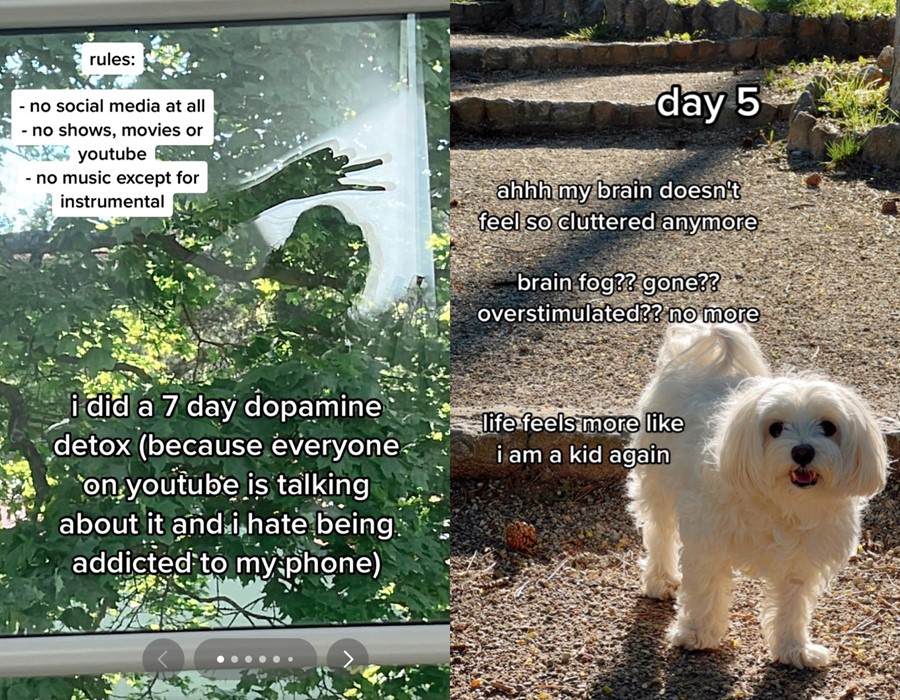
    “I did a seven-day dopamine detox (because everyone on YouTube is talking about it and I hate being addicted to my phone,” writes TikTok user Amelie in one video which has amassed over 1.6 million views. For her detox, Amelie abstained from social media, TV shows, movies, YouTube, and music (except for instrumental). She says she felt anxious in the first few days, but soon began noticing a number of benefits. “Went on a walk and noticed more beautiful things around me because I wasn’t on my phone,” she notes on day two. She started writing a book on day three. By day five her brain fog was “gone”, and by the end of the detox she claims she felt “calmer, less anxious, clearer in the head and more focused”.

    Shannon, 27, also recently jumped on the trend after noticing she noticed a huge dip in her motivation to do mundane tasks and work. “All I wanted to do was sit on my phone,” she tells Dazed. Then she heard about the benefits of a ‘dopamine detox’ on TikTok. “I had tried fully giving up social media in the past and really struggled, so I decided that doing it for just a couple of days a week would be more attainable.” During a detox, Shannon temporarily deletes the Instagram and TikTok apps off her phone, as she says these are the apps where she can fall into the trap of “mindlessly” scrolling.

    Like Amelie, Shannon feels better when she’s making a conscious effort to reduce her screen time. At work, she says she can “stay more focused on tasks and get so much more done”. At home, she no longer puts off chores by procrastinating on her phone and feels as though she has “more time to get life admin tasks done, like returning parcels and buying birthday gifts […] things feel like less of a chore now I’ve got nothing else to do”. Her relationships are also improving. “I am more likely to message friends and family, instead of scrolling through strangers’ feeds and sharing photos to everyone on Instagram,” she says.

    “I guess I approve of the practice in practical terms. But I’m very wary of the way it’s currently being packaged and perceived” – Dr Dean Burnett

    As aforementioned, there’s a clear link between high social media usage and poor mental wellbeing, so it tracks that people like Amelia and Shannon feel better after using their phones less. But, as with any wellness fad, it’s worth approaching the idea of a dopamine detox with a healthy dose of scepticism. “On one hand, it’s probably no bad thing that people are voluntarily disengaging from their devices for a bit,” says neuroscientist Dr Dean Burnett. “Our brains haven’t evolved to engage with the world entirely via a small glowing rectangle, and there are many studies which show that interaction with the real world can be a healthier thing for our brains.”

    But he stresses that he feels “uneasy” about the dopamine detox trend. “For one, cutting yourself off from all devices but recording yourself doing so in order to share it on TikTok and get people to like it, seems… counterproductive?”, he says. It’s a fair point: is it possible to try and meaningfully disengage from social media if you’re recording yourself doing it to post on TikTok for likes?

    https://www.tiktok.com/embed/v2/7181059702506179866?lang=en-GB&referrer=https%3A%2F%2Fwww.dazeddigital.com%2Flife-culture%2Farticle%2F60032%2F1%2Fcould-a-dopamine-detox-cure-your-phone-addiction-tiktok-wellness%3Futm_source%3Dpocket-newtab-global-en-GB

    His biggest concern, though, is the pseudoscientific way people talk about dopamine on social media. The word’s definition appears to have bloated in recent years, and is now often invoked when talking about literally anything which causes pleasure – a change which is known as ‘concept creep’. But dopamine has a lot of other roles in many body functions, such as memory, movement, attention and motivation.

    “Dopamine has countless functions in our brain, many of which are vital,” Dr Burnett says. “Yes, one of those is allowing activity in the reward pathway, the part of the brain that allows us to experience pleasure – but this has, presumably, led to this assumption that dopamine is like some internally-produced narcotic, giving you low-key highs on a regular basis while slowly corrupting you.” And this is “nowhere near how dopamine works,” Dr Burnett stresses. “If you really did ‘detox’ from dopamine and flush it out of your body, you’d probably be dead within minutes. At the very least, you’d be completely non-functional.”

    Nearly everyone who has tried abstaining from social media reports feeling good afterwards – so does it matter if they call it a ‘dopamine detox’, even if it would make more sense to just call it ‘taking a break from social media’? Dr Burnett thinks so. “I get very wary whenever I see neuroscientific terms and concepts being thrown around casually by people who clearly don’t understand them,” he says. “It spreads misunderstanding and flawed ideas about how our brains work, and devalues the expertise of those who know better. And I worry that invoking dopamine is a way to seem more credible by those who really don’t warrant such credibility.”

    “I guess I approve of the practice in practical terms,” he surmises. “But I’m very wary of the way it’s currently being packaged and perceived.” This is fair – words have meaning, after all, and it’s important to use words correctly to avoid spreading false information or perpetuating baseless pseudoscientific ideas – especially in an age where we have an increasing tendency to pathologise normal behaviours and drop ‘therapy speak’ into our everyday language. But still, even if you aren’t actually ‘doing a dopamine detox’ – which, as Dr Burnett says, would leave you dead or incapacitated – if ‘taking a break from social media’ is working for you, keep going with it.

    Life & CultureFeaturewellnessTikTok

    Read Next

    Apocalypse now?Earth has started spinning faster – what does it all mean?

    FeatureWill the North rise again?

    NewsThe Pear ring: will this social experiment really disrupt dating?

    FashionAir Afrique takes readers on a time-hopping, pan-African voyage

    Contact About Jobs Internship Legal Privacy Policy

    Dazed Media Another Another Man Nowness Dazed Studio

    Posted in Uncategorized | Leave a comment

    Horse riding accident: 30+ years. No two accidents create the same injuries so it is critical not to compare. Here is a well researched piece from an article (link included) outlining what happens to the brain. In my case I was going over a jump & therein I recall nexting else, even now. This is just another piece of the jigsaw that the social media allows me to engage in and maybe this article will be of benefit to others. (Personally, I add, I lost hearing in my right ear and gained tinnitus; I lost my sense of smell, and have real difficulties with new memories being formed. The points below are consistent with my experience. Also: Patients with hippocampal amnesia cannot imagine new experiences. Life becomes the permanent present.) And… then 2017 diagnosed with breast cancer and now a survivor

    Head First – Horse Riding Accidents and Concussions  (Source:  Horse Journals magazine)

    horse riding accidents, should i wear a riding helmet, how
        to safely ride a horse, gear for horse riding, beginner rider
        equipment, concussion horse riding, insurance for horse riding

    When horse and rider part company, the rider’s head is usually first to hit the ground. Photo: Shutterstock/Taylon

    Extracts from the article below that relate to my situation.

    …Head injuries are the most common reason for admission to hospital or death among riders. A fall from 60 cm (two feet) can cause permanent brain damage, yet a horse will elevate a rider’s head up to three metres (more than eight feet) above the ground.  When travelling at seven to ten kilometres per hour the human skull can shatter on impact, yet horses can gallop at 60 kilometres per hour. A rider who has had one head injury has a 40 percent chance of suffering a second head injury. Children, teens, and young adults are most vulnerable to sudden death from a second concussion. While death can be the ultimate outcome of a catastrophic accident, those who survive with traumatic brain injury (TBI) may suffer epilepsy, intellectual and memory impairment, speech problems, confusion, depression, personality changes, emotional changes, and post-traumatic stress disorder. By any score, a head injury is a life-altering event.

    What is Concussion or Traumatic Brain Injury?

    The website Parachute, dedicated to preventing injuries and saving lives, explains that when a person suffers a concussion, the brain suddenly shifts or shakes inside the skull and can knock against its bony surface. The blow that causes the brain to collide with the skull may be to the head or the body, but it is the force of the blow that does the damage. The brain can be bruised, or the brain can react with a rotational twist that causes shearing or tearing of the nerve fibres as well as bleeding. The shock can cause a change in the brain’s chemical function. No two brain injuries are alike and symptoms are highly variable, lasting days, months, or years.

    According to the Northern Brain Injury Association (NBIA), injuries to the brain are among the most likely to result in permanent disability or death. In British Columbia, brain injury occurs at a rate greater than all known cases of multiple sclerosis, spinal cord injury, HIV/AIDS, and breast cancer combined, per year. According to the NBIA website, 452 people suffer a serious brain injury every day in Canada.

    https://www.horsejournals.com/life-horses/head-first-horse-riding-accidents-and-concussions

    Posted in Uncategorized | Leave a comment

    TBI: A true loss, forming memories, loss of imagination. Article from Scientific American. Title: Where Imagination Lives in Your Brain…the engine of memory; the hippocampus

    NEUROSCIENCE

    Where Imagination Lives in Your Brain

    The ability to conjure up possible futures or alternative realities is the flip side of memory. Both faculties cohabit in the brain region called the hippocampus

    Where Imagination Lives in Your Brain
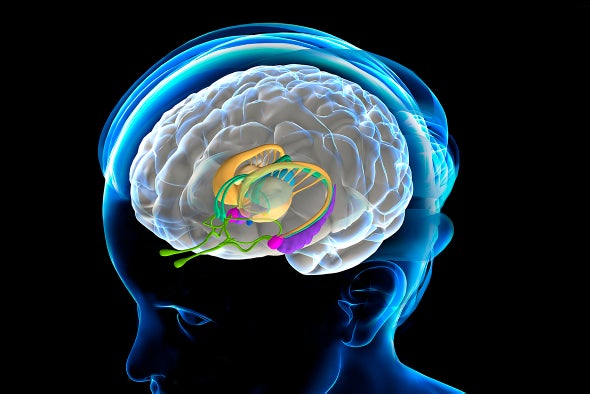
    An artist’s representation shows part of the human brain, including hippocampus (purple). Credit: Fernando Da Cunha/Science Source

    https://5d0b035bf7cc059d3f389ed29a0c8b86.safeframe.googlesyndication.com/safeframe/1-0-40/html/container.htmlADVERTISEMENT

    Henry Molaison, known for years as “H.M.,” was famously unable to form new memories. If someone he had met left the room only to return several minutes later, he would greet that person again as if for the first time. Because of surgery to treat intractable epilepsy, H M. lacked a sea-horse-shaped brain structure called the hippocampus and had amnesia. His case helped establish the hippocampus as an engine of memory.

    In recent years scientists have discovered another essential deficit that burdens people with hippocampal amnesia: they can’t envision the range of possibilities that must be considered to make future plans. When researchers asked a group of people with hippocampal damage to describe themselves in a fictitious scene—say, lying on a white sandy beach—they came up largely blank, producing only fragmented images. Brain scans of healthy people, by contrast, showed that their hippocampus was engaged even more when they imagined the future than when they summoned the past.

    Studies of neural activity in rats have since come along to support the idea that the hippocampus plays a central role in imagination. “It’s still responsible for creating memories of what is happening right now,” says Loren Frank, a systems neuroscientist at the Howard Hughes Medical Institute and the University of California, San Francisco. “And now it seems it is also responsible for rolling out possibilities.” Frank and his colleagues make their case in a paper entitled “Imagination as a Fundamental Function of the Hippocampus,” which was published in the Philosophical Transactions of the Royal Society B.ADVERTISEMENT

    That dual role makes sense, experts say, in part because imagination depends largely, if not exclusively, on memory. “Why do we talk about imagination separately from memory? From the public point of view [talking about them together] is a crazy idea. But you can put it in a simple way: there is absolutely no way you can imagine anything without the past,” says György Buzsáki, a systems neuroscientist at New York University, who was not involved with the paper.

    In addition, both skills involve essentially the same process: combining bits and pieces of experience with emotions, inner commentary and things people have read or heard about, says Donna Rose Addis, a cognitive neuroscientist at the Rotman Research Institute in Toronto and the University of Toronto, who was also not involved with the recent review. This process can even distort memories by mixing them with imaginary material. “Memory is a form of imagination,” Addis says.

    From Frank’s point of view, imagination gives memory a purpose: helping us make decisions based on what we’ve learned—for instance, deciding to avoid a food that once made us sick. “From an evolutionary perspective, we are reasonably sure that the purpose of memories is actually in the future,” Frank says. “Memories allow you to take experiences that you have and retrieve them to make predictions about what will happen next.” This chain of neural events even loops back on itself. We also need to form memories of our simulations of the future so that when we have an experience, we have something to draw on. “We have found that the encoding of an imagined simulation also involves the hippocampus,” Addis says.

    Much of the recent evidence for imagination’s roots in the brain draws on a Nobel Prize–winning discovery in the 1970s of “place cells” in the hippocampus. When a rat runs a maze, the activity of these cells changes in a predictable way based on the animal’s position in the maze. These hippocampal cells tell an animal where it is in the world. This function seemed distinct from imagination until Frank and his colleagues showed that the activity of these cells does not always represent an animal’s actual location.

    The firing patterns of place cells repeat about eight times per second in rats, forming what is called the theta rhythm. And within each cycle, the researchers found, the patterns progressively change to represent three different locations for the animal that are separated in time: the place it just was, its current position and, late in the cycle, a possible upcoming location. “The neural activity has this unmistakable structure where, at certain time points, it looks like what the animal is experiencing in the present. At these other time points, it looks like an imaginary experience,” says Kenneth Kay, a postdoctoral researcher  at the Mortimer B. Zuckerman Mind Brain Behavior Institute at Columbia University and a co-author of the paper. (The paper’s first author is Frank’s graduate student, Alison Comrie.)

    https://5d0b035bf7cc059d3f389ed29a0c8b86.safeframe.googlesyndication.com/safeframe/1-0-40/html/container.htmlADVERTISEMENT

    What a rat seems to be imagining in any given cycle varies. When the rat is approaching a T-junction in a maze, the late theta activity alternates between two possible immediate futures: a turn to the left in one cycle and a turn to the right in the next. It’s as if the animal is planning its next move, akin to a soccer player who is running toward a ball and flipping through various scenarios before deciding on a play.

    In other instances, that late theta activity denotes a more distant place in the maze, as if the animals’ mind wandered to some other scene or scenario, perhaps some place it would rather be. The researchers also found instances in which this imagination portion of the cycle reflected a hypothetical direction of travel that differed from the animal’s actual directional heading. “They are representing things that can roughly be thought of as possibilities or hypotheticals, things that could be but aren’t necessarily the case in terms of a possible future or just an alternative reality,” Frank says.

    The mere existence of spontaneous activity within the hippocampus that is not necessarily tied to a specific place, some experts say, hints at an internal thought process that is separated from reality. “That rhythmicity [of the theta wave] is not coming from the environment,” Kay says. “That’s highly reminiscent of the notion that our imaginings are coming from ourselves, and they are not from this external reality.”

    newsletter promo

    Another form of imagination seems to occur when an animal isn’t traveling through space but is eating, grooming or zoning out. At these times, scientists have detected bursts of activity in the hippocampus called “sharp wave ripples,” which also occur during sleep, that seem to represent mental replays of past events. The replays occur about 10 times faster than the original event, a reenactment that is reminiscent of human experience. “One huge advantage of using our minds to think about things sometimes is: we can quickly play through things, we can quickly simulate them,” Kay says.

    While these mental replays are a form of recollection, they can also represent events the animal has not experienced, Frank says. Some sharp wave ripples appear to connect two trajectories that an animal had experienced separately but not together, he says. The ripple activity may, in essence, build a mental map so that the animal can mentally traverse new paths, such as shortcuts and detours. In this context, the hippocampus seems to be acting to combine past events in new ways, something that “is more like imagination than it is just replaying the past or predicting the future,” says Lynn Nadel, an emeritus professor of cognitive science and psychology at the University of Arizona, who did not contribute to the recent paper.

    https://5d0b035bf7cc059d3f389ed29a0c8b86.safeframe.googlesyndication.com/safeframe/1-0-40/html/container.htmlADVERTISEMENT

    The experiments of neuronal activity in rodents are important, experts say, because they place the idea of imagination into a physical reality: that of the brain itself. “This gives us an opportunity to take a fuzzy cognitive concept like imagination” and link it to brain activity, says Daphna Shohamy, a cognitive neuroscientist at Columbia University, and director and CEO of Columbia’s Zuckerman Institute, who was not involved in those studies or the review paper.

    Humans’ internal worlds are rich, however, and the studies of place cells in rats may not represent all types of human imagination. The animal results connect most directly with imagination that is based in experience and action, as in planning out a strategy for moving through the world, Nadel says. But other experts believe the hippocampus has a much broader repertoire: it may also forge ties between ideas and information. “I don’t think the hippocampus cares, really, about what you’re connecting,” Addis says.

    Some of Shohamy’s work supports the idea that the hippocampus might be important for mental simulations that are not rooted in time or place. She has found that people with damage to the hippocampus are much slower than those without brain damage to choose between food items—say, a Kit Kat versus M&Ms—that they like about equally well. The problem seems to be that they have trouble imagining what the options are like. “It looks as if they are spending more time trying to conjure up the evidence,” Shohamy says. In the end, they make a choice at random.

    Although the hippocampus may play a central role in imagination, it is by no means performing a solo act. It needs the cooperation of other brain areas. Frank likens the hippocampus to an orchestra conductor that cues up neurons in other regions that represent the sights, sounds and smells that either are part of a recollection or “fit together in some imagined thing.”

    One mystery is how people separate a real symphony from music playing in their head. “It’s amazing that we’re not all psychotic all the time, that we’re not all delusional, because our brains are clearly making stuff up a lot of the time about things that could be,” Frank says. New data from Frank’s group suggest the brain may use sensory input—say, the feeling of a foot hitting the ground while walking—to flag what is real versus what is just in the mind’s eye and so ground this hive of neural activity in the physical world. The brain, he says, separates fact from fiction by reconciling the information it receives from the outside world with its own internal models.

    https://5d0b035bf7cc059d3f389ed29a0c8b86.safeframe.googlesyndication.com/safeframe/1-0-40/html/container.htmlADVERTISEMENT

    Rights & Permissions

    ABOUT THE AUTHOR(S)

    author-avatar

    Ingrid Wickelgren is a freelance science journalist based in New Jersey.

    Recent Articles by Ingrid Wickelgren

    READ THIS NEXT

    SPONSORED

    Tools to escape the nicotine addiction cycle

    NEUROSCIENCE

    What Does the Hippocampus Do?

    Felipe De Brigard

    NEUROSCIENCE

    A Brain Deprived of Memory

    Michael D. Lemonick and Steve Mirsky

    NEWSLETTER

    Get smart. Sign up for our email newsletter.

    Posted in Uncategorized | Leave a comment

    PTSD Sufferers To Get Digital Help For Overlooked Symptom. Iraq, Afghanistan, Mali, Central African Republic, Yemen, Palestine, Israel … Libya, and now Ukraine – the countries go on and on. We know that people live struggling to get food to eat. They are all destined to experience PTSD as are many of the combatants in these wars. Please share with people from Ukraine. Source NoCamels (Israel)

    PTSD Sufferers To Get Digital Help For Overlooked Symptom
       4 minutes
    Technology

    (Courtesy Andrew Neel/Pexels)

    Israeli military veterans and other sufferers of post-traumatic stress disorder (PTSD) will soon be able to receive online assistance in addressing a symptom that is often overlooked: chronic procrastination or an ongoing inability to follow through on a goal in their lives. The new “Ani Al Ze” (Hebrew for “I’m on it”) website will help PTSD sufferers combat procrastination and remain consistent in pursuing their goals.

    Volunteers from Israel’s high-tech sector working on the “Ani Al Ze” website (Courtesy)

    The website is for now being exclusively offered by NATAL, an Israeli non-profit organization that treats citizens suffering from war- and terror-related trauma, which is to provide the new service as part of its six-month vocational training program. The website is already being piloted, and it will expand to reach more people in need in the coming months. More on this subject:In First, Israeli Study Of IDF Veterans Shows Oxygen Therapy Reduces PTSD SymptomsIDF Veteran’s Best Friend: Dogs Ease Pain Of PTSDSimple Saliva Test Could Help Diagnose PTSD In SoldiersShaked Arieli, head of Career Development at NATAL, says that she is unaware of an app or website that has been designed thus far to help people with PTSD combat their chronic procrastination. She says that the closest digital help for PTSD she has found has been a US-developed app for American veterans that helps them understand and manage their symptoms.While the website is currently only available in Hebrew, Arieli hopes that it will be expanded into a global service. The Israel Defense Forces does offer a range of PTSD treatments for its soldiers, but does not offer digital assistance. 

    Israeli soldiers. Photo by Timon Studler on Unsplash
    The Israel Defense Forces offers in-person PTSD therapy for its soldiers (Unsplash)

    Participants of the NATAL program meet regularly with trained career coaches to strengthen their soft skills (personal attributes that let someone interact effectively), such as time management and emotional regulation, and build a personal career path that includes setting achievable short-term and long-term goals. Digital Development The new platform lets the participants add goals and set difficulty levels for each one, track the progress they’ve made on a particular goal, and maintain communication with their career coach between meetings. The coaches can use the website to view the progress the participants say they have made on their goals, including verifying how often they logged on, and also provide them feedback through the WhatsApp instant messaging service.The participants also receive daily automated WhatsApp reminders to log their progress, as well as reinforcements with custom messages and notifications. “Our coaches work with the participants on the things that challenge them most in terms of their career progression – like time management, decision-making, and emotional regulation,” Arieli tells NoCamels. 

    “What we wanted to do was integrate an app into the coaching process that would help them with this,” she says. 

    NATAL and Code for Israel team members meeting on the new website. Far left: Shaked Arieli, and far right: Yuval Tamir (Courtesy)

    The website was created through Code for Israel, an initiative in which hundreds of Israelis working in the high-tech sector volunteer to develop technological projects that benefit the country’s society. A team of 15 people spent nine months carefully constructing the website, including two volunteer veterans from NATAL who previously benefited from its therapy and career coaching services. Based on the volunteer veterans’ first-hand experience with PTSD, the team also included a feature that allows the participant to ping their career coach on WhatsApp if they are in need of urgent assistance.And if they’re experiencing a particularly stressful day or week, participants can use the website’s “stop all” feature, which pauses all of their tasks and ceases to send them notifications until they choose to resume the process. It also notifies their career coach that they have used the feature. 

    PTSD sufferers may experience procrastination when certain parts of a traumatic memory are triggered (Courtesy Alex Green/Pexels)

    “The day-to-day life of a person struggling with PTSD is very stressful, and we don’t want to overwhelm them,” says Yuval Tamir, a software engineer at cloud-computing company Zadara, who acted as project manager during the development of the website.“The goal of the app is to help [the participants] complete these tasks, no matter how long it takes,” Tamir tells NoCamels. Triggers And TraumaFor many people struggling with PTSD, procrastination may occur when certain parts of a traumatic memory that have not been fully processed are unconsciously triggered, according to registered practitioner psychologist Gemma Pearson. Arieli, who has worked with many people suffering from PTSD, says that many of her clients share the same attributes of low self-esteem, fear of failure, shame, anger, and helplessness. These traits – specifically fear of failure and low self-esteem – have also been linked to causing procrastination. 

    The “Ani Al Ze” dashboard, as seen by a career coach. Ongoing tasks are in purple and completed tasks in green (Courtesy)

    Arieli believes that the website can extend beyond use by participants within NATAL. She sees it as having the potential to work with other non-governmental organizations in the rest of the world whose focus is coaching young adults with PTSD. “This is not just another task management app – there are thousands of those in the world,” Arieli says. “It feels like someone is helping guide people struggling with PTSD through the most daunting aspects of their goals. Even if the coach is not there all the time, the fact that they know their coach can see what they do on the website makes completing a task more meaningful,” she says. 

    PTSD Sufferers To Get Digital Help For Overlooked Symptom

    By Ariel Grossman, NoCamels June 21, 2023  4 minutes

    Technology

    (Courtesy Andrew Neel/Pexels)

    Israeli military veterans and other sufferers of post-traumatic stress disorder (PTSD) will soon be able to receive online assistance in addressing a symptom that is often overlooked: chronic procrastination or an ongoing inability to follow through on a goal in their lives. 

    The new “Ani Al Ze” (Hebrew for “I’m on it”) website will help PTSD sufferers combat procrastination and remain consistent in pursuing their goals.

    Volunteers from Israel’s high-tech sector working on the “Ani Al Ze” website (Courtesy)

    The website is for now being exclusively offered by NATAL, an Israeli non-profit organization that treats citizens suffering from war- and terror-related trauma, which is to provide the new service as part of its six-month vocational training program. 

    The website is already being piloted, and it will expand to reach more people in need in the coming months. 

    More on this subject:
    In First, Israeli Study Of IDF Veterans Shows Oxygen Therapy Reduces PTSD Symptoms
    IDF Veteran’s Best Friend: Dogs Ease Pain Of PTSD
    Simple Saliva Test Could Help Diagnose PTSD In Soldiers

    Shaked Arieli, head of Career Development at NATAL, says that she is unaware of an app or website that has been designed thus far to help people with PTSD combat their chronic procrastination. 

    She says that the closest digital help for PTSD she has found has been a US-developed app for American veterans that helps them understand and manage their symptoms.

    While the website is currently only available in Hebrew, Arieli hopes that it will be expanded into a global service. 

    The Israel Defense Forces does offer a range of PTSD treatments for its soldiers, but does not offer digital assistance. 

    Israeli soldiers. Photo by Timon Studler on Unsplash
    The Israel Defense Forces offers in-person PTSD therapy for its soldiers (Unsplash)

    Participants of the NATAL program meet regularly with trained career coaches to strengthen their soft skills (personal attributes that let someone interact effectively), such as time management and emotional regulation, and build a personal career path that includes setting achievable short-term and long-term goals. 

    Digital Development 

    The new platform lets the participants add goals and set difficulty levels for each one, track the progress they’ve made on a particular goal, and maintain communication with their career coach between meetings. 

    The coaches can use the website to view the progress the participants say they have made on their goals, including verifying how often they logged on, and also provide them feedback through the WhatsApp instant messaging service.

    The participants also receive daily automated WhatsApp reminders to log their progress, as well as reinforcements with custom messages and notifications. 

    “Our coaches work with the participants on the things that challenge them most in terms of their career progression – like time management, decision-making, and emotional regulation,” Arieli tells NoCamels. 

    Sign up for our free weekly newsletter

    SUBSCRIBE

    “What we wanted to do was integrate an app into the coaching process that would help them with this,” she says. 

    NATAL and Code for Israel team members meeting on the new website. Far left: Shaked Arieli, and far right: Yuval Tamir (Courtesy)

    The website was created through Code for Israel, an initiative in which hundreds of Israelis working in the high-tech sector volunteer to develop technological projects that benefit the country’s society. 

    A team of 15 people spent nine months carefully constructing the website, including two volunteer veterans from NATAL who previously benefited from its therapy and career coaching services. 

    Based on the volunteer veterans’ first-hand experience with PTSD, the team also included a feature that allows the participant to ping their career coach on WhatsApp if they are in need of urgent assistance.

    And if they’re experiencing a particularly stressful day or week, participants can use the website’s “stop all” feature, which pauses all of their tasks and ceases to send them notifications until they choose to resume the process. It also notifies their career coach that they have used the feature. 

    PTSD sufferers may experience procrastination when certain parts of a traumatic memory are triggered (Courtesy Alex Green/Pexels)

    “The day-to-day life of a person struggling with PTSD is very stressful, and we don’t want to overwhelm them,” says Yuval Tamir, a software engineer at cloud-computing company Zadara, who acted as project manager during the development of the website.

    “The goal of the app is to help [the participants] complete these tasks, no matter how long it takes,” Tamir tells NoCamels. 

    Triggers And Trauma

    For many people struggling with PTSD, procrastination may occur when certain parts of a traumatic memory that have not been fully processed are unconsciously triggered, according to registered practitioner psychologist Gemma Pearson. 

    Arieli, who has worked with many people suffering from PTSD, says that many of her clients share the same attributes of low self-esteem, fear of failure, shame, anger, and helplessness. These traits – specifically fear of failure and low self-esteem – have also been linked to causing procrastination. 

    The “Ani Al Ze” dashboard, as seen by a career coach. Ongoing tasks are in purple and completed tasks in green (Courtesy)

    Arieli believes that the website can extend beyond use by participants within NATAL. She sees it as having the potential to work with other non-governmental organizations in the rest of the world whose focus is coaching young adults with PTSD. 

    “This is not just another task management app – there are thousands of those in the world,” Arieli says. 

    “It feels like someone is helping guide people struggling with PTSD through the most daunting aspects of their goals. Even if the coach is not there all the time, the fact that they know their coach can see what they do on the website makes completing a task more meaningful,” she says. 

    Posted in Uncategorized | Leave a comment

    Assisted dying is being discussed in Ireland; this may be of interest to people, especially people with mental illness that often is underpinned by suicide ideation. This is Jordan Peterson’s Thoughts on Assisted Suicide. He shares his “Truth” and is worth engaging with.

    189,724 views 19 Jun 2023 #JordanPeterson#JordanBPeterson#DrJordanPetersonDr. Peterson discusses the ethical and moral implications of granting the state the power to decide who lives and who dies. Drawing on historical parallels, he cautions against the potential dangers of government control over life and death decisions. Watch the full video – https://utm.io/ueSFn

    Posted in Uncategorized | Leave a comment