COURAGE.MEDIA: Bono Shouldn’t … a must read

Bono Shouldn’t Be Speaking on Gaza — Apologizing for Iraq

He helped whitewash war crimes, but now wants the moral high ground?

30 May 2025

John Mac Ghlionn

View articles

There was a time when Bono walked into a room and people cared. When U2 wasn’t just a band, but a musical juggernaut, packing stadiums, soundtracking revolutions, and preaching peace through amplifiers loud enough to shake regimes. That time is long gone. Today, Bono is less prophet, more parrot — a fading frontman chasing relevance in a world that has moved on. And like many rockstars past their prime, he’s turned to a different kind of stage: the global moral high ground.

His latest sermon came at the Ivor Novello awards, where he called on Hamas to release hostages and urged Israel to free itself from the grip of “far-right fundamentalists”. Predictably, The Guardian framed it as brave. But it wasn’t. Not really. This is just the latest bit of cosplay from someone who has spent years posing as a statesman but not living as one. Everyone’s entitled to their opinion, but we should always ask where it comes from and who it benefits. Because for all his talk of justice and peace, Bono has consistently aligned himself with power, not necessarily truth.

Become a Free Member

Enjoy independent, ad-free journalism – delivered to your inbox each week

Join Today

This is the same man who once cozied up to Tony Blair, the man who greenlit the invasion of Iraq leaving cities in ruins and families destroyed. Bono didn’t just shake his hand, he praised him. While Fallujah burned and Baghdad mourned, Bono was backstage with the architects of war, trading smiles and sipping champagne. It was so galling, so tone-deaf, that even his own bandmate Larry Mullen admitted he cringes at the sight of Bono arm-in-arm with Bush and Blair. When your own drummer can’t stomach your guestlist, perhaps it’s time to admit you weren’t bridging worlds, you were just flattering war criminals.

When Bush and Blair launched an invasion on a lie, Bono didn’t protest; he rationalized, wrapped it in humanitarian-speak, and smoothed it over with charity gigs and soft-focus press junkets. And what was the cost of that war Bono helped sanitize? Not just a shattered Iraq, but a region ripped apart. Syria destabilized. Libya in ruins. ISIS rising from the ashes. Millions displaced. Hundreds of thousands dead. And let’s not pretend Europe hasn’t paid the price. Mass migration. Terror attacks in London, Manchester, Paris, Brussels, Berlin. The consequences of Bono’s silence weren’t confined to Mesopotamia but rippled across continents.
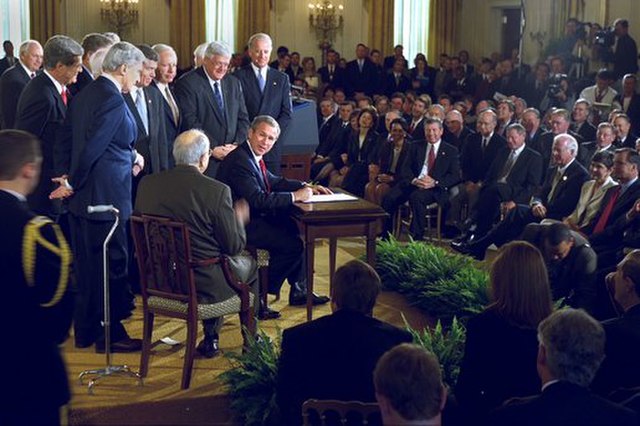
President George W. Bush looks toward Senator Jesse Helms after signing the H.J. Resolution 114 authorizing the use of force against Iraq

Above: President George W. Bush is pictured signing the H.J. Resolution 114, which authorized the use of force against Iraq.

Has the Irishman ever visited the hellhole he helped justify through silence and photo ops? Has he walked through Mosul’s ruins or spoken to the maimed children of Basrah? Or does he just prefer pontificating from Swiss balconies in Davos?

Let’s talk about Davos, that velvet-lined womb of moral decay where the world’s wealthiest gather to pose as saviors. Bono is practically a fixture there. In a sea of detached elites, he still manages to present himself as the conscience of the room, despite being one of them in every way that counts. He sits on panels beside pharmaceutical CEOs, oil barons, and financiers who siphon the future from entire nations, all while selling a version of “compassion” that neatly aligns with their portfolios. Bono fits right in. Not because he’s changed the system, but because he’s been absorbed by it.

Bono Shouldn’t Be Speaking on Gaza — He Should Be Apologizing for Iraq

Long immersed in elite circles, Bono proudly presents himself as the planet’s moral conscience — yet one cannot confront the horrors of one war while turning a blind eye to another.

His toxic brand of activism has always been wrapped in a designer scarf and shades, delivered from the glossy podiums of Silicon Valley and the donor banquets of the ultra-rich. The (RED) campaign, marketed as world-saving philanthropy, became a tax-friendly marketing scheme that helped Apple sell iPods and let Big Pharma polish its halo. And let’s not forget, while he sermonized about fairness and poverty, U2 quietly shifted its massive earnings through Dutch tax shelters. Bono demands world governments give more, but makes sure he gives less. “Do as I say, not as I incorporate” is his defining mantra.

His toxic brand of activism has always been wrapped in a designer scarf and shades, delivered from the glossy podiums of Silicon Valley and the donor banquets of the ultra-rich. The (RED) campaign, marketed as world-saving philanthropy, became a tax-friendly marketing scheme that helped Apple sell iPods and let Big Pharma polish its halo. And let’s not forget, while he sermonized about fairness and poverty, U2 quietly shifted its massive earnings through Dutch tax shelters.

There’s something grotesquely sanctimonious about a multimillionaire rockstar with a private jet lecturing war-torn nations about peace. A man who lives behind gates, dines with kings, and tells us the problem is “us”. Not the elites. Not the governments. Us. The children of Abraham “in the rubble of our revenge”, he says, as if he’s lived among them. As if he’s one of them. As if he hasn’t spent two decades building an image off of the suffering of others.

But really, this isn’t about Gaza or peace or even politics. It’s about keeping U2 in the headlines. About squeezing the last few drops of cultural relevance from a band that hasn’t released a meaningful song in over twenty years. A band that once wrote anthems and now re-records their greatest hits in stripped-down Spotify-friendly formats that no one asked for. A band that once defined an era now clings to its legacy like a drowning man clutches to driftwood.

And this is where we must talk about Ireland. Because the Irish have a nose for fakery, unchecked ego, and disingenuous intent. It’s why Conor McGregor, once the toast of a nation, is now seen as a cautionary tale. Swagger without substance doesn’t last long back home. It’s also why Bono, despite his global stature, is constantly viewed with suspicion, from Dublin to Donegal. There’s something about his preening moralism, his love of elites, and his constant proximity to cameras and causes that just doesn’t sit right. The Irish don’t kneel for saints manufactured in PR departments.

Bono’s political posturing is not rebellion — it’s marketing. It’s a rebrand disguised as righteousness. He’s no longer a threat to power; he is power. He’s no longer raging against the machine; he’s the background music in its lobby.

In the end, Bono may still think of himself as a prophet, but the world sees a parody. The Guardian may still clap. The award shows may still hand him trophies. But the rest of us are left wondering if the man who once cried out “How long must we sing this song?” is even listening anymore. The answer is painfully clear: far longer than we should have to.

Recommended

News

Radical Islam is Consuming Germany

The Insight Series

The Continuing Rise of Europe’s Populist Right

News

On the Antisemitic Murders in D.C.

Comments (0)

Posted in Uncategorized | Tagged , , , , | Leave a comment

The Deep Think: The environmental cost of AI

The environmental cost of AI

Since OpenAI released its ChatGPT chatbot to the world, AI companies have been working on developing bigger Large Language Models (LLMs) to deliver more powerful AI products. In the pursuit of more advanced AI capabilities, the environmental implications have become increasingly significant. Training OpenAI’s GPT-4, for instance, consumed approximately 50 gigawatt-hours (GWh) of electricity—equivalent to the annual energy consumption of about 4,600 average U.S. households. This substantial energy requirement underscores the growing environmental footprint associated with developing and deploying large language models.Bringing AI to consumers is just the beginning; each query on advanced AI models like GPT-4o consumes around 0.3 watt-hours of electricity, roughly the same as a typical Google search. However, the broader integration of AI into everyday activities could significantly impact global electricity demand. According to the International Energy Agency (IEA), if AI-powered searches replaced all 9 billion daily searches, global electricity usage could increase by approximately 10 terawatt-hours annually—equivalent to the total yearly electricity consumption of about 1.5 million European Union residents. 
The cost of construction: mining and manufacturing impacts

When one thinks about an AI model, most of us think about a chatbot. However, at an enterprise level, AI does much more than that. It can automate repetitive tasks, making companies more efficient. However, all of this takes an immense amount of computational power. In order to sustain this performance, AI models are run in data centers that house huge supercomputers. These supercomputers can contain anywhere between 1,000-1,000,000 specialized GPU chips.

Now consider this: around 800 kg of raw materials are used in the construction of a single computer that weighs 2 kg. This represents a fraction of the raw materials that go into the construction of a single supercomputer, “making it a mountain of materials”, not just computational power.Materials such as silicon, copper, gold, silver, platinum, and nickel are mined to create a supercomputer, a process that contributes significantly to carbon emissions, deforestation, and water pollution.

This environmental toll doesn’t even account for accidents or abandoned mining sites, which can continue releasing pollutants long after valuable minerals have been extracted.As AI technologies become increasingly integrated into daily life, their environmental impact warrants closer scrutiny. A single query to ChatGPT can consume approximately 0.0029 kilowatt-hours (kWh) of electricity, nearly ten times the energy required for a typical Google search, which uses about 0.0003 kWh. If AI-powered searches were to replace all 9 billion daily Google searches, this shift could add an estimated 10 terawatt-hours (TWh) to global electricity demand annually—equivalent to the yearly electricity consumption of approximately 1.5 million European Union residents.

This substantial increase underscores the importance of considering the energy implications of widespread AI adoption. Throughout these steps, the computations are performed on GPUs, which require a constant flow of energy. As AI models become increasingly sophisticated, their training demands more computational resources, driving up energy consumption. Currently, most AI companies prioritize enhancing their models’ performance, often overlooking improvements in energy efficiency. It is estimated that since 2012, the amount of computing power used for deep learning research has been doubling every 3.4 months, according to OpenAI researchers. The result will be an increasing pressure on the global net carbon emission goals to be achieved by 2050.It is estimated that the rise of AI could see data centers account for nearly 35% of the country’s energy use by 2026. 
Data centers’ unquenched thirst for water

Data centers also require large quantities of water for cooling. There is very little publicly available data on how much water is used by data centers, but estimates can be made by looking at a lengthy legal battle that involved Google’s data centers in Dalles, Oregon. During the course of the lawsuit, it was revealed that Google’s data centers in the region consumed more than 355 million gallons of water in 2021. The amount had tripled since 2016 and represented more than one-quarter of the town’s annual water consumption. Data centers figure amongst the top 10 ‘water-consuming industrial or commercial industries’, according to a study led by Landon Marston, an assistant professor of civil engineering and environmental engineering at Virginia Tech. The study further noted that data centers draw water from nearly 90% of the U.S. watersheds. And their thirst for water is only going to increase as the adoption of AI increases. 
More AI will mean more e-waste

An important side effect of the adoption of AI systems around the world is the push it has given to the upgrade cycles. An upgrade cycle is the time a consumer holds on to his/her devices. With AI coming into the picture, more users will be willing to let go of their older devices before the end of their performance cycles to access AI features.The biggest example of this can be seen in the smartphone market, where newer devices feature dedicated neural engines capable of running on-device AI features. Due to the lack of newer chips that feature neural engines, more users are willing to let go of their older devices. At the time of its launch, the iPhone 15 series was one of the best-selling smartphones in the market, but its sales were overshadowed by the iPhone 16 series devices launched just a year later. The major difference between the two series was the introduction of AI features.A similar trend can be seen in the personal PC market, where manufacturers are rushing to introduce AI features in the devices to boost sales. All this contributes to e-waste, a majority of which still ends up in landfills. The inability of older devices to run AI features not only impacts their resale value but also contributes to more of them being discarded rather than being refurbished. 
AI’s potential for environmental sustainability

Despite their environmental impact, AI models can assist humanity in recognising patterns to better combat challenges posed by climate change. AI can also be used to reduce the carbon emissions of industries like mining, refining, and manufacturing. It can also be used to improve closed-loop manufacturing, where more materials can be effectively reclaimed and reused.Stronger legislation around the sources of energy used for running data centers can also help reduce the impact of AI on the environment.However, this is more speculative as AI could also have unintended consequences. For example, the development of AI-powered self-driving cars could cause more people to drive instead of cycling or taking public transport, increasing carbon emissions. AI could also cause misinformation about climate change, downplaying its impact on people’s lives, further exacerbating the problem. Whatever the future, AI holds tremendous power, depending on how it is used, not just on social and economic fronts, but also on the environmental front. 
Final Thoughts

While AI promises to revolutionize numerous sectors, its rapid growth comes with significant environmental costs. It’s crucial to balance innovation with sustainable practices, ensuring technology progresses without sacrificing our planet’s health. For companies in growth mode, remote hiring offers access to top global talent—particularly across Latin America—while reducing emissions from commuting and office operations. It also presents a cost-efficient alternative, with potential savings of up to 70% compared to the U.S. market. 

Posted in Uncategorized | Tagged , , , , | Leave a comment

New Atlas:Therapy shock: Pioneering mental health chatbot is shutting down

Mental Health

Therapy shock: Pioneering mental health chatbot is shutting down

By Bronwyn Thompson

May 28, 2025

Acclaimed digital therapist Woebot is shutting down

Acclaimed digital therapist Woebot is shutting down 

Created with DALL-E

View 3 Images View gallery – 3 images

A landmark AI therapy chatbot is closing down on June 30, and industry experts believe that its demise is most likely in response to the challenges of delivering impactful mental health services and navigating safety issues in the digital space.

Woebot, which we covered back in 2017 when it launched, was at the time seen as the “future of therapy,” as in-person mental health services became increasingly harder to access around the globe. After raising millions in funding, it received the US Food and Drug Administration’s Breakthrough Device Designation in 2021 for its personalized postpartum depression service WB001, which combined cognitive behavioral therapy (CBT) and psychotherapy delivered by its conversational chatbot.

Quaise demos maser drill bit to go deeper than humans have ever gone

The company, Woebot Health, rolled out a subscription-free chatbot plus specialized services aimed at teens, and other services to be used in conjunction with therapy or as a standalone tool. And in 2023, Woebot’s famed creator and clinical psychologist, Alison Darcy, was named in TIME magazine’s top 100 most important figures in AI.

Woebot Health founder Alison Darcy
Woebot Health founder Alison Darcy 

“It’s an emotional assistant that’s there for you in tricky moments and always has your best interest at heart,” Darcy told the magazine at the time.

The app had been designed to fill a space that traditional therapy couldn’t – be it for people on wait lists to see psychologists or between appointments, and studies showed it was effective in relieving symptoms of anxiety and depression when used as designed.

Users were informed of the app’s closure via email and also given the option to download their chat logs, and were also reassured of the privacy of their data.

But despite tight guardrails built into Woebot’s therapy services, and the clinicians involved in its programming, its demise underpins the fundamental issues in delivering mental health treatment via AI.

“Chatbots can probably provide benefits for people with mental health concerns, but they also create risks and challenges,” noted researchers in this 2023 Digital Health paper. “The ethical issues we identified involved the replacement of expert humans, having an adequate evidence base, data use and security, and the apparent disclosure of crimes.”

Woebot made a name for itself as a well-considered and well-designed therapy app

Recently, new research suggested that chatbots in general, like ChatGPT, were perhaps isolating those in need even further. Nonetheless, other studies have shown that people are turning to the likes of ChatGPT and Claude for mental health support and as a sort of 24-7 digital life coach.

Since its launch, Woebot has been used in 120 countries and has had more than two million conversations with users. It was the first therapy chatbot of its kind, and research found that people accessing it had formed genuine personal relationships with their digital mental health provider.

“Although bonds are often presumed to be the exclusive domain of human therapeutic relationships, our findings challenge the notion that digital therapeutics are incapable of establishing a therapeutic bond with users,” the researchers noted in a 2021 study.

Woebot Health, which has raised US$123 million in capital to date, is yet to release a statement on the app’s closure, so it’s unclear exactly why the decision has been made to take it offline.

Source: Woebot Health

Posted in Uncategorized | Tagged , , , , | Leave a comment

Carl Sagan in 1986 on the problems with media and science literacy

Posted in Uncategorized | Leave a comment

Col Douglas Macgregor on puppet Trump, Western BS, Ukraine’s fate, Israel and EU’s wake-up call

96,446 views

28 May 2025

Paul Buitink talks to Colonel Douglas Macgregor. In this gripping episode of Reinvent Money, Paul Buitink welcomes back Colonel Douglas Macgregor for an unfiltered deep dive into the geopolitical chaos unfolding across the globe. Macgregor argues that despite Trump’s rhetoric, he has little control over U.S. foreign policy, with the CIA and entrenched war lobbies pulling the real strings. As Ukraine’s front lines falter and Europe ramps up aggression, Macgregor claims the war is already lost for Kyiv—and warns of a coming migration crisis that European leaders seem unwilling to confront. The conversation takes a dark turn as Macgregor discusses the Middle East, accusing Israel of pushing toward a wider war with Iran to maintain power, while U.S. support remains blindly unconditional. Meanwhile, Trump’s about-face on Ukraine, silence on Gaza, and unwillingness to tackle America’s unsustainable debt signal deeper systemic paralysis in Washington. According to Macgregor, even bold promises won’t matter if the machinery behind the scenes keeps operating unchecked. But the most urgent battle, he warns, isn’t happening overseas—it’s happening within national borders. If nations want to survive, he says, they must rediscover sovereignty, identity, and order at home. Provocative, raw, and thought-provoking, this is a conversation that demands to be seen—regardless of where you stand.

Follow Douglas Macgregor on X at https://x.com/DougAMacgregor

Follow Paul Buitink on X at https://x.com/paulbuitink

Posted in Uncategorized | Leave a comment

Times of India: ‘America Has Collapsed: Jeffrey Sachs Blasts Trump : Essential. We need to learn something new every day is a core message. AI augments

30 May 2025 #jeffreysachs#donaldtrump#america

Renowned economist Jeffrey Sachs has issued a stark warning about the state of American democracy, asserting that the U.S. political system has “collapsed” under President Donald Trump. In his critique, Sachs emphasized the rise of autocratic leadership, calling it “one-person rule” and condemning the erosion of democratic norms. “It doesn’t get dumber than this,” Sachs remarked, highlighting what he views as a breakdown in rational governance. He further argued that the era of U.S.-Europe global dominance is coming to an end, signaling a major shift in world order and urging a rethinking of current geopolitical strategies.

Posted in Uncategorized | Leave a comment

Futurism: Gen Z’s … Jobs and uncertainty

AI Is Destroying Gen Z’s Chances at a Stable Career

“Breaking first is the bottom rung of the career ladder.”

/ Artificial Intelligence/ Ai/ Gen Z/ Labor

Getty / Futurism

Image by Getty / Futurism

In 1986, an inventor named David Humble rolled out the first self-checkout machine to a Kroger outside of Atlanta. It was a watershed moment for shop owners at the time, who hoped to “increase store profits” and “alleviate labor shortages” — another way to say “avoid hiring workers above the national minimum wage,” which was then $3.35 per hour, and just $7.25 today.

Fast forward 39 years, and self-checkout has taken the world by storm. Today, there are over 217,000 self-checkout terminals installed throughout the world, a technology which labor experts estimate eliminates 35 to 40 percent of entry-level retail jobs within 12 months of operation in any given store.

But with constant outages, unsettling surveillance schemes, and millions of unexpected items in the bagging area, who really benefits from all this tech?

That’s a question Gen Z is being forced to grapple with in an imminent way. Not just with self-checkout, but with the explosive growth of artificial intelligence over the years they’re entering — or at least attempting to enter — the labor force.

A recent report by the Oxford Economics Group found that unemployment rates among recent college grads in the US are rising, suggesting that “entry-level positions are being displaced by artificial intelligence at higher rates.”

Among 22 to 27 year olds, work in STEM industries like computer science is down 8 percent from 2022, signaling a major disruption in labor market norms. “Recent and experienced college graduate unemployment rates have always been lower than the national average, until now,” the report reads.

While there’s always been a gap in employment as young college grads search for their first “real job,” the number now struggling to find work is growing faster than unemployment overall, suggesting that “entry-level positions have become harder to find.”

That’s a view shared by LinkedIn executive Aneesh Raman, who recently penned an op-ed about artificial intelligence and the entry-level job market.

“Breaking first is the bottom rung of the career ladder,” Raman said. He points to tech as a key example, where simple coding and debugging tasks — once the proving ground for junior software engineers — have rapidly become automated by AI, despite some major shortcomings with the tech.

Other disruptions can be found in big law, where entry-level clerical work is being handed over to AI, and retail jobs, where AI chatbots take on the friction of customer service, to the annoyance of pretty much everyone.

While these upsets may seem isolated to specialized industries compared to US labor overall, the job market is a tightly wound ecosystem, and Raman notes the potential for ruffles in white collar labor to make huge waves across the country.

“If entry-level roles evaporate, those lacking elite networks or privileged backgrounds will face even steeper barriers to finding their footing in the workplace,” the LinkedIn executive wrote. “Plus, the fallout from large-scale economic shifts ripples through entire communities. When manufacturing jobs vanished across America’s heartland, the result wasn’t just lost income, but also social and political upheaval.”

Whether or not AI is ready to take on the jobs typically given to early-career college grads is a whole different story. Many preliminary reports suggest the tech’s actual capabilities are far behind the typical narrative of an AI-dominated labor market.

That’s a story typically fed to us from executives and tech industry moguls. Raman notes that, in a LinkedIn survey of over 3,000 corporate bigwigs, “63 percent agreed that AI will eventually take on some of the mundane tasks” that usually go to entry-level associates.

There’s reason to believe these buzzy tales of AI “innovation” and “workplace paradigm shifts” are really just cover for broader — and more perfidious — trends in the labor market, such as the “gigification” of labor.

Meanwhile, researchers and labor organizers are sounding the alarm that the most vulnerable among us — not just entry-level, but minority, immigrant, and elderly workers — will be among the first to feel the rungs break as the “AI revolution” barrels on.

More on AI: AI Is Replacing Women’s Jobs Specifically

Posted in Uncategorized | Tagged , , , , | Leave a comment

Professor John Mearsheimer: Is Europe a Threat to Netanyahu?

Posted in Uncategorized | Leave a comment

Irish Examiner: There may be more to the saying ‘stop to smell the roses’ — it may help to keep your brain sharp

There may be more to the saying ‘stop to smell the roses’ — it may help to keep your brain sharp

Can honing your sense of smell keep you mentally sharp as you age? The science suggests it can

There may be more to the saying ‘stop to smell the roses’ — it may help to keep your brain sharp
Paying more attention to our sense of smell could help improve our olfactory sensitivity and support cognitive function.

Fri, 23 May, 2025 – 02:00

Dr Catherine Conlon

Many of us have experienced the sensation of a smell immediately returning us to our childhoods. Freshly-cut grass reminds me of athletics in the back field at school. Enticing aromas from sizzling sausages create mental images of delicious smells wafting up the stairs on Sunday mornings. A turf fire brings me back to summer evenings with cousins in the country.

Recent research, led by the National Institute on Aging and published in Neurology (2023), suggests that a declining ability to detect scents as we age could be linked to conditions such as Parkinson’s and Alzheimer’s. However, the good news is that other studies have found that training our sense of smell may delay cognitive decline and might even help reverse some of its effects.

Our olfactory ability works like a muscle — the more we use it, the stronger it gets. It never occurred to me that exercising my sense of smell was important to keeping it in tip-top condition, and I am not the only one who underrates its importance.

In 2015, a survey of some 7,000 young people worldwide found that they would “rather give up their sense of smell than their smartphone”.

Human olfaction is less well developed than it is in animals. Dogs are renowned for their tendency to sniff the air, vegetation, other humans, or anything that crosses their path.

In the late 19th century, the neuroanatomist Paul Broca defined all mammals as osmatiques, such as dogs, or anosmatiques — animals less guided by their snouts, including dolphins, whales, monkeys, and humans. His categorisation of mammals into two groups was based on variations in the size of the olfactory bulb. A dog’s olfactory bulb is about 40 times as big as that of humans.

However, more recent evidence suggests that humans’ sense of smell is more refined than previously thought. In 2014, research at Rockefeller University in New York used 128 odorous molecules to test participants’ ability to notice any change in composition. The researchers found that participants could distinguish subtle changes in scents to a remarkable degree. A further study found that humans can distinguish up to 5,000 odours.

Links to mood

Brain injury, viral infections, and chronic sinusitis are common causes of anosmia, or a lack of the sense of smell.

A study in Nature (2022) investigated just how deeply olfactory dysfunction can affect people. Lead author Thomas Hummel, at the Dresden University of Technology in Germany, tracked 171 people with a damaged sense of smell over 11 months. The researchers found a clear link between patients’ ability to smell and their depressive symptoms over this period. Even more interesting, as their olfactory function improved during recovery, so did their mood.

There is mounting evidence of a link between olfactory ability and cognitive function.

A study published in Alzheimer’s Research and Therapy (2019) assessed the sensitivity of 7,000 participants and found a clear correlation between the ability to discern odours and mental abilities. 

The weaker the sense of smell, the worse participants scored in verbal fluency, attention, memory, and learning. The researchers suggested that olfactory testing could be a useful screening test for cognitive impairment.

A study published in Alzheimer’s Research and Therapy (2019) assessed the sensitivity of 7,000 participants and found a clear correlation between the ability to discern odours and mental abilities.A study published in Alzheimer’s Research and Therapy (2019) assessed the sensitivity of 7,000 participants and found a clear correlation between the ability to discern odours and mental abilities.


Other studies have reached similar conclusions, with some researchers suggesting that lost smell sensitivity could contribute to the brain’s deterioration.

Brain scans support this theory. A study in Frontiers in Allergy (2023) reported widespread loss of brain grey matter accompanying olfactory dysfunction, with the most pronounced changes seen in the olfactory bulb itself.

Research has also linked olfactory dysfunction with impaired immunity. The Karolinska Institute in Sweden found a clear link between participants’ ability to distinguish between smells such as rotten eggs, urine, vomit, and fermented fish, and markers of inflammation in their saliva. The fouler the stench, the higher the levels of inflammation.

This finding suggests that the foul stench primed the body to produce an inflammatory response to protect against pathogens. Meanwhile, pleasant odours such as eucalyptus, lavender, ginger, citrus, and peppermint have been shown to suppress inflammation.

Could a healthy sense of smell help to keep our immune system in check, raising inflammation when it perceives a potential threat to our health and lowering it when we are in a safe environment? Scientists at the Karolinska Institute suggested that olfactory dysfunction may throw this balance out of kilter, leading to chronic inflammation that damages the brain.

Smelling trouble

Paying more attention to our sense of smell could help improve our olfactory sensitivity and support cognitive function.

A study published in Laryngoscope (2009) recruited 56 people with olfactory dysfunction. Forty were assigned to smell training over 12 weeks, during which time they sniffed four odours for at least 10 seconds twice a day and kept a diary of their experiences. The study group demonstrated increased odour sensitivity, compared to no change in the control group. Crucially, the training was shown to boost brain function.

A study in Neuropsychology Review (2023) found promising evidence that smell training can slow or even reverse certain signs of cognitive decline. This included some evidence of neurological changes in the brain, in regions such as the hippocampus, that are important for cognitive ability.

There may be more to the saying “stop to smell the roses” than taking the time to enjoy life. It might also be helping to keep your brain sharp as you age.

Pure essential oils, such as lemon, clove, eucalyptus, and rose, are available in health shops or online and can help make regular ‘smell training’ part of your daily routine.

  • Catherine Conlon is a public health doctor

Posted in Uncategorized | Tagged , , , , | Leave a comment

Futurism: The New York Times Just Published Some Bizarre Race Science About Asian Women

Time To Pretend

May 26, 7:00 AM EDTbyNoor Al-Sibai

The New York Times Just Published Some Bizarre Race Science About Asian Women

Do they have any shame?

/ Future Society/ Apple/ China/ Journalism

CFOTO/Future Publishing via Getty Images

Image by CFOTO/Future Publishing via Getty Images

The New York Times published an article this week with a strange and bigoted claim about Asian women.

The claim came when the newspaper reported, in line with the industry consensus, that for Apple to move any serious amount of iPhone production to the United States from Asia would result in making its gadgets prohibitively expensive.

That’s true, for reasons ranging from the United States’ lack of specialized manufacturing equipment to its lack of properly trained workers. But alongside those reality-based issues, the NYT decided to throw in some bizarre race science.

“Young Chinese women have small fingers,” the article reads, “and that has made them a valuable contributor to iPhone production because they are more nimble at installing screws and other miniature parts in the small device, supply chain experts said.”

For one thing, it’s not even clear that the claim that Chinese women have small fingers is even true. Research on global hand size is lacking, but one study found that the average Chinese person has a hand size approximately equal to that of the average German. An analysis of hand size around the world, though it didn’t include China, found that even the largest average differences in women’s hand size between countries was negligible.

And even if it was true, there doesn’t seem to be a lick of evidence — or, for that matter, even anyone online making the claim — that small hands are preferable for manufacturing small devices. The closest thing we could find was a paper that found that surgeons with smaller hands actually had a harder time manipulating dextrous operating tools, which would seem to contradict the NYT‘s claim that small hands are an advantage for small specialized movements.

Unsurprisingly, the NYT‘s bigoted claim went viral. One particularly compelling counterargument that emerged there: the smartphone repair technicians who engage in microsoldering fixes for broken iPhones are often men, and their larger fingers don’t seem to be causing any issues.

“My favorite part is that [there are] adult men, in America, that do iPhone repair, and they often do repair tasks much more intricate than what assembly requires,” one user noted. “Like nobody even thought about this for a second.”

Sarah Jeong, an editor at The Verge whose outrage at the NYT‘s assertion helped propel it to virality, pointed out that men do all kinds of skillful tasks on a tiny scale — such as for Warhammer 40K and other role-playing games that require users to hand-paint tabletop minifigurines.

“Grown ass men with sausage fingers are also out there painting tiny dolls using nail art brushes so they can play house… with their friends,” Jeong joked. “American men have plenty of manual dexterity.”

Julia Carrie Wong, a senior reporter at The Guardian who also blasted the wild take, revealed that she emailed the newspaper to give them a piece of her mind. In response, a communications director there told her that the NYT “does not make racial or genetic generalizations” and was simply “[citing] experts who have experience with the industrial process in US and Chinese factories.”

That’s a pretty wild claim even on its face: that the NYT is publishing race science based on anonymous experts.

It also raises an ugly possibility: that the newspaper’s use of the word “young” to describe the Chinese women working in Apple factories was supposed to insinuate something dark. Apple has a long history of getting caught employing child labor at its factories, who actually would have smaller fingers because they were minors — so it could be, whether the NYT understood it or not, that its “experts” were simply winking at the reality that it’s hard to build affordable gadgets in a country with robust labor rights.

More on Apple outrage: Apple’s AI-Powered Siri Is Such a Disaster That Employees Have Given the Team Developing It a Rude Nickname

Share This Article

Around the Web

Revcontent

Hearing Aids With Sound So Clear, People Think They're Almost Perfect

Hearing Aids With Sound So Clear, People Think They’re Almost Perfect

HearClear Pro

How to Stop Your Dog From Barking in Seconds

How to Stop Your Dog From Barking in Seconds

Pet Zen Pro

Doctors Baffled: Simple Tip Relieves Years of Joint Pain and Arthritis

Doctors Baffled: Simple Tip Relieves Years of Joint Pain and Arthritis

Healthier Living Tips

Thieves Hate This Smart Home Security Camera

Thieves Hate This Smart Home Security Camera

BulbGuard Cam

Drive With Evidence: Dash Cam Never Lies

Drive With Evidence: Dash Cam Never Lies

DashSentry

12x More Efficient Than Solar Panels? Prepper's Invention Takes Country By Storm

12x More Efficient Than Solar Panels? Prepper’s Invention Takes Country By Storm

Solar Switch

Stop Information Overload

Stop Information Overload

Ethereal Search Engine

9 Kinds of Ancestors You Could Find on Your Family Tree

9 Kinds of Ancestors You Could Find on Your Family Tree

Advertisement

Advertisement

Posted in Uncategorized | Leave a comment