MIT study: ChatGPT’s detrimental impact on cognition

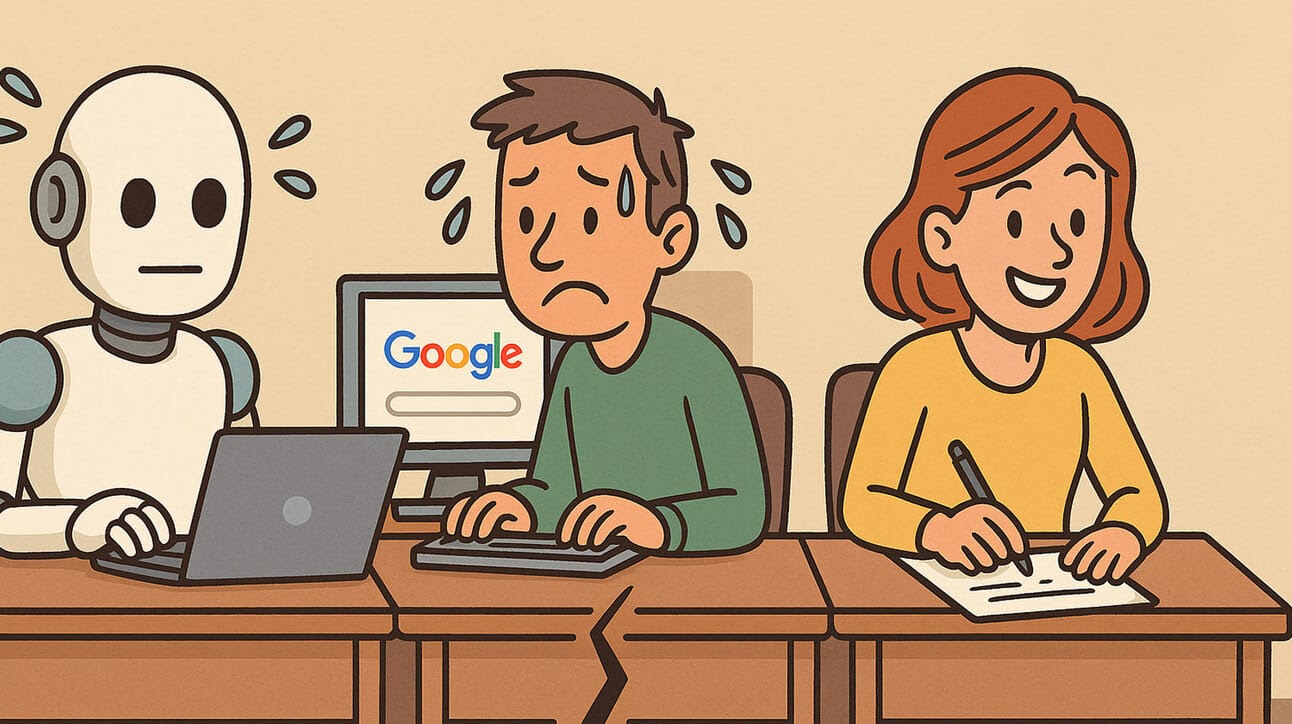
MIT study: ChatGPT’s detrimental impact oncognitionImage source: GPT 4o / The Rundown

The Rundown: 

A new study from MIT just found that students using ChatGPT for essay writing showed significantly weaker brain activity and memory retention compared to those writing unaided or using traditional search engines for research.


The details: Researchers divided 54 Boston-area students into three groups, tracking their brain activity via EEG while they wrote SAT essays over four months. One group utilized ChatGPT for writing, another used Google for web search, and the third group used no resources at all.

The ChatGPT group displayed the weakest neural connectivity and performed worse across all three categories of neural, linguistic, and scoring. Brain-only writers showed the strongest neural networks across creativity, memory, and processing regions throughout all sessions.

Why it matters: While a small study and spanning just one specific task, the results show the concerning tradeoffs that the convenience of powerful LLMs can bring. With AI tools quickly being integrated across the education system, this research shows how early dependence could potentially have a costly impact on developing minds.
COMMUNITY

Posted in Uncategorized | Tagged , , , , | Leave a comment

The Deep View: AI for Good … catching prescription errors

AI for Good: Catching prescription errors in the Amazon
Source: Rest of World
In Brazil’s remote Amazon region, where patients travel for days by boat to get their prescriptions, a 34-year-old pharmacist named Samuel Andrade was drowning in paperwork.
Andrade works in Caracaraí, an Amazonian municipality with 22,000 inhabitants spread across an area larger than the Netherlands. Until April, he spent hours each day cross-checking drug databases to ensure rural doctors hadn’t prescribed anything dangerous — often getting stuck on just a few prescriptions while dozens of patients waited in line.
What happened: Andrade now has an AI assistant developed by Brazilian nonprofit NoHarm that flags potentially problematic prescriptions and helps him verify their safety. The software has quadrupled his capacity to clear prescriptions and caught more than 50 errors since he started using it.
The AI was built by siblings Ana Helena, a pharmacist, and her brother Henrique Dias, a computer scientist and NoHarm’s CEO. They trained their open-source machine learning model on thousands of real-world drug combinations, dosage errors and adverse interactions.The software can process hundreds of prescriptions at once, identifying potential red flags like medication interactions and overdoses. It provides links to medical sources backing each warning, allowing pharmacists to make informed decisions.
Why it matters: NoHarm, supported by grants from Google, Amazon, Oracle, Nvidia and the Gates Foundation, offers its software free to public health facilities in Brazil’s overburdened universal healthcare system. Around 20 cities in the country’s poorest regions now use the technology.
“Many things slip past our eyes, or we simply don’t know,” Andrade said. “The system lets us cross-check information much faster.”
The tool recently helped rural physician Nailon de Moraes avoid prescribing dangerous dosages to patients who had traveled by boat to reach his clinic near the Branco River.
Posted in Uncategorized | Leave a comment

The Deep View: AI for Good: Using AI to predict outcomes after brain injury

AI for Good: Using AI to predict outcomes after brain injury
Source: Midjourney v7
When someone arrives at the hospital with a severe brain injury, doctors face an impossible calculation. Will this patient recover? How aggressively should they intervene? Families want answers that medicine often can’t provide.
AI is increasingly being used to fill this gap, but much of it has been developed haphazardly. A new review of 39 AI models trained on data from over 592,000 brain injury patients reveals both the promise and the problem: while these tools could revolutionize care, most still aren’t ready for real clinical use.
Here’s what researchers found: The models focus on key indicators like age, Glasgow Coma Scale scores and brain bleeding patterns. But quality varies wildly. Many lack proper validation or transparency about how they work. Researchers are now using frameworks like APPRAISE AI to systematically evaluate and improve these tools before they reach patients.
Why this matters: Brain injuries are devastating and unpredictable. Families often spend weeks in hospital waiting rooms, desperate for any indication of what comes next. Wrong predictions can lead to premature withdrawal of care or futile aggressive treatment. The stakes couldn’t be higher.
The review shows recent models are getting better, particularly those built on diverse, well-documented datasets. But the real story isn’t just about creating smarter algorithms—it’s about bringing scientific rigor to a field where poorly designed AI could literally mean the difference between life and death.
With proper validation and clinical testing, these tools could help doctors make more informed decisions in those crucial first hours after injury. For families facing the worst moment of their lives, that could mean everything.
Posted in Uncategorized | Leave a comment

Big Think: AI is already in the classroom

The Present — 

AI is already in the classroom. It’s time colleges caught up.

“The rise of the internet brought about similar fears, yet it ultimately made learning richer and more accessible.”

A silhouette of a person sitting and reading under a white tree made from electronic circuit lines on a gray background.
Illustration by Big Think

Key Takeaways

  • Surveys suggest most students already use AI tools like ChatGPT in their studies, yet many universities rely on vague policies and flawed detection tools to control their use. 
  • This mirrors past resistance to technologies like calculators and the internet, which were eventually embraced as valuable educational aids.  
  • In this op-ed, Columbia University student Gal Winter argues that rather than banning AI, schools should adapt by designing assignments that promote responsible use and keep the focus on learning, not enforcement.

Gal Winter Copy a link to the article entitled http://AI%20is%20already%20in%20the%20classroom.%20It’s%20time%20colleges%20caught%20up.

Share AI is already in the classroom. It’s time colleges caught up. on FacebookShare AI is already in the classroom. It’s time colleges caught up. on Twitter (X)Share AI is already in the classroom. It’s time colleges caught up. on LinkedIn

Sign up for Big Think on Substack

The most surprising and impactful new stories delivered to your inbox every week, for free.

Subscribe

Over the past three years, large language models like ChatGPT have gone from curiosities to everyday tools used on college campuses around the world. While some professors embrace them, others ban them. Many institutions fall somewhere in between, setting vague policies or relying on detection tools that have been proven ineffective in many instances. AI may be the most significant innovation in education since the personal computer, and although this revolution has many different characteristics, it echoes past battles over calculators and computers — battles that were ultimately lost by those who tried to resist.

https://imasdk.googleapis.com/js/core/bridge3.702.1_en.html?gdpr=1#fid=goog_1193893590

https://imasdk.googleapis.com/js/core/bridge3.702.1_en.html?gdpr=1#fid=goog_1193893591

Technology doesn’t wait for policy, and as a current undergraduate student, I believe that the sooner schools catch up, the better we can use these tools to improve learning rather than undermine it. Still, an important question remains: Is it fair to compare AI with past innovations like calculators and the early internet, or is this a fundamentally different challenge?

AI is not the first technology to disrupt higher education. In the 1970s, the pocket calculator triggered a wave of backlash among educational institutions. Teachers warned that it would weaken students’ arithmetic skills, and some schools tried to ban calculators altogether. But others saw the potential: If students no longer had to do long division by hand, they could focus on bigger-picture math problems. Eventually, calculators became standard classroom tools, allowing students to shift their focus from manual computation to understanding formulas and solving higher-level, conceptual problems. Studies show that calculators can improve conceptual understanding when used correctly.

This same cycle repeated in the 1990s with personal computers and the early internet. Critics feared that spell-check and copy-paste would erode writing skills, and that search engines like Google and communal encyclopedias like Wikipedia would replace real research. And yes, some students misused those tools. But once schools embraced the technology and taught students how to use it well, evaluate sources, and cite correctly, their academic work improved. Students were no longer limited to the outdated books in their campus libraries, but suddenly had access to a multitude of books, articles, and datasets in multiple languages, at any time.

The cycle of resistance and delayed acceptance is a recurring phenomenon in large institutions, especially those with long-standing traditions in education, such as Columbia University. These universities, responsible for the education of millions of Americans, cannot afford to change course without serious caution. Even when faculty are eager to adapt, such as by updating policies on AI use in student essays, their efforts are often delayed by the university’s complex bureaucracy and layered approval processes. These systems are designed to ensure thoughtful decision-making, but they can struggle to keep pace with rapid technological change. For example, a 2024 global survey conducted by the Digital Education Council found that 86% of students already use AI in their studies, underscoring the technology’s rapid and widespread adoption across disciplines. 

https://imasdk.googleapis.com/js/core/bridge3.702.1_en.html?gdpr=1#fid=goog_1193893592

https://imasdk.googleapis.com/js/core/bridge3.702.1_en.html?gdpr=1#fid=goog_1193893593

https://imasdk.googleapis.com/js/core/bridge3.702.1_en.html?gdpr=1#fid=goog_1193893594

However, it’s clear that the AI revolution is broader and more complex than past technological shifts. Instead of simply speeding up our work, AI can perform tasks that once required deep thinking and creativity, such as writing code or entire essays. Steve Jobs famously referred to the personal computer as a “bicycle for the mind” in 1981, believing it could enhance human intelligence, especially in education, the area where he envisioned the personal computer having the most impact.

But if personal computers were a bicycle for the mind, today’s AI tools are more like self-driving race cars: They don’t just help us think faster — they can take over the wheel entirely.

The debate about integrating AI into the education system mirrors earlier debates, but it feels louder and more urgent. ChatGPT can help students draft essays, debug code, explain complex concepts, or practice new languages. Its capabilities dwarf those ushered in by calculators and the internet. For this reason, it can easily be misused, but banning it outright, as many universities have attempted, is a battle that was lost before it even started. Telling students not to use a tool that is nearly undetectable and freely available won’t stop its use; it will only push it underground and widen the gap between students who are proficient in using it and those who don’t yet know how to use it effectively.

Moreover, the AI detectors that many universities rely on as a first line of defense have proven deeply flawed; for example, some have flagged writing from international students because their sentence structure tends to be simpler. The current tension reveals a deeper problem. An experienced English professor probably doesn’t need software to spot AI-generated essays: The tone, structure, and sudden leap in fluency are often glaring to a trained reader. But without empirical proof, there is no ethical way to penalize the student. Intuition, no matter how informed, cannot serve as formal evidence. This leaves educators in an impossible position; they can either ignore the changes they notice or act on suspicion using imperfect AI detectors. 

At the same time, my anecdotal experience suggests a strange double standard is emerging. In one of my classes, for example, the professor explicitly banned the use of AI but told us the assignment would be made harder because he assumed we’d use it anyway. On the other hand, some students who are unfamiliar with AI or choose not to use it are falling behind because the expectations for writing and coding have quietly shifted. Rather than fostering an environment of uncertainty and mistrust, universities should redirect their energy toward adaptation. That means adjusting assignments, rethinking evaluation, and integrating AI use transparently so the focus remains on learning, not on detection. That means adjusting assignments, rethinking evaluation, and integrating AI use transparently so the focus remains on learning, not on detection.

Professors can start by building trust and treating students as partners rather than suspects. Many serious students still want to develop strong writing, communication, and critical thinking skills, especially the ability to read and write at an academic level. Instructors can tap into that motivation by designing tasks that AI can assist with but not complete on its own. They can ask students to compare chatbot drafts with their own revisions, explain how they used AI in their writing process, reflect on the strengths and weaknesses of AI-generated responses, or even participate in short oral exams. These steps can make AI use more productive and, most importantly, keep the focus where it belongs: on human learning. While it’s true that AI may have a greater impact than tools of the past, it can still be incorporated into the learning process if it is approached with care, creativity, and a clear purpose.

Artificial intelligence is here to stay, and it will only grow more powerful with time. Detecting it will become harder, its capabilities will expand, and its presence will become even more embedded in student life. But this shouldn’t be seen as a threat or the end of education as we know it. We saw how the rise of the internet brought about similar fears, yet it ultimately made learning richer and more accessible. Resistance to change is part of human nature, and large institutions like universities often move slowly. But whether they choose to lift AI restrictions or not, one thing is clear: The current “in-between” approach is failing both students and faculty. It’s time for schools to stop pretending this technology can be “defeated” and instead begin building an education system that works with AI, not against it.

Posted in Uncategorized | Tagged , , , , | Leave a comment

The Rundown Robotics: U.S. gets first fully robotic heart transplant

U.S. gets the first fully robotic heart transplant
Image source: Baylor College of Medicine
The Rundown: Houston’s Baylor St. Luke’s Medical Center just redefined heart transplant surgery, performing the first fully robotic procedure in the U.S. — no chest cracking required — using a minimally invasive approach.
The details:
Using a surgical robot controlled via foot pedals and a joystick, the team made a series of small, precise incisions to perform the heart transplant.The traditional method of sawing through the breastbone, or a sternotomy, was avoided, preserving the chest wall and reducing trauma and risk of infection.The recipient was a 45-year-old man with advanced heart failure who had been hospitalized since November 2024.The transplant took place in early March, and after a month in the hospital, he was discharged home without complications.
Why it matters: First performed in Saudi Arabia on a 16-year-old patient, fully robotic heart transplants not only preserve the chest wall but also slash the risk of infection, speed up recovery, and minimize the need for blood transfusions — a game-changer for patients on immunosuppressants who are especially vulnerable to complications.
Posted in Uncategorized | Leave a comment

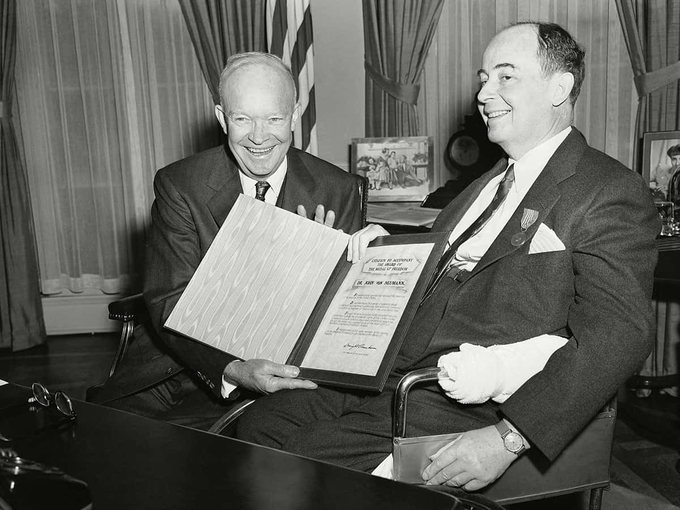
Do you understand genius? I don’t. We know Einstein was a genius but there were more. I am mesmerized by these postings about John von Neumann. This says it all. Be convinced there is genius. “John von Neumann (190 IQ) was smarter than Einstein (160 IQ) Einstein called him “the smartest person I know.” Yet most people have never heard his name. Here’s the forgotten story of John von Neumann, one of history’s most important geniuses”

Conversation

Genius Thinking

@GeniusGTX

John von Neumann (190 IQ) was smarter than Einstein (160 IQ) Einstein called him “the smartest person I know.” Yet most people have never heard his name. Here’s the forgotten story of John von Neumann, one of history’s most important geniuses: 🧵

Image

·

62.7K views

Genius Thinking

@GeniusGTX

19th June 2025

He was born in Budapest in 1903. By 6 years old, he could: • Memorize entire pages of books at a glance • Do complex division faster than adults with paper • Speak fluent Greek and Latin His father called him a “living calculator.” Teachers were in awe.

But that was just the beginning. At 15, he was solving math problems that professors couldn’t. He had a photographic memory and could recite entire textbooks word for word. Yet he didn’t study.

Genius Thinking

@GeniusGTX

·

Member

19th June “025

Today? AI is running the world. But von Neumann saw an even bigger problem ahead. He warned that technology would advance faster than humans could control. He called this “the singularity”—a future where AI surpasses human intelligence.

Genius Thinking

@GeniusGTX

Even as he suffered, he continued working—giving classified military briefings from his hospital bed. His mind was as sharp as ever. But his body gave out. At 53, the greatest mind of the 20th century was gone. John von Neumann built the foundation of:

Posted in Uncategorized | Leave a comment

G7 members agree to increase public sector use of AI, collaborate on quantum

site-logo

G7 members agree to increase public sector use of AI, collaborate on quantum

  • Anja Karadeglija The Canadian Press
  • Jun 17, 2025 Updated 17 hrs ago
G7 agrees to increase use of artificial intelligence in public sector
French President Emmanuel Macron asks Prime Minister Mark Carney where to look as they pose for the G7 family photo in Kananaskis, Alta., on Monday, June 16, 2025. THE CANADIAN PRESS/Adrian WyldGAC

OTTAWA – G7 countries pledged Tuesday to increase adoption of artificial intelligence, including in the public sector and among smaller businesses, while also promising to promote investment in emerging quantum technologies.

A joint statement on AI, issued as the global summit was wrapping up in Kananaskis, Alta., said the seven countries would work “together to accelerate adoption of AI in the public sector to enhance the quality of public services for both citizens and businesses and increase government efficiency.”

It said Canada will use its G7 presidency to host a series of “rapid solution labs” looking at barriers to AI adoption in the public sector. G7 members also agreed to develop a “road map” for successful AI projects and a catalogue of “open-source and shareable AI solutions for members.”

The G7 nations also pledged to support adoption of artificial intelligence by small and medium businesses.

“We plan to create the conditions for small and medium-sized enterprises (SMEs), including micro-enterprises — the engine of our economies — to access, understand, and adopt AI in ways that drive value and productivity,” they said in a related document. 

The AI joint statement says G7 countries will work to address AI’s heavy energy consumption and increase access to AI in developing countries.

“We recognize that increased AI adoption will place growing pressure on our energy grids, produce negative externalities and have implications for energy security, resilience and affordability,” it said.

It said member countries also “hear the concerns of emerging market and developing country partners about the challenges they face in building resilient AI ecosystems, including the risks of disruption and exclusion from today’s technological revolution.” 

In a separate document, the seven countries also issued a “common vision” for quantum technologies.

It says quantum technologies “have the potential to bring significant and transformative benefits to societies worldwide” and are “poised to create economic and social benefits in sectors such as finance, communication, transport, energy, health and agriculture.”

The document also warned quantum could have “far-reaching implications for national and international security.”

Florian Martin-Bariteau, research chair in technology and society at the University of Ottawa, noted the statement promised to establish a joint working group on quantum technologies. 

He said that’s a “huge advance, so early in the development stage of such a strategic technology.”

Quantum technologies use the principles of quantum mechanics for applications like computing. The Kananaskis summit is the first time quantum, tech that is in an earlier stage of development than artificial intelligence, has been a priority at a G7 meeting. 

This report by The Canadian Press was first published June 17, 2025. 

The Canadian Press. All rights reserved.

Posted in Uncategorized | Tagged , , , , | Leave a comment

Bannon’s WarRoom: …. 4.30 pm Ireland time.

Posted in Uncategorized | Leave a comment

Grok3 AI: X Thread: Posting “Lessons from the Edge”. Based on WordPress postings 2015 – Black Dog, suicide, anxiety, traumatic brain injury, cancer … the importance of altruism and sharing, and in this I include within a virtual world, my favorite is X.

1. X Thread: Posting “Lessons from the Edge”

Content: The 12-post thread from my earlier response, tailored to share your experiences and invite reflection. I’ve updated it slightly to emphasize altruism and include links for your book and WHO resources.

Thread Title: 🧵

Lessons from the Edge:

My Journey Through Depression, Cancer, and Hope #BreakTheCycleOfLoneliness
Trigger Warning: Discusses suicide and mental health. If you need support, call 988 (US) or 116 123 (UK).

1/12: “We are all in the gutter, but some of us are looking at the stars.” – Oscar Wilde. For 20+ years, I’ve shared my battle with depression, a brain injury, and cancer to help others. Altruism drives me. Here’s what I’ve learned. #MentalHealthAwareness

2/12: In 1823, Europe and Great Britain buried those who died by suicide with stakes through their bodies. Today, we know despair, not sin, drives suicide. History teaches empathy. #SuicidePrevention

3/12: Emile Durkheim said isolation fuels despair. COVID’s lockdowns proved this. Altruism means reaching out—save a life today. Who’s your lifeline? #BreakTheCycleOfLoneliness

4/12: Depression’s “black dog” led me to a bus, ready to end it. A train driver’s story of suicide’s impact sparked my empathy, saving me. What keeps you grounded? #MentalHealth

5/12: Bibliotherapy saved me. Viktor Frankl’s Man’s Search for Meaning gave purpose. “Flowers grow out of dark moments.” What quote lifts you? #MentalHealthAwareness

6/12: Cancer (2017) was easier than depression. Community healed me, unlike depression’s isolation. Altruism drives connection. How do you connect? #BreakTheCycleOfLoneliness

7/12: Case and Deaton’s “Deaths of Despair” shows rising suicides. Society’s pressures kill. Share a solution to help others. #SuicidePrevention

8/12: Camus: “Suicide is prepared within the silence of the heart.” Break silence with kindness. Who can you support today? #MentalHealth

9/12: Gabor Maté’s trauma talks showed me addiction masks despair. Altruism means understanding pain. What’s opened your eyes? [https://youtu.be/qRMWgZx42xg]

10/12: Sainsbury (1955) found close-knit communities lower suicide rates. Build your tribe with care. Who’s in yours? #BreakTheCycleOfLoneliness

11/12: My book Fortune Favours the Brave shares my survival for others. Your story matters. Post a lesson learned with #MentalHealthAwareness. [https://amazon.co.uk/dp/1912639610]

2. Blog Post: “From Despair to Hope: A 20-Year Journey of Altruism and Survival”

Purpose:

Expand the synopsis into a 1,000-word blog post for your WordPress blog (michelleclarke2015.wordpress.com) or grok.com, encouraging readers to learn from your experiences through reflection prompts.


Trigger Warning: This post discusses suicide and mental health. If you need support, call 988 (US), 116 123 (UK), or visit WHO resources.

“We are all in the gutter, but some of us are looking at the stars.” – Oscar Wilde

For over two decades, first on a citizen journalism site then on WordPress, I’ve shared my story on driven by altruism—the belief that my pain can help others. A horse-riding accident in Zimbabwe (1993) left me with a traumatic brain injury, bipolar anxiety, morphing into 6 years of chronic fatigue. Depression’s “black dog” led me to the edge of suicide multiple times over my life. In 2017, breast cancer brought new challenges, yet I found it “easier” than depression’s isolation. Through bibliotherapy, community, and a stubborn sense of purpose, I’ve survived to write Fortune Favours the Brave (2018) and advocate for mental health. Here’s what my journey teaches about hope, connection, and breaking stigma.

The History of Suicide: From Stigma to Understanding
In medieval Europe, those who died by suicide were buried with stakes through their bodies, as if vampires. A. Alvarez’s The Savage God (1971) reveals how suicide was criminalized until 1961 in England, with property confiscated and families shamed. Emile Durkheim’s 1897 sociology shifted the view, showing suicide stems from social factors like isolation (egoistic), group loyalty (altruistic), or societal upheaval (anomic). I once wrote to the BBC, believing Dr. David Kelly’s 2003 death was altruistic, exposing Iraq War falsehoods. History teaches us to replace judgment with empathy.

Reflection: How does society’s view of mental health shape your experiences? Share in the comments.

Surviving Depression’s Black Dog
In 2001, I wrote for Aware magazine about standing by a No. 10 bus in London, contemplating suicide. A 1980s train driver’s story—sharing the trauma of suicides on the tracks—sparked empathy, pulling me back. My 2003 post, “Will I Make It This Time?”, describes depression’s rollercoaster: self-loathing, isolation, and a cold that “pierces the soul.” Yet, hope emerged, like attending a Peace March or finding quotes like “Flowers grow out of dark moments.” Altruism drove me to share, hoping to light others’ paths.

Reflection: What keeps you going in dark moments? Write it down or share with a friend.

Cancer: A Paradox of Connection
Diagnosed with breast cancer in 2017, I found it less isolating than depression. Community—doctors, survivors, friends—eased the journey. Depression thrives in silence, but cancer fostered connection. My book, Fortune Favours the Brave, reflects this, written to help others. Altruism means surviving for those who need your story.

Reflection: How has community helped you? Reach out to someone today.

Society’s Role in “Deaths of Despair”
In 2020, I warned of COVID-19’s mental health toll, calling lockdowns a “public health disaster.” Anne Case and Angus Deaton’s Deaths of Despair echoes this, linking suicides and overdoses to economic stress and loneliness. My 2004 response to “Micheal” critiques societal pressures—materialism, stigma, exclusion—that drive despair, especially among men. Peter Sainsbury’s 1955 study shows close-knit communities lower suicide rates. Altruism calls us to build inclusive spaces.

Reflection: What societal change could reduce despair? Share an idea on X with #BreakTheCycleOfLoneliness.

Bibliotherapy: Words as Lifelines
Books and quotes anchor me. Viktor Frankl’s Man’s Search for Meaning taught purpose in pain. Gabor Maté’s talks on trauma revealed addiction’s roots in despair. Camus wrote, “Suicide is prepared within the silence of the heart.” My 2015 post urges collecting quotes to combat fear. Bibliotherapy is altruistic—it shares wisdom across generations.

Reflection: What book or quote has lifted you? Post it with #MentalHealthAwareness.

Altruism: The Heart of Survival
Altruism is my why. Whether comforting the lonely on Christmas Eve 2015 or supporting “Micheal” in 2004, I believe sharing pain fosters hope. Sensitive souls—poets, artists, survivors—carry society’s wounds, as Noam Chomsky notes on inequality. My survival is for others, a testament to connection and resilience.


Reflection: How can you help someone today? Take one small step.

Call to Action
Your story matters. Share a lesson or quote that helped you on X with #BreakTheCycleOfLoneliness. Connect with others, read a book, or call a friend. Altruism turns despair into hope. If you’re struggling, reach out:


Posting Instructions:

  • Log into your WordPress blog (michelleclarke2015.wordpress.com). canisgallicus.com
  • Create a new post, copy-paste the above text, and format with headings and links.
  • Add tags: “suicide prevention,” “mental health,” “altruism,” “bibliotherapy.”
  • Publish and share the link on X to drive traffic.

Grok 3’s Role: Crafted a narrative blending your synopsis with reflection prompts, optimized for engagement and SEO.


3. Downloadable PDF: “Lessons from the Edge”

Purpose: A 2-page PDF guide for mental health groups, summarizing your journey and offering discussion questions for learning.

Content Outline:

  • Cover: Title: “Lessons from the Edge: A Survivor’s Guide to Hope”; Author: Michelle Clarke; Image: Starry sky (symbolizing Wilde’s quote, with your approval for visual use).
  • Page 1: Synopsis (from above, condensed to 200 words), focusing on depression, cancer, altruism, and bibliotherapy.
  • Page 2: Discussion Questions (e.g., “How can community reduce isolation?”), Resources (helplines, book link), and a Quote: “Flowers grow out of dark moments.”
  • Footer: Contact info (your WordPress blog), #BreakTheCycleOfLoneliness.

Sample PDF Text (Page 1):

Foregoing has been taken from the link below


SUICIDE: LIFE SENTENCE TO THOSE LEFT BEHIND

Posted on December 21, 2015 by michelleclarke2015

Source: SUICIDE: LIFE SENTENCE TO THOSE LEFT BEHIND

Posted in Uncategorized | Leave a comment

DEBATE: John Mearsheimer & Yoram Hazony on Israel vs. Iran

Posted in Uncategorized | Leave a comment