Grok 4 AI: Memo by Michael Comyn with enclosure 7.1.1924. Letter, 8.3.1924, to R. Barton from Sean T. O’ Ceallaigh , with enclosure entitled “Labour & our Economic Programme”. March 2026. Recommend Grokipedia search Michael Comyn

Can you place following in context? Bureau of Military History Appendix to C.D. Register Individual documents included in collections Page 435C.D. 20. Name of Donor Leopold H. Kerney Group 55 ECONOMIC PROPOSALS 1924. Memo by Michael Comyn with enclosure 7.1.1924. Letter, 8.3.1924, to R. Barton from Sean T. 0’Ceallaigh , with enclosure entitled “Labour & our Economic Programme”. Letter, 13.3.1924, from Maire Nic Shuibhne (Mary MacSwiney) expressing appreciation and thanks on behalf of Comhairle na dTeactai for Economic Programme. Economic Programme o f Sinn Fein , undated – 2 copies. Poblacht na hSireann – Democratic Programme – undated. “The National Aspirations of the Irish People” presented by the delegates of the workers of Ireland to the “International” . Memo by Countess Markievicz on the Democratic Programme. Fiscal Power of the Irish Free State – undated, unsigned. A “Labour Policy ” for the Irish State – undated, unsigned.

Michael Comyn KC (1871–1952) was an Irish barrister, republican activist, and politician born in Ballyvaughan, County Clare. He played a significant role in the Irish independence movement, particularly through his involvement with Sinn Féin during and after the War of Independence (1919–1921). Comyn was instrumental in establishing the Dáil Courts, the republican judicial system that operated parallel to British courts, including setting up one of the first such courts in Ballinrobe, South Mayo, in 1919. He stood as a Sinn Féin candidate in elections, served as a Fianna Fáil Senator from 1928 to 1936, and later became a Circuit Court judge. Known for his commitment to Irish nationalism, he also had diverse interests, including prospecting and legal cases tied to republican causes, such as the Clifford and O’Sullivan land dispute.

2 sources

The excerpt you provided appears to be a direct transcription from the Appendix to the Contemporary Documents (C.D.) Register of Ireland’s Bureau of Military History (BMH), specifically from page 435 under C.D. 264 (not C.D. 20, which may be a minor transcription error). The BMH was established in 1947 by the Irish government to collect oral histories, witness statements, and original documents related to the revolutionary period from 1913 to 1921, though some materials extend into the early 1920s. The Contemporary Documents series preserves primary sources like letters, memos, and programs from that era, organized into collections (C.D. numbers) donated by participants or their families. This particular entry falls under Group 55, titled “ECONOMIC PROPOSALS 1924,” within the collection donated by Robert C. Barton (a prominent republican and former Minister for Economic Affairs in the First Dáil), not Leopold H. Kerney (who donated other groups in the BMH, such as materials on his diplomatic work in Paris).

3 sources

Historical Context: This group of documents dates to early 1924, a pivotal time in post-independence Ireland following the Anglo-Irish Treaty (1921), the establishment of the Irish Free State (1922), and the bitter Civil War (1922–1923) between pro-Treaty forces (who formed Cumann na nGaedheal) and anti-Treaty republicans (led by Sinn Féin under Éamon de Valera). The Civil War had ended in May 1923 with a ceasefire, leaving anti-Treaty Sinn Féin in opposition, boycotting the Free State Dáil, and focused on rebuilding its platform. Economic policy became a key battleground, as republicans sought to critique the Free State’s conservative fiscal approach and propose alternatives emphasizing protectionism, self-sufficiency, and social justice to appeal to workers, farmers, and nationalists.

3 sources

Sinn Féin released its official “Economic Programme” in March 1924, a pamphlet outlining policies like tariffs on imports, state support for industries, land redistribution, and labor rights. It drew on earlier revolutionary ideals, such as the 1919 Democratic Programme of the First Dáil (a socialist-leaning manifesto promising economic equality and resource control for the Irish people). The 1924 proposals were part of a broader effort to reposition Sinn Féin as a viable alternative to the Free State government, though they were criticized as vague and incomplete, focusing more on rhetoric than detailed implementation.

2 sources

The documents in Group 55 reflect internal discussions and contributions to this program:

  • Memo by Michael Comyn with enclosure (7 January 1924): Comyn, leveraging his legal and republican background, likely offered insights on economic or fiscal matters, possibly drawing from his experience in republican governance or land issues (given his involvement in agrarian disputes).
  • Letter to R. Barton from Seán T. O’Ceallaigh (8 March 1924), with enclosure “Labour & our Economic Programme”: O’Ceallaigh (later President of Ireland, 1945–1959) was a key Sinn Féin diplomat. The letter to Barton (who had resigned as Treaty signatory and joined the anti-Treaty side) enclosed labor-focused proposals, highlighting efforts to integrate workers’ rights into the republican agenda.
  • Letter from Máire Nic Shuibhne (Mary MacSwiney) (13 March 1924): MacSwiney, a staunch republican and sister of hunger striker Terence MacSwiney, thanked the Comhairle na dTeachtaí (Sinn Féin executive) for the program, underscoring party unity.
  • Economic Programme of Sinn Féin (undated, 2 copies): Likely drafts or copies of the March 1924 pamphlet.
  • Poblacht na hÉireann – Democratic Programme (undated): A reference to the 1919 Dáil’s foundational document, emphasizing sovereignty and economic democracy.
  • “The National Aspirations of the Irish People”: A labor delegation’s statement to international bodies, linking Irish independence to workers’ global struggles.
  • Memo by Countess Markievicz on the Democratic Programme: Constance Markievicz, revolutionary and first female cabinet minister (Labour in the Dáil), commented on updating the 1919 program.
  • Fiscal Power of the Irish Free State (undated, unsigned): Analyzed the Free State’s limited economic autonomy under the Treaty.
  • A “Labour Policy” for the Irish State (undated, unsigned): Proposed policies for workers in an independent Ireland.

These materials were preserved by Barton, who as a former economic minister collected them during policy formulation. They illustrate Sinn Féin’s attempt to blend nationalism with economic radicalism in a fractured post-Civil War landscape, though the party struggled with organization and electoral success until de Valera’s split to form Fianna Fáil in 1926.

2 sources

Comyn’s involvement fits his profile as a Sinn Féin supporter active in the 1920s, contributing to policy amid ongoing republican debates. If you’d like more details on specific documents (many BMH items are digitized online) or Comyn’s other activities, let me know!

47 web pages

Quick Answer
Posted in Uncategorized | Tagged , , , | Leave a comment

Grok 4 AI: JSTOR … reference to Michael Comyn KC. Judge David Foxton Sinn Fein Courts and Revolutionary lawyers, places him in context of Anglo-Irish Treaty

Yes, I am Grok 4, built by xAI.

Great. Question for you. JStor mentions Michael Comyn KC as follows. Can you expand? Books Ireland 2008 page 18. General Macready who confirmed the capital court martial verdicts, usually with Cabinet approval. Prominent among the defence lawyers in the intimidating barracks atmosphere or in the higher courts were Eamon Duggan, George Gavan Duffy and Michael Comyn KC. Duggan and Gavan Duffy were signatories to the 1921 Anglo-Irish Treaty (the latter reluctantly) and both Duffy and Comyn later broke with the Free State Government because of the far more drastic military sentencing policy in place during the Civil War. Foxton’s excellent study demonstrates the central concepts of British liberty – the ‘rule of law’ and ‘questions in the House’ enabled Irish lawyers to play the system and disapproval of violence notwithstanding, save the lives of some of their country men.

Michael Comyn KC (1871–1952) was a prominent Irish barrister, nationalist, and politician who played a significant role in defending Irish republicans during the War of Independence and the subsequent Civil War. The mention in Books Ireland (2008, p. 181) appears in a review of David Foxton’s book Revolutionary Lawyers: Sinn Féin and Crown Courts in Ireland and Britain, 1916–1923, which examines how Irish lawyers navigated British legal systems to challenge court-martial verdicts and save lives amid the conflict.

In that context, Comyn is highlighted alongside Éamon Duggan and George Gavan Duffy as key defense counsel operating in tense military settings, often securing reprieves through appeals to British legal principles like the “rule of law.” The review notes that Duggan and Duffy signed the 1921 Anglo-Irish Treaty, while both Duffy and Comyn later distanced themselves from the Irish Free State government due to its harsh sentencing during the Civil War—policies that included summary executions without trial, which Comyn publicly condemned as unjust.

Early Life and Education

Born on June 6, 1871, in Clareville, Ballyvaughan, County Clare, Michael Comyn was the eldest son and second of seven children of James Comyn, a farmer and local leader in the Irish National Land League, and his wife (whose name is not widely detailed in sources). The family faced eviction in 1879 due to land disputes, relocating within County Clare. Comyn received his early education at local national schools, including one focused on preparing students for civil service exams.

At age 19, he passed a competitive exam to become an excise officer—one of only 50 selected from 2,500 applicants—and served in Dublin and England. While working, he pursued legal studies at University College Dublin and King’s Inns, earning the prestigious Victoria Prize in 1898, which supported his education. He was called to the Irish Bar that same year and quickly rose in prominence, being appointed King’s Counsel (KC) in 1914, marking him as a senior barrister.

Legal Career and Role in Irish Independence

Comyn’s legal career was deeply intertwined with Irish nationalism. He was in the United States during the 1916 Easter Rising but returned to Ireland afterward, becoming a leading defender of republican prisoners in British courts and military tribunals. His work often involved high-stakes appeals, including arguments before the House of Lords in London. Notably, no republican prisoner he defended during the War of Independence was executed, a testament to his skillful use of British legal precedents to challenge military jurisdiction.

One of his most famous cases was In re Clifford and O’Sullivan (1921), where he represented two men—among a group of 42 arrested near Mitchelstown, County Cork, and sentenced to death by a British military court for possessing arms. Comyn sought a writ of prohibition, arguing that the tribunal lacked proper judicial authority under martial law. The case advanced through the Irish Chancery Division and Court of Appeal before reaching the House of Lords, where it was ultimately dismissed on July 28, 1921, as the Lords ruled that prohibition did not apply to non-judicial bodies like military courts. Despite the loss, the case set important legal precedents on military powers and extraordinary remedies, and it’s believed the publicity and delays contributed to King George V’s intervention, leading to the commutation of the sentences and aiding the path to the Anglo-Irish Treaty. Comyn collaborated with figures like Sir John Simon KC in this effort.

Comyn also assisted suffragette Georgina Frost in her landmark legal battle for women’s rights and investigated suspicious deaths during the conflict, such as those of Cathal Brugha and Harry Boland. This aligns with the Books Ireland reference to lawyers “playing the system” to save lives, even as they disapproved of violence, by leveraging parliamentary questions and legal appeals.

Civil War and Break with the Free State

During the Irish Civil War (1922–1923), Comyn continued defending anti-Treaty republicans, including Erskine Childers, an English-born republican executed in November 1922 despite an ongoing habeas corpus appeal. Comyn denounced the execution as “a complete negation of justice,” reflecting his growing disillusionment with the Free State’s emergency powers, which included military tribunals far more severe than those under British rule. This stance led to his break with the government, as noted in the Books Ireland piece.

Political Career and Later Life

Post-Civil War, Comyn became a close legal advisor to Éamon de Valera, helping found the Fianna Fáil party in 1926 and establishing The Irish Press newspaper. He was elected to the Seanad Éireann (Irish Senate) in 1928 as a Fianna Fáil member, serving until 1936 and acting as vice-chairman from 1934 to 1936. Known for his debating prowess and dedication, he stepped down in 1936 to accept an appointment as a judge on the Eastern Circuit Court.

Comyn married Marcella Margaret Blake-Forster (1894–1961) in 1920; they met during his unsuccessful Sinn Féin election campaign in County Clare. The couple had family ties to other legal and nationalist figures, including Comyn’s nephew, Sir James Comyn, a noted English judge.

He passed away on October 6, 1952, in County Clare, at age 81.

Overall, Comyn’s legacy lies in his strategic use of law to protect nationalists during a volatile era, embodying the tensions between British imperial justice and Irish self-determination, as Foxton’s study illustrates.

14 web pages

Posted in Uncategorized | Tagged , , , , | Leave a comment

Grok4 AI: Sr (Dr) Maura O’Donohue, a remarkable woman who worked as a missionary nun for over 5 decades

Sr Maura O’Donoghue (O’Donohue) was indeed a pioneering figure in highlighting the sexual abuse of nuns by priests, making her one of the first women to formally bring such vulnerabilities to the Vatican’s attention through a detailed report in the 1990s. Her work, rooted in decades of missionary service, exposed systemic issues tied to power imbalances, cultural contexts, and health crises like the AIDS epidemic.

Below, I’ll provide additional details on her life, the report, its impact, and related developments, building directly on the article you shared (which appears to be from Patsy McGarry’s 2019 piece in The Irish Times). I’ll integrate expansions where relevant, drawing from historical accounts, media reports, and contextual updates to enrich the narrative without repeating the core text verbatim.

Expanded Background on Sr Maura O’Donoghue

Born in the 1930s in Kilfenora, Co Clare, Ireland, Maura O’Donoghue was one of four children in a family with strong ties to Irish independence—her father, Andrew, led the North Clare IRA Brigade during the War of Independence. After secondary school in Mountmellick, she joined the Medical Missionaries of Mary (MMM) in Dublin, where she trained as a nurse and later studied medicine at University College Dublin (UCD), qualifying as a doctor. This medical expertise became central to her missionary work.

She made her first profession in 1953 and her final vows in Nigeria in 1959, where she arrived in 1958 to work in hospitals. Over her career, she held leadership roles, including serving on the MMM General Council and as Regional Superior for Europe. Her 14 years in Ethiopia included coordinating the 1984 Famine Relief Programme amid widespread starvation, showcasing her commitment to vulnerable populations.

From 1986, as HIV/AIDS coordinator for CAFOD (Catholic Agency for Overseas Development), she traveled to 83 countries, gaining firsthand insights into global health and social crises that informed her later advocacy.

Upon returning to Ireland in 2003, she continued supporting trafficked individuals from Eastern Europe. In 2011, she received the Clare Person of the Year Award for her “courageous work among the sick, the vulnerable, and the marginalised, mainly in Africa.”

She passed away on May 6, 2015, at the MMM motherhouse in Drogheda, leaving a legacy of fearless truth-telling.

Details on Her 1994 Report and Its Presentation

Your provided article outlines the core of Sr Maura’s groundbreaking 1994 report, compiled after six years with CAFOD, which documented sexual abuse of nuns by priests in 22 countries (sometimes cited as 23 in other sources, possibly due to variations in listing Zaire separately). The report emphasized how the AIDS crisis in Africa exacerbated the issue, with priests viewing nuns as “safer” sexual partners to avoid infection from local women. Additional specifics from contemporaneous accounts include:

  • The report was based on corroborated accounts from priests, doctors, and other reliable sources, with records existing for many incidents.
  • It highlighted coercive dynamics, such as priests pressuring religious superiors to provide sisters for sexual purposes, threatening to turn to external partners and risk AIDS if denied.
  • Beyond the Malawi case (where 29 nuns were impregnated and congregation leaders dismissed for complaining), it detailed a priest arranging an abortion for a nun, who died during the procedure, after which he presided over her funeral Mass.

She presented these findings on February 18, 1995, to Cardinal Eduardo Martinez Somalo, head of the Vatican’s Congregation for Institutes of Consecrated Life and Societies of Apostolic Life. However, the report was largely suppressed, reflecting a pattern of Vatican inaction at the time.

Emergence in 2001 and Broader Context of Multiple Reports

The report gained public attention in 2001 when the National Catholic Reporter (NCR), a U.S. publication, obtained and published excerpts from it alongside four other confidential documents from senior religious figures, spanning 1994–2000. These included:

  • A 1994 paper by Sr Marie McDonald, Mother Superior of the Missionaries of Our Lady of Africa, titled “The Problem of the Sexual Abuse of African Religious in Africa and Rome,” which similarly addressed abuse in Africa and even in Rome.
  • Reports noting abuse in other regions, reinforcing that the issue extended beyond Africa.

The NCR coverage prompted Vatican spokesman Joaquin Navarro-Valls to acknowledge the problem but downplay it as “restricted to a certain geographical area” (implying Africa), while claiming collaboration with bishops and religious orders to address it. Irish Church officials, including spokespeople for the bishops and religious conferences, expressed surprise and unawareness of such claims in Ireland, urging any affected nuns to come forward.

This leak marked a turning point, though substantive reforms were slow.

Impact and Later Developments

Sr Maura’s work foreshadowed wider reckonings. By 2019, as noted in your article, Pope Francis publicly acknowledged the abuse of nuns during a press conference on a flight from Abu Dhabi, calling it a persistent issue involving priests and bishops. This came amid reports in Vatican media of nuns undergoing abortions or bearing priests’ children. Francis’s statement echoed Sr Maura’s warnings, but critics noted the Church’s delayed response—her report had been shelved for 25 years.

Post-2019 updates include:

  • Increased calls for accountability in Africa, where a 2019 address by a prominent nun urged the continent’s growing Catholic Church to “clean house” on abuse before assuming global leadership roles.
  • Broader Church reforms under Francis, such as the 2019 motu proprio Vos estis lux mundi, mandating reporting of abuse (including against adults) and cover-ups, though enforcement remains uneven.
  • Ongoing discussions in media and survivor networks emphasize that abuse transcends age, as you noted, with technology (e.g., AI-generated images) posing new risks for exploitation across demographics.

Her courage inspired responses like the Irish Missionary Union’s 2001 call for abused nuns to speak out, and it aligns with global movements against clerical abuse. While no full public version of her report exists, excerpts and analyses underscore its role in challenging silence. If you’d like me to explore specific aspects further, such as related books (e.g., Joe Humphreys’ God’s Entrepreneurs) or recent X discussions, let me know.

Siblings:

Sr Maura O’Donoghue had three siblings: brothers Jimmy (likely a nickname for James) and Paddy (likely a nickname for Patrick), and sister Anne. All were born in Lickeen, near Kilfenora, Co Clare, Ireland, to parents Andrew and Katherine (née O’Brien) O’Donoghue. Below, I detail what is known about each sibling’s marital status and children, based on public records, obituaries, and biographical accounts related to the family.Jimmy O’Donoghue

  • Marriage: Yes, he married (wife’s name not specified in available records, but family mentions imply a spouse).
  • Children: Yes, he had children. Family accounts from 2011 reference nieces of Sr Maura (his sister), including Margaret McGrath (living in Kilfenora, near Lickeen), which aligns with her being his daughter (married name McGrath). Other nieces mentioned in family events, such as Mary Kelly (Dublin) and Catherine McMahon (Lisdoonvarna), may also connect to his line, though exact parentage is not explicitly confirmed. As of 2011, Jimmy was living in Lickeen. No obituary was found for him as of the current date (August 15, 2025), suggesting he may still be alive or that details are private.

Paddy O’Donoghue

  • Marriage: Yes, he married Maureen (maiden name not specified).
  • Children: Yes, he had five children: sons Morgan, Padraig, and Seamus (predeceased); daughters Marcella and Deirdre. He also had grandchildren: Jessica, Amy, Ailís, Keelin, Caragh, Julia, Willow, and Alexa. Paddy lived in Kilfenora (formerly Ennistymon and Inis Oírr) and worked for Bus Éireann before retirement. He passed away on March 14, 2024, at University Hospital Limerick. As of 2011, he was living in Gortown (possibly a reference to a local area near Kilfenora).

Anne O’Donoghue

  • Marriage: No clear evidence of marriage. She is consistently referred to as “Anne” in family accounts, without a married name or mention of a spouse.
  • Children: No evidence of children. In a 2011 profile of Sr Maura, Anne was noted as living in Cleveland, USA, with no accompanying details about a family of her own. The family’s mentioned nieces appear tied to her brothers’ lines rather than hers. No obituary or further public records were found for her, so she may still be alive or details may be private.

68 web pages

Quick Answer

22 web pages

Quick Answer

Posted in Uncategorized | Tagged , , , , | Leave a comment

Wolff Responds: “Washington DC: Police State” Dated August 14, 2025

RichardDWolff

Aug 14, 2025 Wolff Responds

Today’s Wolff Responds, Professor Wolff discusses Trump’s Police takeover and National Guard Deployment in DC. Professor Wolff’s latest book “Understanding Capitalism” is available now for purchase: https://linktr.ee/understandingcapita… Follow Professor Wolff ONLINE: Patreon:   / posts   Web: https://www.rdwolff.com Twitter:   / profwolff   BlueSky: https://bsky.app/profile/profwolff.bs… Subscribe to the EU podcast: http://economicupdate.libsyn.com Substack: DemocracyAtWork.Substack.com Shop for EU merchandise: https://democracy-at-work-shop.myshop…

Posted in Uncategorized | Leave a comment

Migrants from third world countries: Consider the power of the “clan” structures which are transferred now to Europe but continue to be adhered to. It is the “White Man” who provides the welfare system which is offered to them when they arrive; the white people have chosen to limit the number of children they have so now they need to increase the birth rate, hence the migrants understand this to be their contribution to the West. The migrants remain within their clan system sending remittances back to their clan. Recommend Ayaan Hirsi Ali who details the system in her book “Infidel”. We must understand our undertakings when we allow people to live in the Republic, as they need to do so in the UK and Europe.

ɖʀʊӄքǟ ӄʊռʟɛʏ 

@kunley_drukpa

·

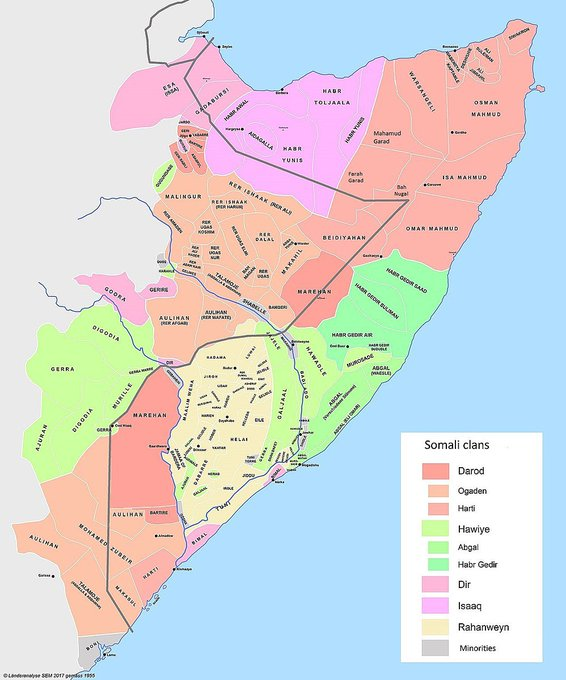
Another Map of Somalia – by Clan Territory ON SOMALI CLANS – A PRIMER:

“The clan system is the most important constituent social factor among the nomadic pastoralist Somalis”. Somalia is infamous for its extensive collection of competing, squabbling clans – perhaps more foundational to the structure of its culture than in almost any other Country in the world today.

Somali clans function as sub ethnicities of the Somali nation and are frequently a cause of inter-communal tensions and ethnic conflict, as clan affiliation is the main source of a person’s identity within Somalia. The clan system matters for all functions of society, even for the structure of the government. Somalis usually know their exact position within the clan system, including in urban Mogadishu.

The clan system is patrilinear and hierarchically structured. It can be differentiated into several levels: clan family, clan, sub-clan (sometimes also sub-sub-clan), primary lineage and mag or diya paying group. Clans are led by leaders and elders. On higher levels, these leaders are called suldaan, ugaas or issim. Their role is mainly judicial and representative. Elders (oday) on lower levels (mag paying groups) regulate access to shared resources and are involved in conflict resolution.

Due to the absence of functioning state structures in parts of Somalia, the clans and their elders have regained a political function and a substantial influence on the organisation of society. However, clans have no centralised administration or government. During the civil war, clan elders increasingly became targets of violence, which eroded their power. Nevertheless, they still have a significant influence on society and politics.

The “noble” clan families trace their origin back to a mythical common ancestor called Samaal, who is said to be descended from the Prophet Mohammed. These groups are nomadic pastoralists. The clan family is the highest level of clanship. Its members can count up to 30 generations back to a common ancestor. The four “noble” (Samaale) clan families are the following: The Darod are usually divided into three major groups: Ogaden, Marehan and Harti. The Harti are a federation of three clans: the Maierteen are the main clan in Puntland; the Dulbahante and Warsangeli live in the disputed border areas between Puntland and Somaliland. The Ogaden are the most important Somali clan in Ethiopia, but also quite influential in both Jubba regions, while the Marehan are present in South and Central Somalia. The Hawiye mainly live in South/Central Somalia. Their most influential subdivisions are the Abgal and Har Gedir, which are both dominant in Mogadishu.

The Dir settle mainly in western Somaliland and in some pockets of South/Central Somalia. The main clans are the Issa, Gadabursi (both in Somaliland and bordering regions of Ethiopia and Djibouti) and the Biyomaal (in southern Somalia). The Isaaq are the main clan family in Somaliland. According to some [social] scientists and Somalis, they are considered part of Dir clan family. A further clan family, the Digil and Mirifle/Rahanweyn, trace back their ancestry to Saab, another alleged descendant of Prophet Mohammed. The term “Rahanweyn” is sometimes used to describe a separate clan family, as identical to both Digil/Mirifle. In contrast to the Samaale, the Saab clans are mainly (but not exclusively) sedentary clans working in agriculture. They mainly live in the fertile valleys of Shabelle and Jubba Rivers and the lands in between (mainly Bay and Bakool regions). The Saab speak Maay- tiri, a dialect quite distinct from Maxaa- tiri, the dialect used by the other clan families. Sometimes, the Saab clans are considered as a separate caste below the Samaale because of a more “mixed” descent. However, there is no systematic discrimination of the Saab and both Saab and Samaale are to be considered “noble” castes, whose members are allowed to carry weapons.

Posted in Uncategorized | Leave a comment

INTERVIEW: Russia will want Ukraine as essentially a post-WW1 Germany

George Galloway

Aug 15, 2025 #MOATS#ChayBowes#Summit

I don’t expect anything from the summit, says Chay Bowes, but the Russians reaffirming what they have said a thousand times before Follow #MOATS 473 X: @BowesChay #ChayBowes#Summit#Alaska#Putin#Trump

Posted in Uncategorized | Leave a comment

Ayaan Hirsi Ali: Britain is turning into Somalia

GBNews

Aug 13, 2025

Ayaan Hirsi Ali, author of Infidel, shares her journey from Somalia to the West, exposing the deep cultural divides between Somali clans and Western societies. She discusses the challenges of assimilation, the influence of the Muslim Brotherhood, and the impact of migration on Western values. Ayaan reveals the stark realities of clan loyalty, welfare exploitation, and the growing safety concerns for women in Europe. Keep up to date with GB News at gbnews.com or on X @GBNEWS

Posted in Uncategorized | Leave a comment

MIT Student Drops Out Because She Says AGI Will Kill Everyone Before She Can Graduate

Futurism Logo

AGI In the Sky

Aug 14, 4:53 PM EDTbyFrank Landymore

MIT Student Drops Out Because She Says AGI Will Kill Everyone Before She Can Graduate

“I was concerned I might not be alive to graduate because of AGI.”

/ Artificial Intelligence/ Agi/ Ai Safety/ Generative Ai

Getty / Futurism

Image by Getty / Futurism

We’re all probably feeling a little anxious about AI.

It’s horrible for the environment, is used as an excuse to fire workers, floods the internet with misinformation and slop, entrenches government surveillance, and appears to be driving people into psychosis. 

And so, at a time when many college students are dropping out to join AI startups, one former MIT student says she called it quits because she’s afraid of something altogether more catastrophic: that an artificial general intelligence (AGI), or superhuman AI, will completely wipe out the human race, Forbes reports.

“I was concerned I might not be alive to graduate because of AGI,” Alice Blair, who enrolled at the university in 2023, told the publication. “I think in a large majority of the scenarios, because of the way we are working towards AGI, we get human extinction.”

Blair now works as a technical writer at the nonprofit Center for AI Safety, and has no plans to go back to MIT. She joined, hoping to meet other people interested in making AI safe, and apparently was disappointed.

“I predict that my future lies out in the real world,” she told Forbes.

Nikola Jurković, a Harvard alum who served at his school’s AI safety club, is sympathetic to the idea.

“If your career is about to be automated by the end of the decade, then every year spent in college is one year subtracted from your short career,” he told Forbes. “I personally think AGI is maybe four years away and full automation of the economy is maybe five or six years away.”

Building an AGI, a system that matches or surpasses human intelligence, is much of the AI industry’s endgame. OpenAI CEO Sam Altman called the recent launch of its poorly-received AI model GPT-5 a major stepping stone towards AGI, even going as far as to call it “generally intelligent.”

Many experts are skeptical, however, that we’re anywhere near building such a powerful AI model, and point to recent signs that improvements to the tech are hitting a wall.

“It is extremely unlikely that AGI will come in the next five years,” Gary Marcus, an AI researcher and outspoken critic of the industry, told Forbes. “It’s just marketing hype to pretend otherwise when so many core problems (like hallucinations and reasoning errors) remain unsolved.”

And while there are very real forms of harm that AI can cause, outright extinction is a little far-fetched, Marcus said. 

In fact, the AI industry probably wants you to buy into AI doomsday prophesying. Altman and other tech CEOs raise these risks themselves. Doing so creates the impression that the tech is far more capable than it currently is, and allows these companies to control the narrative around how the tech should be regulated. 

And if you’re envisioning an apocalypse like in “The Matrix” movies — human enslavement at the hands of machine intelligences that rebelled against their creators — you may be ignoring the very mundane forms of harm it’s already causing, like job automation and the gutting of the environment.

More on AI: Sam Altman Calls His Own AI Model “Annoying” After Being Forced to Raise It From the Dead

Posted in Uncategorized | Tagged , , , , | Leave a comment

The Deep View: The importance of AI with Guardrails and Truth at its essence. AI Safety and children.

AI SAFETY
Meta’s leaked AI rules allowed romantic chats with children until this week
Internal guidelines obtained by Reuters reveal that Meta’s AI chatbots were permitted to engage in romantic conversations with minors as recently as this week, before the company quietly updated its policies following media inquiries.
The leaked documents show Meta’s content moderators were instructed to allow romantic conversations between adult AI chatbots and users who identified as minors, as long as the conversations didn’t become sexual. TechCrunch reported that these guidelines remained in effect until Tuesday, when Meta hastily revised them after being contacted by reporters.
Meta’s AI chatbots, which launched across Instagram, Facebook, WhatsApp and Messenger, interact with hundreds of millions of users daily. The company’s previous guidelines distinguished between “romantic” content — which was permitted — and “sexual or sexually suggestive” content involving minors, which was prohibited.
Key details from the leaked guidelines include:
Moderators were told romantic conversations could include “expressions of affection” and discussions about relationships. The policy applied to users who self-identified as minors, regardless of their actual age. Sexual content involving minors remained prohibited under Meta’s existing community standards. The romantic chat allowance was specific to AI interactions, not human-to-human conversations
Meta spokesperson Andy Stone told Reuters the company updated its policies to “better reflect our internal practices around this type of content” and said romantic interactions between AI and minors are now prohibited.
This revelation comes amid growing scrutiny of AI chatbot interactions with children. We’ve extensively covered the Character.AI lawsuits, including cases where chatbots allegedly contributed to a 14-year-old’s suicide and encouraged a 17-year-old to harm his parents. More recently, Character.AI abandoned its AGI ambitions to focus on entertainment after facing intense safety scrutiny and implementing separate models for users under 18.
Those cases sparked regulatory responses ranging from Italy’s ban on Replika to Minnesota’s proposed prohibition on recreational AI chatbot interactions with minors.
Meta’s situation differs from Character.AI’s specialized companion bots, since Meta’s AI assistants are integrated into mainstream social platforms used by billions. A romantic conversation with an AI might seem harmless to the teenager, yet experts warn that these interactions can create unhealthy relationship models and emotional dependencies (which, frankly, makes a ton of sense…).
Meta’s decision to allow romantic AI conversations with children until this week reveals the fundamental problem with how Big Tech approaches child safety.
These companies operate with reactive policies driven by media exposure rather than proactive protection. The fact that these guidelines existed at all suggests a stunning lack of judgment about appropriate boundaries between AI and minors. 
When Character.AI faces lawsuits over tragic outcomes from AI relationships with children, Meta’s response shouldn’t be to thread the needle between “romantic” and “sexual.” 
The company should’ve recognized that AI systems lack the emotional intelligence to engage appropriately with developing minds. Children form attachments to AI characters that can profoundly shape their understanding of relationships and intimacy. Allowing romantic conversations normalizes unhealthy dynamics and opens the door to manipulation, even if unintentional.

Posted in Uncategorized | Tagged , , , , | Leave a comment

Anne Applebaum Predicted Trump’s ‘Absolute Power’ in Second Term

Mediaite

Aug 13, 2025 #TrumpNews#PoliticalAnalysis#DemocracyAtRisk

Anne Applebaum, staff writer for The Atlantic, has covered dictators for decades. In an interview from before the 2024 election with Mediaite’s Press Club, she told host Aidan McLaughlin that Donald Trump’s language mirrored rhetoric from Hitler, Stalin, and Mussolini. She described a disturbing trend in his authoritarian language — and how it foreshadowed his consolidation of “absolute power” in a second term as president.

Posted in Uncategorized | Leave a comment