First map of mammal brain activity may have shown intuition in action
Scientists have mapped the activity that takes place across a mouse’s entire brain as it decides how to complete a task – and the results could explain the origin of our gut feelings
A map of a mouse’s brain showing 75,000 neuronsDan Birman, International Brain Laboratory
The first complete activity map of a mammalian brain has revealed unprecedented insights into how decisions are made – and may even hint at the roots of that mysterious feeling we call intuition.
For decades, neuroscientists have wanted to capture activity across the whole brain at the level of individual neurons – but there is a limit to how many neurons an electrode can record from, how many electrodes can be implanted in a single brain and how many animals a single lab can test.
Steve Bannon says radical Islam is fuelling unrest across Europe.
James Schneider brands him a racist.
Matt Goodwin warns Westminster has no plan for integration, and is ignoring 40,000 extremists, 80+ Sharia courts, and broken trust in politics. pic.twitter.com/l1jYV98vfV
Michael Comyn: In 1912, he served as a revising barrister at the Cork Revision Sessions, handling voter registration disputes.
Thought for 3m 44s
Michael Comyn (6 June 1871 – 6 October 1952) was an Irish barrister, politician, and judge known for his involvement in nationalist causes and key legal cases during a tumultuous period in Irish history. Born in Ballyvaughan, County Clare, to a tenant farmer father who was active in the Land League, Comyn experienced eviction as a child, which likely shaped his later political views. He studied at King’s Inns and was called to the Irish Bar in 1898while still working as a civil servant in excise. Joining the Munster Circuit in 1900, he built a civil practice in Clare, serving as barrister for the Clare County Council.
In 1912, he served as a revising barrister at the Cork Revision Sessions, handling voter registration disputes.
He became King’s Counsel (KC) in 1914. Comyn’s nationalist activities intensified; during the 1916 Easter Rising, he was in the United States. Upon returning, he defended republican prisoners during the War of Independence and Civil War, notably in high-profile cases like Re. Clifford and O’Sullivan (1921), where he challenged military courts before the House of Lords, and the defense of Erskine Childers in 1922.
Politically, he served as a Fianna Fáil Senator from 1928 to 1936 and was appointed a Circuit Court judge in 1936, retiring in 1945. Beyond law, Comyn was a geologist and mine operator, discovering phosphorite deposits in Clare. He was also a litigant in a prolonged mining rights case he ultimately won. Comyn died in Dublin in 1952.
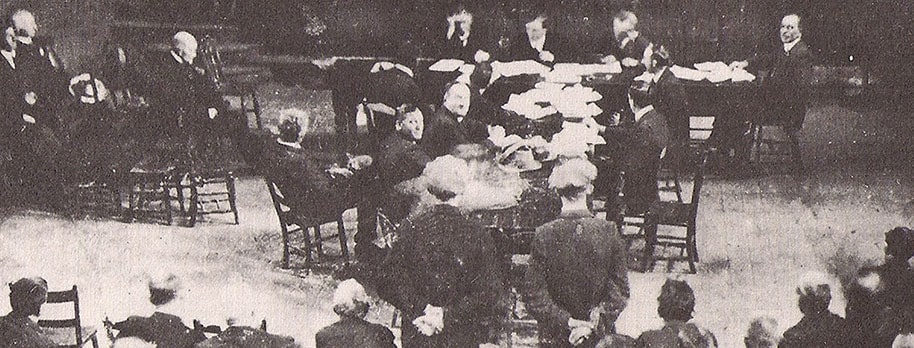
When introducing legislation in 1923 to wind up the parallel courts’ system established during the War of Independence, Minister Kevin O’Higgins characterised them as “an improvised system of justice”. The true story, however, is one of complexity and resilience, write Barry Whelan and John Biggins
After the Great War, land agitation – especially in the in the west of Ireland – saw many litigants turn to ad hoc ‘Republican’ or ‘Sinn Féin’ arbitration courts for fair justice, advocated by Arthur Griffith since 1905. This was in similar spirit to courts established by the Land League in the late 19th century.
The outbreak of the War of Independence and the spread of agrarian unrest accelerated the movement of litigants away from the official ‘Crown’ Courts (petty sessions, county courts) towards arbitration courts. Better organised arbitration schemes emerged in particular areas, such as West Clare.
They lifted the war to a higher plane – the independence movement stood not only for democracy, but also for the rule of law and equitable justice.
The money raised by donations and loans by the then underground government, Dáil Éireann, ensured parties could find an alternative and fair court system for restitution.
Regularised system
A Dáil decree in June 1920 moved the dial from arbitration courts to a more regularised courts system. Court rules were developed through the autumn of 1920.
By January 1921, a provisional constitution, including rules of court, had been issued by the Dáil Department of Home Affairs, though it may not have been in full circulation until after the 1921 Truce in hostilities in the War of Independence.
The system was divided between Parish and District Courts, with mostly lay people adjudicating in both, and legally qualified judges presiding over Circuit sittings of the latter. A Supreme Court, comprised solely of legally qualified judges, was also established.
In the District Courts, protection was provided by Republican police. These experienced IRA units were the only attendees who were permitted to wear caps in court, as a symbol of their office.
It became practice for judges of the Parish Courts to be appointed at conventions of Sinn Féin clubs, trades councils, members of the rural or urban authority, IRA Volunteers and Cumann na mBan.
The collective parish judges then elected the district judges. Women, such as Jennie Wyse Power, adjudicated at these courts, showing a progressive element to this judicial system.
There were no robes, wigs, raised platforms or symbolism in the courts – its plainness spoke of a justice system that could reach all and dispense rulings quickly.
Court sittings took place anywhere – in a school, pub, solicitor’s office or a barn. Urban sittings were usually riskier, as an enemy convoy could roll up and storm the premises before the court had time to hide any documentation or evade arrest.
Rural sittings allowed the IRA to establish look-out posts and cordons but, with much of the country under martial law during the war, the sittings of these courts and travelling to them were still highly dangerous for all involved.
In tandem with this, the IRA actively targeted the Crown Courts by destroying premises, threatening litigants, and forcing the British Army to deploy significant resources to guard their courts.
The net impact of this was the near-total collapse of the established court system and the movement of business to the Dáil courts: “The fact that Sinn Féin set its face against the use of violence for the settlement of disputes and that the courts gave a fair hearing to everybody quickly won respect for the courts, even from those who looked upon them as usurping the functions of the English court.”
Solicitors’ vital role
Solicitors played a vital role in the Dáil Courts process because they represented clients, briefed barristers, prepared legal cases, and handled monies.
The Law Society of Ireland supported their active participation in the Dáil Courts: “Where the interests of their clients require it, solicitors should be free to represent them in any court or before any tribunal.”
Hugh O’Brien Moran, Seán Ó hUadhaigh, William Corrigan, and Michael Noyk were some of the most prominent solicitors who practised in the Dáil Courts and risked arrest at every sitting from raids by enemy forces: “The court had hardly been in progress ten minutes when in came a number of British officers and Auxiliaries.”
Noyk himself achieved a great coup against the established court system by holding a Dáil Court sitting under the noses of the Crown Courts at the Four Courts building. He rented a consultation room for the hearing of one of his cases before Judge Cahir Davitt.
Once solicitors attended Dáil Courts, they were aware that their card was marked in the eyes of Dublin Castle and the British authorities as being sympathetic to the Republican movement.
However, again, the Law Society would defend their members against such charges by citing the privilege of the profession to act in their clients’ interests, and they presented this argument in person to General Nevil Macready – commander of the British forces in Ireland.
In contrast, the Bar Council had passed a controversial resolution in June 1920 declaring it professional misconduct for barristers to appear before Sinn Féin courts. Nonetheless, barristers appeared before the Dáil Courts and the subsequent winding-up commission, including John A Costello and Michael Comyn.
Transition year
The approval of the Anglo-Irish Treaty in Dáil Éireann on 7 January 1922 ushered in a period of administrative transition. The Treaty did not explicitly address the future status of the Dáil Courts, but it was no secret that British political opinion was hostile.
David Lloyd George – British prime minister and solicitor by profession – reportedly commented to his team during the Treaty negotiations that: “I shall have to tell them [the Irish delegation] that we shall have to scatter these courts.”
Even so, the Dáil Courts were in their heyday after the Treaty. By April 1922, regularised criminal trials before judge and jury were also being held in some Dáil Courts.
They were on borrowed time, however. Following publication of the draft Constitution of Saorstát Éireann and the outbreak of the Civil War in June 1922, the Dáil Courts came into sharper political focus.
In the wake of Cabinet discussions in July 1922, communications were issued to the Dáil Supreme Court and judges on circuit to cease sittings.
A more direct showdown between the Provisional Government and the Dáil Courts occurred when an order for habeas corpus was made by Judge Diarmuid Crowley, ordering the release of George Plunkett, son of Count Plunkett, from Mountjoy Jail after his capture at the Four Courts.
Orders were also made for the arrest of the Minister for Defence and Governor of Mountjoy.
In a public notice appearing on 1 August, the Minister for Home Affairs rescinded the original decree establishing the Dáil Courts, though initially limiting the effect to Dublin. Parish and District Courts outside Dublin were disestablished in late October 1922.
The status of claims and appeals pending when the Dáil Courts were abolished, as well as definitive registration and enforcement of court orders, went unresolved for some time.
Eventually, the Dáil Éireann Courts (Winding-Up) Act 1923 was enacted on 8 August 1923 (amended by a further act in 1924), establishing a statutory commission based at Dublin Castle.
James Creed Meredith, former president of the Dáil Supreme Court, was initially appointed as Chief Judicial Commissioner until his elevation to the High Court of Saorstát Éireann in 1924.
The commissioners were empowered to hear appeals against registered decrees; appeals against the registrar’s decisions to register (or refusals to register) decrees; outstanding proceedings and appeals pending before the Dáil Courts’ abolition; and to reopen certain other proceedings where defendants had previously abstained from the Dáil Courts on principle.
Under 1925 legislation, the jurisdictions and powers of the commissioners were transferred to the High Court, and so a fusion of the revolutionary legal system with that of the new State was finally rendered complete.
Trove of records
Perhaps one of the greatest legacies of the commission is its trove of records, which survive in the National Archives. The files reveal that a broad cross-section of Irish society came to rely on the Dáil Courts (and, later, the commission).
Legal actions were wide in variety, many of them still familiar today, including debt recovery, breach of contract, negligence, and land disputes.
Some of these materials are revealing of life at the ground level of society during a disturbed period, illustrated by the following examples from the Dublin files.
At a May 1922 circuit sitting in the North City District, two men were charged with armed robbery at Drumcondra Post Office, while a third was charged with threatening to kill the postmistress and the post office messenger, in February of that year.
A witness statement from the postmistress conveyed how an ordinary day took a terrifying turn when she recalled: “On Tuesday morning about 12 noon, while engaged in my duties in Drumcondra Post Office, I saw men rush into the office. I thought there was something wrong and immediately one of the men put a revolver through the brass railing on the counter. I stood for a moment afraid to move or call…”
Another employee recalled one of the men threatening the post office messenger that “if he stirred, he would shoot him dead”.
The perpetrators made admissions in custody and, while the archival record is not entirely clear, they seem to have entered guilty pleas.
Another case concerned a substantial breach of contract claim levelled against a garage on the Conyngham Road. The defendant had allegedly failed to carry out repairs to a Ford Laudette in reasonable time, putting the plaintiff to considerable expense, particularly in hiring ‘taxi-cars’.
It transpired in evidence that a damaged part from the plaintiff’s car had been sent by the defendant motor works to a third party works, but was then allegedly stolen from there by ‘Sinn Féiners’. It was accepted in evidence that ‘armed men’ had taken the part.
The plaintiff car owner was only awarded a fraction of his claim, while a claim of the defendant motor works was partially upheld in relation to the supply of petrol.
There was fluidity in the use of courts during this period, given that the inherited Crown Courts and the Dáil Courts functioned concurrently (albeit uneasily) in some places, particularly Dublin.
On occasion, the two systems were activated at different points in the same chain of events. For instance, a woman was charged with stealing a fur coat from Arnotts in December 1921. She was taken into custody and remanded until January 1922, when she was tried before the Recorder of Dublin and a jury at the Criminal Sessions.
When acquitted of the charge, she then initiated a claim against Arnotts at the North City Dáil District Court for false imprisonment. The plaintiff was successful at first instance, but Arnotts successfully appealed.
Consistent with the terms of their provisional constitution, it was also quite usual for the Dáil Courts and the commissioners to apply pre-existing law – that is, the common law and Westminster legislation.
For example, on 14 June 1922, a complaint was made by a sanitary officer under the Public Health (Ireland) Act 1878 about the bad state of repair and sanitation of certain properties at Kill o’ the Grange.
The orders made against the landlord required him to “provide two water closets for tenement houses … also new drains, gullies, intercepting trap, vent pipes etc, and connection with Rural District Council’s sewer in public road”.
Penalties for breaches of animal-disease regulations were also imposed by the Dáil Courts at a time when the keeping of cattle within the city was still widespread.
In January 1922, a ‘cowkeeper’ with an overcrowded cowshed on Bow Lane, off Aungier Street, was summonsed and cautioned for breaching the Dairies, Cowsheds and Milkshops (Ireland) Order 1908.
These examples perhaps serve to demonstrate that, by the time of their abolition, the Dáil Courts had become much more than an “improvised system of justice”.
Barry Whelan is a historian with DCU. He works in the Law Society and is currently writing a biography of Michael Noyk, solicitor. John Biggins is a practising barrister, lecturer and researcher. He is currently writing up new research on the Dáil Courts. He gratefully acknowledges the support of the Royal Irish Academy in conducting the National Archives of Ireland research referred to in this article. The content of this article is solely the responsibility of the authors and does not necessarily represent the official views of the Royal Irish Academy or any other organisations to which the authors may be affiliated.
Sir Niall Ferguson, born in Glasgow, Scotland, combined his education in history, politics, and economics at Oxford with his passion for debate to become a prominent historian, author, teacher, and documentarian. His works include a two-volume biography of Henry Kissinger, with the first volume published in 2015 and the second scheduled for release in 2027. His ideas and views appear in various media outlets, including the Free Press and Substack, as well as at conferences around the world. For more, please visit: http://www.charlierose.com
Michael Comyn (born June 6, 1871 – died October 6, 1952) was an important Irish lawyer and politician. He served as a Senator for the Fianna Fáil party and later became a judge. Before his legal career, he also worked in the British Civil Service and was interested in geology and mining.
Comyn was known for his strong will. He once said about a court case he won: “it was his last case, and he won it.” This was very different from his first case as a young lawyer, which he admitted “was a bad case and I did it badly.”
Michael Comyn was born in 1871 in Ballyvaughan, County Clare, Ireland. He was the oldest son in a family of seven children. His father, James Comyn, was a farmer and a leader in the local Land League, a group that helped farmers.
In 1879, Michael’s family was forced to leave their home. They moved to another area in County Clare. Michael went to local schools, including one known for helping students pass civil service exams.
Becoming a Lawyer
When Michael was 19, he took an exam to become an excise officer, which is a type of government worker. Out of 2,500 people, only 50 were chosen, and he was one of them! He started working in Dublin and then in England.
While working, he also studied law at University College Dublin and King’s Inns. Even when he was transferred far away and couldn’t attend all his classes, he kept going. He even won a special award, the Victoria Prize, which helped him finish his studies.
In 1898, Michael Comyn officially became a lawyer in Ireland. He quickly became very successful and was made a King’s Counsel in 1914. This meant he was a top lawyer.
Helping Republican Prisoners
Michael Comyn was very active in Irish nationalist politics, which aimed for Ireland’s independence. During the 1916 Easter Rising, he was in the USA. When he returned, he started defending Irish republican prisoners in court. He even argued some cases in the highest court in Britain, the House of Lords.
The Case of Clifford and O’Sullivan
One of his most famous cases was Re. Clifford and O’Sullivan in 1921. He represented 42 men who were sentenced to death by a military court for having weapons. Michael Comyn and his brother worked hard to find a way to save them.
He used an old legal method called “Prohibition” to challenge the military court’s power. The case went all the way to the House of Lords in London. Michael Comyn used clever tactics, like delaying the case and reviewing old laws, to buy time.
The good news is that none of the 42 men were executed! It is believed that King George V himself learned about the case and made sure the death sentences were not carried out. After the Anglo-Irish Treaty was signed, these men were set free. Michael Comyn later said that King George V’s actions helped bring peace.
It’s important to know that no republican prisoner Michael Comyn defended during this time was ever executed. He also helped other people, like the suffragette Georgina Frost, who fought for women’s right to vote.
During the Civil War
During the Irish War of Independence, Michael Comyn defended Irish republican prisoners. He continued this work during the Irish Civil War. He also helped in investigations into the deaths of important figures like Cathal Brugha and Harry Boland.
Defending Erskine Childers
One very difficult case for Comyn was defending Erskine Childers. Childers was a writer and politician who supported the anti-treaty side during the Civil War. He was captured by the Irish Free State government for having a small gun.
Childers asked his friend Michael Comyn to defend him. The trial was held in private, and Childers was found guilty. Comyn tried to appeal the decision in a higher court. However, before the appeal could be heard, Childers was executed on November 24, 1922.
This deeply affected Michael Comyn. He said it was “a complete negation of justice” to execute someone while their case was still being decided by the courts.
After the Civil War, Michael Comyn became a key legal advisor to Éamon de Valera and the Fianna Fáil party. He helped them set up the party and start The Irish Press newspaper.
Political Career
In 1926, Michael Comyn was one of the people who helped start the Fianna Fáil party. In 1928, he was elected as a Senator to the Free State Seanad. He served as a Senator from 1928 to 1936 and was the vice-chairman of the Seanad from 1934 to 1936.
He was known as a strong debater and a hard-working lawmaker. In 1936, he left his role as a Senator because he was appointed as a judge on the Eastern Circuit Court.
Michael Comyn passed away in 1952 at the age of 81.
Question: the old munster circuit Maurice Healy and his reference to Michael Comyn KC
Thought for 4m 15s
Maurice Healy’s The Old Munster Circuit (1939) is a memoir recounting his experiences as a barrister on the Irish Munster Circuit from around 1910 to the early 1920s, filled with anecdotes about courtroom drama, colorful legal personalities, and the social life of the bar in southern Ireland during that era.Michael Comyn KC (1871–1952), a prominent Irish barrister who joined the Munster Circuit in 1900 and became King’s Counsel in 1914, is referenced in Healy’s book as part of its portrayal of the circuit’s notable figures and cases.
The mention highlights Comyn’s role in the legal scene of the time, including his reputation as a skilled advocate involved in high-profile cases, such as defending republican prisoners during the Irish War of Independence.
This is confirmed in correspondence from King’s Inns dated January 24, 2007, noting Comyn’s inclusion in Healy’s memoir.
The book does not devote an entire chapter to Comyn but incorporates him into its nostalgic accounts of the circuit’s barristers and traditions, reflecting his active participation alongside other figures like Patrick Lynch KC.
For the full context, the memoir is available online via archive.org or in reprint editions.
79 web pages
Is there any history about Michael Comyn 1900 to 1914 when he became a KC like details of cases, speaking at events, representing Clare Co. Council or any information apart from the detailed cases after 1916
Thought for 2m 2s
Michael Comyn (1871–1952) was called to the Irish Bar in 1898 after studying at King’s Inns while working as a civil servant in excise. He joined the Munster Circuit in 1900, initially presenting himself at quarter sessions in his home county of Clare, despite lacking legal connections or family background in the profession.
He built a successful practice primarily on the civil side, and Clare County Council retained him as their barrister during this period.
Comyn was active in nationalist politics before 1914, though specific speeches or events from this era are not well-documented in available sources.
Few detailed records of his individual cases from 1900 to 1914 survive online, but some notable activities include:
In 1912, he served as a revising barrister at the Cork Revision Sessions, handling voter registration disputes.
He took silk as King’s Counsel in June 1914, marking the end of this phase of his career.
His work during these years laid the foundation for his later prominence in defending republican causes post-1916, but pre-1914 details focus more on his civil practice and local Clare connections rather than high-profile criminal or political cases.
I have the ballad concerning Arkins. Are there any other specific cases in that period, especially Co. Clare, 1900 to 1914 when he took silk?
Thought for 3m 3s
Michael Comyn’s legal career from 1900 to 1914 was primarily on the civil side within the Munster Circuit, which he joined in 1900 after being called to the bar in 1898. He initially presented himself at quarter sessions in his home county of Clare, where he gradually built a successful practice despite lacking family connections in the legal profession.
Clare County Council retained him as their standing counsel during this period, meaning he regularly represented them in civil matters, though specific case details from this role are not well-documented in available records.
Apart from the Patrick Arkins case in 1903 (which you mentioned having the ballad for), no other individual court cases from County Clare in this timeframe are explicitly recorded in historical sources, but his work likely involved typical civil disputes such as land and tenant issues common in rural Ireland at the time.In 1912, Comyn served as a revising barrister at the Cork Revision Sessions, handling voter registration disputes and objections to electoral lists—though this was in Cork rather than Clare, it was part of his broader Munster Circuit duties.
He was also active in nationalist politics before 1914, including participating in the North West Manchester by-election campaign in 1908 (not 1909 as sometimes misstated), where he supported the Liberal candidate and interacted with figures like Winston Churchill and Lady Randolph Churchill.
While not a legal case, this political involvement may have included public speaking at events, though exact details of speeches are scarce. His reputation grew steadily, leading to his appointment as King’s Counsel in June 1914.
For deeper insights, consulting archives like the Dictionary of Irish Biography or local Clare records (e.g., via Clare County Library) could reveal more granular details not available online.
Who the Empath Becomes After Absorbing the Narcissist’s Darkness and Surviving – Carl Jung
Discover the profound transformation that occurs when empaths survive narcissistic abuse and emerge as something entirely different. This deep exploration reveals how Carl Jung understood that empaths who absorb a narcissist’s darkness don’t just heal—they undergo what Jung called “individuation” and become psychologically sovereign beings. Through Jung’s analytical psychology framework, we examine the five stages of empathic transformation: Recognition, Internal Shift, Silent Withdrawal, Confrontation with Reality, and the emergence of what I call the Sovereign Self. Learn how Jung’s concepts of shadow integration, projection withdrawal, and psychological boundaries apply to the empath’s journey from unconscious absorption to conscious choice. The video explores Jung’s understanding of how empaths develop “shadow immunity”—the ability to recognize manipulation tactics before they take hold. We delve into Jung’s concept of “the transcendent function” and how it manifests when empaths unite their victim and victor aspects into integrated wholeness. Key psychological concepts covered include Jung’s theories on participation mystique, psychological containers, and the individuation process. Discover how empaths transform from what Jung would recognize as “wounded healers” into conscious beings who can witness suffering without absorbing it, love without losing themselves, and maintain sensitivity while developing unshakeable boundaries. The exploration reveals how this transformation creates what Jung called “the constellation effect”—when one person’s consciousness evolution affects everyone around them. Learn why the empath’s quiet exit becomes so psychologically powerful and how it serves collective consciousness evolution. This isn’t just about recovery from narcissistic abuse—it’s about understanding your archetypal function and stepping into the psychological sovereignty that Jung believed was essential for authentic human development. Source Materials: 🔸Carl Jung’s “The Collected Works” (particularly volumes on individuation, psychological types, and shadow work) 🔸Jung’s theories on projection, participation mystique, and psychological boundaries 🔸Analytical psychology principles regarding codependence and conscious relationship 🔸Jung’s writings on the transcendent function and union of opposites 🔸Depth psychology concepts of container/contained dynamics 🔸Jung’s understanding of archetypal transformation and the wounded healer
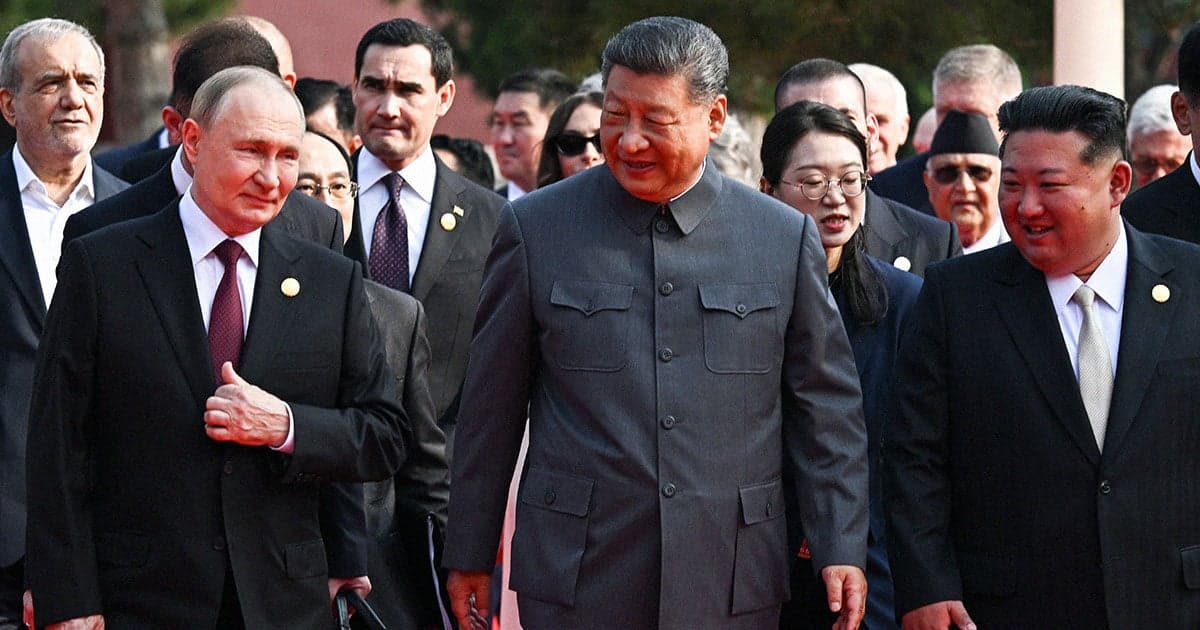
Russian president Vladimir Putin was caught chatting with his Chinese counterpart, Xi Jinping — about the light topic of organ transplants, and how they could let “us live younger and younger, and perhaps even achieve immortality.”
As ABC News reports, the comments were overheard on a hot mic attached to Putin’s interpreter, who was translating his words into Mandarin at a parade in Beijing this week commemorating the end of World War II and showing off fearsome new Chinese military might.
“With continuous advances in biotechnology, human organs will be increasingly transplanted — letting us live younger and younger, and perhaps even achieve immortality,” Putin’s interpreter said in Mandarin.
“In this century, it’s anticipated that it may be possible for people to live to 150 years old,” Xi responded.
It remains unclear whether Putin was referring to his own ambitions to extend his own life with the use of cutting-edge technologies. Powerful people have often become obsessed with their own youth, sometimes resorting to outlandish interventions to artificially prolong their own lives.
Putin himself has been known to consult with a Russian gerontologist and “anti-aging guru” — who, ironically, passed away at the age of 77 last year.
China’s population is expected to drop by half within just 30 years due to increasing economic pressure leading to lower birth rates, not to mention the country’s draconian One Child Policy, which was intended to curb overpopulation but wildly overshot that mark.Russia’s population is also shrinking at an alarming rate, with its years-long war with Ukraine exacerbating a growing crisis.
The comments come after Putin told Russia’s National Healthcare Congress last year that “one of the main goals for the coming years is to increase life expectancy,” as quoted by state-run news network TASS.
The president declared that it was his mission to extend the life expectancy of Russians beyond 80 years. According to the World Health Organization, Russia’s life expectancy has trailed much of the rest of the world, and its population is expected to fall by 6.4 percent by 2050.
Whether advancements in organ transplants will lead to longer lives remains hotly debated. While a new donor organ may extend a patient’s life, it’s far from a permanent fix, let alone a way to live far past somebody’s life expectancy.
Life-saving donor organs are also in perpetual short supply for patients who need them. In response to that reality, doctors are now urgently investigating xenotransplantation, or transplanting organs from a different species, such as pigs, into a human.
In short, the jury is definitely still out on whether people will be able to live to 150 years old by the end of this century, as Xi predicts — and any prognostication of the kind should be taken with a big grain of salt, especially when they come from aging and ultra-powerful authoritarian leaders.
With artificial intelligence integrating — or infiltrating — into every corner of our lives, some less-than-ethical mental health professionals have begun using it in secret, causing major trust issues for the vulnerable clients who pay them for their sensitivity and confidentiality.
As MIT Technology Review reports, therapists have used OpenAI’s ChatGPT and other large language models (LLMs) for everything from email and message responses to, in one particularly egregious case, suggesting questions to ask a patient mid-session.
The patient who experienced the latter affront, a 31-year-old Los Angeles man that Tech Review identified only by the first name Declan, said that he was in the midst of a virtual session with his therapist when, upon the connection becoming scratchy, the client suggested they both turn off their cameras and speak normally.
Instead of broadcasting a normal blank screen, however, Declan’s therapist inadvertently shared his own — and “suddenly, I was watching [the therapist] use ChatGPT.”
“He was taking what I was saying and putting it into ChatGPT,” the Angeleno told the magazine, “and then summarizing or cherry-picking answers.”
Flabbergasted, Declan didn’t say anything about what he saw, instead choosing to watch ChatGPT as it analyzed what he was saying and spat out potential rejoinders for the therapist to use. At a certain point, he even began echoing the chatbot’s responses, which the therapist seemed to view as some sort of breakthrough.
“I became the best patient ever, because ChatGPT would be like, ‘Well, do you consider that your way of thinking might be a little too black and white?'” Declan recounted, “And I would be like, ‘Huh, you know, I think my way of thinking might be too black and white,’ and [my therapist would] be like, ‘Exactly.’ I’m sure it was his dream session.”
At their next meeting, Declan confronted his therapist, who fessed up to using ChatGPT in their sessions and started crying. It was “like a super awkward… weird breakup,” Declan recounted to Tech Review, with the therapist even claiming that he’d used ChatGPT because he was out of ideas to help Declan and had hit a wall. (He still charged him for that final session.)
Laurie Clarke, who penned the Tech Review piece, had had her own run-in with a therapist’s shady AI use after getting an email much longer and “more polished” than usual.
“I initially felt heartened,” Clarke wrote. It seemed to convey a kind, validating message, and its length made me feel that she’d taken the time to reflect on all of the points in my (rather sensitive) email.”
It didn’t take long for that once-affirming message to start to look suspicious to the tech writer. It had a different font than normal and used a bunch of what Clarke referred to as “Americanized em-dashes,” which are not, to be fair, in standard use in the UK, where both she and her therapist are based.
Her therapist responded by saying that she simply dictates her longer-length emails to AI, but the writer couldn’t “entirely shake the suspicion that she might have pasted my highly personal email wholesale into ChatGPT” — and if that were true, she may well have introduced a security risk to the sensitive, protected mental health information contained within an otherwise confidential exchange.
Understandably put off by the experience, Clarke took to Reddit, the Internet’s public square, to see if others had caught their therapists using AI in similar ways. Along with connecting to Declan, she also learned the story of Hope, a 25-year-old American who sent her own therapist a direct message looking for support after her dog died.
Hope got back an otherwise immaculate and seemingly heartfelt response about how difficult it must be “not having him by your side right now” — but then she noticed a prompt that the therapist had forgotten to erase sitting prominently at the top of the missive, providing the trained mental health professional a “more human, heartfelt [response] with a gentle, conversational tone.”
She added that she was “honestly really surprised and confused” because she thought her therapist was competent and could be trusted — and trust issues, ironically, were her onus for going into therapy in the first place.
When she asked the therapist about the AI usage, she too owned up — and claimed that she’d used it because she had never had a dog before herself.
As more and more people turn to so-called AI therapists — which even OpenAI CEO Sam Altman admits aren’t equipped to do the job of a real-life professional due to privacy risks and the technology’s troubling propensity to result in mental health breakdowns — the choice to see a flesh-and-flood mental health professional should be one that people feel confident in making.
Instead, the therapists in these these anecdotes (and, presumably, plenty more where they came from) are risking their clients’ trust and privacy — and perhaps their own careers, should they use a non-HIPAA-complaint chatbot, or if they don’t disclose to patients that they’re doing so.