The Deep View: OpenAI skips data labelers for Goldman bankers


OpenAI skips data labelers for Goldman bankers
OpenAI is sidestepping the data annotation sector by hiring ex-Wall Street bankers to train its AI models. 
In a project known internally as Project Mercury, the company has employed more than 100 former analysts from JPMorgan, Goldman Sachs and Morgan Stanley, paying them $150 an hour to create prompts and financial models for transactions such as IPOs and corporate restructurings, Bloomberg reported. The move underscores the critical role that curating high-quality training datasets plays in improving AI model capabilities, marking a shift from relying on traditional data annotators to elite financial talent to instruct its models on how real financial workflows operate.
“OpenAI’s announcement is a recognition that nobody writes financial documents better than highly trained analysts at investment banks,” Raj Bakhru, co-founder of Blueflame AI, an AI platform for investment banking now part of Datasite, told The Deep View. 
That shift has the potential to shake up the $3.77 billion data labeling industry. Startups like Scale AI and Surge AI have built their businesses on providing expert-driven annotation services for specialized AI domains, including finance, healthcare and compliance.
Some AI experts say OpenAI’s approach signals a broader strategy: cut out the middlemen.
“Project Mercury, to me, clearly signals a shift toward vertical integration in data annotation,” Chris Sorensen, CEO of PhoneBurner, an AI-automation platform for sales calls, told TDV.  “Hiring a domain expert directly really helps reduce vendor risk.”
But not everyone sees it that way.
“While it’s relatively straightforward to hire domain experts, creating scalable, reliable technology to refine their work into the highest quality data possible is an important — and complex — part of the process,” Edwin Chen, founder and CEO of Surge AI, told TDV.  “As models become more sophisticated, frontier labs increasingly need partners who can deliver the expertise, technology, and infrastructure to provide the quality they need to advance.”
OpenAI hiring former bankers to create training data might sound like a flex, but it’s also a sign of how far it still has to go. As the pressure to monetize AI grows, the company is trying to prove its models can perform serious, industry-specific work on the job. Training them to develop financial models is a logical next step. However, paying $150 an hour for curated data highlights a deeper issue: building useful AI still requires a significant amount of manual effort. While Project Mercury may help OpenAI pitch itself to Wall Street clients, it also highlights the limitations of current models and the significant amount of hand-holding they still require to succeed.
Posted in Uncategorized | Tagged , , , , | Leave a comment

The Rundown Robotics: Water-blasting drones fight fires autonomously

SENECA🔥 Water-blasting drones fight fires autonomouslyImage source: Seneca

The Rundown: Sausalito startup Seneca raised $60M to build autonomous, water‑cannon drones that self‑launch to attack wildfires before they spread. After putting out test burns, Seneca is aiming for its first real‑world deployments next year.

The details:The drones self‑dispatch, fly autonomously, and pummel wildfires with dual water cannons engineered for rapid knockdowns.Seneca targets sub‑10‑minute response from remote launch sites, using heavy‑lift airframes that haul 100 lb. payloads and blast water at over 100 PSI.The startup says that five-drone teams can lay around 1,280 feet of foam perimeter with precision, boxing in small fires before they run amok. A five‑drone kit is priced from the high six figures into the low seven figures, undercutting helicopter sorties for initial attack.

Why it matters: California’s fire season now runs year-round, with the state losing over 4M acres in 2020 alone and climate change pushing ignition risk higher. Seneca’s drones could rewrite response by wiping out blazes in their first critical minutes — that narrow window that separates a contained burn from an unstoppable inferno.
Posted in Uncategorized | Leave a comment

The Deep View: Robotic warehouse automation

Amazon leans into robotic warehouse automation
Amazon might be preparing its AI for the future of the holiday rush. 
On Tuesday, The New York Times reported that the e-commerce giant plans to use robotic automation to avoid hiring more than 600,000 US workers by 2033. Amazon’s robotics team is working towards automating 75% of the company’s operations, with 160,000 roles on the chopping block by 2027, according to documents viewed by the Times. 
The automation would save 30 cents per item sold, totalling $12.6 billion between 2025 and 2027. 
Amazon told The Deep View that its investment in automation and efficiency gains will enable it to expand into new business areas, as well as upskill its workforce for evolving roles. 
Amazon spokesperson Kelly Nantel said in a statement that the documents don’t reflect the company’s overall hiring strategy, just that of one team, and that “leaked documents often paint an incomplete and misleading picture of our plans, and that’s the case here.” Nantel noted that the company plans to fill 250,000 positions ahead of the holiday rush. 
Amazon’s push for automation is far from singular. Companies across industries are seeking to automate tedious tasks and roles with AI, resulting in plans for major workforce restructuring: 
Airline Lufthansa cut 4,000 roles in late September as it leans into AI, focusing on administrative roles. Klarna and  Salesforce both cut thousands of staff this year, with their CEOs confirming that AI allowed them to do so. Accenture announced plans to “exit” staff who were unable to be reskilled on AI, with 11,000 already receiving the boot. 
Workforce automation is the primary way that many AI firms expect to notch returns. Given Amazon’s commitment to and investment in developing AI, as well as its longstanding research in robotics, a move like this is hardly surprising.
Posted in Uncategorized | Tagged , , , , | Leave a comment

New Atlas: Ireland, on the shoulders of Giants planning to action urgently.

Amazon goes nuclear with new modular reactor plant

By David Szondy

October 20, 2025

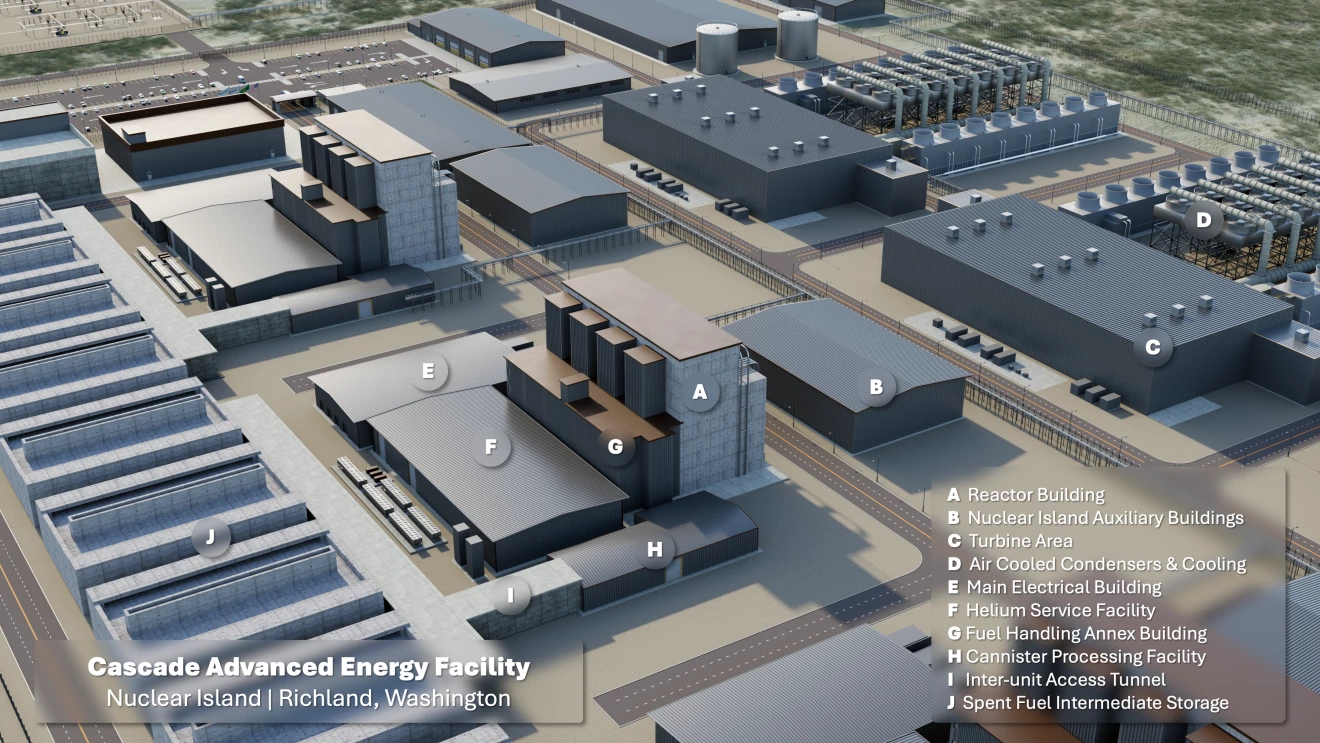
Render of the new Amazon nuclear plan in Washington State

Render of the new Amazon nuclear plan in Washington State

Amazon

View 6 ImagesView gallery – 6 images

In the shadow of a service outage that affected millions of users, outside of Richland, Washington, internet commerce giant Amazon is building the first of a series of modular nuclear power stations to protect its data services from outages.

We tend to think of Amazon as a place to order ramen bowls or concrete vibrators, but it’s also the dominant global provider of internet data services through its Amazon Web Services (AWS), which as of 2025 has an annual revenue of over US$123 billion. It’s for this reason that the recent outage that impacted over 1,000 companies is such a big deal and why Amazon and other tech companies are investing in restarting or constructing nuclear power plants to provide their data centers with a round-the-clock, reliable source of power with zero emissions.

However, there’s more to the Amazon announcement than the company going nuclear or the fact data centers have quickly become such major assets that they need their own bespoke power source. It’s also another example of major companies backing the rapid deployment of Generation IV reactor technology to meet the surging energy demands expected in the coming decades.

The Xe-100 SMR
The Xe-100 SMR

For the new power plant, Amazon is using X-Energy’s Xe-100 Small Modular Reactor (SMR), which will be installed near Energy Northwest’s existing Columbia Generating Station in Washington State.

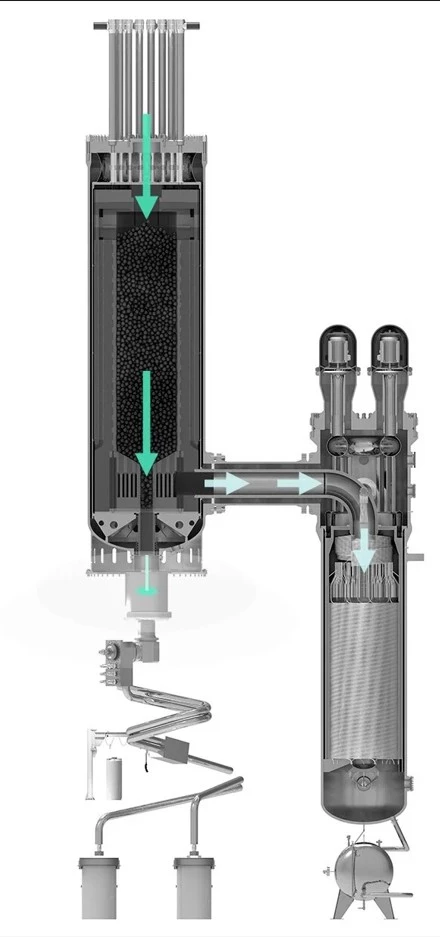
The Xe-100 is a High-Temperature Gas-cooled Reactor (HTGR) that is fueled by TRISO-X , a proprietary Tristructural-Isotropic particle fuel made up of grains of uranium wrapped in layers of carbon and ceramics and then bundled into spherical pebbles. These are fed through a hopper into the reactor vessel to produce a self-regulating fission reaction and are cooled by helium gas that carries off the heat to a heat exchanger to generate steam for electrical generators. As the fuel is used up, it is collected at the bottom of the vessel.

The small Xe-100 reactors only produce 80 MWe of power. That seems small, but these SMRs are much smaller and simpler than conventional reactors, which allows them to be mass produced in factories and then trucked to the site. In addition, this design makes for smaller land footprints and eliminates the need for the extremely expensive civil engineering works required for earlier reactor designs.

Diagram of the Cascade Advanced Energy Facility

Another big advantage is that the SMR plants can be easily scaled up and down to meet requirements by adding or removing reactor modules. Decommissioning and disposal is also easier because the modules, once powered down and defueled, can be removed in whole for dismantling.

According to Amazon, the Cascade Advanced Energy Facility will begin construction by the end of the decade and will be operational in the 2030s. The facility will consist of four reactors producing a total of 320 MWe and has the potential to expand to 12 reactors pumping out 960 MWe. If the initiative is successful, Amazon plans to introduce an overall 5 GW of nuclear power to the US by 2039 – enough to power 3.8 million homes.

“This project isn’t just about new technology; it’s about creating a reliable source of carbon-free energy that will support our growing digital world,” said Kara Hurst, Amazon’s chief sustainability officer. “I’m excited about the potential of SMRs and the positive impact they will have on both the environment and local communities.”

Source: AmazonView gallery – 6 images

We recommend

Posted in Uncategorized | Tagged , , , , | Leave a comment

Neuroscience News: Storytelling and the Brain … how memories are formed. Comment: Fascinated by this because TBI with amnesia means no stories and aphantasia is about no visuals. I watch Podcast grasp it deeply in the moment but then like a sheet of rain on a window pane, it is gone forever more except if there is a predictive prompt, then there might be some recognition.

How Storytelling Style Shapes the Way the Brain Forms Memories

Featured Neuroscience

·October 20, 2025

Summary: The way an event is described—through feelings or sensory detail—changes how the brain stores and recalls it. In this study, participants listened to stories that emphasized either conceptual details (thoughts and emotions) or perceptual details (sights and sounds).

Brain imaging showed that these two types of narratives activated distinct memory networks, which later predicted how well listeners recalled the core story events. The findings suggest that storytelling style can sculpt memory formation and may help tailor communication to different audiences, including age groups.

Key Facts:

  • Dual Memory Systems: Conceptual storytelling activates emotional and interpretive brain networks, while perceptual storytelling engages sensory-focused areas.
  • Predictive Recall: The type of brain activity during listening forecasted how well participants remembered story details later.
  • Applied Insight: Matching communication style to a listener’s preferred memory system—conceptual or perceptual—may improve memory retention.

Source: SfN

Does the way a person hears about an event shape their recollection of it later?

In a new Journal of Neuroscience paper, Signy Sheldon and colleagues, from McGill University, explored whether different storytelling strategies affect how the brain stores that experience as a memory and recalls it later. 

The researchers created narratives with the same core events, but different elaborative details. These elaborations had two different focuses: (1) conceptual details, which describe a person’s feelings and interpretations while experiencing core events, and (2) perceptual details, such as a person’s concrete observations about core events.

Neuroimaging revealed that when the 35 study participants remembered the stories later, different memory networks in the brain were involved.

Notably, the distinct conceptual and perceptual brain networks that were active while listening to these different types of stories could predict how well participants later recalled the core elements of the story. 

This study suggests that how people hear about an event shapes the way their brain makes a memory of that experience. Sheldon elaborates on what this could mean: “There is a lot of work in the field to show that individuals and groups prefer different memory systems.

“For example, older adults tend to engage the conceptual memory system more than younger adults, who prefer to engage the perceptual memory system when experiencing an event.

“This would mean that older adults may process events described with conceptual details better than younger adults.

“If this is the case, this could help us tailor information to different age groups to improve memory. This is something we are hoping to test in the future.” 

Key Questions Answered:

Q: What did researchers test in this study?

A: They explored how different storytelling approaches—conceptual versus perceptual—shape memory formation and recall.

Q: What did brain imaging reveal about storytelling and memory?

A: Listening to conceptually rich stories activated emotional and interpretive brain regions, while perceptually rich stories engaged sensory networks.

Q: Why does this matter?

A: It shows that the way we tell or hear stories influences memory pathways in the brain, potentially allowing communication to be tailored by age or learning preference.

About this memory and neuroscience research news

Author: SfN Media
Source: SfN
Contact: SfN Media – SfN
Image: The image is credited to Neuroscience News

Original Research: Closed access.
“Hippocampal–Cortical Networks Predict Conceptual Versus Perceptually Guided Narrative Memory” by Signy Sheldon et al. Journal of Neuroscience


Abstract

Hippocampal–Cortical Networks Predict Conceptual Versus Perceptually Guided Narrative Memory

Current theories of event memory propose distinct connections between the hippocampus and neocortical regions, particularly those within the default mode network (DMN) subsystems, to support processing different types of content in memory.

It has been established that hippocampal connectivity supports integrating this disparate content into unified event memories, suggesting that changing the way that an event is described could change the underlying hippocampal neural network.

To address this knowledge gap, we developed event narratives that described the same core story (e.g., grocery shopping) with identical central story details described with additional descriptive details that were conceptually or perceptually related to the story.

Using fMRI, we established hippocampal connectivity patterns as a group of human participants (N=35, of any sex) encoded these narratives, and then related these patterns to later memory for the narrative details.

Consistent with prior work, we found that the conceptual narratives were associated with stronger anterior hippocampal connectivity to regions within the core and dorsomedial DMN subsystems, and a portion of this connectivity pattern predicted memory for the core story of the narrative.

The perceptual narratives were selectively associated with anterior hippocampal connectivity to parietal and lateral temporal regions and regions outside the standard DMN, in relation to memory performance.

These results provide new insights into hippocampal and DMN functional organization and how distinct neural components contribute differently to event memory.

Posted in Uncategorized | Tagged , , , , | Leave a comment

Bulletin of the Atomic Scientists: How AI is fueling surveillance capitalism and undermining democracy?

Oct 6, 2025 #AI#artificialintelligence#democracy

Throughout history, humans have always searched for ways to predict the future. AI is just the latest tool to try to predict how humans will behave. While some believe that predictive tools can be used to improve lives, others may exploit this knowledge for financial gain. As the line between public and private data are increasingly blurred, AI is being used to supercharge capabilities to make decisions about people’s lives, whether they realize it or not. In this video, Suresh Venkatasubramanian explains why once you start collecting data, “you’re almost never going to stop,” and how that impulse can be used to control citizens and undermine democracy. The only way to limit these negative outcomes is to treat AI like other dangerous technologies: by creating well-designed regulation to emphasize safety and social well-being.

Posted in Uncategorized | Leave a comment

Exploration of the mind and how it affects each human being but you need to be acquainted with these geniuses and the questions they ask. The Question is: “What is Life? Please share

Arthur Schopenhauer

@SchopenhauerNow

·

What is life?

• Dostoevsky: It’s hell.

• Socrates: It’s a test.

• Aristotle: It’s the mind.

• Nietzsche: It’s power.

• Freud: It’s death.

• Marx: It’s the idea.

• Picasso: It’s art.

• Gandhi: It’s love.

• Schopenhauer: It’s suffering.

• Bertrand Russell: It’s competition.

• Steve Jobs: It’s faith.

• Einstein: It’s knowledge.

• Stephen Hawking: It’s hope.

• Kafka: It’s just the beginning.

Posted in Uncategorized | Leave a comment

Ian Bremmer: “We’re Living in a Post-American Order”

Ian Bremmer took the stage in Tokyo for his annual “State of the World” address on October 21, outlining the major geopolitical turns of 2025 and previewing what comes next. In a year defined by a deepening G‑Zero world, Ian discusses global uncertainty driven by the unpredictable and increasingly unreliable United States, the dynamic emerging in US‑China relations, the nascent American “political revolution,” and the “defense first, hedge second” strategies adopted by US allies.

Ian delivered this year’s State of the World address at the GZERO Summit Japan, hosted by Eurasia Group—the world’s leading political risk research and consulting firm. Bremmer is president of Eurasia Group and GZERO Media, dedicated to intelligent, engaging coverage of international affairs. The speech was streamed live on GZERO’s website and social channels.

Watch the speech in the video above and read Ian’s full remarks below.

Posted in Uncategorized | Leave a comment

Japan’s first female prime minister: What Sanae Takaichi means for Japan and Trump

A historic first in Japan: Sanae Takaichi has become the country’s first female prime minister.

Speaking from Tokyo, Ian Bremmer explains why her rise marks a turning point for Japan, and why her close alignment with Donald Trump could reshape global politics.

“President Trump is coming to Tokyo, and she is going to show Trump that she’s a big fan and friend on the global stage.”

Posted in Uncategorized | Leave a comment

GZERO EVERYTHING IS POLITICAL. ….”Ireland expected to elect socialist president…”

Menu Close Icon

everything is political

Open Search

Sign Up

PUPPET REGIME

Newsletters

TV

Video

Podcasts

Global Stage

Ian Bremmer’s State of the World WATCH RECORDING

GZERO Daily: our free newsletter about global politics


Keep up with what’s going on around the world – and why it matters.

Sign Up

scroll to top arrow or icon
  1. What We’re Watching

What We’re Watching: Russia bombs Ukraine after Trump cancels Putin meeting, US and Qatar object to EU climate law, Ireland expected to elect socialist president

A private kindergarten in the Kholodnohirskyi district that was hit by three Russian Shahed drones in Kharkiv, Ukraine, on October 22, 2025.

A forensic expert examines the premises of a private kindergarten in the Kholodnohirskyi district hit by three Russian Shahed drones in Kharkiv, Ukraine, on October 22, 2025.

 Viacheslav Madiievskyi/Ukrinform

Zac WeiszRiley Callanan

Oct 22, 2025

Russia bombs Ukraine after second Trump-Putin date called off

Hours after Russian President Vladimir Putin and US President Donald Trump canceled plans for a second meeting in Budapest, Russian forces hit Ukraine with missiles and drones, killing at least seven people, including two children. Ukrainian President Volodymyr Zelensky argued that the strikes showed Russia hadn’t come under enough pressure for its war, pointing indirectly to the US’s refusal to lend Tomahawk missiles to Kyiv. There had been some momentum for US-Russia talks following last week’s call between Trump and Putin, which the US leader called “very productive.” That has now dissipated, and Trump said yesterday he didn’t want to go ahead with a “wasted meeting.” Trump is, though, meeting with NATO Secretary General Mark Rutte today to discuss the war.

Proposed EU climate rules prompt warning from the US and Qatar

The Trump administration continues to be a thorn in the side of the European Union, this time teaming up with Qatar to warn the customs union of consequences to its trade, investment, and energy supplies if it follows through with a plan to introduce new environmental regulations. The joint US-Qatar letter to the EU referenced not only its supply of liquefied natural gas – a key import for Europe ever since it imposed sanctions on Russia – but also the US-EU trade deal that was struck in July. The proposed EU law will allow member states to impose large fines on firms whose supply chains damage the environment or human rights, and is set to be phased in from 2027. The group is exploring revisions to it this week.

Ireland set to pick opposition candidate for president

Irish voters will head to the polls to elect a new president on Friday, and left-wing contender Catherine Connolly has a resounding lead over the center-right Heather Humphreys in the polls. Connolly has reignited the left-wing opposition after it failed to break the center-right coalition’s century-long grip on power last year. Known for her pro-Palestinian stance and skepticism of the EU, Connolly’s election would put an independent voice – she doesn’t belong to any one party – into the largely ceremonial role.

Get the latest news from GZERO!

Dive deeper with our top stories and analysis. I consent to the Privacy Policy and Terms of Use

Posted in Uncategorized | Tagged , , , , | Leave a comment