Fr Shay Cullen, Preda Organisation “Meanwhile, there is a raging war of words in the United States against child sexual abuse committed by powerful businessmen and politicians with the release of files and emails from convicted sex offender Jeffrey Epstein.”. To those in Ireland caught with images, this article indicates the abuse of children, often those who are part of the image victims identified in every country. There must be zero tolerance of child abuse. Quote: “The telcos do not block such criminal content, as if they are above the law. Artificial intelligence-powered filters would slow their internet connections and they stand to lose money. Evidence of this is the convictions of foreign pedophiles in Europe and the US for online sexual abuse in the Philippines. The thousands of sexually abused and trafficked children suffer lifelong trauma and receive little or no help, and few ever find justice”…


11 of 1,226

Reflections by Fr. Shay Cullen: The proliferation of child abuse in the Philippines

Inbox

Preda Foundation, Inc. <newsletters@preda.org>Wed, Nov 26, 1:46 AM (1 day ago)
to me
ABOUT PREDA| PROJECTS| J.O.N. STORIES  | DONATE  The proliferation of child abuse in the PhilippinesMarch for the Martyrs photoBy Fr. Shay Cullen, Founder since 1974

Andrea was an 8-year-old girl in a town in Zambales when her parents separated, after which her mother moved in with Christopher, who became her stepfather. In January 2024, when she was 11, Christopher sexually abused her. She was afraid to tell anyone, lest he would hurt her and her mother. During a counseling session with her teacher, Andrea disclosed the abuse. She was referred to the municipal social worker of Castillejos, Zambales, who brought her to the Preda Foundation’s home for abused and trafficked children.There, she was welcomed, affirmed and empowered by undergoing Preda’s Emotional Release Therapy and found the courage to testify in court. Christopher denied the charges, but the judge believed Andrea’s testimony. As a result, Christopher was found guilty of two counts of lascivious conduct and sentenced to a maximum of 15 years and six months in jail. There, he cannot abuse Andrea or any other children and can repent for his crime.

There are thousands of child victims of sexual, physical, verbal and psychological abuse in the Philippines and beyond. At the Preda home, there are 60 child abuse victims/survivors — from 6 to 17 years old — on average at any given time. There, they become healed and empowered, and are testifying against their abusers. They also become self-confident and determined to get justice and be free of their abusers for the rest of their lives. The children win an average of 20 convictions every year. In 2024, they won 27 convictions, sending a strong message to society that child abuse is a heinous crime and will not be tolerated.

Over the years, hundreds of child abuse victims have had their abusers convicted after Preda had healed and empowered them. Meanwhile, there is a raging war of words in the United States against child sexual abuse committed by powerful businessmen and politicians with the release of files and emails from convicted sex offender Jeffrey Epstein. He was convicted of child sexual abuse and human trafficking on his private island home in Florida. These files show he was in close contact with high-ranking politicians and businessmen — including, allegedly, two presidents and a now-former prince — and invited them to his home. What those documents contain could deeply embarrass some powerful people.The US public is calling for zero tolerance of child abuse, which is prevalent in all societies. Humans are the only creatures on the planet that sexually exploit their own offspring. A number of them give in to their perverse desire for sexual gratification with children, even their own.

Many are driven by child sexual abuse material available on the internet to anyone with a mobile phone, enabled by internet service providers and telecommunications companies (telcos).They, spectacularly, are part of crimes against children and operate without moral values or conscience when they fail to block such harmful material and stop the livestreaming of child sexual abuse, as our laws demand. Internet algorithms direct and incite users to view more child-abuse images and videos that can motivate them to actually find and sexually abuse children. These are the hi-tech, modern-day criminals that commit their offenses with impunity and are seemingly protected from prosecution in the Philippines.

Zero tolerance
Since his election on May 8, Pope Leo XIV has condemned clerical child sexual abuse and called for zero tolerance. But for now, he is stymied, like his predecessor Francis was, by clerics in the Vatican bureaucracy who protect child-abusing pedophile priests. Leo voiced his condemnation in a statement read on June 20 on the occasion of the staging of a play on child abuse in Lima, Peru, where he was a missionary for two decades. That play was written by Peruvian investigative journalist Paola Ugaz Cruz, who exposed the Peru-based Catholic movement Sodalitium Christianae Vitae, where it was alleged that child sexual abuse was prevalent.Pope Leo thanked Cruz and others for their perseverance, “even when they were ignored, discredited or even persecuted judicially.” Such is frequently the fate of journalists that expose child sexual abuse, as Cruz found out.

The pope also defended independent journalists who fight for human rights. “Wherever a journalist is silenced, the democratic soul of a nation is weakened,” he said. He has called press freedom an “inalienable common good,” saying the moral fight for justice by victims and journalists “is also the struggle of the Church.”“It is urgent to root the whole Church in a culture of prevention that does not tolerate any form of abuse — neither of power or authority nor abuse of conscience, spiritual or sexual abuse,” Pope Leo said.“This culture will only be authentic if it is born of active vigilance, of transparent processes and sincere listening to those who have been hurt. For this, we need journalists,” he added.In the Philippines, many journalists have been harassed, jailed and even killed.

Reporters Without Borders has said the country had 107 journalists killed between 2003 and 2022; the Committee to Protect Journalists recorded 159 Filipino media workers killed from 1992 to 2024; and the National Union of Journalists of the Philippines reported that about 199 journalists have been killed since 1986. When people in power want to stifle and distort the truth, they go after journalists and try to discredit them with false allegations.The anniversary of the closure of the American base in Olongapo City on Nov. 24 celebrates, in part, a media campaign against child abuse that Preda began.

After exposing the widespread child sexual abuse in Olongapo by local and United States Navy personnel in the 1980s that was tolerated by the local government, this writer was falsely accused of defaming the city and put on trial to be deported, but fought and won that case. Preda then started a campaign to end female and child abuse by calling for the closure and conversion of the US bases that was opposed by city authorities.United Nations Children’s Fund research in the Philippines in 2015 indicated widespread incidents of violence and abuse against children as young as 3 years old. About three in five respondents suffered different kinds of physical and verbal abuse during childhood, mostly in their home. The research found that 22.4 percent of all respondents aged 13 to 24 experienced some form of sexual abuse; among those aged 13 to 17, the figure was 17.1 percent.

Surprisingly, more boys (22.1 percent) than girls (15.9 percent) said they had suffered sexual violence.The Philippines has also become the global hub of online child sex abuse, where pedophiles, mostly foreigners, pay to view live shows where children are being raped. Some of these foreigners come to the Philippines and rape children. These heinous crimes on the internet are facilitated by the children’s parents and relatives in exchange for money. The telcos do not block such criminal content, as if they are above the law. Artificial intelligence-powered filters would slow their internet connections and they stand to lose money. Evidence of this is the convictions of foreign pedophiles in Europe and the US for online sexual abuse in the Philippines. The thousands of sexually abused and trafficked children suffer lifelong trauma and receive little or no help, and few ever find justice.END.* * * * * * * * * *Note: Any original information, stories, or news articles posted on this site authored by the Preda Foundation and Father Shay Cullen may be shared, copied, or reproduced without further permission in support of the truth, freedom of expression,
Posted in Uncategorized | Tagged , , , , | Leave a comment

Neuroscience News: Ages 9, 32, 66, and 83

Summary: Researchers identified five major phases of human brain wiring that unfold from birth to old age, marked by four major turning points at ages 9, 32, 66, and 83. Childhood and adolescence are periods of rapid reorganization, while adulthood brings a long plateau of structural stability.

Beginning in the mid-60s, gradual declines in connectivity begin to reshape brain networks, accelerating into highly localized wiring in late aging. These findings reveal that the brain doesn’t change steadily over time but instead shifts through distinct eras that may influence learning, vulnerability, and resilience.

Key Facts

  • Lifespan Rewiring: MRI data revealed five structural brain epochs defined by shifts in neural connectivity at ages 9, 32, 66, and 83.
  • Peak Efficiency: Neural efficiency rises throughout adolescence and peaks around age 32, marking the strongest rewiring shift of the lifespan.
  • Aging Transition: After midlife, brain networks gradually weaken their global connectivity, increasing vulnerability to cognitive decline.

Source: University of Cambridge

Neuroscientists at the University of Cambridge have identified five “major epochs” of brain structure over the course of a human life, as our brains rewire to support different ways of thinking while we grow, mature, and ultimately decline.  

A study led by Cambridge’s MRC Cognition and Brain Sciences Unit compared the brains of 3,802 people between zero and ninety years old using datasets of MRI diffusion scans, which map neural connections by tracking how water molecules move through brain tissue.

In a study published in Nature Communications, scientists say they detected five broad phases of brain structure in the average human life, split up by four pivotal “turning points” between birth and death when our brains reconfigure.

Childhood brain “topology” runs from birth until a turning point at the age of nine, when it transitions to the adolescent phase – an era that lasts right up to the age of 32, on average.

Our early thirties see the brain’s neural wiring shift into adult mode. This is the longest era, which lasts over three decades. A third turning point around age 66 marks the start of an “early aging” phase of brain architecture. Finally, the “late aging” brain takes shape at around 83 years old.

“We know the brain’s wiring is crucial to our development, but we lack a big picture of how it changes across our lives and why,” said Dr Alexa Mousley, a Gates Cambridge Scholar who led the research. “This study is the first to identify major phases of brain wiring across a human lifespan.”

“These eras provide important context for what our brains might be best at, or more vulnerable to, at different stages of our lives. It could help us understand why some brains develop differently at key points in life, whether it be learning difficulties in childhood, or dementia in our later years.”

From infancy through childhood, our brains are defined by “network consolidation”, as the wealth of synapses – the connectors between neurons – overproduced in a baby’s brain are whittled down, with the more active ones surviving.

Across the whole brain, connections rewire in the same pattern from birth until about nine years old.

Meanwhile, grey and white matter grow rapidly in volume, so that cortical thickness – the distance between outer grey matter and inner white matter – reaches a peak, and cortical folding, the characteristic ridges on the outer brain, stabilises.

By the first turning point at nine years old, the brain is experiencing a step-change in cognitive capacity, as well as an increased risk of mental health disorders.

The second “epoch” of the brain, the adolescence era, sees white matter continue to grow in volume, so organisation of the brain’s communications networks is increasingly refined, as measured by the diffusion of water in the scans.

This era is defined by the efficiency of connections both within specific regions as well as rapid communication right across the whole brain, which is related to enhanced cognitive performance.

“Neural efficiency is as you might imagine, well connected by short paths, and the adolescent era is the only one in which this efficiency is increasing,” said Mousley.

These developments peak in the early thirties, on average, which is the “strongest topological turning point” of the entire lifespan say researchers.

“Around the age of 32, we see the most directional changes in wiring and largest overall shift in trajectory, compared to all the other turning points,” said Mousley.

“While puberty offers a clear start, the end of adolescence is much harder to pin down scientifically. Based purely on neural architecture, we found that adolescent-like changes in brain structure end around the early thirties.”

At age 32, the longest era, that of adulthood, begins. Brain architecture stabilises compared to previous phases – with no major turning points for thirty years. This corresponds with a “plateau in intelligence and personality” based on other studies, say researchers.

They also found “segregation” is more noticeable during this epoch, as regions slowly start to become more compartmentalised.

The turning point at age 66 is far milder, and not defined by any major structural shifts, although researchers still found meaningful changes to the pattern of brain networks on average at around this age.

“The data suggest that a gradual reorganisation of brain networks culminates in the mid-sixties,” said Mousley. “This is probably related to aging, with further reduced connectivity as white matter starts to degenerate.

“This is an age when people face increased risk for a variety of health conditions that can affect the brain, such as hypertension.”  

The last turning point comes around age 83, and the final brain structure epoch is entered. While data is limited for this era, the defining feature is a shift from global to local, as whole brain connectivity declines even further, with increased reliance on certain regions.      

“Looking back, many of us feel our lives have been characterised by different phases. It turns out that brains also go through these eras,” added senior author Prof Duncan Astle, Professor of Neuroinformatics at Cambridge.

“Many neurodevelopmental, mental health and neurological conditions are linked to the way the brain is wired. Indeed, differences in brain wiring predict difficulties with attention, language, memory, and a whole host of different behaviours”

“Understanding that the brain’s structural journey is not a question of steady progression, but rather one of a few major turning points, will help us identify when and how its wiring is vulnerable to disruption.”

Funding: The research was supported by the Medical Research Council, Gates Foundation and Templeton World Charitable Foundation.

Key Questions Answered:

Q: What did researchers discover about brain wiring across the lifespan?

A: They identified five major epochs of brain structure, each defined by distinct patterns of neural wiring and four major turning points.

Q: When do these turning points occur?

A: Ages 9, 32, 66, and 83, marking transitions between childhood, adolescence, adulthood, early aging, and late aging.

Q: Why are these findings important?

A: They reveal when the brain is most adaptable — or vulnerable — and could help explain learning differences, mental health risk, and neurodegeneration.

Editorial Notes:

  • This article was edited by a Neuroscience News editor.
  • Journal paper reviewed in full.
  • Additional context added by our staff.

About this neurodevelopment and brain aging research news

Author: Fred Lewsey
Source: University of Cambridge
Contact: Fred Lewsey – University of Cambridge
Image: The image is credited to Neuroscience News

Posted in Uncategorized | Tagged , , , , | Leave a comment

Futurism: Boy’s Death Was his own fault…

OpenAI Says Boy’s Death Was His Own Fault for Using ChatGPT Wrong

The boy’s family’s lawyer called the response “disturbing.”

By Victor Tangermann

Published Nov 26, 2025 11:49 AM EST

OpenAI has argued that the 16-year-old, who took his own life, used ChatGPT incorrectly and that his tragic death was his own fault.
The Raine Family

Content warning: this story includes discussion of self-harm and suicide. If you are in crisis, please call, text or chat with the Suicide and Crisis Lifeline at 988, or contact the Crisis Text Line by texting TALK to 741741.

OpenAI has shot back at a family that’s suing the company over the suicide of their teenage son, arguing that the 16-year-old used ChatGPT incorrectly and that his tragic death was his own fault.

The family filed the lawsuit in late August, arguing that the AI chatbot had coaxed their son Adam Raine into killing himself.

Now, in a legal response filed in a California court this week, OpenAI has broken its silence, arguing that the boy had used the chatbot wrong and broken the company’s terms of service, as NBC News reports — a shocking argument that’s bound to draw even more scrutiny of the case.

“To the extent that any ’cause’ can be attributed to this tragic event,” the filing reads, “Plaintiffs’ alleged injuries and harm were caused or contributed to, directly and proximately, in whole or in part, by Adam Raine’s misuse, unauthorized use, unintended use, unforeseeable use, and/or improper use of ChatGPT.”

In the months since the lawsuit was filed, OpenAI has made hair-raising demands of Raine’s family, with the firm’s lawyers going as far as to push them to provide a list of people who attended Adam’s funeral, while also demanding materials like eulogies and photos and videos captured at the service.

Its latest response once again highlights how far OpenAI is willing to go to argue that it’s blameless in the teen’s death. The company said Raine had violated ChatGPT’s terms of service by using it while underage, and that it also forbids using the chatbot for “suicide” or “self-harm.”

While ChatGPT did sometimes advise Raine to reach out for help via a suicide hotline number, his parents argue that he easily bypassed those warnings, once again demonstrating how trivial it is to circumnavigate AI chatbot guardrails. Case in point, it also assisted Raine in planning his specific method of death, discouraged him from talking to his family, and offered to write him a suicide note.

Raine’s family’s lead counsel, Jay Edelson, told NBC that he found OpenAI’s response “disturbing.”

“They abjectly ignore all of the damning facts we have put forward: how GPT-4o was rushed to market without full testing,” he wrote. “That OpenAI twice changed its Model Spec to require ChatGPT to engage in self-harm discussions. That ChatGPT counseled Adam away from telling his parents about his suicidal ideation and actively helped him plan a ‘beautiful suicide.’”

“And OpenAI and Sam Altman have no explanation for the last hours of Adam’s life, when ChatGPT gave him a pep talk and then offered to write a suicide note,” he added.

Edelson accused OpenAI of trying to “find fault in everyone else, including, amazingly, saying that Adam himself violated its terms and conditions by engaging with ChatGPT in the very way it was programmed to act.”

Nonetheless, OpenAI maintains that Raine’s “chat history shows that his death, while devastating, was not caused by ChatGPT” and that he had “exhibited multiple significant risk factors for self-harm, including, among others, recurring suicidal thoughts and ideations” long before using ChatGPT.

There’s a dark cloud gathering over the company. The case is one of eight lawsuits that have been filed against OpenAI, many of which also allege wrongful death.

Despite arguing in a Tuesday blog post that OpenAI is hoping to handle ongoing litigation with “care, transparency, and respect,” OpenAI’s aggressive legal strategy against Raine’s family strikes other attorneys as unwise.

“As a corporate lawyer one of your jobs is to know when you can make a legal claim but shouldn’t because of the bad public reaction,” lawyer Emory Parker wrote in a Bluesky post. “Like when Disney tried to say that guy couldn’t sue over his wife’s death because of the fine print in a Disney+ trial he signed up for years earlier.”

More on OpenAI: ChatGPT’s Dark Side Encouraged Wave of Suicides, Grieving Families Say

Victor Tangermann

Senior Editor

I’m a senior editor at Futurism, where I edit and write about NASA and the private space sector, as well as topics ranging from SETI and artificial intelligence to tech and medical policy.

Posted in Uncategorized | Tagged , , , , | Leave a comment

Futurism: Video of a Robot Playing Basketball…

National Robotic Basketball Association

This Video of a Robot Playing Basketball Is EXTREMELY Impressive

Swish!

By Victor Tangermann

Published Nov 26, 2025 10:06 AM EST

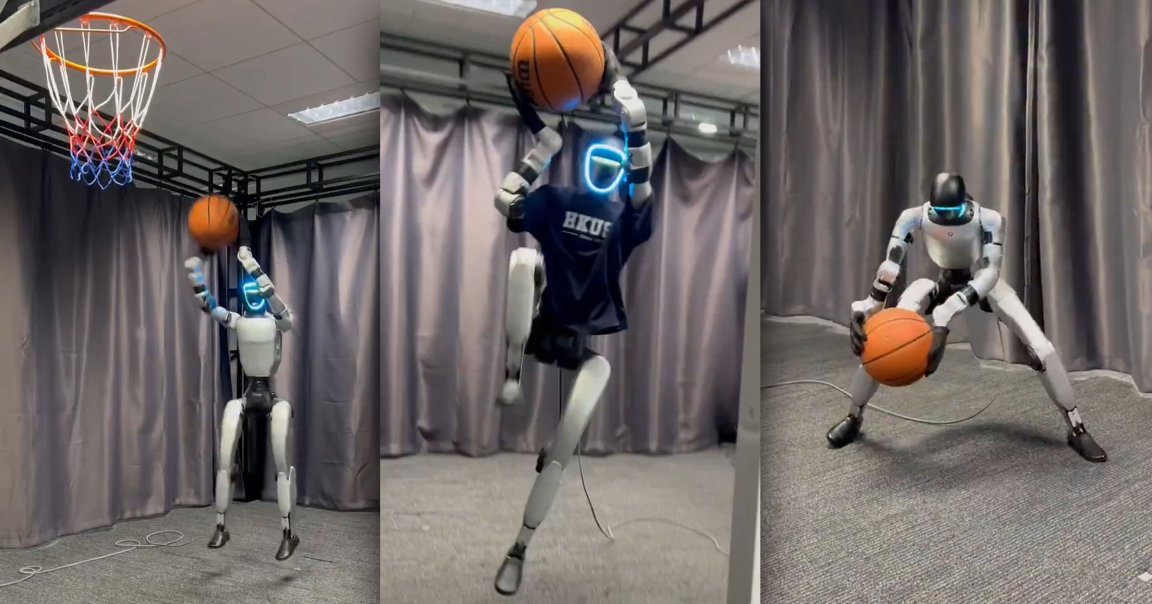
Researchers have programmed a Unitree G1 humanoid robot to play basketball, almost perfectly mimicking the skills of a human athlete.
Yinhuai via X

It’s one small step for man — and one giant, badass layup for robot kind.

Researchers at the Hong Kong University of Science and Technology (HKUST) have programmed a Unitree G1 humanoid robot to play basketball, almost perfectly mimicking the skills of a human athlete.

A video shared by HKUST PhD student Yinhuai Wang shows the robot dribbling, taking jump shots, and even pivoting on one of its feet to evade the student’s attempts to block it from taking a shot.

Wang called it the “first-ever real-world basketball demo by a humanoid robot,” boasting that he “became the first person to record a block against a humanoid.”

It’s an impressive demo, showcasing how far humanoid robotics has come in a matter of years. Unitree, in particular, has stood out in an increasingly crowded field, with its G1 rapidly picking up new skills.

We’ve seen the four-foot-four-inch humanoid perform impressive kung fu moves and easily shrug off a direct flying dropkick from an adult human. We’ve even seen two of them take each other on in a head-to-head kickboxing contest.

Wang and his colleagues are teaching robots how to play basketball through a system they’ve dubbed “SkillMimic,” which is described on his website as a “data-driven approach that mimics both human and ball motions to learn a wide variety of basketball skills.”

“SkillMimic employs a unified configuration to learn diverse skills from human-ball motion datasets, with skill diversity and generalization improving as the dataset grows,” the writeup continues. “This approach allows training a single policy to learn multiple skills, enabling smooth skill switching even if these switches are not present in the reference dataset.”

While netizens were generally impressed by the robot’s basketball skills, others were a little more skeptical.

“Love that the programmer focused on showboating rather than fundamentals,” one wrote.

“Robots will do everything but fill the dishwasher,” another joked.

Others imagined a future in which bipedal robots dominate sports.

“Man, I hope I get to see proper robotics basketball leagues,” another Reddit user mused.

More on the Unitree G1: Unstoppable Martial Arts Robot Can Take a Direct Dropkick Without Falling Down

Victor Tangermann

Senior Editor

I’m a senior editor at Futurism, where I edit and write about NASA and the private space sector, as well as topics ranging from SETI and artificial intelligence to tech and medical policy.

Posted in Uncategorized | Tagged , , , , | Leave a comment

X Eric Daugherty: Charlie Kirk nailed it.

Posted in Uncategorized | Leave a comment

New Atlas: Your brain makes drastic changes at these five points in life

Your brain makes drastic changes at these five points in life

By Michael Franco

November 25, 2025

By observing MRI scans from nearly 4,000 people of all ages, Cambridge researchers uncovered the five epochs of human brain development

By observing MRI scans from nearly 4,000 people of all ages, Cambridge researchers uncovered the five epochs of human brain development

Depositphotos

View 1 Images

In a new study, researchers discovered that the human brain has four pivotal periods when it goes through marked changes, sparking five “epochs” that last for years. The adolescent phase, for example, was found to extend into our early 30s.

To carry out the study, researchers at the University of Cambridge looked at data from 3,802 people ranging from newborns to 90 years old who had undergone MRI diffusion scans. These scans track the movement of water molecules through brain tissue, which helps scientists map the pathways of neural connections.

The study found that there are four times in our lives when the brain undergoes significant topological changes before stabilizing for a period of years. Each of these times kicks off another phase in the structure and organization of our brains, which can impact our thinking and potentially help scientists going forward better understand brain development and conditions that might impact it.

“We know the brain’s wiring is crucial to our development, but we lack a big picture of how it changes across our lives and why,” said Dr. Alexa Mousley, a Gates Cambridge Scholar who led the research. “These eras provide important context for what our brains might be best at, or more vulnerable to, at different stages of our lives. It could help us understand why some brains develop differently at key points in life, whether it be learning difficulties in childhood, or dementia in our later years.”

The first phase was found to run from birth to around age nine. This phase is marked by what’s known as “network consolidation,” during which the huge array of synapses we are born with are slowly reduced, making space for the most active ones to survive. It’s also a period of time during which gray and white matter grow quickly, leading to a peak of our cortical thickness – the brain’s outer layer which thins with age and neurological conditions like Alzheimer’s disease.

After approximately age nine, the brain enters its adolescent phase. During this phase, the brain works to make neural connections shorter, and therefore more efficient – both in specific regions and across the entire brain. Surprisingly, the adolescent phase lasts until about age 32.

After that point, the brain moves into the adult phase and that shift marks the strongest turning point in the brain’s evolution, say the researchers.

“Around the age of 32, we see the most directional changes in wiring and the largest overall shift in trajectory, compared to all the other turning points,” said Mousley.

The adult phase marks the longest epoch of brain evolution. During this time, the brain remains relatively stable with not much change happening for about 30 years. There is, however, a gradual shift toward a segregating process in which brain regions become more compartmentalized.

The next shift in brain evolution comes around age 66 and once again is nowhere near as dramatic as the changes that solidify in our early 30s. In this phase, the brain still works to reorganize itself, although that process slows and cortical thickness begins to lessen.

“The data suggest that a gradual reorganization of brain networks culminates in the mid-sixties,” said Mousley. “This is probably related to aging, with further reduced connectivity as white matter starts to degenerate. This is an age when people face increased risk for a variety of health conditions that can affect the brain, such as hypertension.”

The final phase of brain evolution kicks in around age 83. While the researchers say data for this period of time was hard to come by, they did find out that the brain begins to shift its processing from a global model to a more localized one, leading people to rely on specific regions for cognition rather than processing across the entire organ.

“Many neurodevelopmental, mental health and neurological conditions are linked to the way the brain is wired,” concluded senior study author Duncan Astle. “Indeed, differences in brain wiring predict difficulties with attention, language, memory, and a whole host of different behaviors. Understanding that the brain’s structural journey is not a question of steady progression, but rather one of a few major turning points, will help us identify when and how its wiring is vulnerable to disruption.”

The study has been published in the journal Nature Communications.

Source: University of Cambridge

We recommend

Posted in Uncategorized | Tagged , , , , | Leave a comment

The Rundown AI: Breakdown of Society Prediction?

Godfather of AI Predicts Total Breakdown of Society

Tech billionaires “are really betting on AI replacing a lot of workers.”

By Frank Landymore

Published Nov 25, 2025 11:19 AM EST

British computer scientist and AI "godfather" Geoffrey Hinton predicts the disastrous effects AI will have on our fragile society.
Illustration by Tag Hartman-Simkins / Futurism. Source: Jorge Uzon / AFP via Getty Images

Geoffrey Hinton, one of the three so-called “godfathers” of AI, never misses an opportunity to issue foreboding proclamations about the tech he helped create.

During an hour-long public conversation with Senator Bernie Sanders at Georgetown University last week, the British computer science laid out all the alarming ways that he forecasts AI will completely upend society for the worst, seemingly leaving little room for human contrivances like optimism. One of the reasons why is that AI’s rapid deployment will be completely unlike technological revolutions in the past, which created new classes of jobs, he said.

“The people who lose their jobs won’t have other jobs to go to,” Hinton said, as quoted by Business Insider. “If AI gets as smart as people — or smarter — any job they might do can be done by AI.”

“These guys are really betting on AI replacing a lot of workers,” Hinton added.

Hinton pioneered the deep learning techniques that are foundational to the generative AI models fueling the AI boom today. His work on neural networks earned him a Turing Award in 2018, alongside University of Montreal researcher Yoshua Bengio and the former chief AI scientist at Meta Yann LeCun. The trio are considered to be the “godfathers” of AI.

All three scientists have been outspoken about the tech’s risks, to varying degrees. But it was Hinton who first began to turn the most heads when he said he regretted his life’s work after stepping down from his role at Google in 2023.

He hasn’t changed his tune since then. He has consistently warned that AI will destroy jobs and create massive unemployment. This month, Hinton then injected more fatalism into this prediction by opining that the AI industry couldn’t turn a profit without replacing human labor.

In his discussion with Sanders, Hinton reiterated these risks, adding that the multibillionaires spearheading AI, like Elon Musk, Mark Zuckerberg, and Larry Ellison haven’t really “thought through” the fact that “if the workers don’t get paid, there’s nobody to buy their products,” he said, per BI.

Previously, Hinton has said it wouldn’t be “inconceivable” that humankind gets wiped out by AI. He also believes we’re not that far away from achieving an artificial general intelligence, or AGI,  a hypothetical AI system with human or superhuman levels of intelligence that is able to perform a vast array of tasks, which the AI industry is obsessed with building.

“Until quite recently, I thought it was going to be like 20 to 50 years before we have general purpose AI,” Hinton said in 2023. “And now I think it may be 20 years or less.”

Strikingly, Hinton now claims that the latest models like OpenAI’s GPT-5 “know thousands of times more than us already.”

While leading large language models are trained on a corpus of data vastly exceeding what a human could ever learn, many experts would disagree that this means that the AI actually “knows” what it’s talking about. Moreover, many efforts to replace workers with semi-autonomous models called AI agents have often failed embarrassingly, including in customer support roles that many predicted were the most vulnerable to being outmoded. In other words, it’s not quite set in stone that the tech will be to so easily replace even low-paying jobs.

Nonetheless, never put it past your overlords to find a way how to screw you over anyway. AI machines could be a great tool for carrying out imperial actions abroad; deploying AI robots to fight overseas would be great for the US military industrial complex, Hinton argued, since there wouldn’t be dead soldiers to cause “political blowback.”

“I think it will remove one of the main barriers to rich powerful countries just invading little countries like Granada,” Hinton told Sanders.

More on AI: Mark Zuckerberg Accused of Doing Unforgivable Things to Teens on Meta

Frank Landymore

Contributing Writer

I’m a tech and science correspondent for Futurism, where I’m particularly interested in astrophysics, the business and ethics of artificial intelligence and automation, and the environment.

Posted in Uncategorized | Tagged , , , , | Leave a comment

The Deep View: AI and rare diseases

Researchers reveal AI for discovering rare diseases
AI is getting better at scientific discovery. 
On Monday, a group of researchers from the Centre for Genomic Regulation in Barcelona unveiled an AI model capable of discovering previously unknown human genetic mutations that are linked to diseases, outperforming Google DeepMind’s AlphaMissense in some areas. The model could help medical professionals better understand and treat rare diseases. 
The model, called popEVE, was built in partnership with Harvard Medical School and examines the evolutionary diversity of genetic sequences for hundreds of thousands of animal species for genetic mutations to gauge whether certain ones might have negative effects. 
PopEVE was tested on 31,000 families that have kids with developmental disorders. In more than 500 cases where the kids had genetic mutations, the model was able to pick out that genetic mutation as damaging 98% of the time. 
This model is the latest example of researchers using AI to rapidly advance science. Google in particular has long been involved in AI for science, developing models for cancer cell research, protein structure prediction and genetic mutation research. OpenAI and Microsoft also have initiatives dedicated to applying AI models to scientific research. 
However, these models might not be ready to take the lead in the lab just yet. OpenAI published research last week detailing its experiments with scientists using GPT-5. The findings showed that while this tech proved useful in helping researchers “expand the surface area of exploration and help researchers move faster toward correct results,” the model isn’t capable of performing experiments or solving scientific problems autonomously.
Posted in Uncategorized | Leave a comment

The Rundown Tech: McKinsey: This is how AI is changing work

McKinsey: This is how AI is changing work
Image source: Ideogram / The Rundown
The Rundown: McKinsey dropped its AI jobs verdict: algorithms could swallow 57% of U.S. work hours. But before you panic-update your résumé, they say the future isn’t about machines replacing you, it’s about you becoming their conductor.
The details:
McKinsey pegs AI’s potential economic value at $2.9T in the U.S. by 2030 — but only if organizations redesign workflows for human-machine collaboration.More than 70% of the skills employers look for today are shared across both automatable and non-automatable roles, so there’s a large overlap. However, certain specialized cognitive skills — routine accounting, data entry, simple coding — face the biggest hit. Demand for “AI fluency” has grown sevenfold in two years, making it the fastest-growing skill in U.S. job postings.
Why it matters: The shift from execution to orchestration means your job probably survives, but only if you can pivot fast enough to manage the machines instead of mimicking them. Jobs demanding judgment, empathy, and social intelligence stay human, at least until the next breakthrough proves otherwise.
Posted in Uncategorized | Leave a comment

The Rundown: Apple’s sales team hit by rare layoffs


🍎 Apple’s sales team hit by rare layoffs
Image source: Ideogram / The Rundown
The Rundown: Apple just carried out a rare round of layoffs, cutting dozens of roles across its global sales organization in a restructuring move, as first reported by Bloomberg’s Mark Gurman.
The details:
The axe fell on account managers handling major corporate, school, and government accounts, plus staff running Apple’s enterprise briefing centers. Management broke the news over the past couple of weeks, with employees saying the cuts blindsided them, given Apple’s famous aversion to layoffs. Apple says the restructuring is meant to “streamline” how it reaches customers and strengthen engagement, while insisting it is still hiring.
Why it matters: While Meta, Google, and Amazon slashed tens of thousands of jobs in 2023–2024, Apple mostly sidestepped the carnage, limiting cuts to specific projects. These layoffs remain minor compared to Apple’s total workforce, but notable in that the tech giant looks to generate record sales of $140B in the December quarter.
Posted in Uncategorized | Leave a comment