
-
Archives
- October 2026
- September 2026
- August 2026
- July 2026
- June 2026
- May 2026
- April 2026
- March 2026
- February 2026
- January 2026
- December 2025
- November 2025
- October 2025
- September 2025
- August 2025
- July 2025
- June 2025
- May 2025
- April 2025
- March 2025
- February 2025
- January 2025
- December 2024
- November 2024
- October 2024
- September 2024
- August 2024
- July 2024
- June 2024
- May 2024
- April 2024
- March 2024
- February 2024
- January 2024
- December 2023
- November 2023
- October 2023
- September 2023
- August 2023
- July 2023
- June 2023
- May 2023
- April 2023
- March 2023
- February 2023
- January 2023
- December 2022
- November 2022
- October 2022
- September 2022
- August 2022
- July 2022
- June 2022
- May 2022
- April 2022
- March 2022
- February 2022
- January 2022
- September 2021
- August 2021
- July 2021
- June 2021
- May 2021
- April 2021
- February 2021
- January 2021
- December 2020
- November 2020
- October 2020
- September 2020
- August 2020
- July 2020
- June 2020
- May 2020
- April 2020
- March 2020
- February 2020
- January 2020
- December 2019
- November 2019
- October 2019
- September 2019
- August 2019
- July 2019
- June 2019
- May 2019
- April 2019
- March 2019
- February 2019
- January 2019
- December 2018
- November 2018
- October 2018
- September 2018
- July 2018
- June 2018
- May 2018
- April 2018
- March 2018
- February 2018
- January 2018
- December 2017
- November 2017
- October 2017
- September 2017
- August 2017
- July 2017
- June 2017
- May 2017
- April 2017
- March 2017
- February 2017
- January 2017
- December 2016
- November 2016
- October 2016
- September 2016
- August 2016
- July 2016
- June 2016
- May 2016
- April 2016
- March 2016
- February 2016
- January 2016
- December 2015
- November 2015
- October 2015
- September 2015
- August 2015
- July 2015
- June 2015
- March 2015
- January 2015
-
Meta
‘Netanyahu is amalek’ … being aware is essential as the world is being consumed by wars
Posted in Uncategorized
Leave a comment
A Psychiatrist interested in World Politics. “…EXPOSES the Sickness of Collective West Leaders. Clinical Psycopaths Dr Niall McLaren”. Think about Tribalism.
Mar 29, 2026 Interviews
What if the world at the moment seems insane because the people running its conflicts are in fact clinically psychotic? This is what I discuss today with the retired psychiatrist Dr. Niall MacLaren. We talk about his biocognitive model and how a craving for dominance dictates the actions of modern empires. His book, Narcisso-Fascism, explains why nations act like playground bullies and why we keep electing narcissists who love the rush of power. It is a deep dive into the testosterone economy and the biological reasons why peace is so hard to find in a world obsessed with being number one. Links: Niall MacLaren Substack: https://niallmaclaren.substack.com Niall MacLaren Amazon: https://www.amazon.com/stores/author/… Neutrality Studies substack: https://pascallottaz.substack.com
Posted in Uncategorized
Leave a comment
JNS: Iran’s Revolutionary Guards begin recruiting 12-year-olds
Iran’s Revolutionary Guards begin recruiting 12-year-olds
Children are being enrolled for checkpoint duty and logistics.
Mar. 28, 2026

( Mar. 28, 2026 / Israel Hayom )
Iran’s Islamic Revolutionary Guard Corps has lowered the minimum age for participation in war-support roles to 12, a senior official acknowledged on state television, in remarks cited by the Iran International news channel.
Rahim Nadali, a cultural official in the IRGC’s Tehran branch, said an initiative called “For Iran” has been recruiting participants to assist in activities such as patrols, checkpoints and logistics. According to him, most of the minors being recruited are being directed to the Basij paramilitary militia, which is responsible for suppressing opposition to the regime.
“Given that the age of those coming forward has dropped and they are requesting to participate, we lowered the minimum age to 12,” he said, adding that children aged 12 and 13 can now join. The remarks were broadcast as part of state media coverage of the war effort.
The move comes despite Iran’s commitments under the Convention on the Rights of the Child, which prohibits the use of children in military activities.

For weeks, the U.S. and Israeli air forces have been targeting Basij personnel, who have suffered heavy casualties. Morale among Basij gunmen has plummeted, driven by fear of strikes on checkpoints and headquarters, with many forced to sleep in streets and mosques. Videos circulating on Iranian social media show Basij members fleeing in panic after civilians play drone sounds through their mobile phones.
Originally published by Israel Hayom.
- CopyLink copied
Posted in Uncategorized
Leave a comment
Axios: New AI models empower hackers
| New AI models empower hackers |
 |
| Illustration: Brendan Lynch/Axios |
| Top AI and government officials tell Axios CEO Jim VandeHei that Anthropic, OpenAI and other tech giants will soon release new models that are scary good at hacking sophisticated systems at scale. The one to watch: Anthropic is privately warning top government officials that its not-yet-released model — currently branded “Mythos” — makes large-scale cyberattacks much more likely in 2026. The model allows agents to work on their own, with wild sophistication and precision, to penetrate corporate, government and municipal systems. It’s a hacker’s dream weapon. Jim reveals in his new weekly newsletter for CEOs that one source briefed on the coming models says a large-scale attack could hit this year. Businesses are ripe targets. (C-suite only: Request beta of Jim’s newsletter.) Fortune got its hands on an unpublished Anthropic blog post describing Mythos. The post said the model is “currently far ahead of any other AI model in cyber capabilities. “The post adds that Mythos “presages an upcoming wave of models that can exploit vulnerabilities in ways that far outpace the efforts of defenders. “So the threat is no longer theoretical, and will be exacerbated by employees testing agents without realizing they’re making it easier for cybercriminals to hack their company. Here’s why this is different: The new models are even better at powering agents to think, act, reason and improvise on their own without rest or pause or limitation. Think of a warehouse full of the most sophisticated criminals who never sleep, learn on the fly and persist until successful — except the warehouse is infinite. Bad actors can now scale simply with more compute. They aren’t limited by finite personnel. A single person can run campaigns that once required entire teams. At the same time, systems are more vulnerable because so many employees are firing up Claude, Copilot or other agentic models — often at home — and creating agents of their own. They often connect to their internal work systems unwittingly, opening a new door for cybercriminals to enter. The industry has a name for this: “shadow AI.” A Dark Reading poll found that 48% of cybersecurity professionals now rank agentic AI as the No. 1 attack vector for 2026 — above deepfakes, above everything else. The bottom line: Everyone working at every company in America needs to know right now the dangers of using agents, especially unsupervised, anywhere near sensitive information.Share this column. |
Posted in Uncategorized
Tagged ai, artificial-intelligence, chatgpt, cybersecurity, technology
Leave a comment
EL PAIS: Psychoanalyst Stephen Grosz: ‘Some people find unhappiness more comfortable than surrendering to love’. Comment: Read “The Unexamined Life”. Highly recommend it for insight to self, others and psychoanalysts
Select:

Psychoanalyst Stephen Grosz: ‘Some people find unhappiness more comfortable than surrendering to love’
The expert, who has worked with patients for more than 40 years, has published ‘Love’s Labor,’ a book about what he has learned from the pain that human relationships can cause
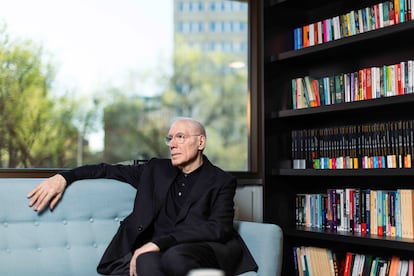

Madrid – MAR 29, 2026 – 06:00 CEST
“For one human being to love another: that is perhaps the most difficult of all our tasks, the ultimate, the last test and proof, the work for which all other work is but preparation.” This quote – from the Austrian poet Rainer Maria Rilke – opens the second book by Stephen Grosz, titled Love’s Labor: How We Make and Break the Bonds of Love (2026). The 73-year-old Indiana-born psychoanalyst – who has lived and practiced in the United Kingdom for more than four decades – believes that love isn’t a state one arrives at, but rather, a task one undertakes… and one that we almost always do poorly.
His first book – The Examined Life, published in 2013 – was a phenomenon: number one on the British bestseller lists, translated into more than 30 languages and adapted for the stage. The New York Times described Grosz as “a combination of Chekhov and Oliver Sacks.”
Labor of Love is its sequel: 12 real-life case studies – with names changed – about the fears, deceptions and losses that prevent us from truly connecting with those we love (or those we think we love).
The book has recently been translated into Spanish. Grosz welcomed EL PAÍS at his publisher’s office in Madrid. He speaks in a measured voice with such kindness and empathy that the interview often feels more like a therapy session.
Question. “For one human being to love another: that is perhaps the most difficult of all our tasks.” This is the quote by Rilke, which you chose for the epigraph. But most people don’t think of love as a task…
Answer. We tend to think of love as a feeling. [But I liked the idea expressed by Rilke] , because we have to work to see ourselves clearly, our beloved clearly, the world clearly… We live in a world where everything is quite confused; [many people think] that what they feel is true. We have to join the world as it is, not as we imagine it to be.
Q. And yet, there’s a deeply ingrained cultural tradition that says when love starts to require effort, it’s no longer love…
A. I’m friends with the British poet Wendy Cope. She’s wonderful. [And she says,] well, there’s the fun bit, at the beginning. That’s when we’re talking about excitement and romance and dating and eroticism… all the pleasures. Real love is the difficult thing that starts when you care about someone. And, if you really do care, you have to start listening. It’s hard to really hear what your partner needs.
Sometimes, people like myself – men – will often go,“Oh, you know, I just want to fix things very quickly.” But they won’t listen. And sometimes their partner just wants to be heard. They want to be seen and recognized.
Q. In the book, you distinguish between surrender and submission. Why is that important?
A. Submission is a kind of masquerade or performance of surrender. When we really love someone, we involuntarily just let ourselves go to them. [We surrender]. Submission is much more transactional. It’s saying, “I’ll be the person you want me to be.” [But after a while], people can start to feel bitter. Surrender is different. It means accepting the reality of love. That it’s going to end. That it doesn’t go on forever. That I’m not perfect and the other person isn’t perfect. But it’s the [feeling] of being deeply accepted. Which is a very different experience.
Q. How can someone recognize if they’re in a dynamic of submission in a relationship?
Q. One of the most complex cases in the book is that of Sophie. She’s in love with her fiancé, but even so, she can’t send out the wedding invitations. Why can getting married feel like a loss?
A. I think people recognize submission pretty quickly. A person in [this kind of] relationship will say, “I did all the things you wanted.” But what builds up is a kind of resentment underneath the surface. With surrender, it’s more involuntary. There has to be a sort of equality for there to be real intimacy. Not “I’m going to give you everything and then, you’ll give me this.”
A. [Because] it is. You’re giving up your birth family to make a new unit. Sophie is an only child. [She and] her parents are very attached. People don’t think that a wedding is a moment of loss… but it is. And, for some people, there is such a feeling of loss that they can’t get married. I see that more now, with young people. Parents are so involved with their children. It’s good [when] parents are very romantic and loving to one another. It can then push the child to want to have their own life.

Q. Does having children change love?
A. I think it can. That’s one of the big problems now. You can even see [this change] in literature. I think books used to be very much about the relationship between men and women, or between people of the same sex, in the 1960s, ’70s and ’80s… but increasingly, they’re about children and parents’ relationship with their children. There’s so much focus on that. One of the great problems is that, after people have children, they don’t sexually find each other again. This is a huge problem that therapists talk about. People are so focused on their children that they lose sight of the couple that they’re a part of. And they think that’s better for the children. But what I’m trying to say is that it doesn’t help them.
Q. Sophie returns to therapy decades later. Her husband has been unfaithful. And she sees the infidelity as an opportunity to escape the marriage without anyone judging her. But you conclude that she was never truly married…
A. Yes. Her problem wasn’t whether to stay or leave. It was that she had always maintained a distance. Unhappiness felt safer to her than surrender.
Some people don’t change. And they stay attached to their unhappiness. There’s a paradox: if you’re raised in a family where there’s a lot of unhappiness, that’s sort of what you know… it’s what’s familiar. So, later in life, when you open a door and step into things which are happy and pleasurable, I find that some of my patients then drift back toward unhappiness, because it’s familiar.
Q. Can someone unconsciously prefer suffering?
A. Unhappiness, or suffering, is my ally: that’s why people come to see me. But it’s only over time that you might get to a point where you say, “wait a minute, they were motivated… but now, they’re not.” And they’re actually finding it more comfortable to stay in this place. And that’s really sort of the limit of a therapist’s skill. [After a while], they’re unhappy and I’m unhappy. They’re not getting better and I’m thinking that “this really isn’t working” after a certain point. I take my work to my colleagues – we’re in a group where we discuss our cases – and they’ll say, “enough is enough. It’s time to help this person see someone else.”
Q. Are there differences in how men and women experience love?
A. Women seem to be much more comfortable and fluid in their sexuality; [they’re] more relaxed about their relationships with women. But that makes sense, because when you think about it, we all love a woman first. We all love our mothers. For women, that’s part of their femininity. And men [also] begin [life] loving their mother. They identify with their mother. When you ask little boys what they want to be when they grow up, they say, “I want to be mommy.” We all want to be our mothers! Now, this is very important, because later on in life, when men are called “sissies,” they learn or internalize [that it’s wrong to be] a “mama’s boy.” Boys are socialized out of their femininity.
Q. And we’re seeing that clearly in politics right now…
A. Politically, it’s a huge thing. Part of Trump’s success, for example, [has come from] feminizing his opponents. They’re weak, they’re small… You have to think about why California elected Arnold Schwarzenegger as governor. Or, in Minnesota, Jesse Ventura, a wrestler. In England, we say things like “the nanny state.” We feminize things to put them down. What Trump does with European leaders is to feminize them. Like “Keir Starmer is weak,” or the way he speaks about Macron.
Q. There’s a case in the book that’s particularly brutal: a man struggles with intense grief for years after his partner’s suicide, unable to operate. Are there losses that simply can’t be processed?
A. I wanted to put that in because, first of all, when we fall in love, we never know where it’s going to end. I very much believe in human courage. I’ve had people in my consulting room who have lost a child, people who have been diagnosed with cancer and have a very short time to live… people who have degenerative neurological diseases. And, each week, I see them get worse.
But you know, we’re amazing. People are incredible in their capacity to face these things… [That is], if they feel that they’re being listened to. If they feel that someone is thinking about them. When [your] story and feelings are being heard, we can face almost anything. You feel that you’re with someone, that you’re not alone.
Q. We live in the age of accelerated “self-knowledge.” There are self-help books, meditation apps, chatbots to talk to about our problems… are they useful?
A. I had a patient come in recently who said, “You weren’t around last week” – it was Christmas – “so I did therapy with AI.” With all this self-help, there’s a kind of externalization. What AI does is that it gives a bit of a performance of consciousness and empathy. But when a patient sits with me in a room, I’m thinking about [them], about their experience… AI isn’t going to die. It doesn’t have to face mortality. There’s a bond when there are two people sitting [in a room] together which doesn’t happen through a self-help book or through AI. With therapy, something is shared between two people. So, actually, I’m very optimistic about psychoanalysis, about therapy, in the future.
Q. What’s the most important lesson you’ve learned in your 40 years as a practicing psychoanalyst?
A. I think the problems people bring [me] are still fundamentally the same sort of problems. They’re problems about wanting to be seen, listened to, heard, recognized. I think those are the things that haven’t changed – the crucial things. I was 31 when I started, and I thought that pain was something to get rid of. I now see that pain – and I say this in the book – is the best instrument we have for understanding what we desire. It’s actually really important to listen to suffering.
Sign up for our weekly newsletter to get more English-language news coverage from EL PAÍS USA Edition
Seyed Abbas Araghchi on X
·
Israel has hit 2 of Iran’s largest steel factories, a power plant and civilian nuclear sites among other infrastructure. Israel claims it acted in coordination with the U.S. Attack contradicts POTUS extended deadline for diplomacy. Iran will exact HEAVY price for Israeli crimes
Posted in Uncategorized
Leave a comment
Carl Jung: Be careful With Trauma-Born Empath Loners – 1% only survive
Posted in Uncategorized
Leave a comment

