Yesterday the Trump administration indicted Raúl Castro.
Now the question—in Washington as much as Havana—is if Trump is preparing another regime change campaign in the Caribbean. But he’d do well to remember that Cuba is not Venezuela, says Eurasia Group’s Latin America expert Risa Grais-Targow.
Welcome back, Tuesday team. Today’s newsletter, edited by Alex Fitzpatrick and Natalie Daher, is 762 words, a 3-min. read. Thanks to Sheryl Miller for copy editing.
1 big thing: Hormuz hangover
Illustration: Aïda Amer/Axios
Even if a U.S.-Iran deal lands, the oil market will look different from its pre-war version, Axios’ Ben Geman writes.
Why it matters: The emerging deal — which would reopen the Strait of Hormuz while nuclear talks proceed — could return large numbers of barrels to the market, but it will take time.
Related: U.S. Central Command disputed reports today that the Navy restarted escorting commercial vessels through the strait.What we’re watching:
1. Confidence: Vessel owners and crews need to feel safe transiting the world’s most important energy shipping line. It’s unclear they will, said oil analyst Ben Cahill of UT Austin.
2. Timelines: The International Energy Agency estimates at least two to three months are needed to reestablish steady exports after mines are cleared.PersianGulfcountries need time to resume production that declined after the main export route was cut off.
3. Definitions: What “open” means for the strait is unsettled.Iran may notcall it a toll, but Iranianofficials are floating new fees on tankers.This could be a boon to Iran even if the fee is relatively small, said Edward Fishman, an ex-State Department aide at the Council on Foreign Relations.
4.Vibes and market risk: Before the crisis throttled supplies, there was debate in oil circles about whether markets were blasé about threats to infrastructure or shipping.Even once the crisis passes, watch the level of geopolitical risk premium — the market’s willingness to preemptively price in risk — that elevates prices.
5. U.S. oil production: Higher prices will likely push producers to increase output, as the broader market went from oversupplied to tight.
Between the lines: Restoring Gulf shipping, rebuilding crude inventories and restarting shuttered production will take months, Bloomberg Intelligence analysts said in a note today.
That delay makes the timing of steep pump price cuts more uncertain.
Data: Trust for Public Land. Table: Alex Fitzpatrick/Axios
The pickleball craze may be cooling off, Alex Fitzpatrick writes from new Trust for Public Land data.The number of pickleball courts across the 100 most populous U.S. cities increased just 4% from 2025 to 2026.That’s compared to 13%–14% growth in each of the previous two years. Garden spending is up 8%, disc golf is up 4% and outdoor fitness zones are up 3%.Reality check: Parks in the country’s biggest cities now have 3,765 pickleball courts, TPL says. That’s up nearly 900% from 2017. Will Klein, TPL’sdirector of parks research, tells Axios that the slowdown “mirrors what we’re seeing more broadly in parks systems nationwide, where local leaders are balancing tighter budgets, aging infrastructure, and growing demand for many different kinds of recreational amenities.”Go deeper.
A MESSAGE FROM GOLDMAN SACHS
Oil disruption is driving U.S. consumer inflation
Rising prices, driven by disruptions to the flow of oil from the Middle East, are having a measurable impact on U.S. consumers, according to Goldman Sachs Research.The impact: Low-income households are facing the biggest hit proportionally.Read the outlook for U.S. consumer inflation.
The Class of 2026 is set to make history – and shape the future – when the humanoid training center opens its doors in July
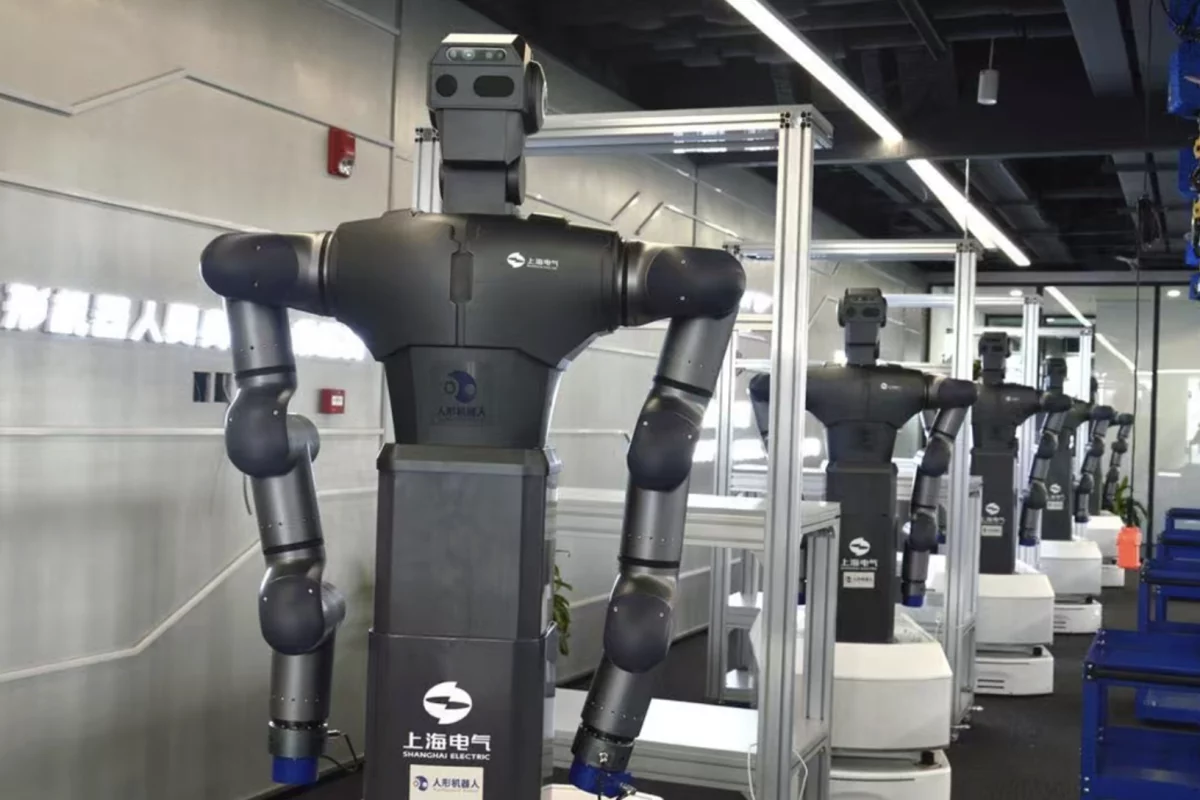
National and Local Co-Built Humanoid Robotics Innovation Center/People’s Daily Online
The first humanoid “training school” for robots of all shapes and sizes will open its doors in July, bringing together more than 100 different models made by a host of companies. As well as mastering real-world skills, the humanoids will provide unique data that’ll be used to advance the bots that follow in their footsteps.
For some, this sounds like a dystopian nightmare, but if you’ve been lucky enough to spend time witnessing the emergence of this technology first-hand in China, as I have, it’s hard not to be excited about the country’s first heterogeneous humanoid training center. Here, more than a dozen companies have enrolled 100-plus robots to take part in the pilot training program at the 5,000-square-meter (53,800-sq-ft) facility in Shanghai’s high-tech heart of Zhangjiang (张江).
Here, they will finetune their motor skills in order to ease into everyday life for people who can afford a domestic bot, as well as master tasks needed for specialized workplaces across the country. Then, millions of data points gathered from this inaugural Class of 2026 will be used to train larger and even more diverse robots at a faster rate. Depending on their capabilities, the humanoids are expected to be trained to work in a variety of fields including industrial, medical, service and agriculture.
It’s also worth noting here that this facility and the groundwork it’s laying are key aspects of China’s robotics industry. The sector operates more like a tech ecosystem – from startups to established companies – centered around crowded clusters of manufacturing and innovation hubs. With this comes the sharing of infrastructure, hardware suppliers and components between tech firms. Of course, there’s still plenty of competition, but there’s also collaboration. Which, generally speaking, results in faster, cheaper and more efficient advances. And this robot training school is a pretty good reflection of that.
Operated by the National and Local Co-built Humanoid Robotics Innovation Center, the new facility, which has been a few years in the making, will train a wide range of humanoids, with two goals. Firstly, to get these models ready for life in the real world – and also to build a massive database of learning intel to help future facility intakes of robots get up to speed quicker.
The first lesson will be how to actually grip a book (not confirmed)
As the facility’s general manager Xu Bin told People’s Daily Online, the center is designed to advance the humanoid robot industry through shared technologies and fine-tuning the robots for real-world use.
“We established the center to enable large-scale data sharing and utilization, empowering the entire industry,” Xu said.
The diversity of the robots – which come in all shapes and sizes and have varying degrees of movement – will help researchers gather data on performance, strengths and ways to best work with specific humanoid designs in the future.
The “students” will have no time for R&R, with the robots expected to begin their learning by mastering 45 “atomic skills” including grasping, picking, placing and transporting items, crucial for the humanoids to function in industries like hospitality and in factories.
“The embodied robots being trained at the center are expected to accomplish more complex tasks requiring a sequence of actions based on their autonomous judgments formed through searching and matching the data collected through training,” Yang Zhengye, director of market systems at the center, told People’s Daily Online.
Much like my own experience in the science laboratories at university, the robots will need to understand directives from their human teachers, then follow through with the task on their own. They’ll also be put through more repetitive drills, like the surprisingly difficult art of grasping objects like humans can. This has been one area of movement that robots in the past have struggled with – yes, looking at you, Neo – but will be integral to their integration into fields that depend on precision and, well, knowing when to let go of a frying pan when it’s time to. (Though perhaps the joke is on that YouTuber who spent US$80,000 on his pan-flipping-and-tripping Unitree G1 late last year, which you can now buy for $13,500.)
The robot training center’s primary focus will be on gathering all the data possible, across a diverse collection of robots, in an effort to be able to fine-tune methods to teach new bots old tricks. According to the paper, a scientist may be tasked with watching and guiding a humanoid as it performs a single core movement or action up to 600 times a day, collecting important data along the way.
The 2026 class of assorted robots will primarily be trained to master 10 key tasks needed for work in the industries they’re most likely to be deployed to – domestic labor (of course), in industrial settings and in tourism. And while humanoids have come a very long way in a few short years, they still have some work to do when it comes to what we’d consider basic tasks: folding clothes, moving objects from one spot to another, tidying shelves and cleaning equipment. Incidentally, folding a T-shirt is one of the most challenging jobs for a robot as this article explains. (Just wait until someone introduces them to fitted sheets.)
Yang added that the training center, which is expected to be fully operational in July – and hopefully New Atlas will be able to check it out – will generate around 50,000 data points each day, amounting to an incredible 10 million pieces of intel a year. This critical foundational work will help China fast-track training and spot problems regardless of model.
True to China’s collaborative system, the center is also expected to create a data-exchange model for robotics firms to access and allow them to to focus on specific industries for their products, like healthcare, and to improve efficiency. Consider it home schooling, but with robust scientific data at the center of the curriculum.
And that’s not all. The mountain of data will be pooled, creating a general purpose robot (can we call it “Student Zero”?) – a model that will represent the wide range of humanoids being trained at the center. Yang told the news outlet that this “super brain” will allow robots of all shapes and sizes, developed by different manufacturers, to learn and advance together. And while this may sound like some sinister sci-fi movie arc, China’s focus is more about progress than power, supporting its community – be it human or machine.
Meanwhile, some robots skipped ahead to go straight into the workforce – where 3,000 machines work alongside humans in this Chongqing, China mega-factory.
Discovering a sensory quirk in patients sent Robert Freedman on a decades-long quest for genetic and biological clues
Spring 2026
by Molly McDonough
4 minute read
Profile
Robert Freedman Photo: Timothy Archibald
Robert Freedman, MD ’72, was standing in front of his psychiatry class, and he was floundering.
The assignment was to present a case study of his patient with schizophrenia, who was sitting just a few feet away, to his HMS classmates and professor. The professor pressed Freedman for details about the patient’s parents — this was the early 1970s, after all, when schizophrenia was largely understood as the legacy of insensitive or even cruel parenting. But Freedman didn’t know the answers, and he was mortified.
Afterward, Freedman asked the patient how he’d felt during the ordeal. The man’s response came as a surprise: “The air conditioner was very interesting.” While the professor was probing his family history, Freedman’s patient was focusing on voices he heard in the drone of the unit overhead.
“I realized for the first time that we had overlooked an interesting sensory problem,” recalls Freedman. It was a moment that foreshadowed the arc of his career: a shift away from searching for answers in family narratives and toward uncovering the brain circuitry that shapes how people with schizophrenia filter the world.
Freedman originally wanted to be a lawyer. But a social science requirement at Harvard College landed him in the classroom of cognitive psychologist George Miller, who fascinated Freedman by framing schizophrenia as some kind of psychedelic mind experiment. “I decided then and there to go into medical school instead,” he says.
At HMS, working under psychiatrist John Allan Hobson, MD ’59, and neurophysiologist Stephen Kuffler, Freedman was introduced to electrophysiology, the study of the brain’s electrical signals. After a research stint at the NIH and a psychiatric residency at the University of Chicago, he joined the faculty at the University of Colorado and began applying skills he’d honed at HMS to clinical research on schizophrenia.
As he got to know more patients, the romantic view that first captivated him gave way to an understanding that the delusions of schizophrenia are more terrifying than mind-expanding, but his interest only increased. “People with schizophrenia have enormous creative abilities,” Freedman says. “I admire them for what they struggle against when the world around them is threatening and they just keep plugging away.”
Early on, Freedman figured out a way to measure the sensory issues he’d suspected: a test consisting of two clicking sounds. In a neurotypical brain, the first click evokes a slew of electrical activity as the person directs attention to the sound — but subsequent clicks evoke less. The brain, constantly exposed to more information than it can process, must weed things out. But people with schizophrenia tend to show as much electrical activity in response to the second click as the first, indicating possible deficiencies in that weeding process.
The idea we could prevent schizophrenia is far out there, but it essentially just fell out of the science.
Freedman traced this phenomenon to the hippocampus, where a neurotransmitter called acetylcholine activates receptors that help dampen repeat signals. If that circuitry was malfunctioning, he wondered, could the issue be genetic?
To find out, he hopped in a van and crisscrossed Utah and Colorado searching for large families with multiple cases of schizophrenia. He traced the faulty click response through those family trees, making it a genetic clue: By comparing the DNA of relatives who failed the test with those who didn’t, he zeroed in on a gene called CHRNA7, which encodes the receptor that acetylcholine triggers in the brain’s filtering process.
Freedman tried using different drugs to manipulate that receptor in patients, but results were modest. Then, one day in the shower, he had a realization: Babies of parents with schizophrenia are more likely to fail click tests within weeks of birth. Perhaps by the time a person is born, the hardware is wired, and intervening in adults is too late.
In the fetal hippocampus, receptors for acetylcholine are abundant, but the neurotransmitter itself doesn’t surge until just before birth. Until then, the fetus relies on choline, a nutrient from the mother’s diet, to activate the receptors. But many women are choline deficient, and some fetuses have impaired CHRNA7 function. If mothers don’t get enough choline to activate the fetus’s receptors at the right time, could the circuitry fail to form properly?
In clinical trials, Freedman and colleagues found that newborns whose mothers received extra choline — including newborns with impaired CHRNA7 function — had improved results on the click test compared to those whose mothers did not. As they grew into toddlers, they demonstrated improved attention and social engagement. The work suggests that supporting the brain at the right moment could reduce biological risks for traits linked to schizophrenia, as well as for related conditions like autism and ADHD.
While more trials are ongoing, demonstrating that choline prevents schizophrenia would take decades, as the illness is usually diagnosed in young adulthood. But choline has many benefits for developing fetuses, is relatively safe, and doesn’t require a prescription. It’s a departure from the traditional pharmacology of schizophrenia, which relies on dopamine- blocking drugs with severe side effects.
“I’ve kind of been out in the wilderness looking at acetylcholine and this strange receptor,” Freedman says. “The idea we could prevent schizophrenia is far out there, but it essentially just fell out of the science.”
Despite focusing on just one of many genes that could raise the risk of schizophrenia, Freedman has played a central role in linking the condition to biology. That contribution made him a main character in the 2020 book Hidden Valley Road, which follows the Galvins, a family he met on his Colorado van trips. Six of 12 Galvin children developed schizophrenia, offering an extraordinary opportunity to study the genetics of the disease. Freedman says he’s grateful for the attention the book brought, if only because it helped him spread the word about prenatal choline.
These days, another role competes for his time. He recently moved to San Francisco to be closer to his four grandchildren. After decades studying how brains are built early in life, the subject now feels personal. His greatest pleasure has been “the really great kids in our studies and in our families,” he says. “That’s what it’s all about.”
Molly McDonough is the associate editor of Harvard Medicine.
A collection of features and graduate profiles covering Harvard’s 375th Commencement.
Sanders Theatre swelled with poetry and music, orations and awards on Tuesday morning, at the unofficial kickoff to Commencement week.
These were the 234th literary exercises of the University’s chapter of Phi Beta Kappa, inaugurating Harvard College’s top-performing juniors and seniors into one of the nation’s oldest academic societies.
But the celebrations were cut liberally with injunctions and warnings — sometimes stern — about the great responsibilities that fall upon new chapter members, half of whom are poised to graduate on Thursday.
The intellect and drive of these students are not in question: The chapter admits, at most, only one in 10 undergraduates based on their academic performance. But throughout the 90-minute program, speakers insisted that, on their own, intellect and drive are not enough — for responsible citizenship, or even for a meaningful life.
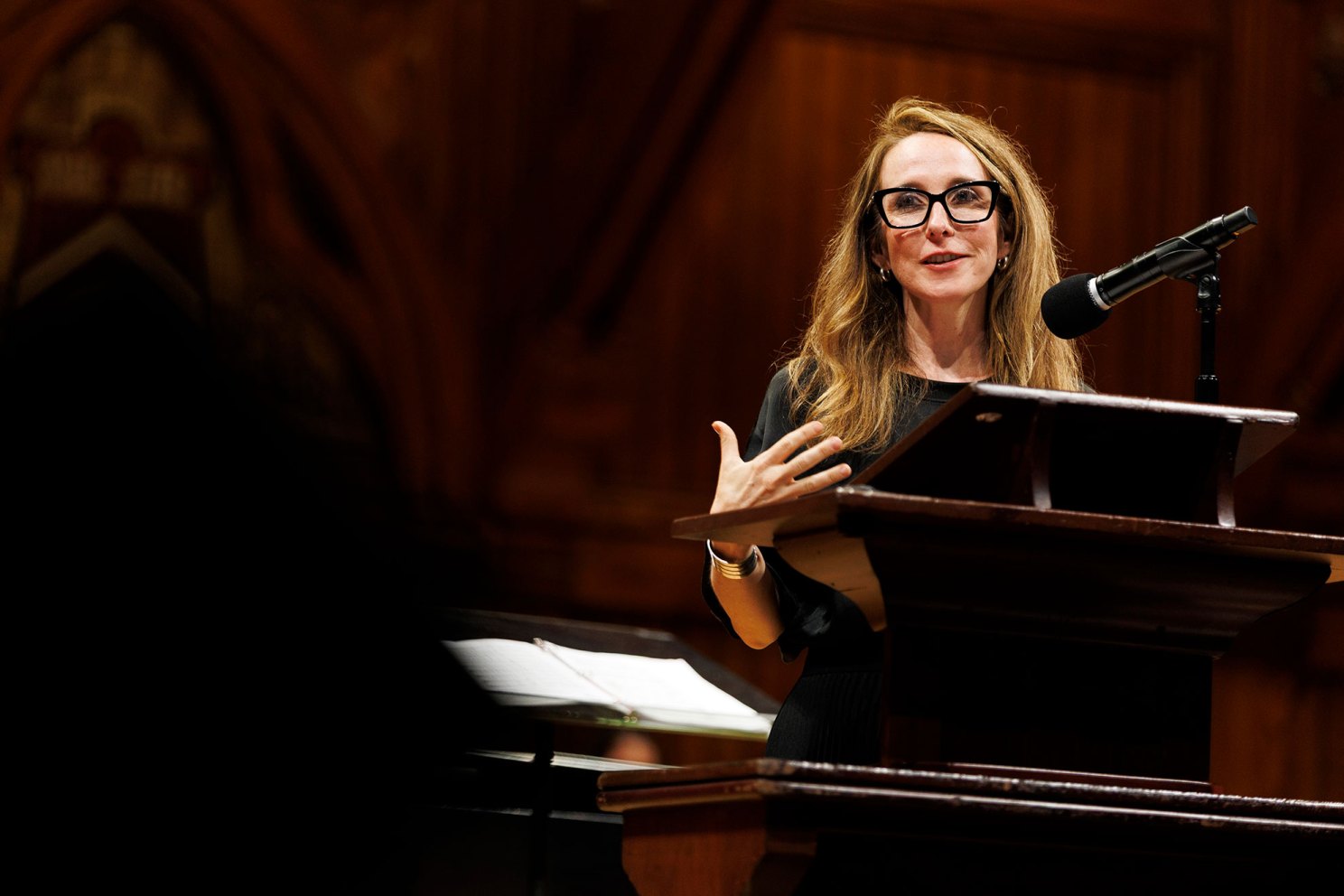
The chapter’s new members were enjoined to keep, and cultivate, their intellectual courage, in an opening invocation by the Rev. Matthew Ichihashi Potts, the Pusey Minister, and by Meghan O’Rourke, the exercises’ poet.
Potts’ invocation followed on Ralph Waldo Emerson’s famous address at the 1837 exercises. “The scholar’s basic task is a form of bravery,” Potts said. “The scholar turns toward danger, and by taking courage to comprehend that danger, defies it.”
O’Rourke — herself a PBK graduate of Yale, and now a professor and editor on that campus — noted that as she joined the society ahead of graduation, she felt “proud to have done what was asked of me, and done it well.”
The difficult part comes next, she said, as each young person figures out “what you are going to ask of yourself.”
It is frightening work, she said, drawing upon the tradition of James Baldwin, who was a teenage preacher long before he was a writer.
Baldwin came to see the two roles as almost antithetical, she noted: “‘When you are standing in the pulpit, you must sound as if you know what you’re talking about. When you’re writing, you’re trying to find out something that you don’t know … [even] what you don’t want to know.’”
O’Rourke read three poems, the last of them a recently finished reflection on holding her young son in the predawn hours: “Did You Use Your Time?”
It was long in coming, she said, begun in the immediate aftermath of mass killings at two mosques in Christchurch, New Zealand, in 2019.
My son’s skin, water-soft, is still unmarked And he holds a bear in his left hand And looking at it, he says, “I love you, Mr. Bear.” And what can I say? I can’t say, “The love you have for animals Doesn’t stop you from eating them.” We have already compromised you. There is everything you can do And nothing to do, and everything to do. And when you are old … To whom will you tell How much you loved the world?
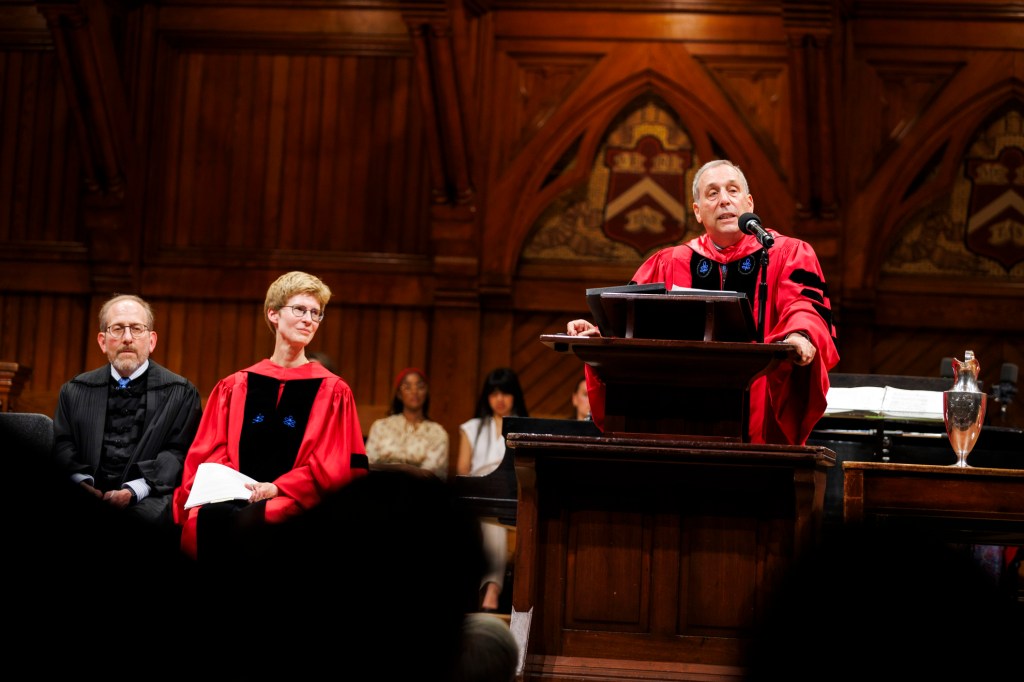
Then came the formal address, delivered by President Emeritus Larry Bacow. As he looked over the crowd of mortar-boarded students, Bacow smiled and said: “You are some of the most ambitious people in the world.
Orator Larry Bacow with President Alan Garber (from left) and Karen Thornber.
“I don’t say that as a criticism. Ambition is not a vice; it is in many ways what brought you here, not just to Harvard, but here, today, to Phi Beta Kappa.” Bacow added. (He was himself part of MIT’s inaugural PBK class in 1972.)
“But there’s a version of ambition [that] curdles into something else: an ambition that is never satisfied, that treats every achievement as merely a platform for the next one,” he said.
At times, Bacow — an economist and administrator, a lifelong student of institutions — sounded despairing about the current political moment.
Things he thought of as sources of consensus — like truth and universal human dignity, kindness and the rule of law — are “not as secure as we once believed.”
Bacow’s talk turned on the teachings of Simeon ben Zoma, a second-century Talmudic sage, who sought to overturn the commonplace understandings of power and achievement of his time.
“Who is wise?” ben Zoma asked. “One who learns from all people. Who is wealthy? One who rejoices in his portion.”
The powerful, ben Zoma found in turn, are those who “exercise self-control.”
It was that teaching that Bacow wanted to stress, given the moment.
The class of 2026, who came to Harvard amid the most profound disruptions associated with the pandemic, will leave campus with war raging in the Middle East, and as AI begins an unpredictable upheaval of the human intellectual enterprise as it has played out for millennia.
In remarks aimed — though never by name — at some among the nation’s ruling class, Bacow said, “We are surrounded by people who have confused the ability to compel others with genuine strength.”
Self-control, then, Bacow said, is not just a private virtue but a public duty — critical to finding remedies for our most urgent crises.
“Your election to Phi Beta Kappa tells us something about your minds. What you do next will tell us about your character,” Bacow said. “The world does not need you to be merely clever. It needs you to be good.”
Travis Tucker ’26 (left) and Ziad Ben-Gacem ’29 lead the procession on fife and snare drum through Harvard Yard.
Iranian president says economic resilience is the primary battle against the US and Israel —— Iranian President Masoud Pezeshkian announced on Wednesday that the ongoing battle with the US and Israel has shifted away from direct military confrontation, designating the domestic economy as the primary battleground. In statements carried by Tasnim news agency, Pezeshkian asserted that western adversaries, having failed to secure their objectives through military force, are now deliberately targeting Iran’s economic stability and the livelihoods of its citizens. The shift highlights a coordinated strategy by the US and Israel to cripple Tehran’s financial foundations through persistent economic containment. Addressing members of the Tehran Chamber of Commerce, the president called for a robust mobilization of the private sector to fortify the country’s economic baseline against external shocks. Pezeshkian emphasized that expanding private industry and maximizing domestic production are essential prerequisites to projecting national power and resisting foreign threats. The administration’s focus underscores a broader state effort to transition toward a sanctions-resistant model capable of sustaining the country’s regional alignment despite severe financial blockades. This economic focus arrives as Iran navigates highly sensitive ceasefire negotiations aimed at securing relief from western sanctions and restoring freedom of navigation through the Strait of Hormuz.
Ireland. Asbestos in apartment blocks. Expensive work do the Government give any grants
Thought for 52s
No, the Irish Government does not provide dedicated grants specifically for asbestos removal in residential apartment blocks (or other private homes). This has been consistently confirmed in parliamentary answers over many years (including as recently as 2022), and current official sources and specialist sites state there is still no targeted asbestos remediation grant scheme for residential properties.
reddit.com Asbestos removal in homes is treated as a private responsibility. It must be carried out safely by licensed specialists due to strict health and safety rules.
Limited Indirect Options Where Asbestos Removal Might Be Supported
In specific situations, costs can sometimes be included as part of other grants:
Vacant Property Refurbishment Grant (VPRG / Croí Cónaithe) — Most relevant option
Up to €50,000 for refurbishing a vacant property (or €70,000 if it qualifies as derelict).
The property must have been vacant for at least 2 years and built before 2008.
Asbestos removal is eligible under the category “Demolition work and site clearances, including removing hazardous materials.”
It can apply to individual houses or apartments meeting the criteria (including some conversions of vacant buildings into apartments).
Not typically suitable for occupied apartment blocks or common areas in a multi-unit development — it is aimed at bringing vacant properties back into use.
Apply through your local authority. You need proof of vacancy/ownership, quotes, and usually a Refurbishment/Demolition Asbestos Survey (RDAS). Works must be approved before starting.
Apartment & Duplex Defects Remediation Scheme (Interim scheme running; full statutory scheme in development)
Covers apartments and duplexes built 1991–2013 with specific fire safety, structural safety, or water ingress defects caused by poor construction.
Grants can cover eligible remediation works (potentially a high percentage or 100% under the full scheme).
Asbestos is not a covered defect on its own. However, if asbestos removal is necessary as part of fixing one of the eligible defects (e.g. during structural or fire safety works), it may be included in the funded costs.
Many buildings are affected and waiting times have been long. Check eligibility via the Housing Agency if your block has qualifying defects.
SEAI Solar Grants (limited context)
If you are removing asbestos roofing specifically to install solar panels, domestic homeowners may receive support of up to around €1,800 towards the asbestos removal costs as part of the solar project.
Not available for general asbestos removal.
Important Practical Advice for Apartment Blocks
Apartment blocks are usually managed by an Owners’ Management Company (OMC) or agent. Asbestos issues in common areas are typically funded through the sinking fund or a special levy voted on by owners. There is no automatic government grant to cover this.
Never disturb or remove asbestos yourself — it is illegal for non-licensed persons and extremely dangerous. It must be done by competent, licensed contractors (check the Health and Safety Authority register).
Start with a professional asbestos survey (management survey or refurbishment/demolition survey) by a specialist company. This identifies what is present and whether it needs removal or can be safely managed in place.
Proper removal involves licensed contractors, containment, specialist waste handling, and disposal (Ireland has no dedicated asbestos landfill, so it involves licensed transfer stations and often export).
Who to Contact
Local authority — For VPRG applications, environmental health advice, or general queries.
Health and Safety Authority (HSA) — Asbestos regulations, licensed contractors, and workplace/home work rules.
Housing Agency — Information on the Apartment & Duplex Defects Remediation Scheme.
Citizens Information or your local Citizens Information Centre — For grant details and forms.
Specialist asbestos surveyors/contractors for quotes and surveys.
Bottom line: For most occupied apartment blocks, owners will have to fund asbestos work themselves (or via the OMC). The main possible supports are the Vacant Property Refurbishment Grant (only if vacant) or incidental coverage under the defects remediation scheme (only if your block has qualifying construction defects). Check directly with your local authority and/or the Housing Agency with details of your specific situation, as eligibility depends on the property’s status. Schemes and rules can be updated, so official sources are best. If you provide more details (e.g. whether the apartments are vacant, build year, or if there are known defects), I can help narrow it down further.
Powerful AI CEOs are splitting over whether their technology will gut white-collar work or supercharge it, Axios’ Madison Mills writes.
Why it matters: Leading AI labs are trading in hype and doom, making it hard for companies, policymakers and the public to know what’s coming.
The big picture: A pair of public appearances this week highlighted differences between Anthropic and OpenAI.
Anthropic co-founder Chris Olah, speaking at the Vatican event where Pope Leo’s encyclical was unveiled, doubled down on CEO Dario Amodei’s warnings about AI’s effects on jobs. “There is a real possibility that AI will displace human labor at very large scale,” Olah said.
OpenAI CEO Sam Altman is sounding rosier. He said it’s unlikely to cause a jobs apocalypse and that he was “wrong” about earlier projections that it would wipe out entire categories of jobs.“
I’m delighted to be wrong about this,” Altman told Commonwealth Bank of Australia CEO Matt Comyn. “I thought there would have been more impact on entry-level white-collar jobs being eliminated by now than has actually happened.”Data: Indeed. Chart: Noah Bressner/AxiosA spate of recent tech layoffs has given fresh fodder to the “doomer” camp.
Meta let go of nearly 8,000 employees after projecting at least $125 billion in AI capital expenditures this year.
That came after Coinbase, Block, Pinterest, Shopify and others tied workforce restructurings to AI capabilities.
The other side: Software engineering job openings on Indeed are up over 18% year over year, while all openings are down 4.3%.
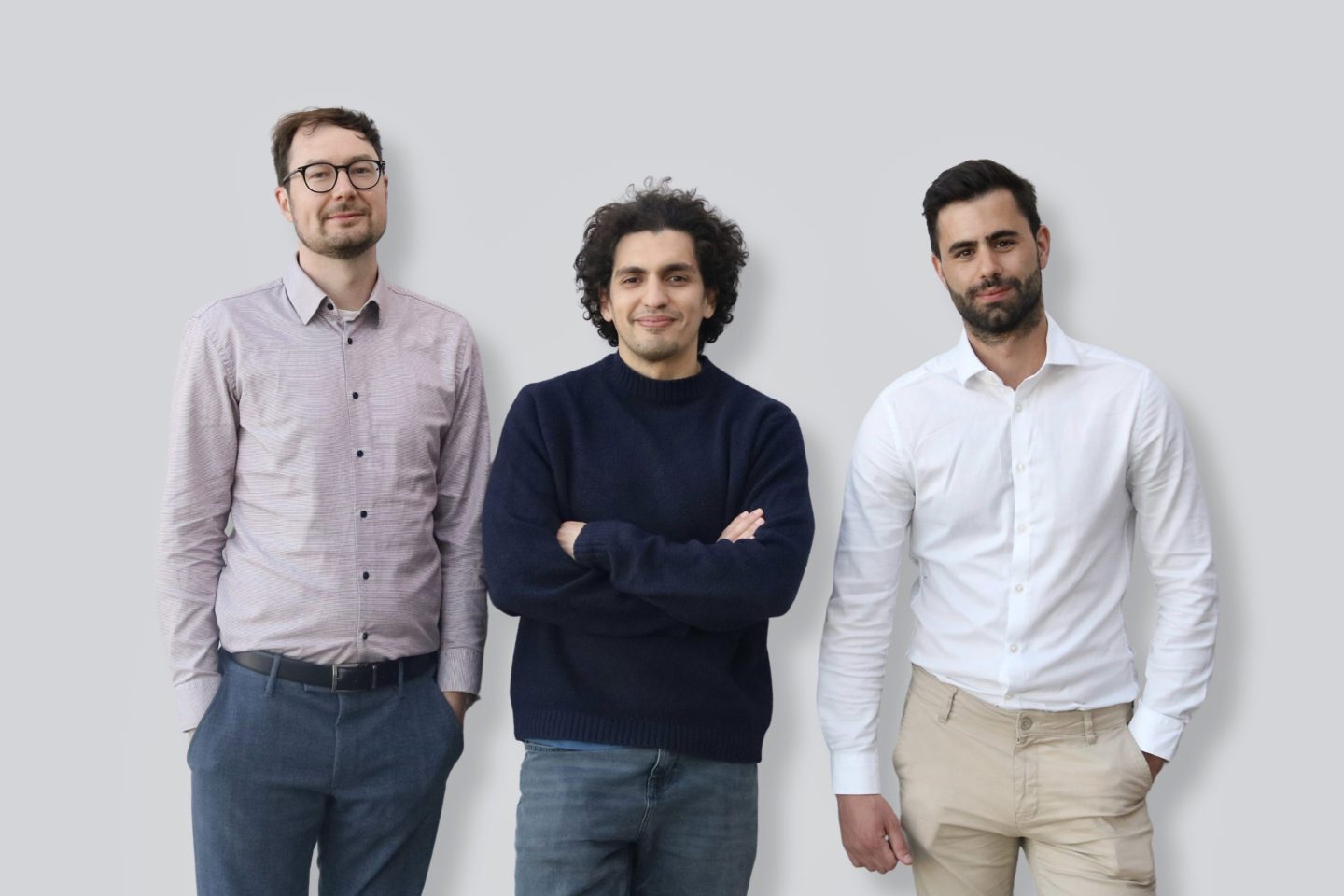
Former Palantir executives Tilman Flock (left), Zaki Trache (center), and Martin Copes have cofounded Perceptic.The startup is building an AI platform to automate and speed drug discovery end-to-end for Big Pharma companies. Perceptic just secured a $12 million seed funding round led by venture capital firm Accel.Photo courtesy of Perceptic
A trio of former Palantir executives who helped spearhead that company’s Life Sciences practice have founded a startup called Perceptic that is building an end-to-end AI platform for drug development, handling everything from drug discovery to clinical trial design. The company emerged from stealth today and announced a $12 million seed funding round.
London-based venture capital firm Accel led the funding round, alongside Air Street Capital and Elder Gull. The company’s valuation following the funding round was not disclosed. Perceptic said its software is already being used by multiple top-tier pharmaceutical companies, though it was only allowed to name CSL, the Australian biotechnology company.
In the past two years, numerous startups have sprung up to use AI to speed drug discovery. This includes Isomorphic, a spin out from GoogleDeepMind, robotic lab pioneer Recursion, Insilico Medicine, and many others. But so far, no AI-discovered drugs have made it all the way through human clinical trials and been approved for sale, leading some to question whether AI is living up to the hype around revolutionizing drug development.
Tilman Flock, Perceptic’s cofounder and CEO, is a bioscience researcher who spent nearly seven years at Palantir, building the company’s commercial AI platform and helping life sciences companies use it. He tells Fortune that most AI startups targeting drug development have focused on improving just one particular part of the complex process, such as predicting protein structures, or looking for a molecule that will bind with a particular site on a target protein, or trying to optimize the recruitment of patients for clinical trials. Perceptic, by contrast, is pitching itself as the “connective tissue” between those discrete AI tools and the proprietary internal and external data that pharmaceutical companies use to make decisions.
Recommended Video
The self-improving AI era: what are agentic loops? | Fortune AI Playbook
“For years, the industry has tried to improve each part of the [drug discovery] process separately, but that’s a linear process where insight dies at every handoff,” Flock said.
Perceptic’s platform is “infrastructure and model agnostic,” Flock said, meaning customers can plug in their own data, hardware and AI models, while Perceptic acts as the layer that ties them together.
Perceptic is targeting three areas of pharma R&D. The first is scouting external assets that biotechnology companies have developed and that big pharma companies look to license. The startup says its system can compress the scientific due diligence needed to assess these drug candidates from weeks to hours.
The second area where Perceptic is focusing is helping pharma companies choose which indications to pursue in clinical trials, a decision that Flock said can swing the fate of investments worth millions of dollars. The third is building a “data foundation” for clinical trial design which the company says has produced a 50-fold increase in clinical data extractions.
Sonali De Rycker, the Accel partner who led the firm’s investment, said she was won over by the idea that Perceptic’s software can “follow the drug” through the entire life cycle of development rather than being pitched towards a particular departmental silo within a big pharma company. “From the point at which you have hypothesis and evidence all the way to when you’re designing the clinical trial, and everything you do in between … it makes no sense for it to be siloed,” she told Fortune.
De Rycker said Accel had been tracking Flock and his co-founders, Martin Copes and Zaki Trache, while they were still at Palantir, where the trio were key engineers on AIP, and met them shortly after they decided to leave. The firm invested roughly a year after that first meeting, by which point Perceptic had moved beyond pilots into paid production deployments, she said. The team has grown to about 20 employees today, Flock said.
Pharmaceutical companies, Flock said, tend to draw on three buckets of data: public knowledge, such as patents and literature; internal proprietary data accumulated over years of research and clinical trials; and external datasets purchased from consultants and data vendors. Perceptic can harmonize all three types of data, he said. The system uses “AI workers,” or AI agents, that are tuned to different data types to hunt for insights or optimizations.
Pharmaceutical customers need to know the provenance of any data used to make a decision, Flock said. As a result, they cannot tolerate AI hallucinations, where an AI model invents or conflates information. Perceptic’s AI system allows customers to trace every claim back to its source, he said.
De Rycker argued that Perceptic’s approach reflects a broader pattern in enterprise AI, in which platforms increasingly unify workflows and data across multiple departments rather than offering standalone tools. She added that these platforms can be “almost a new source of truth,” potentially replacing—or at least relegating to the background—traditional databases and enterprise resource planning software.
She added that Perceptic has a “right to win” from Europe given the concentration of pharmaceutical talent in Switzerland and the U.K. Most of the company’s engineering is in London, drawing in part on Palantir alumni, Flock said; many of its customers are in the United States, where Perceptic plans to expand its presence.
Nathan Benaich, the founder and general partner of Air Street Capital, said in a statement that pharma’s next R&D leap “won’t come from a thousand better point tools, or from frontier models alone” but from an operating system “that connects data, decisions, and context across a 15-year process.”
Flock said the bulk of the seed money will go into engineering and growing Perceptic’s customer base. “We’re far beyond product-market fit,” he said. “It’s about scaling out.”
In 2001, Fortune first convened the smartest people we know, bringing together CEOs and founders, builders and investors, thinkers and doers. Since then, Fortune Brainstorm Tech has been the place where bold ideas collide. From June 8–10, we will return to Aspen—where it all began—to mark 25 years of Brainstorm. Register now.
Jeremy Kahn is the AI editor at Fortune, spearheading the publication’s coverage of artificial intelligence. He also co-authors Eye on AI, Fortune’s flagship AI newsletter.
Illustration by Tag Hartman-Simkins / Futurism. Source: Grzegorz Galazka / Archivio / Mondadori Portfolio via Getty Images; Shutterstock
Sign up to see the future, today
Can’t-miss innovations from the bleeding edge of science and techEmail address Sign Up
As the AI backlash continues to grow, critics of the tech have found an unlikely voice of support: the Catholic Church.
In perhaps his strongest rebuke of the tech industry’s rampant obsession with AI yet, Pope Leo called for the tech to be “disarmed” in his first encyclical, which is a special letter sent to bishops to outline the Catholic Church’s perspective on a topic.
“The word is strong, I know, but deliberately chosen because this moment needs words capable of attracting attention,” the Pope said in an accompanying statement.
In his letter, titled “Magnifica Humanitas,” or “Magnificent Humanity,” the bishop of Rome did not beat around the bush. Despite being a “valuable tool,” Pope Leo slammed AI as “merely” imitating “certain functions of human intelligence,” contradicting tech leaders’ claims that AI might be gaining sentience or consciousness.
“So-called artificial intelligences do not undergo experiences, do not possess a body, do not feel joy or pain, do not mature through relationships and do not know from within what love, work, friendship or responsibility mean,” the document reads.
The pope went as far as to warn of parallels between tech and slavery, warning of “new digital slaveries” that normalize the exploitation of those tasked with labeling data for AI models or moderating content on social media.
“The bodies of these people are scarred, injured and worn down so that computational flow may continue uninterruptedly,” the letter reads.
In his letter, the Pope also criticized the use of AI in war, writing that “no algorithm can make war morally acceptable.”
Therefore, Pope Leo called to “disarm” AI to prevent it from “dominating humanity,” as well as “freeing technology from monopolistic control and opening it to discussion and debate.”
“AI is already an environment in which we are immersed, as well as a force with which we must engage,” the encyclical reads. “For this reason, merely regulating it is insufficient; it must be disarmed, welcoming and accessible.”
The Pope also drew attention to another highly contentious issue plaguing the AI industry, noting the “enormous amounts of energy and water, significantly influencing carbon dioxide emissions” of data centers, while calling for “more sustainable technological solutions that reduce environmental impact.”
None of this should come as much of a surprise. The pontiff has a long track record of being skeptical of AI and related tech. Shortly after being anointed just over a year ago, he revealed that his name was in part inspired by asutomationas the last Pope Leo, Leo XIII, was the head of the Catholic Church during the 19th century Industrial Revolution, an era defined by rapid technological advancement, rampant labor exploitation, severe wealth inequality.
“In our own day, the Church offers to everyone the treasury of her social teaching in response to another industrial revolution and to developments in the field of artificial intelligence that pose new challenges for the defense of human dignity, justice, and labor,” he said during his first speech as pope last year.
Pope Leo’s AI skepticism hasn’t exactly endeared him to tech leaders and politicians. Trump-nominated secretary of the Interior Doug Burgum accused the pope of “tech editorializing” during a Fox Business interview on Tuesday.
President Donald Trump’s relationship with the pope has been severely strained as of late. Earlier this month, Trump lashed out at the Chicago-born bishop, for speaking against the Israel-US war on Iran, erroneously accusing him of being okay with the country having nuclear weapons.
Meanwhile, Claude developer Anthropic has chosen to throw its weight behind the pontiff, with cofounder Chris Olah calling for a “collaboration between those of us who are building this and those who can see what we, from inside, cannot.”
I’m a senior editor at Futurism, where I edit and write about NASA and the private space sector, as well as topics ranging from SETI and artificial intelligence to tech and medical policy.

 Welcome back, Tuesday team. Today’s newsletter, edited by Alex Fitzpatrick and Natalie Daher, is 762 words, a 3-min. read. Thanks to Sheryl Miller for copy editing.
 Vibes and market risk: Before the crisis throttled supplies, there was
  Pickleball peters out
 Data: Trust for Public Land. Table: Alex Fitzpatrick/Axios




 AI jobs civil war
 The big picture: A pair of public appearances this week highlighted differences between Anthropic and OpenAI.
 Data:
Data: