

Academic rigour, journalistic flair
Arts + CultureBusiness + EconomyEducationEnvironmentHealthPolitics + SocietyScience + TechWorldPodcastsInsights
The contested legacy of Edmund Dene Morel – the man who exposed the murderous exploits of King Leopold II in the Belgian Congo
Published: June 23, 2026 11.04am BST
Share article
Print article
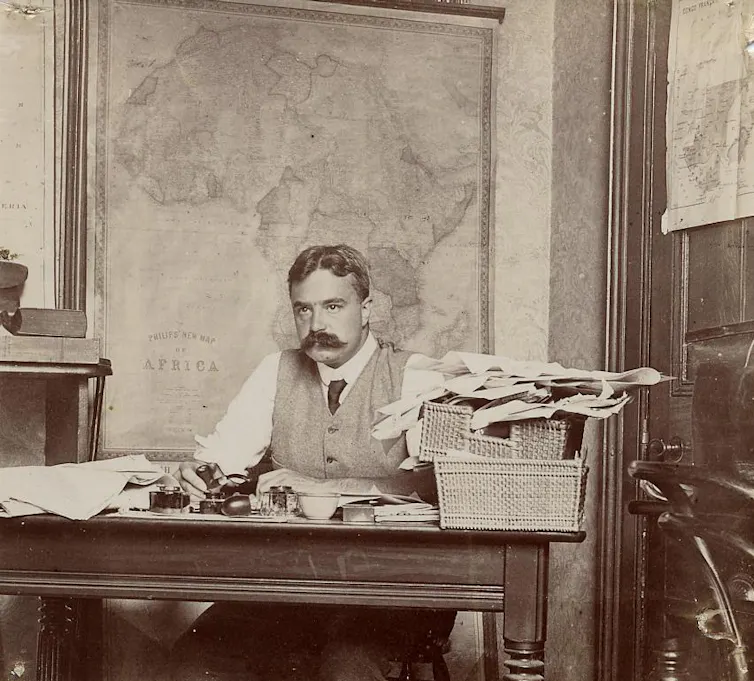
Young shipping clerk Edmund Dene Morel was working as for the Liverpool firm Elder Dempster when he noticed what appeared to be a discrepancy in the figures. What Morel found in his investigation of that discrepancy would expose one of the most notorious systems of violence of the colonial era: the Congo Free State, ruled personally by King Leopold II of Belgium.
Leopold founded the Congo Free State in 1885. It was his private colonial possession, not a Belgian colony. During Leopold’s 23-year rule, millions of Congolese died amid widespread atrocities – murder, torture, mutilation, forced labour – driven by the extraction of ivory and rubber.
Morel would become the most effective public campaigner against Leopold’s regime. His writings helped transform what had been scattered missionary testimony into an international scandal. But while dedicating much of his energy to exposing Leopold’s crimes in the Congo, Morel proved far less willing to confront abuses linked to some of his own allies and financial supporters.
Born Georges Edmond Pierre Achille Morel de Ville in Paris in 1873, Morel moved to Britain with his English mother following his father’s death. In 1891 he joined Elder Dempster as a clerk. Four years later, when the firm opened a shipping route between Antwerp and West Africa, the bilingual Morel was an ideal candidate for the job.
He supplemented his income with journalism, drawing on information from sailors, traders and officials who passed through Elder Dempster’s offices. While researching an article, Morel noticed a striking imbalance in Congo trade statistics. Large quantities of rubber and ivory were being shipped to Belgium, but almost nothing flowed back to Africa except firearms and ammunition.
For a shipping clerk accustomed to ledgers and manifests, the implications were stark. Trade normally moved in both directions. The Congo figures suggested something closer to organised extraction: wealth leaving Africa, force returning in its place. Morel began to piece together testimony from missionaries, traders and officials, realising that the violence reported from the interior was not incidental but structural – an economic system sustained by terror. He described Leopold’s Congo as “a secret society of murderers with a king for a croniman”.
Our mission is to share knowledge and inform decisions.
About us
When Morel raised his concerns with Elder Dempster’s managing director, Alfred Jones, he was offered a promotion in return for his silence. He refused. In 1903 he launched a newspaper, The West African Mail, and the following year founded the British Congo Reform Association (CRA), which aimed to end Leopold’s rule.
Morel’s associates included the Liverpool businessman John Holt and the Anglo-Irish diplomat Roger Casement. Holt had extensive commercial interests in West Africa, including in rubber. Casement’s 1904 report for the British government documented widespread violence in the Congo’s rubber districts. Casement would later be executed for treason following his involvement in the 1916 Easter Rising.
Defending powerful allies
The CRA relied heavily on wealthy donors. Its largest single financial contributor was the British cocoa manufacturer William Cadbury. Cadbury paid Morel £50 per quarter as editor of the West African Mail – more than one-third of Morel’s personal income at the time – and asked that the arrangement remain private. He later helped fund the education of Morel’s eldest son and encouraged Morel to stand for parliament, promising further financial support.
At the same time, Cadbury Brothers were facing growing criticism for purchasing cocoa from plantations on the Portuguese islands of São Tomé and Príncipe. These plantations relied on coerced African labour recruited from Angola under a contract system that critics widely described as a form of slavery.
The issue was exposed publicly by the journalist Henry Nevinson in 1905 and 1906. Nevinson argued that British chocolate manufacturers, including Cadbury, bore responsibility for sustaining this system by continuing to buy plantation cocoa. Some humanitarian organisations went further: figures within the British and Foreign Anti-Slavery Society argued that British firms should boycott cocoa produced under coercive labour systems, a position Morel declined to endorse.
Cadbury’s response was cautious and incremental. The firm commissioned investigations, lobbied Portuguese officials and resisted immediate boycotts, arguing that sudden withdrawal would worsen conditions for workers. Morel consistently defended this approach in his journalism. While acknowledging the existence of abuse, he questioned Nevinson’s judgment and tone, portrayed Cadbury as acting in good faith, and worked to limit public criticism of the firm while the Congo campaign was ongoing.
Abuse on the plantations was not the point of dispute. What divided critics was how – and how forcefully – British firms should be held to account. On this question, Morel consistently sided with Cadbury’s cautious strategy, prioritising the Congo reform campaign and the cohesion of its supporters over public confrontation elsewhere. His humanitarianism was shaped as much by strategic calculation as by moral outrage.
Morel’s legacy
Once the Congo campaign wound down, Morel remained politically active. He became a prominent critic of British foreign policy during the first world war and was imprisoned in 1917 for his opposition to the war. After the conflict, he joined the Labour Party and was elected MP for Dundee in 1922, defeating Winston Churchill. He died in 1924 at the age of 51.
Morel’s work against Leopold’s Congo has rightly been recognised as a landmark in the history of humanitarian activism. His investigative methods, international networking and ability to mobilise public opinion influenced later reform movements. In recognition of his activism, Morel’s name is inscribed on the Humanitarian Wall at the Wilberforce Institute in Hull, alongside other prominent historical figures, such as Nelson Mandela, Mahatma Gandhi and Martin Luther King.
He was also the subject of an early day motion proposed by Labour MP Jim McGovern in 2013 to “pay homage to his dedication to the Congo Reform Association and his early work in championing human rights for all”. The motion was signed by 17 MPs, including Jeremy Corbyn and John McDonnell.
But his legacy is not a simple one. Morel’s career shows how humanitarian campaigns can coexist with compromise, prioritisation and silence. He was capable of denouncing extreme violence while defending allies whose commercial interests were entangled with coercive labour systems elsewhere.
This does not negate Morel’s achievements. It does, however, complicate them. His story is a reminder that humanitarian activism has never been morally pure, and that understanding its impact requires attention not only to what reformers opposed, but also to what they chose not to confront.


 Image source: Ideogram / The Rundown

