
-
Archives
- September 2026
- August 2026
- July 2026
- June 2026
- May 2026
- April 2026
- March 2026
- February 2026
- January 2026
- December 2025
- November 2025
- October 2025
- September 2025
- August 2025
- July 2025
- June 2025
- May 2025
- April 2025
- March 2025
- February 2025
- January 2025
- December 2024
- November 2024
- October 2024
- September 2024
- August 2024
- July 2024
- June 2024
- May 2024
- April 2024
- March 2024
- February 2024
- January 2024
- December 2023
- November 2023
- October 2023
- September 2023
- August 2023
- July 2023
- June 2023
- May 2023
- April 2023
- March 2023
- February 2023
- January 2023
- December 2022
- November 2022
- October 2022
- September 2022
- August 2022
- July 2022
- June 2022
- May 2022
- April 2022
- March 2022
- February 2022
- January 2022
- September 2021
- August 2021
- July 2021
- June 2021
- May 2021
- April 2021
- February 2021
- January 2021
- December 2020
- November 2020
- October 2020
- September 2020
- August 2020
- July 2020
- June 2020
- May 2020
- April 2020
- March 2020
- February 2020
- January 2020
- December 2019
- November 2019
- October 2019
- September 2019
- August 2019
- July 2019
- June 2019
- May 2019
- April 2019
- March 2019
- February 2019
- January 2019
- December 2018
- November 2018
- October 2018
- September 2018
- July 2018
- June 2018
- May 2018
- April 2018
- March 2018
- February 2018
- January 2018
- December 2017
- November 2017
- October 2017
- September 2017
- August 2017
- July 2017
- June 2017
- May 2017
- April 2017
- March 2017
- February 2017
- January 2017
- December 2016
- November 2016
- October 2016
- September 2016
- August 2016
- July 2016
- June 2016
- May 2016
- April 2016
- March 2016
- February 2016
- January 2016
- December 2015
- November 2015
- October 2015
- September 2015
- August 2015
- July 2015
- June 2015
- March 2015
- January 2015
-
Meta
DW Homeless, those on medications, mentally ill people in this heat… People need to provide space where they are protected from the sun
Posted in Uncategorized
Leave a comment
Mario Nawfal: What has Jaime Damon to say about EU’s decline?
Posted in Uncategorized
Leave a comment
Fortune: Big Short legend Steve Eisman says everyone is buying the wrong AI stocks. Quote: Eisman ““Tesla’s been a horrible failure for the past several years,” he avows. “Every year Musk says we’ll have self-driving cars and robotaxis, which he doesn’t do, and all we know is that earnings go down year after year. Musk is a cult, so people keep saying ‘wait till next year.’”
Trendingnow
1
MacKenzie Scott alone accounted for one-third of America’s $19.2 billion in megagifts last year
2
3
1
MacKenzie Scott alone accounted for one-third of America’s $19.2 billion in megagifts last year
2
3
Big Short legend Steve Eisman says everyone is buying the wrong AI stocks

By
Senior Editor-at-Large
June 27, 2026, 4:00 AM ET

Eisman called the subprime housing bubble. Now he’s seeing great miscalculations in how investors are approaching AI.TIMOTHY A. CLARY / AFP
Steve Eisman has a simple way to explain why SpaceX is the most absurd stock in America: its revenues are roughly equal to those of the company that makes Froot Loops. The difference? Nobody is valuing Kellogg’s at 100x revenue.
Recommended Video
If you’ll recall, Eisman identified that a housing bubble was building in 2006 and 2007, fueled by an explosion in the issuance of “teaser-rate,” sub-prime mortgages, and that a crash was imminent. He famously seized the moment by shorting the home-loan market big time, a move that greatly profited both the trader and his firm FrontPoint Partners, a subsidiary of Morgan Stanley. Michael Lewis made Eisman a Wall Street legend by chronicling his exploits in his 2010 bestseller The Big Short. In the 2015 film version, Steve Carrell played the famously cranky, contrarian (re-named “Mark Baum”), while Marisa Tomei portrayed his wife and co-skeptic, former J.P. Morgan analyst Valerie Feigen (“Cynthia Baum”). Today, Eisman hosts the weekly podcast “The Real Eisman Playbook,” a program I highly recommend as much for its rollicking mockery of the group think that dominates the sell-side stock community as its sharp insights on economic trends and knack at nailing the basics that over time, drive outstanding returns to investors.
In a half-hour phone call, Eisman skewered the latest case where he reckons that hype and hysteria are fogging minds—and it’s hardly surprising that his new target’s none other than the SpaceX phenomenon. “SpaceX has the revenues of Kellogg’s, which makes Froot Loops, which I love, but no one is going out of their way to buy Froot Loops,” he declares. (The Ferrero Group of Italy bought Kellogg’s cereal business; Ferrero’s 2025 revenues of $21 billion are indeed close to SpaceX’s $19 billion.) “SpaceX stock’s being valued at over 100 times revenue, whereas no company of any size has ever had that kind of valuation. By comparison, Palantir is at 50x.” Eisman relates that Elon Musk plans to make money from ventures that only exit in the fictional world. “I grew up reading a lot of sci-fi, a ton of it, I’ve read it all,” says Eisman. “Musk and Silicon Valley grew up on it, too. The difference is, Musk and the SpaceX crew take it seriously!”
Eisman notes that a particular source of riches SpaceX hopes to pluck from the planets especially caught his attention, since it’s central to the plot of a sci-fi streamer he loves. “In the SpaceX S-1, where they talk about things SpaceX will eventually do, one of them is asteroid mining. Literally, there is really a great, wonderful sci-fi show on Apple TV called ‘For All Mankind,’ and asteroid mining plays an important part on the show. (Indeed page 71 of the SpaceX S-1 contains the following: “We plan to pursue asteroid mining operations to extract metals and other critical resources from near-Earth and main-belt asteroids, providing abundant raw materials for space-based industries.”)
It also puzzles Eisman that Musk is building an enterprise that straddles at least two industries, and may well add another, when the corporate world’s moving in the opposite direction. “Why make the company into a massive conglomerate, when conglomerates are totally out of favor? The world is de-conglomerate-izing. People want pure play, and they’re in rockets, Starlink and AI.” The prospect that SpaceX will buy Tesla, Musk’s second largest holding, is especially appalling to Eisman. “Tesla’s been a horrible failure for the past several years,” he avows. “Every year Musk says we’ll have self-driving cars and robotaxis, which he doesn’t do, and all we know is that earnings go down year after year. Musk is a cult, so people keep saying ‘wait till next year.’”
Eisman holds a dim view of the hyper-scalers’ future in AI
Eisman points to a part of the S-1 that’s effectively a manifesto wagering SpaceX’s future on AI. In fact, its chief AI product sports a brand name that Eisman fondly recalls from his teenage sci-fi enchantment. “Robert Heinlein invented the word ‘grok’ in his novel ‘Stranger in a Strange Land’ [1961] about a Martian who comes earth,” says Eisman. “In the book, ‘grok’ means ‘deep understanding.’” In contrast to its lofty moniker, Grok the product’s a lightweight, claims Eisman. “The S-1 says that SpaceX total addressable market is $28.5 trillion, and the irony is that over 90% of that TAM is AI, which is all about Grok,” he intones. “Grok is a third-tier product. I’ve heard reports that even the engineers in Musk’s own space division won’t use it because it sucks.”
Overall, he says, the outlook for the hyperscalers is darkening fast. “We’ve seen a sea change in their AI story, and not for the better,” he declares. “That’s because of two vectors. The first is that for the hyperscalers, AI is becoming increasingly capital intensive. Last year, Alphabet spent $80 billion on AI and funded it from cash flow. This year, it will spend $180 to $190 billion and raised $85 billion in stock. Now, they all have to raise funding through stock offerings because the table stakes get bigger and bigger.” He adds that post-IPO, SpaceX will need to keep tapping the capital markets since its recurring cash flow doesn’t come close to meeting its hunger for AI-driven capex.
“The other vector is that there are no ‘moats’ in AI,” he contends. “Someone moves to ChatGPT then to Gemini then to Claude. Even if AI is the greatest thing since the invention of the printing press, there are no moats to shield the providers. You don’t want to be the hyperscalers selling this highly competitive product where you have to cut prices to win customers. You want to be the suppliers selling them the picks and shovels, the chips and networking gear the hyper-scalers buy to make their products. Those products are highly customized and protected.” For Eisman, it’s far better to be a Nvidia, Arista or Cisco riding the capex boom than a Meta, Oracle, Microsoft or Alphabet battling a field of fellow behemoths in the brutal arena where the enterprise and retail solutions are easily swappable.
Eisman stresses that he’s not advising anyone to short SpaceX. “I have no opinion on what will happen to SpaceX,” he says. “From a fundamental perspective, it’s ridiculous But a lot of things can be ridiculous for a long time.” For this dourest of doubters, Musk’s claims for the feats ahead can only happen in the SpaceX founder’s head, or in the sci-fi fantasies Eisman grew up on.
The Fortune 500 Innovation Forum will convene Fortune 500 executives, U.S. policy officials, top founders, and thought leaders to help define what’s next for the American economy, Nov. 16-17 in Detroit. Apply here.
About the Author
By Shawn TullySenior Editor-at-Large
Shawn Tully is a senior editor-at-large at Fortune, covering the biggest trends in business, aviation, politics, and leadership.
Slugger O’Toole. BBC Spotlight: Politician, Predator and Paedophile. Comment: search Irish Times June 2021 for the photo of Donaldson’s daughter Laura marrying a man whose father was a member of the UUP. Photos … what a fairytale … turned into a mire of depravity
Posted in Uncategorized
Leave a comment
Axios: Anthropic’s Fable 5 on track to return
| Scoop: Anthropic’s Fable 5 on track to return |
 |
| Illustration: Sarah Grillo/Axios |
| The Trump administration is close to allowing Anthropic to restore access to its powerful Fable 5 model, which has been offline for 15 days because of security fears by the government. Insiders expect the administration’s limits on Fable 5 could be lifted as soon as this coming week, a source familiar with the situation tells me. A second source tells Axios’ Sam Sabin that conversations are expected to continue over the weekend, and Anthropic expects to restore Fable access soon.  Why it matters: For developers and even non-technical early adopters, Fable 5’s blackout was unprecedented and deeply jarring — a top-tier model, already in users’ hands, pulled offline due to government intervention, Axios’ Zachary Basu writes. Why it matters: For developers and even non-technical early adopters, Fable 5’s blackout was unprecedented and deeply jarring — a top-tier model, already in users’ hands, pulled offline due to government intervention, Axios’ Zachary Basu writes. The big picture: The progress toward liberating Fable 5 marks a thaw in a bitter four-month, bicoastal standoff between the administration and Anthropic, based in San Francisco. The big picture: The progress toward liberating Fable 5 marks a thaw in a bitter four-month, bicoastal standoff between the administration and Anthropic, based in San Francisco.In another sign of de-escalation, the Commerce Department yesterday allowed Anthropic to restore access to Mythos 5, the company’s strongest cybersecurity model, for a limited number of trusted users. Mythos 5 has guardrails to deter its use in cyberattacks or biological terror, and has never been freely available.  Fable 5’s return is eagerly awaited by users, who quickly fell in love with the model’s deep thinking and quick, sophisticated coding. Developers were wowed by the leap in capability. Every new model, especially open-source ones, is being measured against Fable 5. Fable 5’s return is eagerly awaited by users, who quickly fell in love with the model’s deep thinking and quick, sophisticated coding. Developers were wowed by the leap in capability. Every new model, especially open-source ones, is being measured against Fable 5.The Pentagon and National Security Agency still have to give Fable 5 the green light, so the outcome remains unpredictable. But other government agencies have determined Fable 5 can safely return to the wild.  Behind the scenes: I’m told that Commerce Secretary Howard Lutnick and Treasury Secretary Scott Bessent have helped defuse the fight between the administration and Anthropic. Anthropic “has worked positively with the government,” one administration source told Axios. That’s quite a change from the furious statement by Defense Secretary Pete Hegseth designating Anthropic a “Supply-Chain Risk to National Security,” after he and Anthropic CEO Dario Amodei couldn’t agree on how the Pentagon can use Claude.  Zoom in: Anthropic had billed it as the most capable model ever released to the public. The “Vibe Check” newsletter from Every, a media and software company, called it “the best coding model in the world” before it was pulled, just three days after launch. Zoom in: Anthropic had billed it as the most capable model ever released to the public. The “Vibe Check” newsletter from Every, a media and software company, called it “the best coding model in the world” before it was pulled, just three days after launch.In early testing highlighted by Anthropic, the payments company Stripe used Fable 5 to overhaul a 50-million-line codebase in a single day — a job that would have taken engineers more than two months by hand. When access vanished June 12, developers found automated work frozen mid-task. Companies raced to swap in rivals, including cheaper Chinese models.Share this story … Go deeper: Commerce Department greenlights limited return of Anthropic’s Mythos. |
Posted in Uncategorized
Tagged ai, artificial-intelligence, chatgpt, llm, technology
Leave a comment
Axios: Cluster of quakes. Venezuela so rich in resources without the infrastructure to extract. This earthquake has destroyed the lives of so many who live in poverty because politics is so derisive. Hope the charity/NGO sector can get the help needed to Venezuela as soon as possible. There are people buried beneath buildings … they need to be saved.
4.  Cluster of quakes Cluster of quakes |
 Data: USGS. Map: Danielle Alberti/AxiosSeveral strong earthquakes have recently rocked areas in or near the “Ring of Fire,” the world’s most seismically and volcanically active area, Axios’ Alex Fitzpatrick writes:Devastating magnitude 7.5 and 7.2 earthquakes in Venezuela left at least 188 people dead, with many more injured or missing.Magnitude 5 or higher quakes have struck since Wednesday in California, Japan, the Philippines and Papua New Guinea. Zoom in: Clusters of strong earthquakes are rare but not unprecedented.Scientists have been researching whether large quakes in one area can trigger more elsewhere.The Venezuela earthquakes — too strong for either to be a foreshock or aftershock — are connected because they likely occurred on the same fault. There’s no evidence that the rest of the quakes are directly related.Get the latest. Data: USGS. Map: Danielle Alberti/AxiosSeveral strong earthquakes have recently rocked areas in or near the “Ring of Fire,” the world’s most seismically and volcanically active area, Axios’ Alex Fitzpatrick writes:Devastating magnitude 7.5 and 7.2 earthquakes in Venezuela left at least 188 people dead, with many more injured or missing.Magnitude 5 or higher quakes have struck since Wednesday in California, Japan, the Philippines and Papua New Guinea. Zoom in: Clusters of strong earthquakes are rare but not unprecedented.Scientists have been researching whether large quakes in one area can trigger more elsewhere.The Venezuela earthquakes — too strong for either to be a foreshock or aftershock — are connected because they likely occurred on the same fault. There’s no evidence that the rest of the quakes are directly related.Get the latest. |
Posted in Uncategorized
Leave a comment
Fortune: Does “Insider trading” still exist? Can you still give a gift and gain a guaranteed prize? Check this out?
Larry Ellison quietly gave $45 million to a pro-Trump group—then Oracle landed a starring role in a $500 billion AI buildout

By
Associate Editor
June 25, 2026, 12:00 PM ET
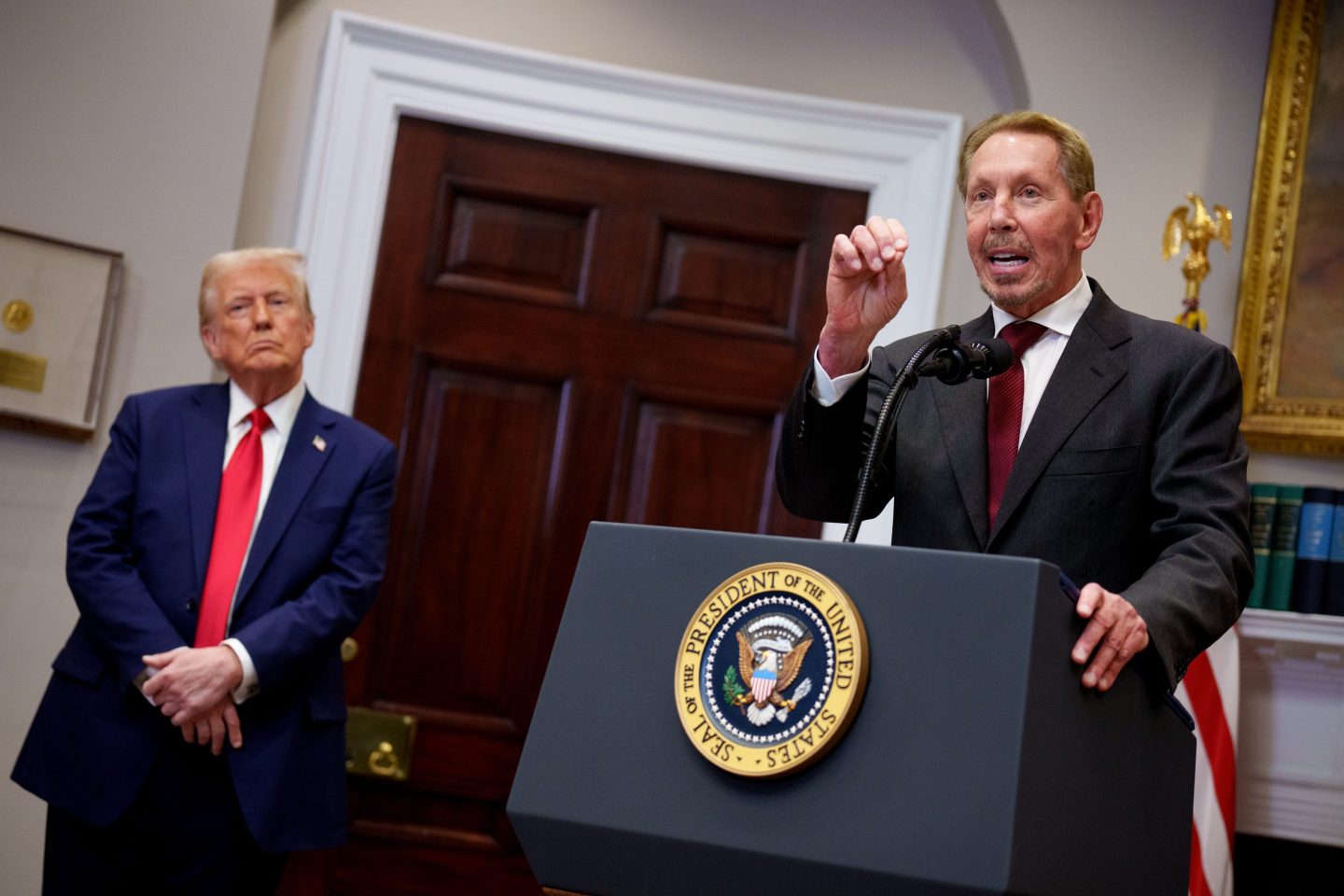
Larry Ellison has been slightly more inconspicuous about his dealings with President Donald Trump.Getty Images—Andrew Harnik
While many of Big Tech’s biggest names have been fairly public and open about their dealings with President Donald Trump, there’s one executive who has been more stealth in his dealings with the CEO-in-Chief.
Recommended Video
Larry Ellison, the billionaire Oracle cofounder, gave about $45 million to a nonprofit backing Trump’s 2024 campaign, people familiar with the fundraising told The Wall Street Journal. This funding wasn’t subject to disclosure rules, according to WSJ, and hadn’t been reported until this week.
This quiet donation runs counter to the donations and support from other billionaires for either Trump’s campaign or his ongoing efforts in his second term. Many CEOs, including Tesla’s Elon Musk, Apple’s Tim Cook, Boeing’s Kelly Ortberg, and Nvidia’s Jensen Huang, joined Trump on his recent trip to China. Trump also hosted a White House dinner in September with 33 Silicon Valley power players and invited executives like Meta’s Mark Zuckerberg and Reddit cofounder Alexis Ohanian to his recent 80th birthday celebration, which included a UFC event.
Ellison was absent for all of those.
Instead, the Oracle cofounder and the world’s sixth-richest man has continued to give millions more to groups supporting Trump since the election, according to the WSJ report, and Oracle is one of the corporate sponsors for Freedom 250. Federal disclosure documents from the U.S. Office of Government Ethics also show Trump’s investment accounts actively trading Oracle shares earlier this year.
Ellison’s quieter approach has coincided with some major wins for Oracle. The day after Trump’s second inauguration, Oracle was named one of the anchors of Stargate, a $500 billion plan to build AI data centers across the U.S. Trump unveiled it at the White House on Jan. 21, 2025, with Ellison standing alongside him, OpenAI’s Sam Altman, and SoftBank’s Masayoshi Son.
Later in 2025, Oracle joined a group that took over TikTok’s U.S. operations after Trump signed an executive order clearing the deal. The president said in September 2025, Oracle and Ellison would “play a very big role in terms of security, safety, and everything else” for the app. That same month, Oracle reported $455 billion in remaining performance obligations, up 359% year over year.
The payoff has appeared to extend to Ellison’s family. Larry’s son David, 43, has built a media empire over the same stretch. The Trump administration cleared the merger of his company, Skydance, with Paramount last year. The deal closed soon after Paramount settled Trump’s lawsuit against CBS for $16 million. This month, the Justice Department cleared Paramount Skydance’s takeover of Warner Bros. Discovery, with no divestitures required, despite concerns from some antitrust staffers. The deal would hand the family CNN, a network neither Ellison nor the family likes. The elder Ellison once told Trump that if Paramount won, it could overhaul the channel, people familiar with the matter told the WSJ. But the deal isn’t final. California Attorney General Rob Bonta said the deal “is not a done deal” and is still under investigation by his office.
The White House told Fortune that Trump isn’t really playing favorites, though.
“President Trump is committed to working with every American business and business leader to cement America’s innovative dominance, reshore critical manufacturing, and accelerate economic growth for everyday American workers,” White House spokesman Kush Desai told Fortune in a statement. “Industry leaders in sectors ranging from autos to pharmaceuticals to technology have committed to investing trillions in the United States because they know they have a friend and ally in the White House.”

Paid Content
How Binance is unifying crypto finance in one app
From Binance
Oracle didn’t immediately respond to Fortune’s request for comment.
To be sure, Ellison hasn’t always backed Trump. In the 2024 race, he supported Senator Tim Scott of South Carolina and pushed Trump to pick Scott as his running mate. Trump chose JD Vance instead.
A Pivotal Year for Democracy: The Attlee Foundation Lecture: The Policy Institute at King’s College London. Sir John Major … Comment: my cousin Sir James Comyn knew Clement Attlee’s daughter for Peggy from days in Oxford and throughout the decades that followed.
Posted in Uncategorized
Leave a comment
Clash Report: German AfD politician Maximilian Krah. The EU will collapse within the next 5 to 10 years
German AfD politician Maximilian Krah:
The EU will collapse within the next 5 to 10 years.
https://twitter.com/clashreport/status/2070614316886204532/video/1
Posted in Uncategorized
Leave a comment

