Can AI create a golden age of scientific discovery? In this episode of The Deep View Conversations, we sit down with Yossi Matias, head of Google Research, to explore how AI is transforming the way science gets done.
Rather than replacing scientists, Google is building AI systems designed to amplify human ingenuity. From searching millions of research papers to generating new hypotheses and accelerating experiments, these tools aim to help researchers move from ideas to discoveries faster than ever before.
Yossi explains why he believes we’re entering a new era where AI can democratize scientific research, empower the next generation of scientists, and dramatically shorten the path from breakthrough to real-world impact.
Topics covered include: How Gemini for Science is changing research workflows. What AI Co-Scientist, AlphaEvolve, and the Empirical Research Assistant actually do. Why the scientific method is becoming even more important in the AI era. How Google is partnering with universities including Stanford and Imperial College. Why AI could give every researcher a “virtual lab” in their pocket. What a golden age of scientific discovery might look like. If you’re interested in AI, scientific discovery, biotechnology, or the future of innovation, this conversation offers a look at how one of the world’s leading AI research organizations sees the next decade unfolding.
The first hotel run by robots will open its doors to the public next year. It comes as no surprise that it’s happening in China – on the artificial island built for the Shenzhen-Zhongshan Link, the cross-sea megaproject in the Pearl River Delta.
Pudu Robotics has announced the first “full-scenario robot-serviced hotel” on West Artificial Island that connects the ambitious bridge and tunnel crossing known as the Shenzhen-Zhongshan (ShenZhong) Link in Guangdong Province.
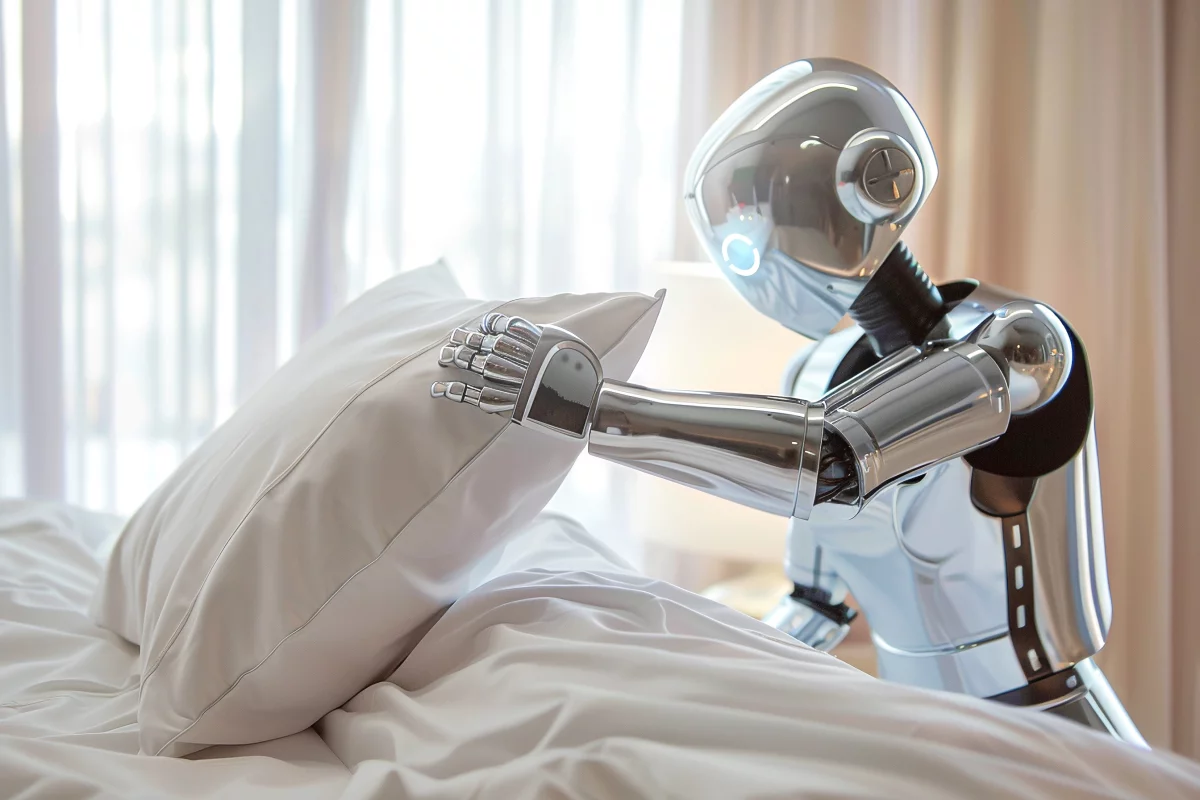
The hotel, officially set to open its doors in 2027, will see robots occupy every hospitality role, including reception, room service, cleaning, food preparation and guest support. Shenzhen’s Pudu Robotics has already deployed its machines to work in various retail, food-and-beverage and cleaning positions, but this new project will have them running the entire operation.
Pudu and Shenzhen Culture & Tourism Industry Development will work together to turn the West Artificial Island, which opened in December 2025, into a dedicated robotics and technology destination for visitors.
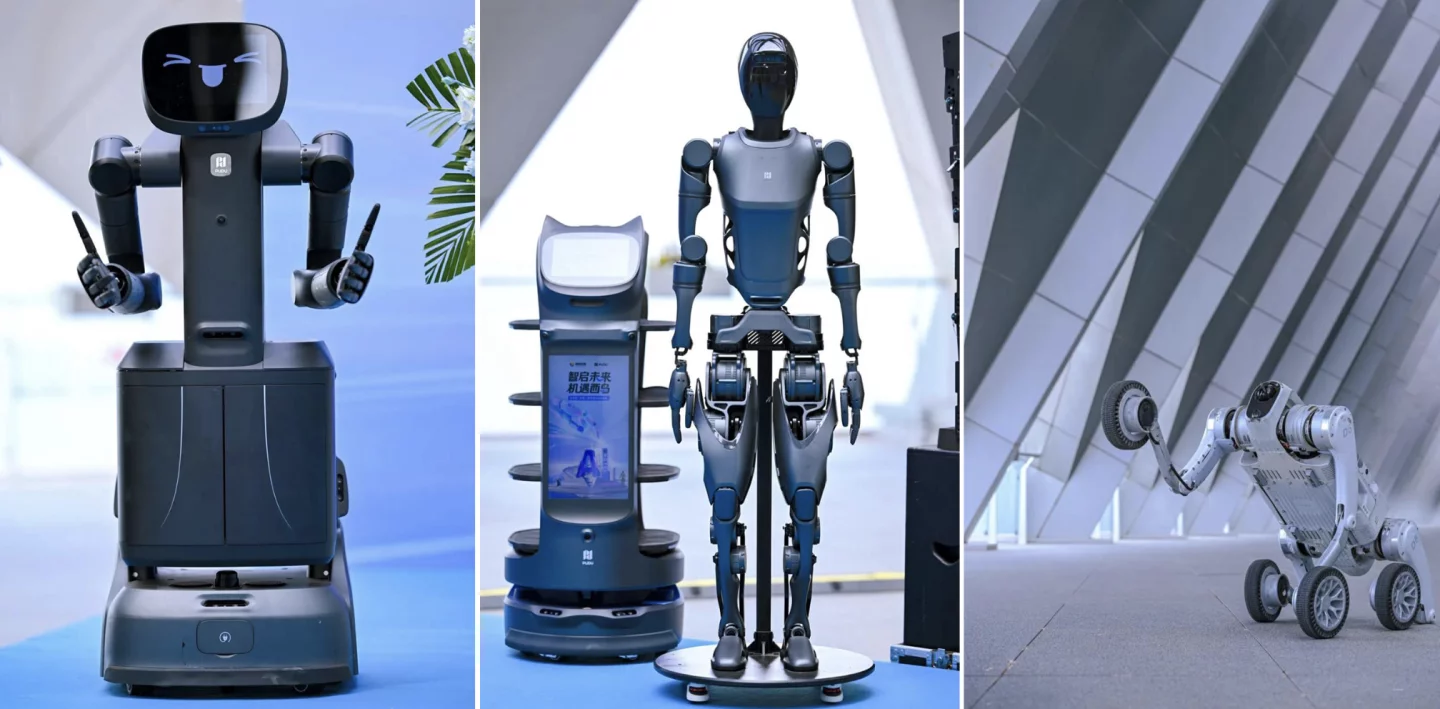
A few of the models to be deployed to the Artificial West Island hotel, on show at the Shenzhen launch
“This partnership represents an important step toward large-scale deployment of embodied intelligence in premium hospitality environments,” said Cong Guo, Co-founder and CTO of Pudu Robotics. “It also provides an opportunity to explore new service models where AI and robotics work together to deliver intelligent, end-to-end experiences in the real world.”
The hotel will be rolled out in stages, with the first trial scheduled to begin in late 2026, where a handful of guest rooms and robot-powered services will be in operation for the general public. These early visitors will get to experience robot-run welcoming and check-in services, plus autonomous in-room delivery.
Room-service delivery robots are commonplace in hotels across China’s large cities already, including the nearby technology hub of Shenzhen. And Shanghai’s Shangri-La Hongqiao Airport has recently put the humanoid XMAN-R1 to work on the front desk, with other robots handling room deliveries, luggage and cleaning.
However, the new island hotel isn’t just a smart space with robots assisting human staff throughout the premises. It’ll be designed to be a fully functional and interconnected robot “service ecosystem” run entirely by Pudu’s hardware and software. The company’s embodied intelligence foundation model, PuduFM 1.0, will work with PuduAgent to run the hotel’s “intelligent operations.”
Among the staff, Pudu’s FlashBot will operate an intelligent vending system, where guests can order drink deliveries via smartphone, the PUDU T300 will transport luggage from the foyer to hotel rooms, and the PUDU CC1 Pro and PUDU MT1 cleaning bots will do the dirty work using AI waste-detection technology.
“This architecture enables robots with different physical forms and responsibilities to operate from a shared intelligence framework,” Pudu said in a statement. “Reception robots can understand gestures and social interactions, delivery robots can autonomously optimize routes, and cleaning robots can dynamically adapt to changing environments – all while leveraging the same core AI capabilities.”
Artificial West Island
At the hotel launch in Shenzhen, the company’s BellaBot Pro served coffee while KettyBot Pro delivered refreshments and snacks to those in attendance. This isn’t novel by the city’s standards, however; at the sprawling Shenzhen Talent Park by the bay, a permanent coffee shop is staffed by a robot barista, close to a hub where you can get food delivered by drone simply by ordering on your phone like UberEats.
In this sense, it’s no surprise that West Artificial Island will become the home of even more advanced autonomous service. The hotel project is just one of the developments planned for the island, with advanced robotics rolled out in stages across service and tourism over the next four years.
“This ‘full-scenario’ model means Pudu robots will be deeply involved in every part of hotel operations, with no service gaps and no human interruptions,” Guo told Chinese news agency Xinhua at the launch.
The hotel is planned to include 44 high-end rooms, a restaurant, gym and other spaces for guest use. They’ll be connected through a closed-loop smart service system ensuring that all aspects of service – from check-in to cleaning – will work together. Looking further ahead, plans are for the project to expand beyond the hotel to the island’s broader tourism and hospitality sector.
Bronwyn has always loved words and animals, and she has the journalism and zoology degrees to prove it. After more than 20 years as a writer and editor, the former music journalist went back to university to build on her passion for wildlife and conservation with a Bachelor of Zoology, which unlocked two new loves: sharing animal facts at any opportunity and getting others excited about science. Particularly interested in neuroscience, genetics, animal behavior and evolutionary biology, Bronwyn has found a happy home at New Atlas, coming on board in February 2023.
On July 4, the United States will celebrate its 250th birthday. Over the past two and a half centuries, American society has changed profoundly, from an agrarian republic of 13 colonies to the urban, diverse, and economic superpower it is today. To mark the quarter-millennium, we decided to look back on how the country has demographically evolved since its last major milestone, the bicentennial.
One of the most striking developments since 1976 is the increasingly diverse face of the nation. As our Graphic Truth shows, Hispanic Americans have increased to roughly a fifth of the population – a more than fourfold jump – while the Asian American population has grown from under 1% in the 1970 census to 6% in 2024.
In 1970, only 4.7% of the US population was foreign-born, the lowest share in the country’s recorded history. That reflected the long shadow of the 1924 Immigration Act, which tightened immigration from everywhere other than the Western Hemisphere. That law, along with other restrictive immigration measures, wasn’t overturned until 1965. Because the US experienced relatively little immigration over the preceding four decades, the country’s demographic breakdown in the 1970s reflected a period of demographic stagnation.
Meanwhile, the share of non-Hispanic white Americans has dropped, from 83% to 56%. The near-30-percentage-point drop reflects a half-century of steady flows of immigration into the country, the growth of ethnic-minority groups, as well as an aging population and lower fertility rates, meaning deaths outnumber births among non-Hispanic white Americans.
There are data challenges when it comes to checking how America’s changing racial and ethnic makeup has changed. Since the 1970s, the way the US Census records race and ethnicity has changed. Only since 2000 has the census allowed Americans to tick off more than one box for race – prior to the 21st century, people of multi-racial backgrounds had to select the race with which they most identified.
In 2030, the census will change again. After decades of advocacy, people with origins in the Middle East and North Africa will receive their own ethnic category, and “Latino” will be included as an option under “race and ethnicity.” As the US approaches its 250th birthday, it’s clear the country remains a demographic in motion. The picture is always changing, and the next census suggests it will continue to evolve in ways that challenge assumptions about who Americans are.
The Rundown: In this guide, you will learn how to use a free AI-enhanced video editor that connects to your existing Claude account. You can use it to have AI automatically transcribe, caption, cut, and color grade any raw footage for you.
Step-by-step:
Download and install Palmier Pro, open a new project, and create an Anthropic API key at console.anthropic.com/settings/keys In Palmier Pro, go to Settings > Agent, and paste your API key. Then, drag a 5-minute screen recording, talking-head clip, or product demo Ask the agent: “Edit this down to about one minute. Keep the strongest moments, remove dead air, and preserve the main point”After the first cut, ask for captions, better pacing, and light color or crop/frame polish. Review the timeline before exporting, then run this cycle in production
Pro tip: Install Palmier as an MCP server for Claude Code or Codex. This supports more automated workflows outside the in-app chat.
Conservative Leader Kemi Badenoch warns that Britain’s economy will be left in ‘limbo’ as Labour MPs focus on the jobs they will secure in the next government.
Ireland has zero gas storage capacity. And that’s despite being unusually reliant on gas in the national energy mix (both electricity generation and domestic/industrial use). No Plan B either. There is no capacity to import Liquified Natural Gas. Energy security should be the government’s most urgent priority. It would be most embarrassing if the lights were to go out when all of Europe’s democratic leaders visit Dublin for the European Political Community summit in November.
The Crimes of Nurse Cadden aka Mary Anne “Mamie” Cadden | Murder & Scandal in 1950s Dublin | History Ireland At 6:30am on the morning of the 18th April 1956 a milkman named Patrick Rigney made a shocking discovery on the steps leading to the basement of a Georgian town house on Dublin’s Hume Street. Before him lay the body of 33 year old Helen O’Reilly, her legs bound together and a silk stocking tied tightly around her neck. As Rigney tried to make sense of what he was seeing he was startled by a noise that seemed to emanate from the basement below. Fearfully he peered over the wrought iron railings where he saw a woman pressing her back up against the wall and staring back up at him. Rigney left the scene in search of a Garda and the blonde haired woman climbed back up the steps as quickly as her arthritic knees would allow and fled to her cramped and cluttered flat two doors down the street. How could this have happened again she thought, it was only 5 years since she had dumped Bridget’s body on Hume Street and those poxy detectives had nearly collared her for murder. Mamie Cadden paced up and down in her flat as she frantically concocted a story to tell the guards who were bound to come knocking on her door. It was hardly her fault that those pregnant women had died, she thought, sure they had sought the famous Nurse Cadden out themselves, she was only providing a service the women desperately wanted but which the law strictly forbade. She gathered up her medical equipment and hid it as best she could in the small space and braced herself for what was to come. When Patrick Rigney discovered the body of Helen O’Reilly on Hume Street he exposed an underworld of backstreet medical practitioners that many people knew about but in a deeply conservative 1950s Ireland were practically forbidden from discussing. It set in motion a police investigation and a dramatic trial that would find Mamie Cadden guilty of murder and see her sentenced to death. From her birth in Scranton Pennsylvania, to her childhood in Mayo and her glory days at her prestigious nursing home in Rathmines where she excelled as an independent business woman in a repressive 1930s Dublin, her multiple convictions and prison terms and her death sentence in a Dublin court room this is the story of one of the most notorious women in Irish history, Mary Anne Cadden and also the lives of the two women whose bodies were discarded on a Dublin Street. Please be sure to like the video and subscribe to the channel. These videos require hours of research, writing and editing so if you enjoyed it please consider sharing it with a friend, thanks! Chapters
Summary: In an era dominated by generative AI, smartphones, and short-form digital media, the way humanity consumes text has transformed more over the past decade than in the entire century preceding it. While modern wellness trends heavily emphasize meditation, biohacking, and neurostimulation to achieve peak mental clarity, a new book points to an overlooked cognitive tool. Reading is not simply a neutral pathway for receiving information; it is a profound neurological catalyst that fundamentally rewires memory, attention, executive reasoning, and visual perception.
Bringing together decades of cross-disciplinary research spanning psychology, linguistics, education, and cognitive neuroscience, researchers detail how literacy reshapes the physical architecture of the human brain. The work challenges traditional neural “invasion” theories, which assumed reading intrusively steals space from older visual systems, by demonstrating that learning to read actually sharpens overall visual processing, including our ability to recognize human faces.
Key Facts
The Cognitive Enhancer:Huettig frames literacy as one of the most potent, evidence-backed tools for cognitive enhancement available to humans, driving broad structural upgrades across multiple neural networks.
The Visual Recycling Myth: Cognitive neuroscience long held that because reading is an evolutionary newcomer, it must destructively “co-opt” or crowd out older visual real estate, such as the brain networks dedicated to face recognition.
Enhanced Face Recognition: Huettig’s field research comparing literate and illiterate adults in India proved the opposite: learning to read triggers a functional fine-tuning that structurally adapts and improves face and object recognition performance.
The Continuous Literacy Spectrum:True reading proficiency is an unfolding continuum, not a binary on/off switch. Avid readers constantly automate and refine sub-cortical processes, shifting how they physically perceive and interpret the world.
The Screen Effort Disconnect: Meta-analyses show inferior comprehension when reading on digital screens compared to print. The root cause is psychological self-regulation: readers instinctively view paper print as “serious,” causing them to exert greater cognitive effort.
Audiobook Limitations:While listening to audiobooks successfully exposes the brain to rare vocabulary and complex narrative structures missing from everyday speech, Huettig emphasizes that the full spectrum of neurological benefits is only unlocked by actively processing written text.
The Danger of Over-Simplification:The author warns that relying heavily on AI readability scores, autocorrect, and simplifying text to match shrinking vocabularies dilutes the richness of written expression, ultimately stalling neural development in young people.
Source: Max Planck Institute
Smartphones, online learning, generative AI: the way we read has changed more in the last decade than in the previous century. So what do we actually know about what reading does for the mind?
In his new book, Falk Huettig, Senior Investigator at the Max Planck Institute for Psycholinguistics, brings together research spanning psychology, linguistics, neuroscience, and education to answer that question.
The result is a systematic account of how literacy reshapes memory, attention, language processing, and reasoning – and even abilities readers might not expect, like face recognition.
Cognitive enhancement is having a moment, with people turning to better sleep, exercise, nutrition, stress management, and tools like caffeine or neurostimulation in search of a sharper mind.
According to Huettig, one of the most powerful enhancers of all has largely flown under the radar: “One of the most powerful cognitive enhancers, with broad and increasingly well-documented effects, is rarely emphasized in these discussions: the ability to read.”
An unexpected finding: reading and face recognition
One of the more surprising threads in the book concerns face recognition. A long-standing idea in cognitive neuroscience holds that because reading is a relatively recent cultural invention, the brain has no dedicated reading network of its own, so literacy training has to borrow space from older visual systems, including the one used for recognising faces.
“Neuroscientists have proposed that the development of reading expertise may therefore partially displace or encroach upon the face recognition network in the brain,” Huettig explains.
“This postulated cortical ‘invasion’ could result in a measurable decline in face or object recognition performance, as neural resources are reallocated to support the newly acquired reading skill.”
Huettig’s own research points the other way. “Our alternative perspective challenges the idea of destructive competition by proposing that learning to read may actually enhance sensitivity to faces and other visual object categories, rather than intrusively co-opting existing face recognition territory,” he says.
In studies conducted in India comparing literate and illiterate adults, his team found that “such co-opting leads to functional fine-tuning, where older networks are not diminished but rather adapted and even enhanced. We confirmed this explanation in behavioral studies: literate people were better at face recognition than illiterate people.”
A continuum, not a switch
The book argues that literacy keeps developing long after someone learns to decode text. “Reading proficiency does not end once a reader can fluently decode a writing system,” says Huettig. “Avid readers continue to automatize and refine these subprocesses and their coordination, training both lower- and, with increasing practice, higher-level cognitive functions.
As a result, literate people come to ‘see’ the world through a fundamentally different lens than those who are illiterate or less literate.” Few people, he notes, ever reach the very top: “only a small proportion of individuals reach the highest levels of critical reading in international assessments such as the PISA tests.”
Content matters too: “It matters a great deal what people read,” Huettig says. “Reaching these advanced levels of literacy requires regular engagement with sophisticated texts, along with the development of strong critical thinking and reasoning skills.”
Print, screens, and audiobooks
On format, the picture is more nuanced than “print good, screens bad. Meta-analyses have found inferior reading comprehension when text is read on digital screens,” Huettig notes, but he points to self-regulation as the likely driver: “Readers tend to regard analogue print as a more appropriate medium for ‘serious’ reading than screens, and monitor their behavior accordingly. As a result, they exert more cognitive effort for the task at hand.”
Still, he’s cautious about overstating the case: “The existing body of research does not support the simplified inference that print always results in better reading outcomes than digital reading.”
Audiobooks, meanwhile, can deliver some of reading’s benefits at a distance. “Listening to audiobooks can expose listeners to rare and sophisticated words, infrequent grammatical constructions, and complex narrative structures: elements that are not commonly found in everyday speech,” he says. But the full picture requires the real thing: “The full spectrum of the benefits of reading is only obtained from reading text.”
A message for parents and educators
Huettig’s advice runs counter to a popular instinct: don’t over-simplify. “Simplifying texts to align with shrinking vocabulary and declining grammatical proficiency among young people may be counterproductive,” he warns.
“Relying too heavily on human- or AI-generated readability scores, or defaulting to autocorrect for ‘better words’ and ‘better grammar,’ can dilute the richness of written expression. Instead, prioritizing quality writing, memorable prose, and the use of complex, uncommon, and sophisticated language may be a more effective strategy for maintaining and enhancing literacy.”
More broadly, he wants readers to come away with a sense of just how much is at stake: “Reading and writing are not merely neutral tools that humans use: they take hold of the mind and profoundly reshape it.”
What comes next for reading?
The book closes by asking what happens to these benefits as reading habits keep shifting. Huettig is cautious about firm predictions but draws a parallel with vinyl records: “What once was the standard medium for music has become a niche interest, sustained by a small group of enthusiasts… In a similar way, the written medium may persist in pockets of culture, or even become a nostalgic fad for future generations, before largely fading from everyday use.”
If literacy continues to decline globally, he suggests, the kinds of skills current intelligence tests measure may decline with it, and he’s doubtful new technologies will simply compensate: “Mastering new, future technologies may compensate for the loss in cognitive abilities, but personally, I wouldn’t bet on that happening.”
Early praise
Early endorsements describe the book as an original and accessible contribution to the science of reading, with reviewers from Oxford, the University of Illinois at Urbana-Champaign, and CNRS/Aix-Marseille University praising its scope and clarity.
Key Questions Answered:
Q: How does learning to read actually improve a person’s ability to recognize faces?
A: For a long time, neuroscientists believed in the “cortical invasion” theory. Because reading was invented relatively recently in human history, the brain hasn’t had time to evolve a built-in reading network. Scientists assumed text recognition had to aggressively crowd out older visual systems, like the face recognition network. Dr. Huettig’s research in India proved the opposite. By comparing literate and illiterate adults from identical backgrounds, his team found that learning to read acts like an intensive gym workout for your entire visual system. It refines the brain’s visual sensitivity, functionally fine-tuning older networks so that literate individuals actually become measurably better at identifying faces and distinct objects.
Q: Why does reading on a physical piece of paper yield better comprehension than reading on a digital screen?
A: It isn’t necessarily a limitation of the screen technology itself, but rather a reflection of human psychology and self-regulation. Meta-analyses consistently show that people retain less information when reading digitally. Huettig explains that our brains treat mediums differently based on habit. We instinctively view analog print as the proper medium for “serious” reading, which subconsciously prompts us to invest more cognitive effort and monitor our focus closely.When reading on screens, where we are used to skimming fast social media feeds or clicking away, we drop our cognitive guard, read more superficially, and fail to deeply process the material.
Q: What is the danger of using simplified language and AI readability tools for children?
A:There is a popular instinct among modern educators and content creators to simplify text, strip away rare words, and use AI tools to smooth out complex grammar to accommodate declining attention spans. Huettig warns that this approach is completely counterproductive.Written text is unique because it exposes the mind to intricate sentence structures and rare vocabulary that almost never occur in casual spoken conversation. If we constantly sanitize text and rely on autocorrect to fix expressions, we dilute the cognitive challenge. To keep human intelligence sharp, we must prioritize memorable prose and sophisticated language, as these are the exact ingredients that force the mind to grow.
Editorial Notes:
This article was edited by a Neuroscience News editor.
Journal paper reviewed in full.
Additional context added by our staff.
About this reading and cognition research news
Author: Anniek Corporaal Source: Max Planck Institute Contact: Anniek Corporaal – Max Planck Institute Image: The image is credited to Neuroscience News
Original Research: The Perks of Being a Bookworm: The Science of the Benefits of Reading by Falk Huettig is available to purchase online




 Watch on YouTube
 Listen in your favorite podcast playerSubscribe to Deep View Conversations for interviews with the leaders shaping the future of AI, business, and technology: tdv.transitor.fm