The average gallon of regular gasoline costs $3.84 nationally as of this morning, Axios’ Ben Geman reports from AAA data.
That’s lower than a few weeks ago. But it’s by far the highest price heading into the July Fourth weekend since 2022, when the national average was $4.80 on the holiday itself.
️ Gas price politics are tricky.
The price surge during the Iran war, which started at the end of February (charted above), could hurt Republicans in November midterms.
But thetrajectory has been sharply downward in recent weeks, after prices peaked at $4.56 per gallon in May
. What we’re watching: President Trump this week issued a vague threat of “big problems” for gasoline retailers unless stations cut prices faster.
He also said a handful of “Freedom Fuel Network” gas stations around the Philly area would slash prices tomorrow. Go deeper.
Those vanity projects provide the backdrop to the Trump family’s obscene pilfering in their return to power, characterized by crypto scams and government handouts to personal allies.His latest windfall, an obscene $1.4 billion earned in a single year as president, may be the most damning proof yet of just how little our elected leaders care — and how powerless the rest of us are to stop the profiteering.
New financial disclosures have revealed Trump’s massive profits for the year 2025, which is up significantly thanks to his position as president. As the New York Times notes, Trump’s total earnings the year before he returned to the White House were around $622 million.
“I found out that nobody cared,” Trump told the NYT in a two-hour interview when asked about his financial gains as president. “I’m allowed to.”
“You know, George Washington, when he was president — did you know this, in his equivalent of the White House, it was a little before the White House — he had two desks,” Trump continued. “He had a business desk and he had a president desk, and he did both. It’s OK to do that.”
His profiteering has drawn criticism from even the traditionally conservative editorial boards at the Wall Street Journal and New York Post, as well as the broader American populace. According to one Pew Research poll, 61 percent of US residents believe Trump has probably or definitely “used his office to enrich himself or his friends and family.”
The fact that a clear plurality believes this — but cannot stop it from happening — isn’t just a condemnation of Trump, but of the whole political system that granted a billionaire one of the most powerful offices on the planet.
Dublin City Council destroyed its own €7.5 million plan to restore Mountjoy Square, through another unforgivable example of their stupidity with taxpayers money. Officials told councillors in June they had to vote immediately or miss a statutory deadline and lose Government funding, a claim chief executive Richard Shakespeare has since admitted was wrong. Rather than risk a legal challenge, the council has scrapped the process altogether and will start again from scratch, a fresh 20-week planning cycle that may not even begin until September, against a 2028 deadline set by the funders! Independent councillor
called it a “grievous error” and accusing the executive of trying to railroad the vote through. A decade of promises to restore the square’s circular lawn and strip out its tarmac has now been undone by a council that couldn’t get its own paperwork straight. Bureaucrats are making a killing off these schoolboy errors. This is utterly unacceptable, and there will be zero consequences. Dublin deserves better!
How depraved was Adolf Hitler really? In this deep-dive documentary, we examine one of history’s most infamous figures through the lens of psychology, behaviour, and our Depravity Index. Rather than focusing solely on World War II, this video explores the man behind the dictatorship. What was Adolf Hitler’s childhood really like? Did he show early warning signs of narcissism, psychopathy, or other dark personality traits?
How did a failed artist become the architect of the Holocaust and the most destructive war in human history?
Over the course of this feature-length documentary, we’ll examine Hitler’s upbringing, family dynamics, artistic ambitions, psychological development, rise to power, ideological beliefs, drug use, wartime decision-making, the Holocaust, and his final days inside the Führerbunker.
We’ll also explore whether Hitler ever personally killed anyone, how he viewed other world leaders, and why millions were willing to follow him. Using historical research, psychological analysis, and our Depravity Index scoring system, we’ll attempt to answer one of the most difficult questions in modern history: how does a human being become responsible for so much death and destruction?
This documentary is intended for educational purposes and aims to better understand the psychology and behaviour of Adolf Hitler and the Nazi regime. It does not glorify, justify, or promote any extremist ideology. If you enjoy long-form true crime, psychology, history, and documentary content, make sure to subscribe and let me know your thoughts in the comments below.
📖 Check out the Dark Finds book: https://www.amazon.com/dp/B0CVFR5Q49 🧨 Connect with me on Instagram: / . . 🎙️ Tune into the Dark Finds Podcast: https://open.spotify.com/show/0bYBE7b... 💯 patreon.com/DarkFindsPodcast 🎧 How it Falls Apart: https://open.spotify.com/episode/4ILa... DISCLAIMER: The pictures, audio, and video used in the videos on this channel are a mix of paid stock, by attribution, royalty-free, public domain, or otherwise fall under the guidelines of fair use. No copyright infringement is intended. All rights belong to their respective owners. If you are or represent the copyright owner of materials used in this video and have an issue with the use of said material, please send an email to gary@darkfindsmedia.com. Chapters 00:00 Intro 02:36 The Making of Adolf Hitler 13:56 The Failed Artist 19:29 WW1 – The Search for Meaning 25:26 The Birth of the Hitler Myth 32:39 Failure, Martyrdom, and Mein Kampf 37:18 The Long Road to Power 41:59 The Destruction of Democracy 46:26 Engineering a Nation 50:11 War as a Worldview 54:45 The Road to Genocide 01:00:07 The Chemical Mask 01:02:26 The Downfall 01:13:58 The Aftermath 54:45 The Destruction of Democracy 01:17:49 The Depravity Index
America’s 250 years have been divided into 47 presidencies, served by 45 men.
A new exhibit in the lobby of Goldman Sachs’ global headquarters in Manhattan brings each presidency to life. Salvatore Catalano — who calls himself an artist, illustrator and educator — pairs a portrait of each president with a hand-lettered quote that captures the man or era.
Why it matters: “Most Americans can’t name the presidents, much less tell you what they look like,” Catalano tells Axios’ Erica Pandey. “This was a labor of love.”
“Portraits are very important to me,” adds Catalano, who has spent decades developing a distinctive style of color, shadow and light in portraiture. “We look at a list of names, but there’s no color there. There’s no brilliance, no blood.”
Zoom in: Sal, as he’s known, used quotes from each president to inspire the style of the portrait. Here’s a sampling from the first three and latest three presidents, shown above:
George Washington: “Guard against the impostures of pretended patriotism.” —From the first president’s farewell address on Sept. 19, 1796.
John Adams: “To be good, and to do good, is all we have to do.”—From a letter Adams wrote to his daughter, Abigail, on March 17, 1777.
Thomas Jefferson: “Where the press is free … all is safe.” —From a letter to close friend and political ally Charles Yancey on Jan. 6, 1816.
Barack Obama: “We are the change that we seek.” —From his speech after Super Tuesday on Feb. 5, 2008.Joe Biden: “The art of living is simply getting up after you’ve been knocked down.” —From an event at the National Press Club on Aug. 1, 2007, during his 2008 candidacy. Donald Trump: “Our golden age has just begun.” —From his second inaugural address.
“My job is to find things that nobody else knows about these people,” Catalano tells us.
“For Washington,I could have chosen something more recognizable, but this one struck me.”Photo: Goldman Sachs
The exhibit, featuring all 47 presidential portraits, flanked by two American flags — the 13-star Betsy Ross flag on the left and today’s 50-star flag on the right — will remain on display in Goldman Sachs’ lobby through August.
For the first time in nearly 1,000 years, the Bayeux tapestry is returning to Britain. The 70-metre embroidery will be displayed at the British Museum from September. The tapestry depicts the Norman Conquest of 1066 and the battle of Hastings. In comic-strip form, it tells the story of Harold II and William the Conquerer.
For centuries, the tapestry has been read as the ultimate example of “great-man” history. But, like most embroidery in the medieval period, the tapestry was almost certainly made by women.
In writing about the tapestry, this fact is often acknowledged only briefly, before attention returns to elite men – particularly Odo of Bayeux, who is widely thought to have commissioned it.
This oversight is a familiar historical pattern in which men are remembered as patrons and decision-makers, while the labour that produced the object itself fades from view.The absence of named makers matters. It shapes how we understand the tapestry as a story of conquest and power, rather than a display of collective skill.
The twin tapestries
There is a full-scale Victorian replica of the Bayeux tapestry in Reading Museum. This British tapestry tells the same story of 1066 – but this time the makers are visible.
In 1885, the pioneering embroiderer Elizabeth Wardle set out to create a full-scale copy. She was the founder of the Leek Embroidery Society, which won awards for its high quality needlework and received commissions from all over the country.
Our mission is to share knowledge and inform decisions.
About us
Wardle travelled to Bayeux to study the original and became convinced that England should have its own version.Working from tracings made from images held by what is now the Victoria and Albert Museum, she coordinated a team of 35 women to recreate the entire tapestry.
The women worked carefully to reproduce the original, but a few distinctly Victorian changes remain. In the borders of the original work there are several nude figures. In the Reading version, one has been given trousers. This change is often attributed to the embroiderers, but they were in fact copying images already altered by male staff at the South Kensington Museum (now the V&A), who had censored the photographs for Victorian audiences.
The project took around a year to complete. It is an extraordinary object in its own right – not simply a copy, but a record of 19th-century artistic practice, collaboration and historical imagination.
On the move
Some people are against the plans to transport the original medieval tapestry from Bayeux to London, calling it a “heritage crime”. Critics feel that the tapestry is too fragile and precious to be moved and that taking such a risk is madness.
The Victorian copy is much more widely travelled than its medieval cousin. After its completion, it toured British towns and cities and as well as going on display in Germany and the US. It was also shown at Windsor Castle for Queen Victoria after it was acquired by Reading Museum in 1895. Before its permanent installation at Reading in 1993, it continued to tour Britain and overseas until the outbreak of the second world war.
Each woman who worked on the Victorian tapestry signed her contribution, stitching her name into the lower border. These signatures transform the object. What was once anonymous labour is here personal, traceable and proudly acknowledged.
The contrast between the two tapestries is striking. One obscures the identities of its creators; the other insists upon them. Together, they reveal how easily women’s work can be overlooked – and how that invisibility can be both produced and challenged.
This matters not only for how we understand the past, but for how we interpret the objects that survive it. The Bayeux tapestry has long been treated as a narrative of male conquest and power. However, it is also a product of skilled, collaborative female labour. Recognising this only enriches its historical significance.
With this new chapter in the tapestry’s history, there is an opportunity to tell a fuller story: not just of kings and battles, but of the women who stitched those stories into being. Women are always present in history. Sometimes, we just need to look a little more closely to see them.
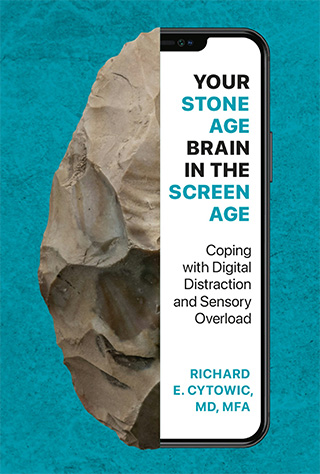
Renowned neurologist Richard Cytowic exposes the dangers of multitasking in the digital age.
Image: DK_2020, Adobe Stock
By: Richard Cytowic
Whether applied to machines or human brains, the term “multitasking” is a misnomer. Despite marketing claims, your computer does not multitask, and neither does your brain. The latter simply cannot, whereas a computer’s processor divvies up each clock cycle and apportions a slice of time — 200 milliseconds, say — to each task. Round and round it goes until everything is done. The inherent inefficiency of having to split up processor time is why your computer bogs down the more you ask it to do.
Brains respond the same way when multiple tasks vie for attention. We lack the energy to do two things at once effectively, let alone three or five. Try it, and you will do each task less well than if you had given each one your full attention and executed them sequentially.
According to Cal Newport, a professor of computer science at Georgetown University, simply jumping over to check your inbox and coming right back can be just as damaging as multitasking. “When you looked at that email inbox for 15 seconds, you initiated a cascade of cognitive changes.” He says even minor switching from a current task to a different one is “productivity poison.”
Stanford University professor Clifford Nass presciently saw multitasking as particularly insidious. One of his most cited studies assumed that heavy multitaskers would excel at ignoring irrelevant information and at switching tasks, and accordingly would have superior recall. He was wrong on all counts:“We were absolutely shocked,” he told “Frontline” in 2009. “Multitaskers are terrible at ignoring irrelevant information; they’re terrible at keeping information in their head nicely and neatly organized; and they’re terrible at switching from one task to another.”
“Multitaskers are terrible at ignoring irrelevant information; they’re terrible at keeping information in their head nicely and neatly organized; and they’re terrible at switching from one task to another.”
Nass assumed that people would stop trying to multitask once shown the evidence of how bad they were at it. But his subjects were “totally unfazed,” continuing to believe themselves excellent at multitasking and “able to do more and more and more.” If individuals in a controlled experiment are this oblivious and refuse to change when confronted with proof of their shoddy performance, then what hope do the rest of us have as we wade through the daily sea of digital distractions?
The challenges of multitasking are especially acute in fields like medicine, where attention to detail can mean the difference between life and death. A powerful example comes from a training session with George Washington University medical students in which we scrutinize an incident that reportedly occurred at another well-known teaching hospital. The story was shared with me during our faculty development sessions, though the specific details were withheld due to privacy and confidentiality concerns.
During bedside rounds on the pediatric cancer ward, the story goes, the whoosh of an incoming text distracted the resident physician, who was entering medication orders and updating the electronic chart. She was a digital native; the message was about a friend’s upcoming party, nothing crucial in the context of the moment. But it momentarily seized her attention long enough to flush her working memory. (When you are interrupted you don’t have a chance to flush your working memory completely; a remnant of attention always remains behind, hooked onto the previous task. The larger the residue you hang on to, the higher the switching costs will be.) The clinical team at the bedside was discussing changing the dose of an intravenous drug, and she failed to enter the change. By the time the omission was discovered, the four-year-old patient had developed kidney failure and gone into shock. In a different setting of 257 nurses and 3,308 pediatric intensive care patients, medication errors occurred when a text or phone call came in on a nurse’s assigned institutional phone “in the 10 minutes leading up to a medication administration attempt.”
We have all experienced how electronic medical records steal time from mutual doctor-patient engagement — one example of the negative consequences of multitasking.Instead of looking, listening, and laying on hands, physicians now must type and check boxes on multiple screens to satisfy bureaucratic demands. A doctor may spend the entire appointment time facing a computer screen. Logically, it should not matter whether a doctor takes handwritten or electronic notes. But it does matter because “hearing” is not the same as “listening.” The former is a passive act of perceiving audible sounds whereas the latter is an active effort to understand another’s perspective, what they are feeling and trying to communicate.
Electronic records demand so much of a physician’s attention and working memory that attentive listening has become impossible. Forced to focus on the screen, they miss reading facial expressions and patient body language. Doctors have been handling interruptions for decades without making these kinds of errors. But screen-based distractions are different in kind, leading to more frequent errors during situations that demand attention. Something powerful takes hold of attention’s so-called spotlight. Perhaps it is time to resurrect a phrase that all parents once knew: “Look at me when I’m talking to you.”
At George Washington University a colleague and I teach small groups of medical students over their four years of study. We instruct them in clinical reasoning and professional development. We watch smart young adults transform into singular professionals who master huge amounts of factual knowledge as well as the know-how to apply it judiciously in the practice of medicine. Accomplishing a transition like this demands a high degree of sustained focus. It is the art of medicine we teach because the human being is more than the human body. Increasingly, though, I witness inattention undermining our students, especially the undergraduates I encounter.
As I waited for the elevator the other day, the doors opened and a dozen undergrads spilled out. All were staring down at their phones, oblivious to my presence even as they jostled and bumped into me. The screen lock on their attention had created a blind spot that made me invisible, a normal feature of perception called “inattentional blindness” or “change blindness.” (You can see a mind-blowing example of it by watching the “invisible gorilla” test on YouTube.) The phenomenon is not a flaw or an optical illusion: The brain evolved to ignore whatever lies outside its immediate focus even when it stares us in the face. Some types of brain damage suspend patients in a perpetual state of inattentional blindness, a variety of agnosia (from the Greek meaning “not knowing”). In common terms, neurology calls this looking but not seeing. A growing proportion of the population seems to be drifting through life, looking at their screens but not seeing what is going on around them.
The brain evolved to ignore whatever lies outside its immediate focus even when it stares us in the face.
Because attention is like a sharp-edged spotlight, we can never know what we are missing. Anything outside its perimeter lies, by definition, within our mental blind spot. The undergraduates who mindlessly careened into me had already acquired habitsthat were actively undermining their ability to learn, think, and remember. Worse, their screen fixation made them oblivious to their self-inflicted handicap.
An enduring myth says we use only 10 percent of our brain. The other 90 percent presumably stands idly by to serve as spare capacity. If the premise of untapped intellectual capacity were true, then the depictions of film characters ranging from Johnny Mnemonic to Lucy and Limitless would be documentaries rather than thrilling science fiction.
Yet two-thirds of the American public and more than a quarter of its science teachers (yes!) mistakenly believe the 10 percent myth, which perhaps underlies assumptions that one can multitask and overcome distractions by sheer force of will. Worse, many American science teachers believe that enriching a child’s environment — with Baby Einstein videos or iPads clamped to bassinets, car seats, and potty trainers — enhances intellect, despite a dearth of supportive evidence they can do any such thing. On the contrary, ample evidence explains why introducing tech impedes the natural development of a child who would otherwise have normal amounts of person-to-person interaction.It is true that growing up isolated and deprived of human contact drastically stunts brain development. But it does not logically follow that using tech to supplement a child’s typical environment will boost cognitive development. Too much stimulation is equally detrimental as not having enough. Besides, it isn’t stimulation per se that is crucial but the social context in which it occurs.
By living in a rich social environment, our neural networks self-calibrate, self-assemble, and adapt to stimulation, experience, and context. Yet energy consumption trumps all other factors. When we measure how the brain actually uses energy, the proposition that we have untapped reserves doesn’t hold up. There is no sluice gate to open that will provide more juice to multitask or think genius league thoughts. To see why this is so, look at brain size and how it scales to the energy it must consume just to stay alive. During the past 2.5 million years the human brain grew proportionally much faster than the human body. Our central nervous system is nine times larger than expected for a mammal of our weight. The cortex constitutes 80 percent of the brain’s volume, and its prodigious consumption of energy begat higher caloric meals and the invention of cooking. Cooking renders the calories in food more easily absorbed and allows the consumption of meat protein and carbohydrates that are otherwise indigestible in their raw forms.
We do use 100 percent of our brain, just not all of it at the same instant.
A rat’s or a dog’s brain consumes about 5 percent of the animal’s total daily energy requirement. A monkey’s brain consumes 10 percent. An adult human brain accounts for merely 2 percent of the body’s mass yet consumes 20 percent of the calories we ingest, whereas a child’s brain consumes 50 percent and an infant’s 60 percent. These numbers are larger than one would expect for their relative sizes because, in all vertebrates, brain size scales in proportion to body size. Big brains are calorie-expensive to maintain, let alone operate, and the discrepancy means that energy demand is the limiting factor no matter what size a particular brain reaches.
It is also costly in terms of energy consumption to generate electrical spikes in a cell. This we know thanks to research undertaken during the administration of general anesthesia. As a person loses consciousness, their brain activity gradually shuts down until it reaches the “isoelectric condition,” the point at which half the calories burned simply go toward housekeeping — the pumping of sodium and potassium ions across cell membranes to maintain the resting electrical charge that keeps the brain’s physical structure intact. This never-ending pumping means that the brain must be an energy hog.
Even if only a tiny percentage of neurons in a brain region were to fire simultaneously, the energy burden of generating spikes over the entire brain would still be unsustainable. Here is where the innate efficiency of evolution comes in. Letting just a small fraction of cells signal at a given time — known as “sparse coding” — uses the least amount of energy but carries the most information because a small number of signals have thousands of possible paths by which to spread themselves out over the brain.
A major drawback of the sparse coding scheme is that it costs a lot to maintain our 86 billion neurons. If some neurons never fire (meaning that if cells don’t generate a current strong enough to travel down the axon and cross the synapse to the next neuron down the line), then they are superfluous, and evolution should have jettisoned them long ago. But it didn’t. What evolution did discover by way of natural selection was the optimum proportion of cells a brain can keep active at any given instant. That number depends on the ratio between a resting neuron’s housekeeping cost and the additional cost of sending a signal down its axon. For maximum efficiency, it turns out that between 1 and 16 percent of cells should be active at any given moment. We do use 100 percent of our brain, just not all of it at the same instant.
Maintaining this balance is part of homeostasis, which we can think of as a budget whose currency consists of all the metabolic molecules that maintain our 86 billion neurons. As with a budget based on money, you can run a metabolic deficit and have your ledger go into the red. When this happens, the brain slashes processes that are too expensive, resulting in fatigue, boredom, clumsy errors, and foggy thinking. The window of maximum efficiency noted above refers to an instantaneous snapshot of energy consumed by whatever neurons are firing at the time. The need to marshal resources in the most efficient manner also explains why most brain operations must be unconscious.
Keeping ourselves alert and conscious, along with shifting, focusing, and sustaining attention, are the most energy-intensive things our brain can do. The high energy cost of cortical activity is why selective attention — focusing on one thing at a time — exists in the first place and why multitasking is an unaffordable fool’s errand.
Fewer Americans are reading books, but here’s the plot twist: Bookstores are staging a comeback.
Why it matters: Barnes & Noble and independent bookstores — once left for dead in the wake of Amazon’s rise and the death of Borders — have pulled off a stunning turnaround, opening new stores and reporting higher sales, Axios’ Nathan Bomey reports. “The revival is there,” Barnes & Noble CEO James Daunt tells Axios.
Independent booksellers are also enjoying a renaissance.
The number of U.S. bookstore companies rose 70%, from 2,010 in 2021 to 3,416 in 2025, according to the American Booksellers Association.73% of booksellers recorded a sales increase in 2025.

 Data: AAA. Chart: Ben Geman/Axios
 ️ Gas price politics are tricky.
 What we’re watching: President Trump this week issued a vague threat of “big problems” for gasoline retailers unless stations cut prices faster.


 / .
/ . 
 Why it matters: “Most Americans can’t name the presidents, much less tell you what they look like,” Catalano tells Axios’ Erica Pandey. “This was a labor of love.”
 Zoom in: Sal, as he’s known, used quotes from each president to inspire the style of the portrait. Here’s a sampling from the first three and latest three presidents, shown above:
 “My job is to find things that nobody else knows about these people,” Catalano tells us.
 Photo: Goldman Sachs
 The exhibit, featuring all 47 presidential portraits, flanked by two American flags — the 13-star Betsy Ross flag on the left and today’s 50-star flag on the right — will remain on display in Goldman Sachs’ lobby through August.

 Bookstore renaissance
 Independent booksellers are also enjoying a renaissance.