The MIT Press: The myth of the “Psychopathic Brain”.

In Brief: The Myth of the “Psychopathic Brain”

Inbox

The MIT Press Reader <thereader@mit.edu> UnsubscribeFri, Jul 17, 2:56 PM (2 days ago)
to me
New on the MIT Press Reader | View this email in your browserDear Readers:

Welcome to our newsletter series, In Brief, where werevisit a piece from the MIT Press Reader archive and invite the author to reflect on it through a short set of questions and answers.

This month, we’re delighted to welcome Rasmus Rosenberg Larsen, Assistant Professor of Forensic Epistemology and Philosophy of Science at the University of Toronto Mississauga and author of Psychopathy Unmasked, which critically examines the scientific status and forensic application of the psychopathy diagnosis.

In a related Reader essay, Larsen argues that decades of neuroimaging research have failed to provide reliable evidence that psychopathy is associated with brain abnormalities, and that the scientific literature has often overstated what the data actually show.Psychopathy Unmasked

You argue that the neuroscience of psychopathy is often presented as far more settled than it really is. Why do you think the image of the “psychopathic brain” has proved so compelling to scientists, courts, journalists, and the public?

Part of the problem is that scientists themselves have helped create the impression that a “psychopathic brain” exists. Neuroimaging research is technically complex, and even scientifically trained readers often struggle to evaluate its methods and statistics. Lay readers therefore have little chance of recognizing when a confident conclusion is not well supported by the underlying evidence. 

The more interesting question, I think, is why the image of the “psychopathic brain” became so influential within science itself. Part of the answer may lie in scientific incentives. Null findings are difficult to publish and rarely attract attention, whereas studies reporting apparent brain differences seem novel and important — and can help researchers secure lucrative grants and advance their careers. Researchers are therefore rewarded for finding and emphasizing statistically significant effects, even when the broader pattern of evidence is inconsistent or simply wrong. This dynamic is part of the wider replication and reproducibility crisis that has affected many fields, and psychopathy research strikes me as a textbook example.

But there may also be a deeper, less nefarious explanation. The traditional image of the psychopath — charming and outwardly normal, yet emotionally hollow and morally deficient — is an exceptionally powerful cultural narrative. Once researchers assume this distinct type exists, it can seem self-evident that such people must also possess distinctive brain abnormalities. That expectation may have influenced what researchers looked for, and what they believed they found.

You describe a striking gap between the actual MRI findings on psychopathy — many of them null or inconsistent — and the way those findings are summarized in review literature. How does this kind of distortion happen in science, especially when no single researcher may see themselves as acting irresponsibly?

This is a difficult question to answer because we lack conclusive evidence, so any answer must be speculative. I doubt there is deliberate or nefarious intent involved. Researchers are generally enthusiastic about their work, invested in the theories they are testing, and naturally attentive to patterns they expect to find. As I suggested earlier, the idea of the psychopath — and of a distinctive “psychopathic brain” — is so deeply ingrained in our culture that it may shape expectations before data are even collected.

In my view, the problem is methodological. The neuroscience of psychopathy suffers from too much analytical flexibility and too few methodological constraints. Studies often examine numerous brain regions and statistical models while relying on small or poorly controlled samples and inadequately accounting for confounding factors such as head trauma or substance use. Under these conditions, statistically significant findings are almost inevitable, even if they are spurious. That is largely what the literature shows: many null results, virtually no direct replications, and a handful of positive findings that receive disproportionate attention.

So the distortion emerges cumulatively. One exciting finding is highlighted, later reviews cite it while overlooking the many null results, and the simplified conclusion is repeated until it takes on the appearance of established fact.

What would you most like judges, lawyers, clinicians, and journalists to understand before invoking brain research in discussions of psychopathy?

The most important thing to understand is that the neuroscience of psychopathy remains wholly inconclusive. That is the central message, and it is also entirely uncontroversial. We have not established that there is such a thing as a distinctive “psychopathic brain,” but neither have we conclusively demonstrated that no such pattern could ever exist. The evidence simply does not support any confident conclusions.

For judges, lawyers, clinicians, and journalists, the practical implication is therefore simple and straightforward: they should not invoke the “psychopathic brain” as though it were an established scientific finding. For now, that idea should simply be set aside.

As I show in Psychopathy Unmasked, the evidence across the major domains of psychopathy research does not support the traditional picture of the psychopath, let alone establish that such individuals even exist. The failure to identify a “psychopathic brain” may therefore be one symptom of a deeper mistaken assumption. Perhaps some of our most basic beliefs about psychopathy are simply wrong. There is nothing embarrassing about that. Discovering that a long-standing assumption was mistaken is not a failure of science; it is one of the most fundamental ways in which science advances.Check out these recent roundups of MIT Press Reader stories:June 2026
May 2026
April 2026
March 2026Browse previous issues of In Brief

June 2026
April 2026
March 2026
February 2026
 Copyright © 2026 The MIT Press, All rights reserved.
You are receiving this email because you opted in via our website.

Our mailing address is:
The MIT Press255 Main Street, 9th FloorCambridge, MA 02142-1209Add us to your address book

Want to change how you receive these emails?
You can update your preferences or unsubscribe from this list.
 
Posted in Uncategorized | Leave a comment

Axios: The hate election

 The hate election
 
Illustration of a person's shirt with a sticker with an American flag on it, and the text,
Illustration: Brendan Lynch/Axios. Stock: Getty Images
 
Republicans admit their midterm forecast is bleak. But they’re clinging to two hopes: voters’ fear and loathing of Democrats, Axios’ Marc Caputo reports.

“It’s going to be a hate election,” a Republican tied to President Trump‘s political operation told Axios. “Voters have to hate the Dems more than they hate us. And we have material to work with.”

So watch for the GOP to play up swing voters’ fears that Democrats would go too far left if they won control of the House and/or Senate — arguing that “yeah, we suck, but they’re worse,” as one GOP pollster put it.

Why it matters: There’s broad GOP frustration that Trump has made challenging midterm elections harder by not focusing on pocketbook issues — especially the tax cuts Republicans won — while launching the Iran war, which raised gas prices and fueled inflation.

Trump’s prime-time speech Thursday night about China’s alleged influence campaign targeting U.S. voters six years ago did little to assuage those concerns.

“I have yet to understand how we win the midterms by talking about what happened in 2020,” Sen. John Cornyn (R-Texas) told Axios.

🔎 Zoom in: Trump hopes his speech will pressure Congress to pass his controversial SAVE America Act and energize his base. But GOP pollsters and election pros outside the White House say the message is falling on deaf ears.

“We’ve studied this, and it’s not a winner,” said a second Republican pollster working on multiple races nationwide. “Our research shows people want the president to make their life better, and they don’t believe he has.

“The pollster’s data now indicate Democrats could wind up with a seven-seat majority in the House, where Republicans have a six-seat edge. Trump’s net approval rating is 10 points underwater.

A Washington Post/Ipsos pollout Thursday showed Trump’s net approval rating was even worse among registered voters: -19%.

👀 Friction point: Democrats also have poor favorability ratings. And Republicans plan to use the Democrats’ Tea Party-like revolt by progressives to paint the entire party as radicals who can’t be trusted to govern.📉 

Reality check: Both political parties have similar (low) approval ratings, according to a Pew Research Center poll.

A majority of voters consistently view Trump as dishonest (even in red states, including Texas).

And Republicans counting on voters hating liberal Democrats more than them might consider this: A CNBC poll out Friday found that voters now are more likely to be turned off by a MAGA candidate than a democratic socialist.Share this story.
Posted in Uncategorized | Leave a comment

Democracy … what about Lindsey Graham’s appointment on his death. Lego

https://twitter.com/charise_lee/status/2078459366974599235/video/1

Posted in Uncategorized | Leave a comment

Something changed when Swiss farmers stopped fighting pests with more chemicals and started planting flowers instead.

Something changed when Swiss farmers stopped fighting pests with more chemicals and started planting flowers instead.

Researchers found that wildflower strips sown through winter wheat fields cut cereal leaf beetle numbers by up to 53%. Crop damage dropped by 61% because the flowers gave natural predators like parasitic wasps and hoverflies a place to live and hunt on. The idea is refreshingly simple.

Give nature’s pest controllers a home and they take care of the rest. The UK Centre for Ecology and Hydrology has now planted similar strips across 15 farms in England to test whether the results hold outside Switzerland. Early signs suggest these flower corridors help insects reach the center of large fields, not just the edges.

It is a small change with a big promise for farmers hoping to grow food without leaning so hard on pesticides. Source: Schumi et al., Proceedings of the Royal Society B, Agroscope, Switzerland.

·

751 Views

Posted in Uncategorized | Leave a comment

Shining Science on X: A new drug stops dementia …

A new drug stops dementia, restoring the brain’s natural cleanup system.

An international research team led by the Institute for Bioengineering of Catalonia has unveiled a nanotechnology breakthrough that reverses Alzheimer’s symptoms by rebooting the brain’s waste-clearing system.

These “supramolecular drugs” are tiny, engineered particles that repair the blood-brain barrier—the protective shield that often breaks down as dementia progresses. Rather than simply delivering medicine, the nanoparticles themselves act as agents to reset transport proteins, enabling the brain to naturally flush out the toxic amyloid-beta plaques that cause cognitive decline.

The experimental results were staggering: toxic protein levels dropped by up to 60% within just one hour of treatment.

In long-term tests, elderly mice equivalent to 90-year-old humans regained the cognitive performance of healthy young adults after receiving just three doses. By shifting the focus from attacking brain plaques to repairing the brain’s vascular plumbing, this approach offers a radical new strategy that could potentially move beyond slowing Alzheimer’s to actively restoring lost mental function.


source: Chen, J., Battaglia, G., et al. (2026). Nanotechnology Reverses Alzheimer’s in Mice via Blood-Brain Barrier Restoration. Signal Transduction and Targeted Therapy.

Posted in Uncategorized | Leave a comment

The Winston Marshall Show: Islam trying to conquer the west since the 7th century, now they “Woke” their way in.

https://twitter.com/Shariakill/status/2078771881595838562/video/1

Leave a comment

This day in History July 19th. Seneca Falls Convention. Women sought the right to vote


U.S.

Eras & Ages

    Culture

    WWII With Tom Hanks

    HISTORY Honors 250

    Create a free HISTORY profile to stay in the know.

    Stream HISTORYTryHISTORY Vault

    Advertisement

    JUL19

    JUL19

    Choose another dateOK

    July

    1848

    Seneca Falls Convention begins

    HISTORY.com Editors

    Getty Images

    Published: July 21, 2010 Last Updated: February 18, 2025

    At the Wesleyan Chapel in Seneca Falls, New York, a woman’s rights convention—the first ever held in the United States—convenes with almost 200 women in attendance. The convention was organized by Lucretia Mott and Elizabeth Cady Stanton, two abolitionists who met at the 1840 World Anti-Slavery Convention in London. As women, Mott and Stanton were barred from the convention floor, and the common indignation that this aroused in both of them was the impetus for their founding of the women’s rights movement in the United States.

    In 1848, at Stanton’s home near Seneca Falls, the two women, working with Martha Wright, Mary Ann McClintock, and Jane Hunt, sent out a call for a women’s conference to be held at Seneca Falls. The announcement, published in the Seneca County Courier on July 14, read, “A Convention to discuss the social, civil, and religious condition and rights of women will be held in the Wesleyan Chapel, at Seneca Falls, on Wednesday and Thursday, the 19th and 20th of July current; commencing at 10 o’clock A.M. During the first day the meeting will be exclusively for women, who are earnestly invited to attend. The public generally are invited to be present on the second day, when Lucretia Mott, of Philadelphia, and other ladies and gentlemen, will address the Convention.”

    The Seneca Falls Convention

    Learn about the movement for women’s equality that precipitated the Seneca Falls Convention in 1848, and what its attendees – including Elizabeth Cady Stanton and Lucretia Mott – hoped to achieve.

    4:19m watch

    On July 19, 200 women convened at the Wesleyan Chapel, and Stanton read the “Declaration of Sentiments and Grievances,” a treatise that she had drafted over the previous few days. Stanton’s declaration was modeled closely on the Declaration of Independence, and its preamble featured the proclamation, “We hold these truths to be self-evident: that all men and women are created equal; that they are endowed by their Creator with certain inalienable rights…” The Declaration of Sentiments and Grievances then detailed the injustices inflicted upon women in the United States and called upon U.S. women to organize and petition for their rights.

    On the second day of the convention, men were invited to attend–and some 40 did, including the famous African American abolitionist Frederick Douglass. That day, the Declaration of Sentiments and Grievances was adopted and signed by the assembly. The convention also passed 12 resolutions–11 unanimously–which called for specific equal rights for women. The ninth resolution, which declared “it is the duty of the women of this country to secure to themselves their sacred right to the elective franchise,” was the only one to meet opposition. After a lengthy debate, in which Douglass sided with Stanton in arguing the importance of female enfranchisement, the resolution was passed. For proclaiming a women’s right to vote, the Seneca Falls Convention was subjected to public ridicule, and some backers of women’s rights withdrew their support. However, the resolution marked the beginning of the women’s suffrage movement in America.

    The Seneca Falls Convention was followed two weeks later by an even larger meeting in Rochester, N.Y. Thereafter, national woman’s rights conventions were held annually, providing an important focus for the growing women’s suffrage movement. After years of struggle, the 19th Amendment was adopted in 1920, granting American women the constitutionally protected right to vote.

    Posted in Uncategorized | Leave a comment

    I often wonder do people ask why Forster Street, Galway. You will find the Sept on this site under Blake-Forster also ffrench connection. Bamburgh is where the Forsters originate, as detailed in the Sept

    https://twitter.com/AMAZINGISEARTH/status/1911167330047885317/video/1

    Posted in Uncategorized | Leave a comment

    Fortune: With a $15 billion net worth, Palantir CEO Alex Karp predicts he will get 20x richer from AI—but that middle-class workers will get just modest raises

    Search

    Subscribe

    Sign in

    Trendingnow

    1

    U.S. companies have finally gotten $71 billion in tariff refunds, but they’re using it to offset inflation caused by the Iran war

    2

    FedEx CEO says we are in the middle of the biggest supply chain shift he’s seen in 35 years: ‘We are the referendum’

    3

    Kevin O’Leary claimed opposition to his Utah data center was fueled by Chinese money. Now he and Fox News are being sued for defamation

    Success Wealth

    With a $15 billion net worth, Palantir CEO Alex Karp predicts he will get 20x richer from AI—but that middle-class workers will get just modest raises

    Preston Fore

    By 

    Preston Fore

    Success Reporter

    July 17, 2026, 11:06 AM ET

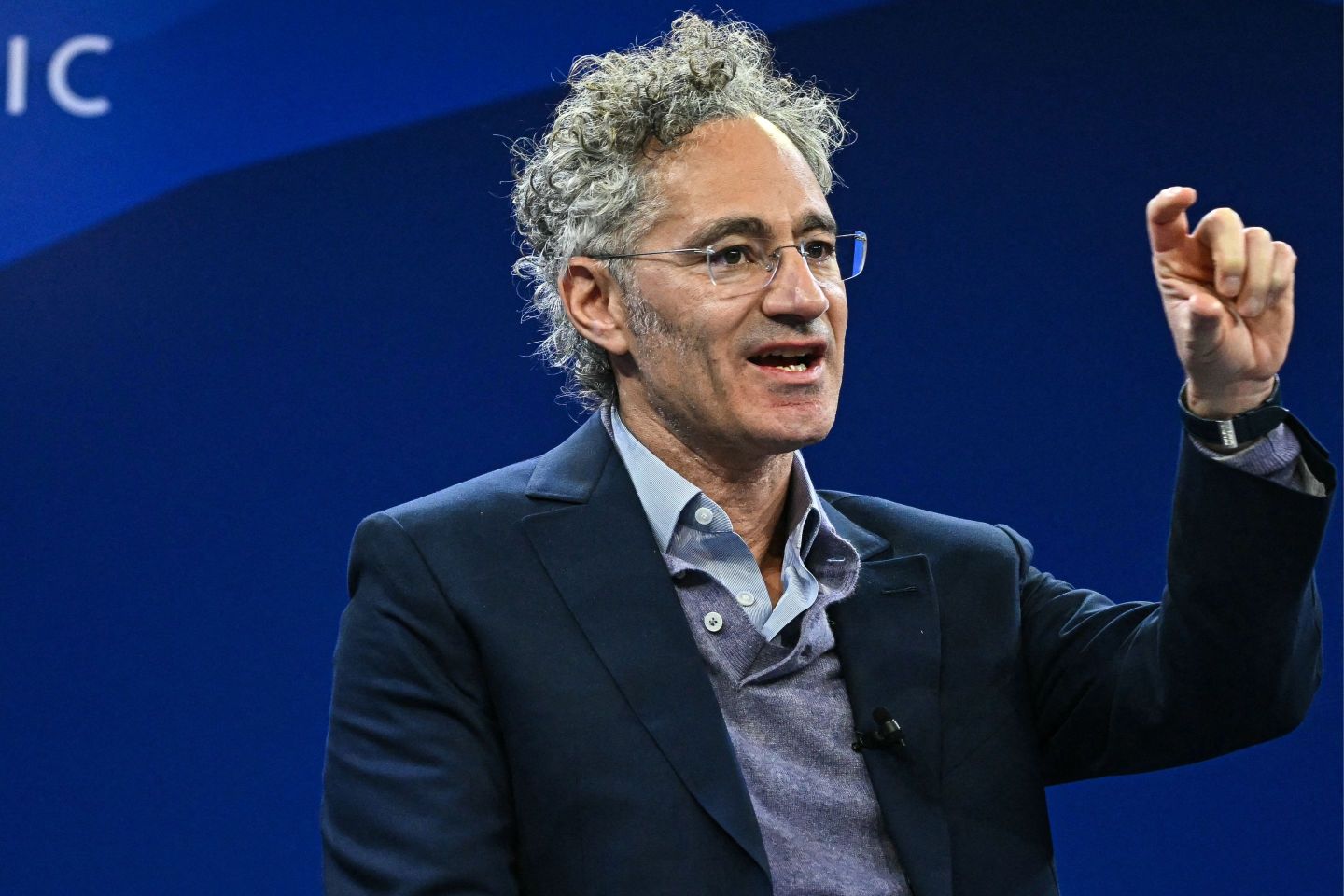
    Alex Karp gestures

    Palantir CEO Alex Karp expects his fortune to grow to $300 billion thanks to AI—he says the U.S “biggest problem” is wealth going to unrelatable tech bros and leaving the middle-class behind.Fabrice COFFRINI / AFP via Getty Images

    The artificial intelligence boom has propelled Palantir’s market value to roughly $322 billion—and pushed CEO Alex Karp‘s net worth to about $15 billion. But the 58-year-old has just warned that the wealth imbalance generated by AI is only going to get worse.

    Recommended Video


    Billionaires’ children are pushing their parents to give away wealth faster

    NextStay

    “The biggest problem in this country is [AI] will raise the standard of living of the average person, but the people involved are likely to get 10, 100 times wealthier than they already are,” Karp told Axel Springer CEO Mathias Döpfner on the MDMeets podcast. “That’s a problem for society.”

    Karp estimated AI could make him “20x wealthier,” implying a fortune approaching $300 billion. Middle-class workers, he said, might simply see their salaries double over the next decade. Karp slammed the disparity as a “complete decoupling of unimaginable wealth and normal wealth.”

    For Karp, the problem isn’t just the scale of the wealth—it’s who is likely to accumulate it.

    “It’s done by people you don’t really relate to, like very oddly shaped IQ specimens that you probably wouldn’t want to have over for dinner,” Karp said. “And if they were over for dinner you’d have nothing to talk to them about, and vice versa.”

    Many of the same people who stand to benefit the most from AI are also overselling its promise, he added: “The overselling of AI in this country is really somewhat disconcerting, but it’s also depressing because you don’t have to do it.”

    Income inequality has been widening for generations—and 2025 was a record-breaking year for billionaire wealth

    Wealth inequality has been a topic of debate for decades, with the richest households capturing an ever-larger share of economic gains, while wage growth for many workers has remained comparatively modest. 

    The AI boom has only accelerated that trend. In 2025, global billionaire wealth surged by over 16%—three times faster than the previous five-year average—to $18.3 trillion, its highest level in history, according to Oxfam.

    No one has embodied that explosion in wealth more than Elon Musk. The Tesla and SpaceX CEO’s fortune currently stands at roughly $833 billion after he briefly became the world’s first trillionaire earlier this year.

    The scale of that wealth is almost difficult to comprehend. 

    Paid Content

    CEO of RSM’s Transatlantic Partnership Brian Becker on 100 years of business…

    From RSM

    Oxfam estimated that someone with a $1 trillion fortune could pay a 10% wealth tax—roughly $100 billion—and still remain among the richest people on Earth. The organization also estimated that $100 billion would be enough to lift more than 800 million people out of extreme poverty for a year.

    Even Jamie Dimon and Larry Fink share Karp’s concerns about workers being left behind

    Karp hasn’t been the only leader to sound the alarm about rising income inequality.

    BlackRock CEO Larry Fink, whose net worth is estimated at $1.3 billion, warned earlier this year that AI risks leaving much of the world behind if its benefits remain concentrated among a small number of winners.

    “Since the fall of the Berlin Wall, more wealth has been created than in any time prior in human history, but in advanced economies, that wealth has accrued to a far narrower share of people than any healthy society can ultimately sustain,” Fink said at the World Economic Forum in Davos, Switzerland.

    “Early gains are flowing to the owners of models, owners of data and owners of infrastructure,” Fink added. “The open question: What happens to everyone else if AI does to white-collar workers what globalization did to blue-collar workers? We need to confront that today directly. It is not about the future. The future is now.” 

    Nobel Prize-winning computer scientist Geoffrey Hinton—often dubbed the “Godfather of AI”—has voiced similar concerns.

    “What’s actually going to happen is rich people are going to use AI to replace workers,” Hinton said last year. “It’s going to create massive unemployment and a huge rise in profits. It will make a few people much richer and most people poorer. That’s not AI’s fault, that is the capitalist system.”

    JPMorgan Chase CEO Jamie Dimon, however, has taken a more measured view. While he questioned some of the rhetoric surrounding inequality, he has acknowledged many lower-income Americans face hardships.

    “If you were the average citizen here and you say, ‘These wealthy people are getting unbelievably wealthy, and this segment’s been left behind,’ that’s kind of annoying.”

    He added to Axios that “we have, in fact, left the lower-income folks behind.”

    The Fortune 500 Innovation Forum will convene Fortune 500 executives, U.S. policy officials, top founders, and thought leaders to help define what’s next for the American economy, Nov. 16-17 in Detroit. Apply here.

    About the Author

    Preston Fore

    By Preston ForeSuccess Reporter

    Preston Fore is a reporter on Fortune‘s Success team.

    Posted in Uncategorized | Leave a comment

    Thinking of getting a dog; you may have a dog and you cannot train it, a chat yesterday took me back to Barbara Woodhouse “Training Dogs” … it was a BBC TV programme and Barbara caught the attention of so many followers

    Posted in Uncategorized | Leave a comment