
Man sees his cat’s eyes in the faces of his friends after brain surgery
By Mike McRae
November 11, 2026
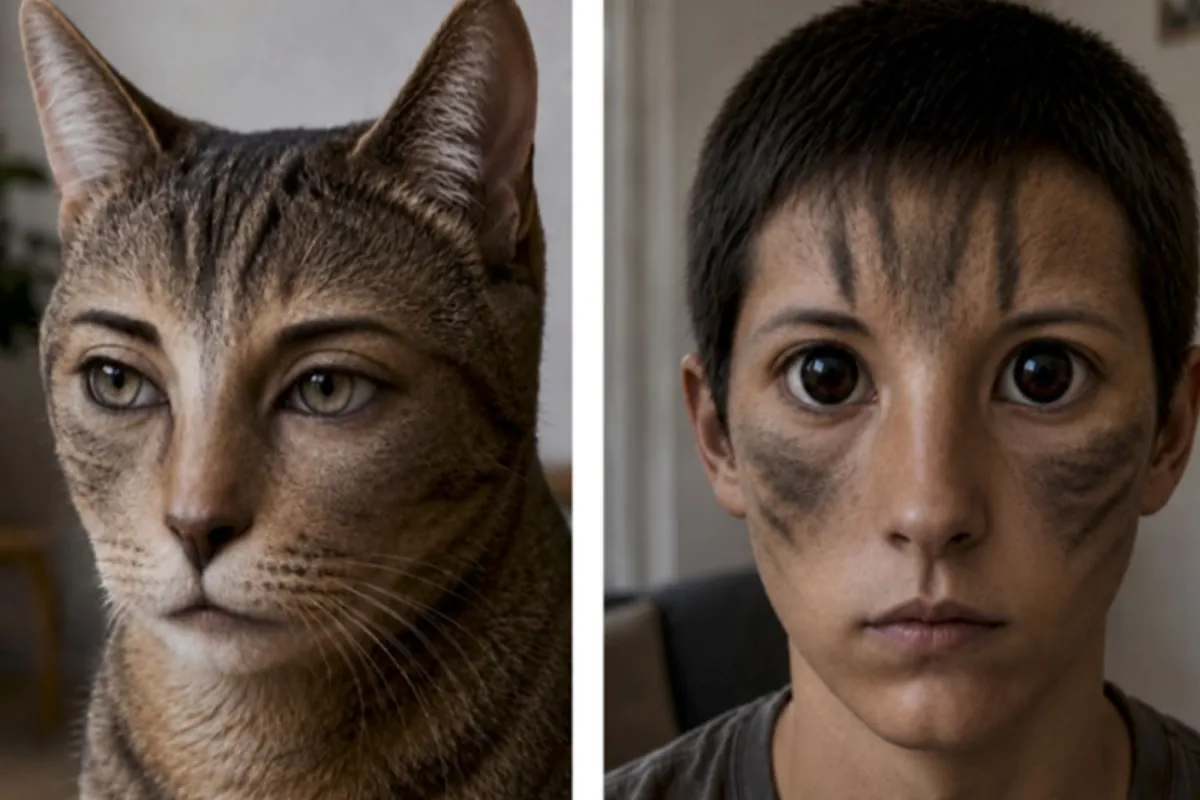
Participant-guided visualization of Karl’s recollection, in which he saw a familiar woman’s eye region within his cat’s face, and vice versa.
Duchaine et al., Cortex, 2026 – using ChatGPT
View 2 Images
A familiar face can often remain with us long after its owner leaves the room. For the patient described in a recently published case study, that persistence took an unusually literal form after brain surgery, as features of his cat’s eyes appeared in the faces of people he encountered.
The bizarre eye swap also ran in reverse, with a familiar person’s eyes sometimes appearing in his cat’s face.
Described in a new report in the journal Cortex, the experiences of the 28-year-old man known only as Karl provide researchers with a rare glimpse into how the human brain assembles faces, and how memories can become entangled with what we see.
“This case of Karl seeing his cat’s features in human faces and vice versa demonstrates that individual features can be pulled from memory and influence our ongoing perception,” says the study’s lead author, Brad Duchaine, a principal investigator of the Social Perception Lab at Dartmouth College.
To better appreciate Karl’s experience, Duchaine and his team developed AI-assisted images, refining them over months with his feedback until he judged them representative.
These are reconstructions of remembered perceptions, rather than direct recordings of vision, but they go a long way in helping researchers build a picture of how the brain creates perceptions.
It’s easy to take for granted our ability to recognize a familiar face. As an individual with a relatively severe form of “face-blindness” – aka prosopagnosia – I personally struggle with this seemingly straightforward task on a daily basis.
Buried within our brains are a number of inbuilt systems dedicated to rapidly constructing Identikits of family, friends, and foes, which can deliver some surprising outcomes when they go awry.
In Karl’s case, the changes to his own facial recognition pathways began after surgery to remove an arteriovenous malformation, an abnormal tangle of blood vessels, from his right posterior temporal region. This part of the brain is involved in tasks such as language and visual processing, contextual memory, and recognizing environments, so removing a part of it risks any number of unexpected consequences.
According to a Dartmouth College press release, Karl’s gray tabby, Luna, is often the first face he sees in the morning. On some days, her almond-shaped eyes, big pupils, and even her stripes then appear on human faces, both in person and online. If he sees a person first, their features may carry over to other people, or even back to Luna.
The phenomenon is described as a feature of palinopsia, in which something previously seen persists or returns to perception. Karl also appears to have prosopometamorphopsia (PMO), a rare condition that alters the appearance of faces.
Sometimes called “demon face syndrome,” PMO can change the apparent shape, position, color, or texture of facial features. For Karl, the transferred features blend seamlessly into the face before him, which moves naturally as his viewing angle or distance changes. Episodes often last hours, occasionally continuing throughout the day.
Crucially, he recognizes the borrowed features, which points to individual facial components being retrieved from long-term visual memory of his cat or friends.
It’s a clinical interpretation that builds on a 1986 case of a 58-year-old woman who experienced hallucinations, including fellow passengers on a bus each appearing with the face of a dog moments after she had looked at a poodle. This was four months after experiencing a stroke that slowed her right posterior temporal area.
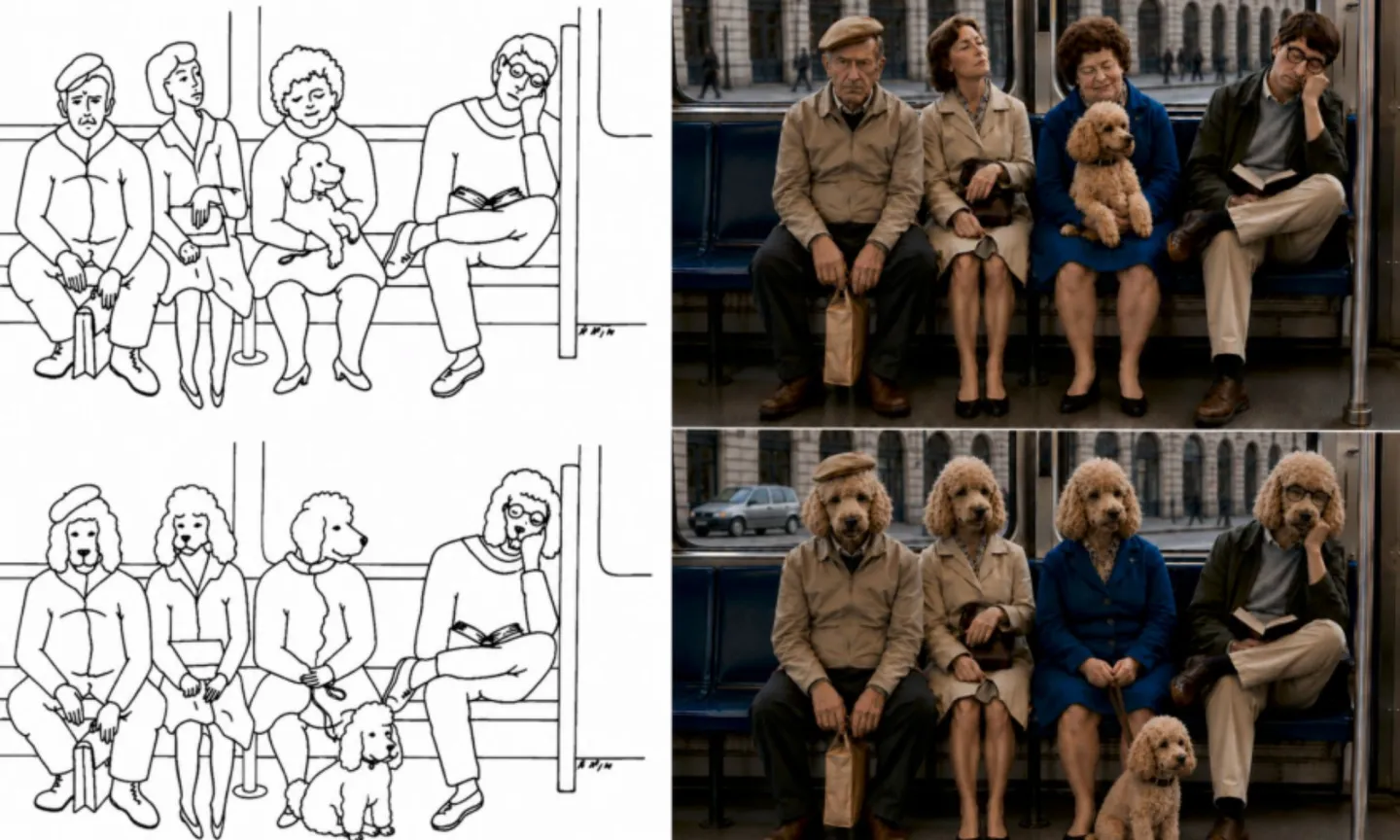
Other cases show how differently face perception can change following neurological injury.
A report published in 2014 described a woman who developed facial distortions after a stroke. Faces looked older, younger, swollen, dirty, or grimacing. She also struggled to recognize relatives. A 2024 Lancet report tells of a 58-year-old man who saw stretched, deeply grooved faces in person, while photographs appeared normal. His history included a serious head injury and possible carbon monoxide poisoning, although the report did not establish a cause. Despite the distortions, he knew who people were and held no delusional beliefs about their identities.
None of these cases can tell us on their own just how the brain produces such substitutions.
But each contribution makes an otherwise private experience more accessible to researchers, clinicians, and the people around them, helping people like me better understand how the task of recognizing or remembering a face is typically accomplished with ease.
The research was published in Cortex.
Source: Dartmouth via Eurekalert
