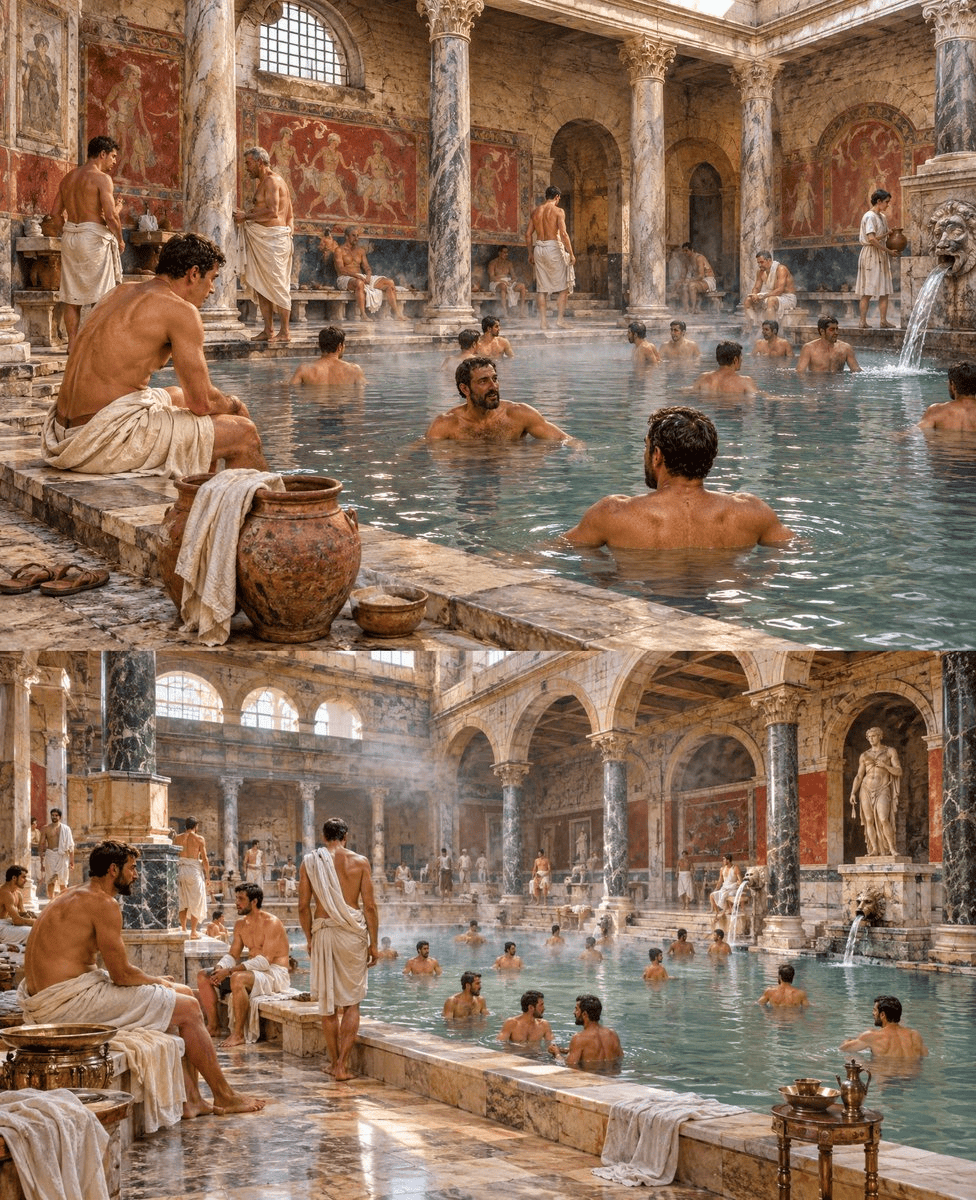
The history of ancient pools and baths spans thousands of years, evolving from sacred ritual tanks to grand social and engineering marvels…
As people have loved swimming and soaking in water since… well, humans have always loved water, from what historical records show. History of pools is a fascinating story in and of itself. From when pools were invented, who first decided that artificial pools were a great idea, and how the swimming pool has evolved since its early beginnings, the history of the swimming pool is a story worth diving into.
. . .
The earliest man-made pools of note were the Great Baths of Mohenjodaro in Pakistan. Built in 2600 BC, give or take a few centuries, the Great Baths were constructed from plaster-covered bricks, sealed with a tar sealant, and surrounded by terraced decks. While the Great Baths certainly sound like a swimming pool, it’s thought people used them primarily for religious reasons. No one was swimming laps at Mohenjodaro, so while definitely an ancient, artificial pool, the Baths don’t quite fit the modern swimming pool definition.
Historians often point to the Greeks and Romans as the first cultures to build pools designed specifically for swimming. In both cultures, bath houses existed, but like Mohenjodaro, they weren’t exactly swimming pools… or were they? According to Archaeology Magazine, Roman culture prioritized physical fitness. Romans in particular were known to exercise at bath houses, even incorporating games (especially ball games, so beach ball isn’t necessarily such a modern concept!) into their visits. Some baths, such as the natatio in Pompeii, are even visually similar to pools today, complete with tile work and decoration. Interestingly, very word natatio exists in modern languages descended from Latin. Natación is the word for swimming in Spanish, and English has its own similar word – natation, though its use has declined significantly since late 1800s.
After Romans, there’s a bit of a gap in history of swimming pools, at least in Western culture. Turns out wars, plagues, and general unrest of Middle Ages weren’t conducive to advances in swimming facilities. It was back to lakes and oceans for swimming fans until middle of 19th Century. The first public indoor swimming pool in England was a salt-water pool called St. George’s Baths, which opened in 1828. By 1837, London boasted six indoor pools. Of course, one can’t talk about swimming in that era without also commenting on the unique poolside fashions of the era. In Bath, ancient peoples embraced the natural hot mineral springs for relaxation and recreation alike. As English community continued to enjoy the waters, local leaders eventually called for some sort of designated swimwear.
Term bathing suit was born out of this… Early bathing suits were, especially for women, on the cumbersome side. They tended toward modesty, and often were constructed with heavy materials like wool. Of course, women eventually rebelled against this heavy, inconvenient fabric, but we’ll wade into that topic shortly.