
UK accuses Russia of covert submarine operation threatening undersea cables
Together with allies, the UK tracked “every mile” of the deployment involving an Akula-class and a pair of Main Directorate for Deep Sea Research (GUGI) surveillance submarines, according to British defense secretary John Healey.
By Tim Martin on April 09, 2026 2:07 pmShare
BELFAST — The UK said today it had uncovered what it described as a secret Russian attack submarine and underwater spy vessel mission in and around British waters that lasted over a month and threatened undersea cables.
British Defense Secretary John Healey said there was “no evidence” that the cables or underwater pipelines had been damaged, but said, “I’m making this statement to call out this Russian activity, and to President [Vladimir] Putin, I say ‘we see you.’”
Healey told media during a press conference in London that over the last few weeks and together with allies, the UK tracked “every mile” of the deployment involving an Akula-class and a pair of Main Directorate for Deep Sea Research (GUGI) surveillance submarines.
He said that the Akula was “likely” used as a decoy to distract from the GUGI-led activities, as the sister vessels “spent time over critical infrastructure relevant to us and our allies in the North Atlantic.”
Healey said there would be “serious consequences” if “any attempt” is made by Moscow to destroy subsea infrastructure, though he refused to reveal any options that the UK and allies could consider, on grounds that it would “make the Russians wiser.”
The Russian embassy in London reportedly denied Healey’s claims.
He noted that at a national level alone, the effort to track the foreign subs involved a Royal Air Force P-8 Poseidon maritime patrol aircraft logging over 450 flight hours. In support, the Royal Navy’s Type 23 frigate HMS St Albans, covered “several thousand” nautical miles. Both services also deployed sonobuoys to monitor the Russian subs.
A related UK statement outlined that the Akula-class vessel was also tracked by Merlin naval helicopters and the Royal Fleet Auxiliary’s Tidespring – a logistics support ship.
The coordinated response to counter the submarine incursion included support from Norway. Norway’s defense minister, Tore O. Sandvik, said in a separate statement that the Nordic nation’s contribution involved a P-8 and a frigate.

Modernizing defense enterprise IT without disrupting the mission
Government can’t stop to update systems, so modernization has to happen without interruptions.
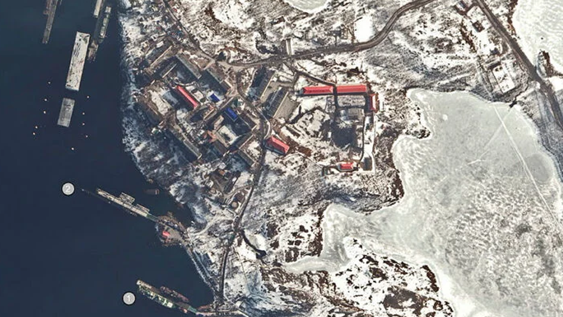
The UK MoD also released a satellite image on X of Russia’s naval base Olenya in the High North, pictured with what the UK identified as a Yantar spy ship and the two GUGI submarines prior to leaving port for British waters.
As stated by Healey, the subs are specifically designed to “survey underwater infrastructure during peacetime and sabotage it in conflict.”
In comments widely shared with media, John Hardie, Russia program deputy director at the Foundation for Defense of Democracies, a Washington DC-based national security think tank, said GUGI vessels have “long engaged in suspicious activity near undersea cables. Russia can use these vessels to place wiretaps or collect intelligence to support contingency planning to disrupt NATO communications in the event of war.”
In addition to the three-vessel submarine episode, the UK also says that it has undertaken a further “ten days of intensive monitoring operations of Russian warships and a submarine which entered UK waters in the English Channel and North Sea,” per the government statement.
In response, Royal Navy surface ships and wildcat helicopters monitored the journeys of a Russian destroyer, frigate, landing ship, and Kilo-class submarine.
The Russian deployments come at a time when analysts say UK naval resources are overly stretched, highlighted in particular by the recent reported struggle to deploy one of six Type 45 destroyers to the eastern Mediterranean, in response to regional defensive operations spawned from the war in Iran.
Since then, Germany’s frigate Sachsen has been forced to step in and fill a gap left by the British destroyer, which was initially planned to be the flagship of a NATO mission in the North Atlantic.
Healey acknowledged that the Royal Navy has been “hallowed out” over the last 14 years, as he accused previous Conservative governments of cutting warships, mine hunters and delaying the renewal of Britain’s nuclear deterrent.
“We can’t turn that [legacy] round as a relatively new government overnight, but we’re spending £300 million [$403 million] more on ship building,” he stressed.
Healey did not provide any new information about when the long-delayed UK defense investment plan will be published. The document, originally planned for release in the fall of 2025, is set to spell out MoD acquisition commitments and cuts over the next decade.
“We will” publish the plan “as soon as possible,” he explained, consistent with messaging from the MoD and other ministers dating back over several weeks.

 canisgallicus