
Select:

Psychoanalyst Stephen Grosz: ‘Some people find unhappiness more comfortable than surrendering to love’
The expert, who has worked with patients for more than 40 years, has published ‘Love’s Labor,’ a book about what he has learned from the pain that human relationships can cause

Madrid – MAR 29, 2026 – 06:00 CEST
“For one human being to love another: that is perhaps the most difficult of all our tasks, the ultimate, the last test and proof, the work for which all other work is but preparation.” This quote – from the Austrian poet Rainer Maria Rilke – opens the second book by Stephen Grosz, titled Love’s Labor: How We Make and Break the Bonds of Love (2026). The 73-year-old Indiana-born psychoanalyst – who has lived and practiced in the United Kingdom for more than four decades – believes that love isn’t a state one arrives at, but rather, a task one undertakes… and one that we almost always do poorly.
His first book – The Examined Life, published in 2013 – was a phenomenon: number one on the British bestseller lists, translated into more than 30 languages and adapted for the stage. The New York Times described Grosz as “a combination of Chekhov and Oliver Sacks.”
Labor of Love is its sequel: 12 real-life case studies – with names changed – about the fears, deceptions and losses that prevent us from truly connecting with those we love (or those we think we love).
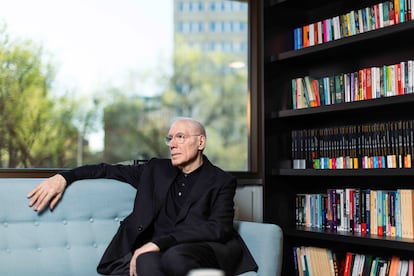
The book has recently been translated into Spanish. Grosz welcomed EL PAÍS at his publisher’s office in Madrid. He speaks in a measured voice with such kindness and empathy that the interview often feels more like a therapy session.
Question. “For one human being to love another: that is perhaps the most difficult of all our tasks.” This is the quote by Rilke, which you chose for the epigraph. But most people don’t think of love as a task…
Answer. We tend to think of love as a feeling. [But I liked the idea expressed by Rilke] , because we have to work to see ourselves clearly, our beloved clearly, the world clearly… We live in a world where everything is quite confused; [many people think] that what they feel is true. We have to join the world as it is, not as we imagine it to be.
Q. And yet, there’s a deeply ingrained cultural tradition that says when love starts to require effort, it’s no longer love…
A. I’m friends with the British poet Wendy Cope. She’s wonderful. [And she says,] well, there’s the fun bit, at the beginning. That’s when we’re talking about excitement and romance and dating and eroticism… all the pleasures. Real love is the difficult thing that starts when you care about someone. And, if you really do care, you have to start listening. It’s hard to really hear what your partner needs.
Sometimes, people like myself – men – will often go,“Oh, you know, I just want to fix things very quickly.” But they won’t listen. And sometimes their partner just wants to be heard. They want to be seen and recognized.
Q. In the book, you distinguish between surrender and submission. Why is that important?
A. Submission is a kind of masquerade or performance of surrender. When we really love someone, we involuntarily just let ourselves go to them. [We surrender]. Submission is much more transactional. It’s saying, “I’ll be the person you want me to be.” [But after a while], people can start to feel bitter. Surrender is different. It means accepting the reality of love. That it’s going to end. That it doesn’t go on forever. That I’m not perfect and the other person isn’t perfect. But it’s the [feeling] of being deeply accepted. Which is a very different experience.
Q. How can someone recognize if they’re in a dynamic of submission in a relationship?
Q. One of the most complex cases in the book is that of Sophie. She’s in love with her fiancé, but even so, she can’t send out the wedding invitations. Why can getting married feel like a loss?
A. I think people recognize submission pretty quickly. A person in [this kind of] relationship will say, “I did all the things you wanted.” But what builds up is a kind of resentment underneath the surface. With surrender, it’s more involuntary. There has to be a sort of equality for there to be real intimacy. Not “I’m going to give you everything and then, you’ll give me this.”
A. [Because] it is. You’re giving up your birth family to make a new unit. Sophie is an only child. [She and] her parents are very attached. People don’t think that a wedding is a moment of loss… but it is. And, for some people, there is such a feeling of loss that they can’t get married. I see that more now, with young people. Parents are so involved with their children. It’s good [when] parents are very romantic and loving to one another. It can then push the child to want to have their own life.
Q. Does having children change love?
A. I think it can. That’s one of the big problems now. You can even see [this change] in literature. I think books used to be very much about the relationship between men and women, or between people of the same sex, in the 1960s, ’70s and ’80s… but increasingly, they’re about children and parents’ relationship with their children. There’s so much focus on that. One of the great problems is that, after people have children, they don’t sexually find each other again. This is a huge problem that therapists talk about. People are so focused on their children that they lose sight of the couple that they’re a part of. And they think that’s better for the children. But what I’m trying to say is that it doesn’t help them.
Q. Sophie returns to therapy decades later. Her husband has been unfaithful. And she sees the infidelity as an opportunity to escape the marriage without anyone judging her. But you conclude that she was never truly married…
A. Yes. Her problem wasn’t whether to stay or leave. It was that she had always maintained a distance. Unhappiness felt safer to her than surrender.
Some people don’t change. And they stay attached to their unhappiness. There’s a paradox: if you’re raised in a family where there’s a lot of unhappiness, that’s sort of what you know… it’s what’s familiar. So, later in life, when you open a door and step into things which are happy and pleasurable, I find that some of my patients then drift back toward unhappiness, because it’s familiar.
Q. Can someone unconsciously prefer suffering?
A. Unhappiness, or suffering, is my ally: that’s why people come to see me. But it’s only over time that you might get to a point where you say, “wait a minute, they were motivated… but now, they’re not.” And they’re actually finding it more comfortable to stay in this place. And that’s really sort of the limit of a therapist’s skill. [After a while], they’re unhappy and I’m unhappy. They’re not getting better and I’m thinking that “this really isn’t working” after a certain point. I take my work to my colleagues – we’re in a group where we discuss our cases – and they’ll say, “enough is enough. It’s time to help this person see someone else.”
Q. Are there differences in how men and women experience love?
A. Women seem to be much more comfortable and fluid in their sexuality; [they’re] more relaxed about their relationships with women. But that makes sense, because when you think about it, we all love a woman first. We all love our mothers. For women, that’s part of their femininity. And men [also] begin [life] loving their mother. They identify with their mother. When you ask little boys what they want to be when they grow up, they say, “I want to be mommy.” We all want to be our mothers! Now, this is very important, because later on in life, when men are called “sissies,” they learn or internalize [that it’s wrong to be] a “mama’s boy.” Boys are socialized out of their femininity.
Q. And we’re seeing that clearly in politics right now…
A. Politically, it’s a huge thing. Part of Trump’s success, for example, [has come from] feminizing his opponents. They’re weak, they’re small… You have to think about why California elected Arnold Schwarzenegger as governor. Or, in Minnesota, Jesse Ventura, a wrestler. In England, we say things like “the nanny state.” We feminize things to put them down. What Trump does with European leaders is to feminize them. Like “Keir Starmer is weak,” or the way he speaks about Macron.
Q. There’s a case in the book that’s particularly brutal: a man struggles with intense grief for years after his partner’s suicide, unable to operate. Are there losses that simply can’t be processed?
A. I wanted to put that in because, first of all, when we fall in love, we never know where it’s going to end. I very much believe in human courage. I’ve had people in my consulting room who have lost a child, people who have been diagnosed with cancer and have a very short time to live… people who have degenerative neurological diseases. And, each week, I see them get worse.
But you know, we’re amazing. People are incredible in their capacity to face these things… [That is], if they feel that they’re being listened to. If they feel that someone is thinking about them. When [your] story and feelings are being heard, we can face almost anything. You feel that you’re with someone, that you’re not alone.
Q. We live in the age of accelerated “self-knowledge.” There are self-help books, meditation apps, chatbots to talk to about our problems… are they useful?
A. I had a patient come in recently who said, “You weren’t around last week” – it was Christmas – “so I did therapy with AI.” With all this self-help, there’s a kind of externalization. What AI does is that it gives a bit of a performance of consciousness and empathy. But when a patient sits with me in a room, I’m thinking about [them], about their experience… AI isn’t going to die. It doesn’t have to face mortality. There’s a bond when there are two people sitting [in a room] together which doesn’t happen through a self-help book or through AI. With therapy, something is shared between two people. So, actually, I’m very optimistic about psychoanalysis, about therapy, in the future.
Q. What’s the most important lesson you’ve learned in your 40 years as a practicing psychoanalyst?
A. I think the problems people bring [me] are still fundamentally the same sort of problems. They’re problems about wanting to be seen, listened to, heard, recognized. I think those are the things that haven’t changed – the crucial things. I was 31 when I started, and I thought that pain was something to get rid of. I now see that pain – and I say this in the book – is the best instrument we have for understanding what we desire. It’s actually really important to listen to suffering.
Sign up for our weekly newsletter to get more English-language news coverage from EL PAÍS USA Edition

 canisgallicus