
CalendarNews Kempner Community Search
breadcrumb Menu
HomeNews The Cerebellum Takes the Stage, Playing a New Role
The Cerebellum Takes the Stage, Playing a New Role
By Deborah Apsel Lang | January 30, 2026
Share on
New research from Harvard’s Kempner Institute offers insights into the cerebellum’s important role in language processing
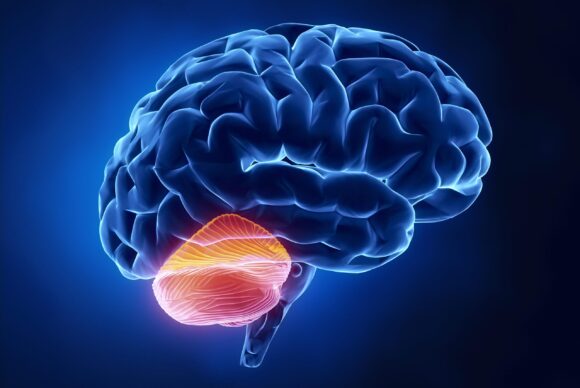
The cerebellum is an area of the brain most frequently studied in coordinating the body’s movements, but researchers from the Kempner Institute for the Study of Natural and Artificial Intelligence have now identified specific regions of the brain that could be key in language processing, an insight with potential implications for treating language disorders, as well as for building future artificial intelligence language models.
New research, published last week in Neuron, has identified specific language-processing regions in the cerebellum that closely mirror regions in the frontal and temporal lobes of the neocortex, the brain areas long understood as the specialized epicenter for processing language. The study was spearheaded by Kempner Institute Graduate Fellow Colton Casto and Ev Fedorenko, faculty member in Harvard’s Speech and Hearing Bioscience and Technology program and associate professor of brain and cognitive sciences at MIT.
“We’ve identified a specific region of the cerebellum that closely mirrors the neocortex, which fundamentally changes how we understand the neural architecture of language,” says Casto. “There is a region in the brain that is being ignored by language researchers that is potentially really important.”
“There is a region in the brain that is being ignored by language researchers that is potentially really important.”Colton Casto, Kempner Graduate Fellow
Some regions of the neocortex are so specialized for language that they are only used when processing language, and not, for example, when someone does a math problem or listens to non-verbal music. Now, Casto and his team have identified a region in the cerebellum that, like those selective regions of the neocortex, responds exclusively to language inputs and processing. The researchers identified several additional regions in the cerebellum that have “mixed selectivity,” meaning they are used in language processing as well as non-language tasks, such as visual perception and movement.
The discovery of a region in the cerebellum that so closely resembles the neocortical language system has potential applications for treating people with language disorders such as stroke patients with aphasia, a language impairment that doesn’t affect intelligence but hinders the ability to use and process language.
“Interventions for people with language disorders is a critical goal,” says Casto. “This research presents another area of the brain for researchers to target with interventions to improve language function.”
Beyond its potential to improve treatment of stroke patients and others with language disorders, this research also updates current scientific thinking about how the brain processes language, which could have important implications for building future large language models (LLMs), the artificial intelligence computer models that process and generate language.
“If we understand how this region of the cerebellum fits into the core language system, we might gain new insights into how language is optimally processed, insights that can hopefully be carried over to artificial systems” says Casto.
By studying the brain’s “clever design principles,” AI scientists might be able to better address some of the stubborn problems that plague LLM design and function, says Greta Tuckute, a Kempner research fellow and co-author of the study.
“Although current LLMs are incredibly powerful, they require vast amounts of data to train and still remain brittle in certain settings,” says Tuckute. “The human brain, on the other hand, processes language efficiently and robustly in the service of a wide range of goals. Mapping out its neural architecture for language and other cognitive capacities allows us to take inspiration from it.”
“The human brain… processes language efficiently and robustly in the service of a wide range of goals. Mapping out its neural architecture for language and other cognitive capacities allows us to take inspiration from it.”Greta Tuckute, Kempner Research Fellow
While it’s still too early to tell exactly how this research on the cerebellum’s role might affect the way engineers understand and build LLMs, it points to the promise of using insights about brain function and structure to advance the science of AI.
“It’s a ten-year bet, but I think these findings could have implications for building language models that are more neuro-inspired, and that are ultimately more efficient and effective,” says Casto.
Recent Related News
See All NewsNew Study Sheds Light on the Brain’s “Extended Language Network”Kempner Institute Announces 2026 Accelerator Award RecipientsA New Kind of AI Model Gives Robots a Visual Imagination

 canisgallicus