
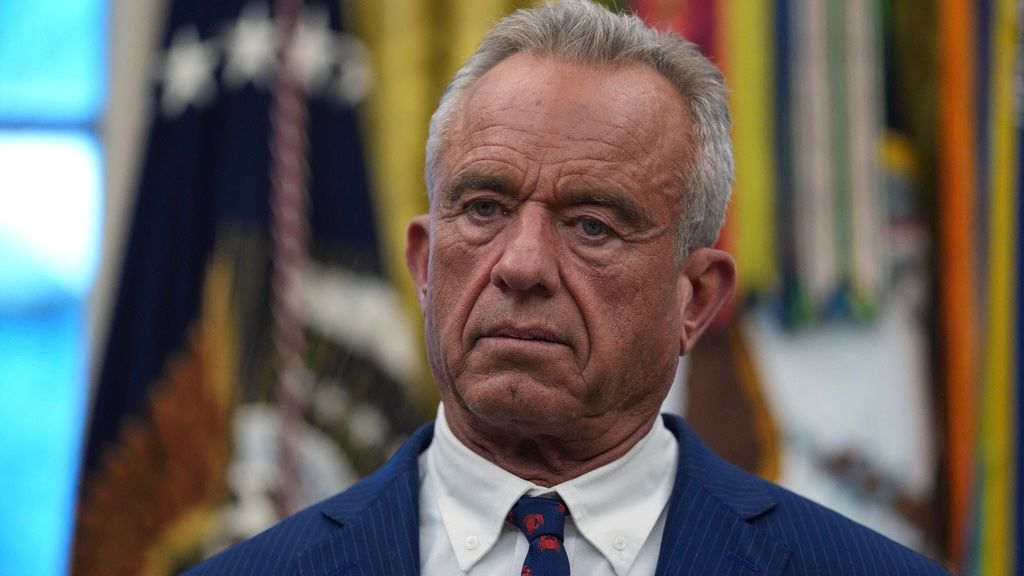
Health and Human Services Secretary Robert F. Kennedy Jr. listens as President Donald Trump speaks at an event on addiction recovery in the Oval Office of the White House, Thursday, Jan. 29, 2026, in Washington. (AP Photo/Allison Robbert)
HEALTH
RFK Jr. announces mental health and addiction initiative focused on reducing costs, boosting innovation
BY Susan Carpenter Washington
PUBLISHED 4:20 PM ET Feb. 02, 2026
WASHINGTON — Health and Human Services Secretary Robert F. Kennedy Jr. joined forces with his cousin and former Democratic congressman Patrick Kennedy on Monday to announce a new addiction and mental health care initiative.
Action for Progress seeks to advance the executive order President Donald Trump signed last week to coordinate a federal response to treat addictions like other chronic diseases.
What You Need To Know
Health and Human Services Secretary Robert F. Kennedy, Jr. joined forces with his cousin and former Democratic Congressman Patrick Kennedy on Monday to announce a new addiction and mental health care initiative
Action for Progress seeks to advance the Great American Recovery Initiative executive order President Donald Trump signed last week to coordinate a federal response to treat addictions like other chronic diseases
On Monday, HHS announced a $100 million Safety Through Recovery, Engagement and Evidence-based Treatment and Supports, or STREETS, program to “fund targeted outreach, psychiatric care, medical stabilization and crisis intervention, while connecting Americans experiencing homelessness and addiction to stable housing with a clear focus on long-term recovery and independence,” according to an agency statement
About 46.3 million people in the United States have a substance use disorder, according to the National Institute on Drugs and Addiction. Of those, 6.3% received treatment in 2021
“We in this country have an acute care system that continues to treat people but never supports them in their longer-term recovery,” Patrick Kennedy said at a forum to prevent substance use in Washington, D.C., where he was joined by Robert F. Kennedy Jr., Centers for Medicare & Medicaid Services Administrator Dr. Mehmet Oz and leaders of various medical groups.
Both Kennedys are former addicts who successfully recovered and later went into politics. The health secretary was addicted to heroin for 14 years, starting as a teenager, and has been clean for 43 years, he said Monday. Patrick Kennedy, son of the late Sen. Ted Kennedy, has said he was addicted to alcohol and prescription painkillers, including while he served in Congress.
“We never take a holistic approach, and furthermore, we never connect all the different government agencies that touch someone with these illnesses,” Patrick Kennedy said. “We relegate them to one system, and that’s the health care system. What we’ve never done as a country is think about the true cost of these illnesses across the government. We only look at the cost to the medical spend alone.”
Action for Progress is an attempt to address the billions of dollars Medicaid spends annually on mental health care and addiction treatment with new payment structures to reduce costs, technology innovations to improve care, efforts to grow the caregiver workforce and interagency cooperation.
Patrick Kennedy said the goal is to align payments for treatment with real-world outcomes. He criticized the current system as paying for care without checking to see how addicts and individuals with mental health issues are doing with stable housing, employment and community connections in their actual lives.
Drug addicts and alcoholics aren’t just “in the emergency room all the time,” the health secretary said. “They’re also imposing costs on our justice system. They’re imposing costs on our foster care system. They overutilize every aspect of the government. You get them into treatment, and that stops.”
Robert F. Kennedy Jr. said he supports outcome-directed strategies and coordination between housing, law enforcement, health care and mental health care systems.
Over the next three years, he said, the HHS needs to “switch the model” at the Center for Medicare & Medicaid, the CMS Innovation Center, the Health Resources and Services Administration, and Substance Abuse and Mental Health Services — all agencies it operates — to coordinate its response “so that somebody oversees that addict. Somebody is accountable as he moves through the system.”
Robert F. Kennedy Jr. said providing a single payment to that accountable entity for three years to make sure the addict does not relapse will bring down the cost of care.
The health secretary praised Trump’s Great American Recovery Initiative executive order, which said it “will drive a new national response to the disease of addiction that will create stronger coordination across government, the healthcare sector, faith communities, and the private sector in order to save lives, restore families [and] strengthen our communities.”
On Monday, HHS announced a $100 million investment to further the Great American Recovery Initiative’s goals. The Safety Through Recovery, Engagement and Evidence-based Treatment and Supports, or STREETS, program will “fund targeted outreach, psychiatric care, medical stabilization and crisis intervention, while connecting Americans experiencing homelessness and addiction to stable housing with a clear focus on long-term recovery and independence,” according to an HHS statement.
HHS also announced a $10 million grant program to support adults with serious mental illness who are in civil court-ordered, community-based outpatient mental health treatment programs.
The new initiative comes less than three weeks after the Department of Health and Human Services abruptly cut $2 billion for mental health and addiction programs, saying the services did not align with the agency’s priorities of supporting “innovative programs and interventions that address the rising rates of mental illness and substance abuse conditions, overdose, and suicide.”
One day after funding termination notices were sent to over 2,000 programs across the country, the HHS restored the money.
About 46.3 million people in the United States have a substance use disorder, according to the National Institute on Drugs and Addiction. Of those, 6.3% received treatment in 2021.
About 1 in 5 U.S. adults experienced mental illness in 2024, according to the National Alliance on Mental Illness. The group is one of several medical organizations involved with Action for Progress, including the American Academy of Family Physicians, the Association for Behavioral Health and Wellness and the American Psychological Association.

 canisgallicus