

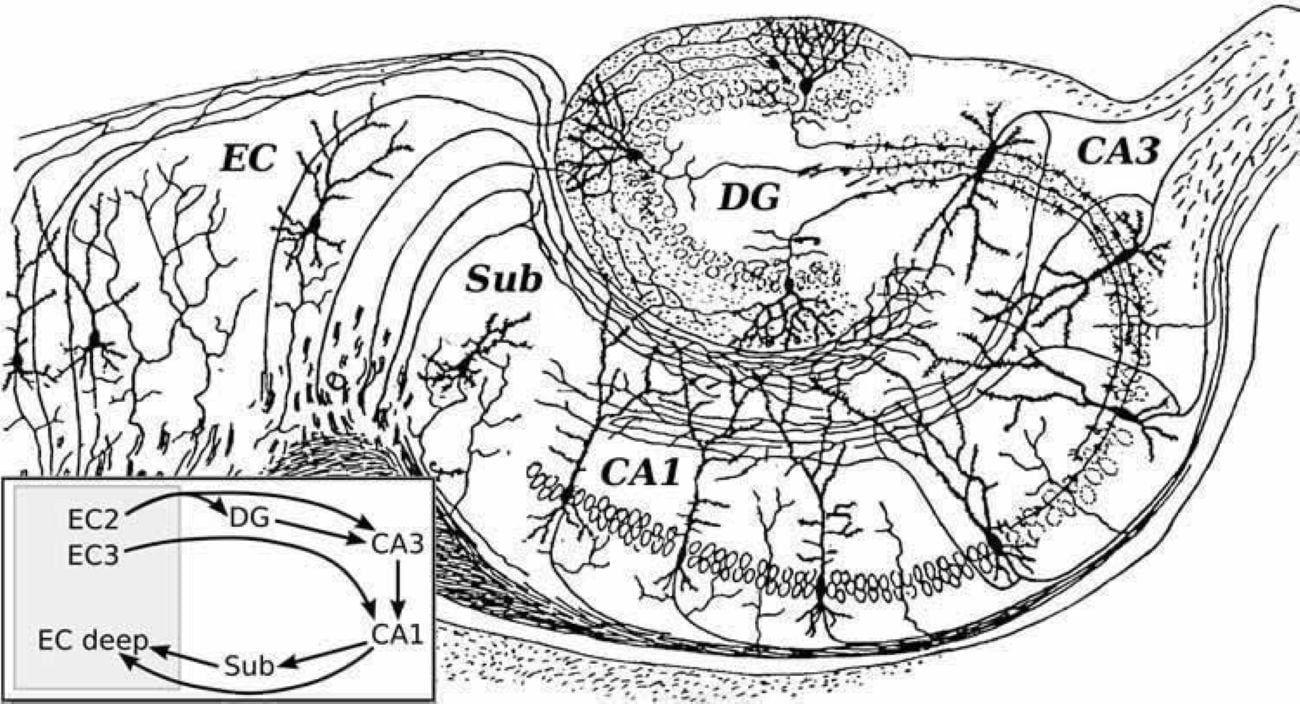
The image of the hippocampus in the public domain.
Hippocampus Predicts Rewards by Reorganizing Memories
ElectrophysiologyFeaturedNeuroscience
·January 29, 2026
Summary: A new preclinical study reveals that the hippocampus does more than just store memories; it actively reorganizes them to predict future rewards. By tracking brain activity over several weeks, researchers discovered that hippocampal neurons shift their activity to fire before a reward is reached, essentially building a predictive model of the world. These findings offer a new framework for understanding why learning and decision-making are often the first functions to decline in Alzheimer’s disease.
Source: McGill University
Key Facts:
- Predictive Mapping: The hippocampus updates its “internal model” of the world daily, shifting neural activity from the moment of reward to the moments leading up to it.
- Advanced Imaging: Researchers used calcium imaging (making neurons glow) to track specific cells over weeks, capturing slow learning processes invisible to traditional electrodes.
- Beyond Pavlov: While simple reward learning is linked to primitive brain circuits, this study shows the hippocampus uses complex memory and context for sophisticated anticipation.
- Alzheimer’s Insight: The breakdown of this predictive signaling may explain why Alzheimer’s patients struggle with decision-making and learning from new experiences.
A preclinical study published in Nature has found evidence that the hippocampus, the brain region that stores memory, also reorganizes memories to anticipate future outcomes.
The findings, from researchers at the Brandon Lab at McGill University and their collaborators at Harvard University, reveal a learning process that had not been directly observed before.
“The hippocampus is often described as the brain’s internal model of the world,” said senior author Mark Brandon, Associate Professor in McGill’s Department of Psychiatry and Researcher at the Douglas Research Centre. “What we are seeing is that this model is not static; it is updated day by day as the brain learns from prediction errors. As outcomes become expected, hippocampal neurons start to respond earlier as they learn what will happen next.”
A new view of learning in action
The hippocampus builds maps of physical space and past experiences that help us make sense of the world. Scientists have known these maps change over time as brain activity patterns shift, a phenomenon that is currently assumed to be random.
The new findings demonstrate the changes are not random, but structured. Researchers obtained these findings by tracking brain activity in mice as the mice learned a task with a predictable reward.
“What we found was surprising,” said Brandon. “Neural activity that initially peaked at the reward gradually shifted to earlier moments, eventually appearing before mice reached the reward.”
Rather than relying on traditional electrodes, which can only track neurons for short periods, the researchers used new imaging techniques that cause active neurons to glow. The Brandon Lab is among the first in Canada to use this technology, enabling the team to follow cells over several weeks and track slow changes that traditional methods often miss.
Insights into learning and Alzheimer’s disease
Simpler forms of reward learning have long been associated with more primitive brain circuits, as famously demonstrated by Ivan Pavlov’s experiments, which showed that animals can associate a cue, such as a bell, with food. The new findings suggest the hippocampus supports a more sophisticated version of this process, using memory and context to anticipate outcomes.
Alzheimer’s disease patients often struggle not only to remember the past but also to learn from experience and make decisions. By showing that the healthy hippocampus helps turn memories into predictions, the study offers a new framework for understanding why learning and decision-making are affected early in Alzheimer’s disease and opens the door to research into how this predictive signal may fail and be restored.
Editorial Notes
- This article was edited by a Neuroscience News editor.
- Journal paper reviewed in full.
- Additional context added by our staff.
About this Hippocampus Research
- Source: McGill University
- Contact: Keila DePape
- Image: The image is in the public domain
Original Research:
“Predictive Coding of Reward in the Hippocampus” by Mohammad Yaghoubi and Mark Brandon et al., was published in Nature. This research was supported by funding from Fonds de recherche du Québec – Santé and the Canadian Institutes of Health Research.
DOI: 10.1038/s41586-025-09958-0
About the Brandon Lab
The Brandon Lab was founded in 2015 at the Douglas Research Centre at McGill University by Professor Mark Brandon. The lab investigates the core mechanisms of memory, including how memories are encoded, stored, and retrieved in the brain. It also studies how memory breaks down in Alzheimer’s disease, with the goal of identifying strategies to protect and restore memory.

 canisgallicus