
What to know about China’s military purges
By Ian BremmerJanuary 28, 2026
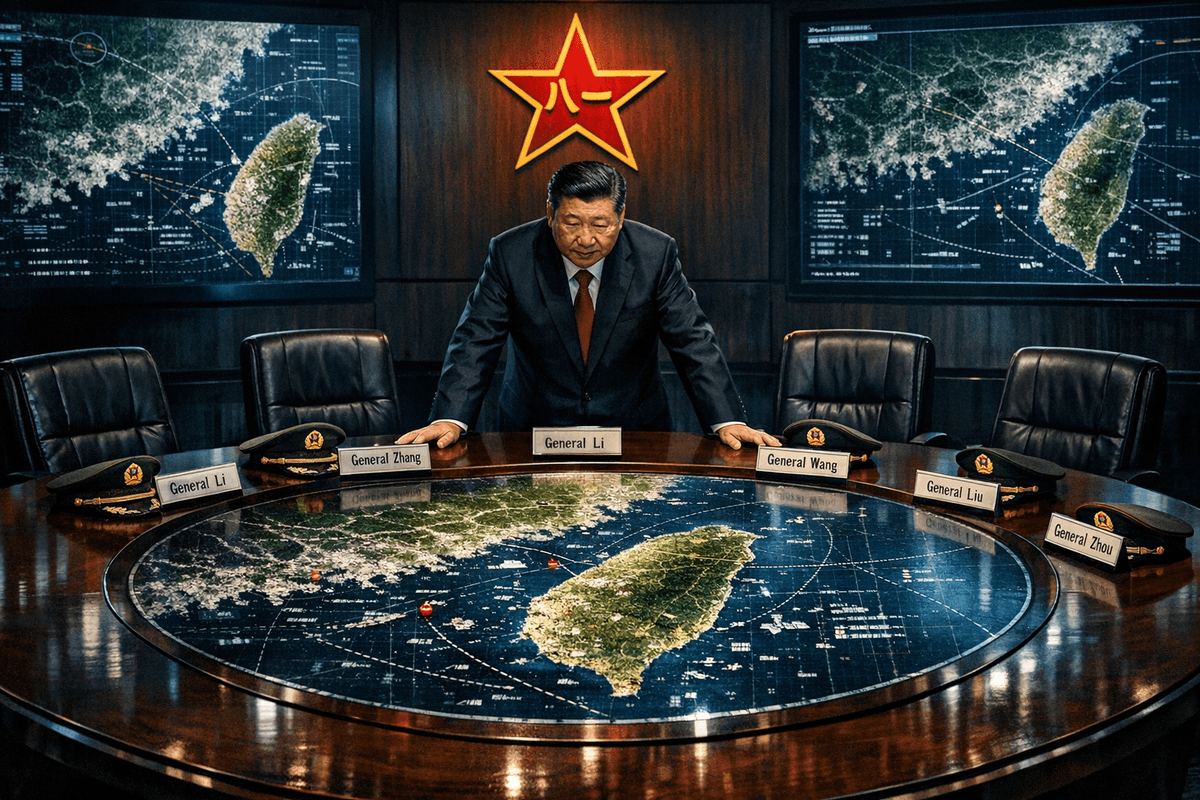
Xi Jinping has spent three years gutting his own military leadership. Five of the seven members of the Central Military Commission – China’s supreme military authority – have been purged since 2023, all of whom were handpicked by Xi himself back in 2022. But if anyone seemed safe from the carnage, it was Zhang Youxia.
Zhang wasn’t just China’s most senior uniformed military officer. He was a fellow “princeling” whose father fought alongside Xi’s in the revolution, a combat-tested general who distinguished himself in the 1979 war with Vietnam, and someone who had backed Xi since he first rose to power in 2012.
And yet, on Jan. 24, Beijing announced that Zhang and another CMC member, Liu Zhenli, were under investigation for “suspected serious discipline and law violations.” In practical terms, that means detention and dismissal. Official PLA media accused them of causing “damage to combat capability construction,” a phrase suggesting problems that go well beyond ordinary corruption. Wild rumors have swirled about what really happened. Some online chatter ties Zhang to a foiled coup attempt against Xi; a Wall Street Journal report suggests he leaked nuclear secrets to the United States. Color me skeptical of both.
What’s more likely, and plenty alarming in its own right, is that this reflects Xi’s deepening paranoia and mistrust. Zhang had accumulated significant power simply by surviving the earlier purges, and his combat pedigree, reputation for competence, and princeling status made him a potential rival in Xi’s eyes. By removing him, Xi blocks the formation of an alternative power center that might one day defy his rule and sends an unmistakable message to every party leader, military commander, and provincial official in China: whatever authority you hold is delegated, not owned. Loyalty guarantees nothing; no one is ever truly safe. Once that lesson sinks in, officials become consumed not with whether they’ve done anything wrong but with whether they might be next. Taking initiative becomes riskier than doing nothing. The ambitious learn to keep their heads down; the cautious get promoted. Honest information stops flowing upward. Problems don’t get flagged until they’re crises.
This is Maximum Xi – the logical endpoint of a system where all power flows to a single leader with no checks, no dissent, and no trusted counsel. We’ve witnessed this dynamic since Xi emerged from China’s 20th Party Congress in 2022 with a grip on power unrivaled since Mao Zedong. Back then, the concern was that stacking the Politburo Standing Committee with loyalists would leave Xi virtually unfettered and unconstrained in his ability to make big mistakes. Arbitrary decisions, policy volatility, elevated uncertainty – these are the consequences of concentrating so much authority in one man’s hands. Three years later, we’re watching that play out in the most dramatic arena possible – the military command structure itself.
Get the latest news from GZERO!
Dive deeper with our top stories and analysis. I consent to the Privacy Policy and Terms of Use
The only people left on the CMC now are Xi and his anti-corruption enforcer, Zhang Shengmin. The chairman commands an army of two million with what is essentially a committee of one. Some will read this as proof of Xi’s iron grip, and there’s certainly truth to that. But control and power aren’t the same thing. Xi exercises more direct control over the People’s Liberation Army than at any point in his tenure, but a hollowed-out CMC means a less effective military in the near term – even if the purges are intended to produce a stronger, more disciplined fighting force over time.
The CMC’s five vacancies will likely remain open until the 21st Party Congress in October 2027, with Xi elevating trusted service chiefs or theater commanders to acting roles in the meantime. He’ll screen these candidates primarily for loyalty and disciplinary records rather than competence or warfighting ability, heightening operational risks. As one of the few active Chinese generals with actual combat experience, Zhang’s loss will be felt particularly hard. His removal creates a vacuum of reliable counsel at the very top of the command structure. Orders will be more difficult to transmit clearly down the chain of command. Readiness for complex joint operations – the kind required for, say, an amphibious invasion of Taiwan – will suffer.
The silver lining is that this turbulence pushes back the timeline for an already-unlikely invasion of Taiwan. Beijing has always viewed this option as a last resort: the risk of US military intervention remains too high, the economic costs would be staggering, and Chinese leaders still believe unification can be achieved without a direct conflict. Xi has reason to feel comfortable about the near-term trajectory: President Donald Trump is much more personally invested in bilateral stability than in Taiwan, President William Lai is in political trouble at home, and the opposition KMT is making favorable noises about Beijing ahead of Taiwan’s 2028 elections. And China is playing a long game, betting that as it catches up militarily and becomes economically and technologically self-reliant, unification can be achieved at a lower cost in the future. Why risk everything on an invasion today when time is on your side?
Against that backdrop, losing two senior generals with real warfighting experience pushes the invasion timeline back further still. The purges themselves clearly signal Xi’s lack of confidence in his military right now. Leaders don’t gut their command structures when they’re feeling bold, suggesting a reduced appetite for large-scale kinetic moves, at least until he fills the CMC vacancies with vetted loyalists. And even then, Xi will be asking generals he barely knows, men who watched him throw all their former bosses in jail, to advise him on the biggest military decision China has faced since splitting with the Soviet Union – hardly a recipe for candid counsel.
This doesn’t mean Taiwan can breathe easy. Xi remains set on unification by any means necessary. Beijing will continue favoring gray-zone coercion to chip away at the status quo and deter Taipei (and Washington) from moving toward independence. China will likely conduct at least two major military exercises in 2026 and work to isolate Taiwan internationally.
Perhaps most importantly, Maximum Xi cuts both ways. A degraded command structure makes the PLA less capable today, but it also means Xi is less likely to hear that from anyone around him. If he ever convinces himself the PLA is ready to pull off an invasion when it isn’t – or feels cornered enough to act – there will be fewer voices in the room to stop him. When no one dares tell the emperor he has no clothes, the risk of miscalculation rises. And if Xi eventually succeeds at forging a more disciplined, loyal military, Taiwan will face a far more dangerous threat down the road.
The more power Xi accumulates, the more brittle the system becomes. The fewer people who can tell him he’s wrong, the more likely he is to be wrong. And the tighter his grip on the military, the less capable that military may be when it actually matters … or so we should hope.
_________
🔔 Be sure to subscribe to GZERO Daily to get the world’s best global politics newsletter every day on top of my weekly email. Did I mention it’s free?
Trending Stories

 canisgallicus