
Muslim country Iran wasn’t always ‘Islamic’: How it went from hybrid secular to theocratic state

Authored By Vinod Janardhanan
Published: Jun 17, 2025, 13:16 IST | Updated: Jun 17, 2025, 13:16 IST
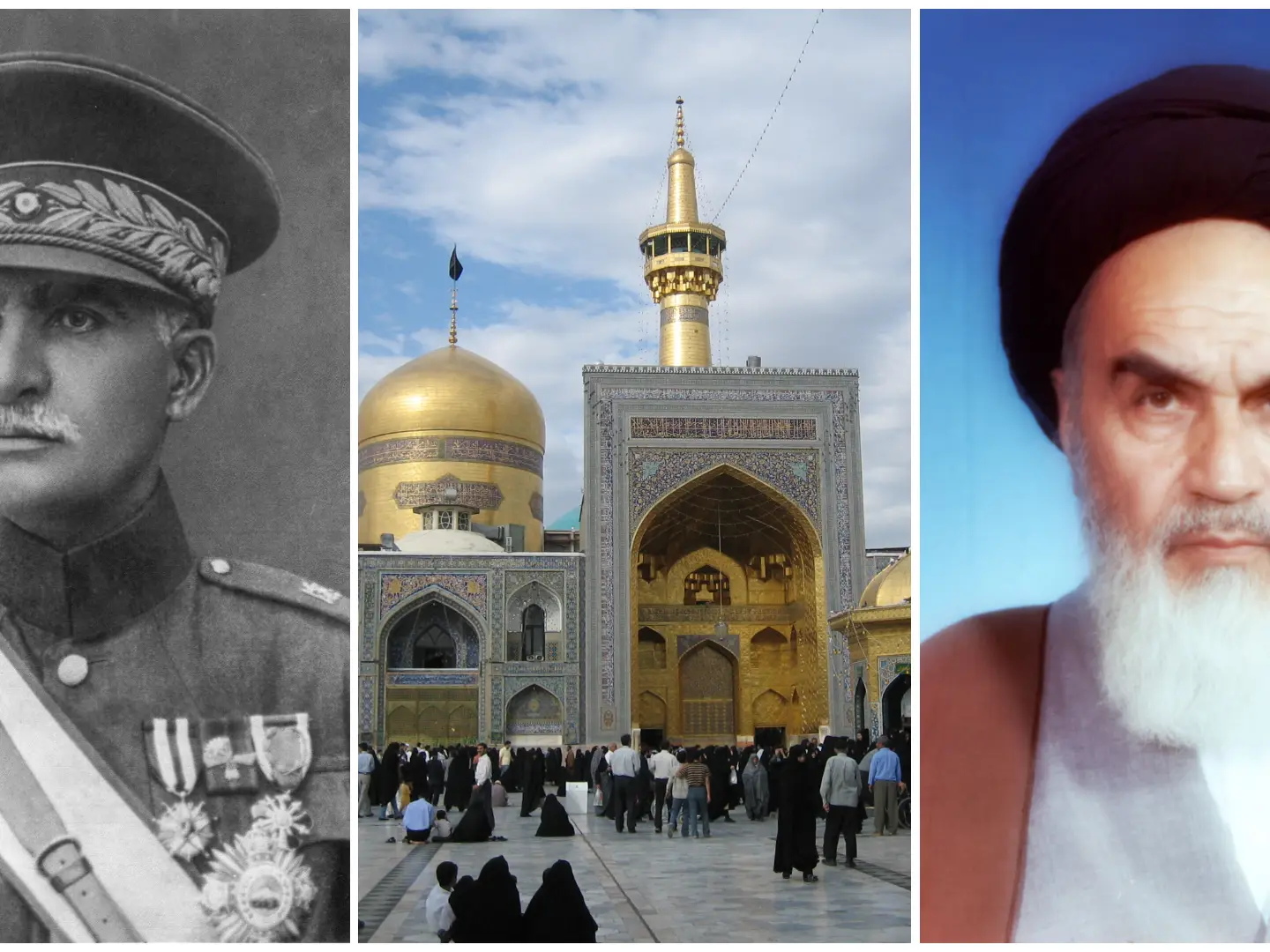&imwidth=800&imheight=600&format=webp&quality=medium "Muslim country Iran wasn't always ‘Islamic’: How it went from hybrid secular to theocratic state")
Reza Shah Pahlavi, Imam Reza shrine, and Ayatollah Khomeini are shown in this combo Photograph: (others)
Story highlights
Did you know that Iran, once part of the vast Persian empire, was a much more secular, hybrid and tolerant nation?
Israel’s attacks on Iran and its counteroffensive have brought unprecedented global attention to the Islamic Republic and its regime. Many are wondering how the theocratic state became the arch rival of the Jewish nation, leading to the current flare-up of hostilities. The religious identity of Iran, as an Islamic Republic, is at the core of its political and strategic belligerence towards Israel. But did you know that Iran, once part of the vast Persian empire, was a much more secular, hybrid and tolerant nation? Let’s dive into how Iran moved from a hybrid-secular nation to an Islamic country.
Religious makeup of Iran
Iran is a Muslim-majority nation, with nearly 99 per cent of the population self-identifying as Muslim. Out of this, nearly 95 per cent or around 85 per cent of the total population, is Shia Muslim. Shias, who number around 80 million out of the nearly 87.6 million total population, are the majority community. Shia Islam was established as the official state religion during the Safavid dynasty of 1501–1736.
Sunni Muslims, while a prominent community in the rest of West Asia, are a minority in Iran, consisting of around 5 to 10 per cent of the Muslim population, or up to 10 per cent of the total population, and is estimated to be around 9 million people (Note that these are only figures in a range, as there could be undercounting of several minority communities). Most Sunnis belong to ethnic minority groups like the Kurds, Turkmen, Arabs, Baloch, and some Persians, and live mainly in provinces like Kurdistan, Sistan-Baluchistan, and Hormozgan.
Non-Muslim communities are less than 1 per cent of the population. They include Christians, Baha’is, Zoroastrians, Jews, Yarsanis, and Sabean-Mandaeans.
Add WION as a Preferred Source
You May Like
Why Premium Skincare Focuses on Fewer IngredientsNorthwayjournal
TV providers are furious: this gadget gives you access to all channelsTechno Mag
Note that many of the minority communities were persecuted, exiled or undercounted. Iran once hosted one of the largest Jewish populations in the region, for instance, before many of them were forced out. In Iran’s past, Zorastrians – or Parsis – were driven out by Muslim conquerers and went into exile to various countries, including India. Bahai’s are another silenced community.
Is Islam really a big part of Iranians’ daily life?
Given the population figures, the obvious answer is yes, but there are some shifts observed by recent surveys, like the one by GAMAAN in 2020.
It found that only 40 per cent of respondents self-identified as Muslim (32 per cent Shia, 5 pc Sunni and 3 pc Sufi).
There may be a bias in this study as the survey might have been done only among urban and literate respondents.
Was Iran less ‘Islamic’ before 1979?
The best way to describe Iran just before the Islamic Revolution of 1979 would be as hybrid-secular. Under the Pahlavi dynasty of 1925–1979, which ruled just before the 1979 Islamic Revolution, religion and state were partially separated.
Reza Shah Pahlavi, who ruled from 1925–1941, led a modernisation drive in Iran, offering a limited amount of secularisation. The Shah cut down the Shia clergy’s influence. He centralised state power and brought in legal codes influenced by the West. He brought in secular reforms like a ban on the hijab in 1936, and promoted Western dress. Under his rule, mosques and Islamic seminaries lost autonomy, with the state taking control of education and judicial systems.
Mohammad Reza Shah, who ruled from 1941–1979, continued with these policies. The stress was on modernisation and Westernisation, with undercurrents of secularism.
The Islamic clergy was marginalised, with new reforms like the 1963 White Revolution, which included land reforms and women’s suffrage.
The state, not the clergy, was in charge of waqf, or Islamic religious endowments.
Secular laws were introduced on many aspects of life, even as Shia Islam remained the official state religion as enshrined in the 1906 Constitution.
Side note here: The secular policies were creating disenchantment in Islamic clerics and religious people. There was also criticism that the Shah dynasty was beholden to the Anglo-American powers and former colonialists.
Another point to note is that Iran was not fully secular like Turkey at the time, as the Shahs had continued the state’s links to Shia Islam. Much of the society was still very religious.
The Islamic clergy continued to have influence in rural areas and among traditional people who opposed the Shahs.
So at best, Iran under the Pahlavis can be described as a hybrid of monarchy with secular laws and reforms, with a society that was still largely followers of Shia Islam.
Under the Shahs, the state looked back at Iran’s pre-Islam past for inspiration and national identity, based on its Persian heritage, with events celebrating Cyrus the Great, even as it sidelined Islamic religious authorities.
Such a secularism, brought by decree from the top, had its pitfalls. As mentioned earlier, the Islamists and conservative sections of the society were angry, and that resentment was a factor that led to the Islamic Revolution.
What was Iran’s religion before it became a nation?
Remember that Iran, in its current form as a nation, is part of a vast Persian empire that once spanned almost half the globe.
So one has to look at present-day Iran as an inheritor of millennia of evolution when it comes to religion.
Pre-Islam Iran was the land where religions came and went
From around 1000 BCE to 651 CE, Zoroastrianism was the predominant religion of empires centred around present-day Iran. The Achaemenid, Parthian and Sasanian empires had a religion that stressed on good versus evil. Ahura Mazda was their supreme deity. Fire temples and priestly classes known as the Magi were central to religion.
Under these empires, new religions and cults emerged, and old ones are thought to have coexisted with them. During Achaemenid Empire, other communities that lived in the Persian region included Jews, Christians, and those following Mithraism and Manichaeism.
The Muslim conquest of 651 CE started the change in Iran’s religious landscape
Islam was introduced to the Iranian region through the Arab Muslim conquests. Over the subsequent centuries, most Iranians converted, mainly to Shia Islam.
By the 10th century AD, Shia Islam became deeply rooted in Iran, particularly with the Buyid dynasty and Safavids. At this time, Zoroastrians were persecuted. They and other minorities like Jews and Christians lived as protected, yet second-class citizens, generally known as ‘dhimmis’.
Safavid Dynasty of 1501–1736 enforced the conversion of the Sunni population and established a strong Shia clergy. This was the era that brought in Iran’s current Shia national identity. The Qajar Dynasty of 1789–1925 continued the Shia dominance, with the clerics given vast powers over key aspects of life like law and education.
The stranglehold of religion was eased with the Constitutional Revolution
In the late 19th century, during and under the influence of British colonialists, Western ideas like nationalism and constitutionalism were introduced to Iran.
This led to the 1906 Constitutional Revolution, and Iranian nationhood. The constitution, while keeping Shia Islam as the state religion, still allowed limited religious freedoms for minorities like Zoroastrians, Jews and Christians.
A parliament was introduced, and the powers of the monarchy, by this time under attack by the Western colonial powers, had been weakened.
Iran’s transition from semi-secular to Islamist
Resentment towards the Pahlavi Dynasty of 1925–1979, particularly about its promotion of a pre-Islamic identity for Iran, was the seed for the Islamic Revolution of 1978–79. The clergy, whose powers were cut short by the Shahs, wanted to gain back control. Socially, Shia Islam was still the dominant force, which meant that at the ground level, religious minorities faced discrimination despite the legal protections ensured in the constitution.
The Islamic Revolution was in fact, prompted and led by a disgruntled group of clerics, conservatives and traditionalists. They saw in the Shah’s dynasty the influence of Western cultural imperialism, which was aimed at preserving the Anglo-American interests, mainly in the then recently-emerged oil wealth of Iran. While the Western powers continued to plunder Iran’s wealth, the country’s economy suffered under the Shahs.
It is from this disgruntlement that figures like the Ruhollah Ayatollah Khomeini emerged.
Khomeini, who was living in exile at the time, advocated for a nation governed under Islamic principles. That was the beginning of the Islamic Revolution of 1979.
Post Islamic Revolution: How Iran went back to Shia Islam
The Islamic Revolution was a reaction to both the Shah regime, and the Anglo-American petrodollar interests that kept it in power.
At the time, a return to Islamic principles was seen as the best way for Iran to come out of the Western influence, with the accusation that Iran’s economy was suffering at the hands of the British-US duo, particularly the oil.
After the Islamic Revolution, Khomeini established a nation under the so-called Velayat-e Faqih or Guardianship of the Islamic Jurist. Once again, Shia Islam, already the dominant religion, became the preeminent force of the state, with a cleric, the Supreme Leader in the form of Khomeini, becoming the ultimate authority.
Sharia law changed the face of Iran’s religious life
A new constitution, established in 1979 enshrined Shia Islam as the state religion. Sharia, or Islamic law became the governing force for legal, social, and political aspects of Iran.
Under Sharia, the state strictly enforced Islamic codes on dress and behaviour. Shia rituals like Ashura became central to national identity, and the clergy dominated politics and education.
Technically, the non-Shia Muslims such as the Sunnis, as well as Zoroastrians, Jews, and Christians are recognised as minorities, but in reality, their rights are limited, while unrecognised groups like Baha’is face persecution.
Currently, Iran remains a theocracy, with Shia Islam as the ideological backbone.
The government funds religious institutions, and the clergy controls key sectors.
Will Iran go back to being hybrid -secular?
Dissent is actively curtailed in Iran, which has witnessed several movements against the theocratic state, all of which were forcibly suppressed. Many of these movements are secular and reformist in nature, but are concentrated in urban youth and intellectuals, while the rural folk still remain highly religious.
There is a segment of society yearning for reform and more liberal attitudes towards religion and life, yet the state retains tight control over these matters.
Sometimes, these tensions come to the fore, as seen in the 2022 anti-veil protest in the wake of Mahsa Amini’s death in police custody.
For the time being, those wanting reforms and the Islamist state are in a tense coexistence.
Related Stories
About the Author


Vinod Janardhanan
Vinod Janardhanan, PhD writes on international affairs, defence, Indian news, entertainment and technology and business with special focus on artificial intelligence. He is the de…Read More

 canisgallicus