
Crimes of the Future
Police Warn of Robot Crime Wave
Autonomous vehicles, drones, and humanoid robots are coming for us all.
Published Dec 21, 2025 9:45 AM EST
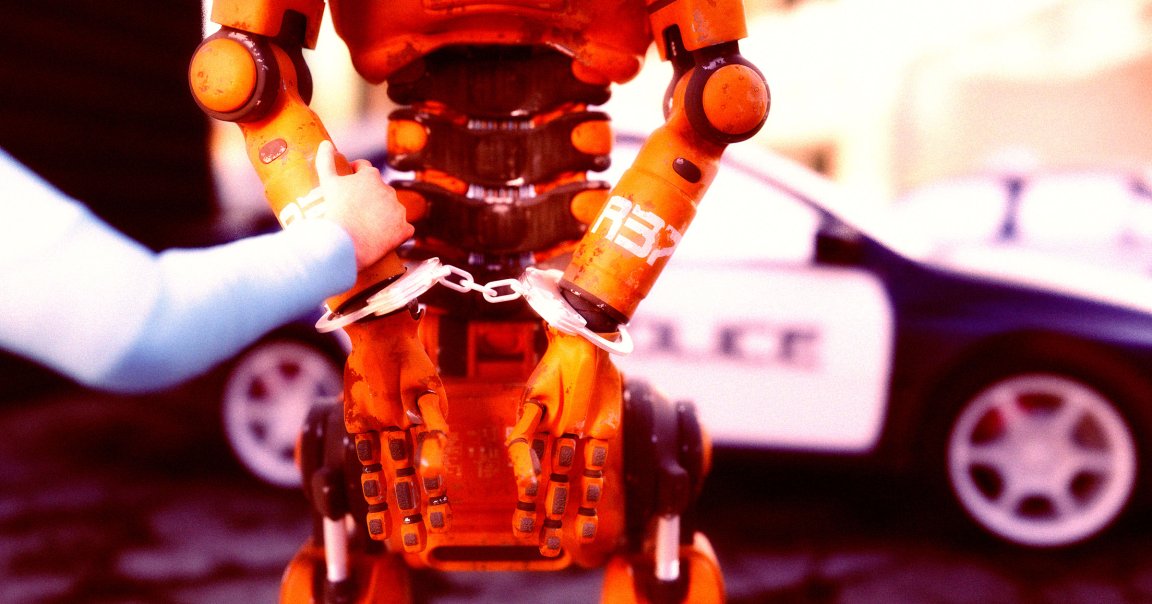
The use of autonomous drones on the battlefield has already raised plenty of murky ethical questions. Many experts and human rights groups have decried the use of killer robots, particularly when you consider the possibilities of technological flaws resulting in the deaths of innocent people — not to mention using the tech to commit atrocities with no direct human involvement.
But what would happen if such a technology were to land in the hands of terrorists and criminals, who aren’t beholden to the norms of modern warfare at all? In a new report, pan-European police agency Europol’s Innovation Lab has imagined a not-so-distant future in which criminals could hijack autonomous vehicles, drones, and humanoid robots to sow chaos — and how law enforcement will have to step up as a result.
By the year 2035, the report warns that law enforcement departments will need to deal with “crimes by robots, such as drones” that are “used as tools in theft,” not to mention “automated vehicles causing pedestrian injuries” — an eventuality we’ve already seen in numerous cases.
Humanoid robots could also complicate matters “as they could be designed to interact with humans in a more sophisticated way, potentially making it more difficult to distinguish between intentional and accidental behavior,” the report notes.
Worse yet, robots designed to assist in healthcare settings could be hacked into, leaving patients vulnerable to attackers.
Rounding out the cyberpunk dystopia vibes, according to the report, is that all the folks who were put out of a job as a result of automation may be motivated to commit “cybercrime, vandalism, and organized theft, often targeted at robotic infrastructure” just to survive.
Law enforcement needs to evolve rapidly to keep up, Europol says. For instance, a police officer may need to determine whether a driverless car that was involved in an accident did so after receiving deliberate instruction as part of a cyberattack, or whether it was a simple malfunction.
They could also deploy fanciful gadgets in their fight against killer robots with “RoboFreezer guns” and “nets with built-in grenades” to take down drones, per the report.
While a Europol spokesperson told The Telegraph that the agency “can’t predict the future,” the warning signs are certainly already there. For one, the use of autonomous tech like drones has already become commonplace in active warzones such as on the frontlines of the Ukraine-Russia war.
Advanced weapons have already “spilled over into organised crime and terrorism, impacting law enforcement,” the report reads. “There has also been a reported increase in the use of drones around European infrastructure, and there are examples of drone pilots selling their services online, transforming this criminal process from crime-as-a-service to crime-at-a-distance.”
In short, it’s a troubling vision of the future of crime, facilitated by rapidly evolving technologies.
“The integration of unmanned systems into crime is already here, and we have to ask ourselves how criminals and terrorists might use drones and robots some years from now,” said Europol’s executive director, Catherine De Bolle in a statement. “Just as the internet and smartphones presented significant opportunities as well as challenges, so will this technology.”
With the year 2035 a mere decade away, experts told The Verge that the rapidly changing technological landscape could very well result in the crime-ridden future Europol envisions in its report.
“One way or another, criminals will use any kind of new technology,” University of Kent roboticist and lecturer in computer science Giovanni Luca Masala told the publication, but conceded that “predictions about the year 2035 are difficult,” given how quickly the situation is evolving.
Some voiced concerns over privacy invasions as well, perpetrated not only by criminals, but by law enforcement as well, using sophisticated surveillance methods.
Others were far less convinced that either crime or law enforcement will get a major robot makeover any time soon.
“There are not only technical barriers but regulatory barriers to some of those very extreme scenarios becoming a reality by 2035,” Locus Robotics chief commercial officer Denis Niezgoda told The Telegraph. “I don’t see Robocop crossing our streets and policing, I simply don’t believe that robots will erase work.”
More on AI and crime catching: AI Startup Says It Will End Crime by Blanketing the Entire United States in Ever-Watching Spy Cameras

 canisgallicus