
Looting, escape, and mystery: The hidden story behind the painting stolen by the Nazis and found in Argentina
After the recovery of ‘Portrait of a Lady,’ researchers are analyzing other seized works, such as a 17th-century still life spotted on the social media of the daughters of Nazi official Friedrich Kadgien

Buenos Aires – SEP 15, 2025 – 17:51 CEST
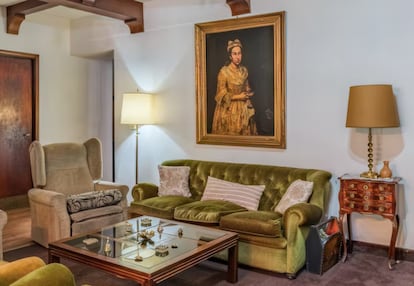
Heinous crimes, art thefts, escapes, intrigues, and family secrets are the elements that make up the dark picture that was the life of Nazi official Friedrich Kadgien. A simple advertisement for a house sale in Argentina revealed the plot that, for more than 80 years, obscured the legacy of the so-called “financial wizard” of Nazism, characterized as “a snake” by the Allied officers who tried to arrest him in 1945. He was a close collaborator of war criminal Hermann Göring, who managed to recycle himself as a wealthy businessman in South America and died an illustrious citizen in Buenos Aires in 1978. When last month one of his daughters published photos in order to sell the family home in the coastal city of Mar del Plata, 250 miles south of the Argentine capital, she unwittingly revealed, dominating the living room, a painting that had long been sought by the Netherlands. That image untied the knot that Kadgien had tied around his past.
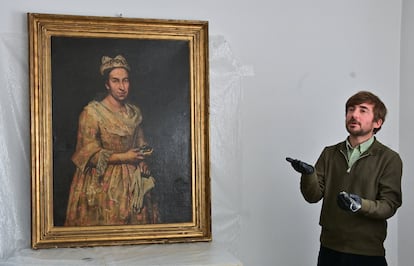
All traces of Portrait of a Lady, painted in the 17th century by Giuseppe Ghislandi (1655-1743), had been lost in Amsterdam during World War II, after the Jewish art dealer Jacques Goudstikker (1897-1940), its owner, was forced by Adolf Hitler’s regime to part with the more than 1,100 works that made up his valuable art collection. The painting has now been recovered by the Argentine authorities, and the courts must decide its fate. In the United States, Goudstikker’s heirs are claiming the painting.
The Nazi official’s daughter, Patricia Kadgien, and her husband are also being investigated in the same case. Both were detained for 72 hours and are prohibited from leaving the country. “They are charged with aggravated accessory after the fact,” explains the prosecutor in charge, Carlos Martínez. “The underlying crime being covered up is particularly serious: robbery in the context of genocide,” he explains.
While the discovery of the oil on canvas work began to answer a question that had been lingering for eight decades, it also posed new mysteries. During the search of the property owned by Patricia Kadgien and her sister Alicia, while looking for the Ghislandi painting, law enforcement officers found many other antique works: prints, plates, drawings, and engravings of various kinds, which will be examined by specialized experts to determine whether they were stolen by the Nazis.
Among the finds are two paintings that experts, after preliminary examination, believe date back to around 1840. The two works, which depict male figures and feature ornate carved wooden frames, will also be analyzed to determine their possible authorship and provenance.
One of the still unexplained mysteries of the case concerns a painting that has yet to be recovered. The Cultural Heritage Agency of the Netherlands (RCE) records that at least two works from the collection of the art dealer Goudstikker ended up in Kadgien’s hands in the mid-1940s. In addition to the recently recovered Portrait of a Lady, there is also a still life by the Dutch artist Abraham Mignon (1640-1679). It is an oil on canvas measuring 88 by 66.5 centimeters and depicting flowers, fruit, and small animals.
Although investigators didn’t find it in the raided properties, a very similar painting — if not the same one — can be seen in photos posted by Alicia Kadgien on social media. In two Facebook images from 2011 and 2012, she is seen with other people posing inside a house; in the background is a work that is strikingly similar to Mignon’s.
That’s not the only surprise. In Buenos Aires, the National Museum of Decorative Art exhibits — as part of its collection — a still life almost identical to the missing one painted by Mignon. It is attributed to the Dutch artist Rachel Ruysch (1664-1750). Some experts suggest that Ruysch may have been attempting an imitation of Mignon’s work. Others suspect that, with or without malice, the authorship of one of the paintings may have been misassigned. In that case, the confusion would not be unique: there are other works that are not known to have been painted by Mignon or Ruysch; there is even a still life of flowers that belonged to the Dutch collector Gustaaf Hamburger (1887-1977), which was also stolen by the Nazis and is still being sought without it being specified which of the two artists painted it.
The origin
The inheritance that German lawyer Friedrich Gustave Kadgien (1907-1978) left to his daughters stemmed from his role as a financial expert for National Socialism. He joined the SS in 1935 and, from 1938, served as the right-hand man to Göring. According to various historiographical and journalistic investigations, he played a key role in purchasing foreign currency for the regime and in the plundering of German-occupied territories during the war.
As Nazi defeat loomed, he began preparing his escape by shipping diamonds and other valuables to Switzerland. He settled there in 1945 with his partners Ernst Rudolf Fischer, an official in the Third Reich’s Ministry of Economics, and Ludwig Haupt, a businessman. With the Swiss lawyer and civil servant Ernst Imfeld and his wife Tony — who were instrumental in helping their German friends evade Allied officials — they created a company and named it Imhauka (an abbreviation of Imfeld, Haupt, and Kadgien). It is presumed that through this and other companies, they laundered part of the money they had managed to steal.
Kadgien later spent a period in Brazil, where the partners purchased 85,000 hectares. Around 1950, he settled in Buenos Aires, where he also acquired land. Among other businesses, he sold German weapons to the Brazilian military regime of the time and represented Brazilian companies, such as Siemens, before the government of Juan Perón. Settling in the town of Vicente López, on the outskirts of the Argentine capital, he started a new family after the death of his first wife.

While his remains now rest unpunished in the German Cemetery in Buenos Aires, his daughters are being investigated for allegedly covering up the crimes he committed as crimes against humanity, which are not subject to the statute of limitations under international law.
“The work I owned and exhibited for more than 35 years belonged to my father and was legitimately owned,” Patricia Kadgien argued before the Argentine court. The 59-year-old filed a lawsuit in a civil court to claim thatPortrait of a Lady belongs to her. She claimed it was purchased by a sister of her father’s first wife in February 1943 and that she learned through the media in recent weeks that it was stolen. “I was extremely surprised, given that I never hid this painting from third parties,” she explained.
Investigators are skeptical: they believe Kadgien and her husband, Juan Carlos Cortegoso, were aware that “it was an important and valuable work.” In fact, they claim to have evidence indicating that they had tried to sell the painting some time ago. They also emphasize that, when the Dutch newspaper Algemeen Dagblad revealed the presence of the painting in their home, they hid it and concealed it from the judicial authorities. They only handed it over days later, through their lawyer, when they were already under house arrest.
The judicial investigation is expected to continue for six months. Regardless of the outcome, the case will have revealed another conspiracy hatched thanks to Argentina’s openness to the leaders and officials of the Third Reich. The Commission for the Clarification of Nazi Activities in Argentina (Ceana) estimated that at least 180 war criminals arrived in the country between 1946 and the mid-1950s. Friedrich Kadgien earned the right to appear on that ominous list, which includes names such as Adolf Eichmann, Josef Mengele, Erich Priebke, and Reinhard Kopps.
Sign up for our weekly newsletter to get more English-language news coverage from EL PAÍS USA Edition

 canisgallicus