
·
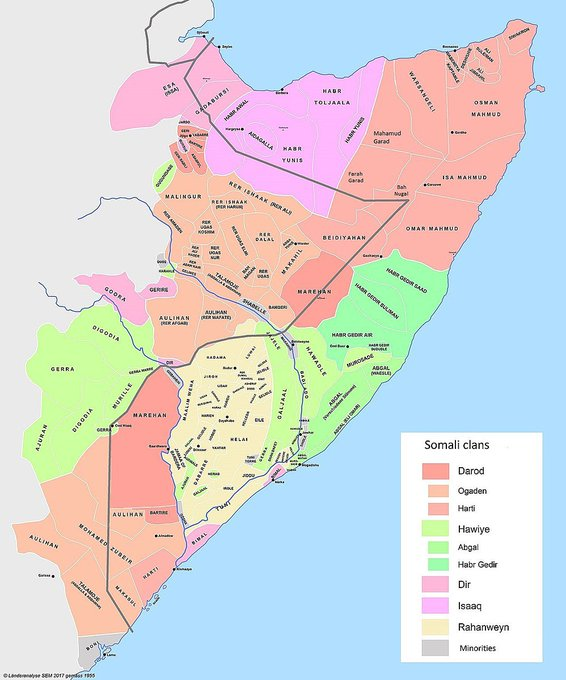
Another Map of Somalia – by Clan Territory ON SOMALI CLANS – A PRIMER:
“The clan system is the most important constituent social factor among the nomadic pastoralist Somalis”. Somalia is infamous for its extensive collection of competing, squabbling clans – perhaps more foundational to the structure of its culture than in almost any other Country in the world today.
Somali clans function as sub ethnicities of the Somali nation and are frequently a cause of inter-communal tensions and ethnic conflict, as clan affiliation is the main source of a person’s identity within Somalia. The clan system matters for all functions of society, even for the structure of the government. Somalis usually know their exact position within the clan system, including in urban Mogadishu.
The clan system is patrilinear and hierarchically structured. It can be differentiated into several levels: clan family, clan, sub-clan (sometimes also sub-sub-clan), primary lineage and mag or diya paying group. Clans are led by leaders and elders. On higher levels, these leaders are called suldaan, ugaas or issim. Their role is mainly judicial and representative. Elders (oday) on lower levels (mag paying groups) regulate access to shared resources and are involved in conflict resolution.
Due to the absence of functioning state structures in parts of Somalia, the clans and their elders have regained a political function and a substantial influence on the organisation of society. However, clans have no centralised administration or government. During the civil war, clan elders increasingly became targets of violence, which eroded their power. Nevertheless, they still have a significant influence on society and politics.
The “noble” clan families trace their origin back to a mythical common ancestor called Samaal, who is said to be descended from the Prophet Mohammed. These groups are nomadic pastoralists. The clan family is the highest level of clanship. Its members can count up to 30 generations back to a common ancestor. The four “noble” (Samaale) clan families are the following: The Darod are usually divided into three major groups: Ogaden, Marehan and Harti. The Harti are a federation of three clans: the Maierteen are the main clan in Puntland; the Dulbahante and Warsangeli live in the disputed border areas between Puntland and Somaliland. The Ogaden are the most important Somali clan in Ethiopia, but also quite influential in both Jubba regions, while the Marehan are present in South and Central Somalia. The Hawiye mainly live in South/Central Somalia. Their most influential subdivisions are the Abgal and Har Gedir, which are both dominant in Mogadishu.
The Dir settle mainly in western Somaliland and in some pockets of South/Central Somalia. The main clans are the Issa, Gadabursi (both in Somaliland and bordering regions of Ethiopia and Djibouti) and the Biyomaal (in southern Somalia). The Isaaq are the main clan family in Somaliland. According to some [social] scientists and Somalis, they are considered part of Dir clan family. A further clan family, the Digil and Mirifle/Rahanweyn, trace back their ancestry to Saab, another alleged descendant of Prophet Mohammed. The term “Rahanweyn” is sometimes used to describe a separate clan family, as identical to both Digil/Mirifle. In contrast to the Samaale, the Saab clans are mainly (but not exclusively) sedentary clans working in agriculture. They mainly live in the fertile valleys of Shabelle and Jubba Rivers and the lands in between (mainly Bay and Bakool regions). The Saab speak Maay- tiri, a dialect quite distinct from Maxaa- tiri, the dialect used by the other clan families. Sometimes, the Saab clans are considered as a separate caste below the Samaale because of a more “mixed” descent. However, there is no systematic discrimination of the Saab and both Saab and Samaale are to be considered “noble” castes, whose members are allowed to carry weapons.

 canisgallicus