

Silicon ValleyYoutubeGoogleLatest News
The Dead Sea Scrolls were written earlier than previously thought, according to AI
Machine analysis of the handwriting on the manuscripts has recalibrated the dating of over 100 of them, rewriting the history of their origin
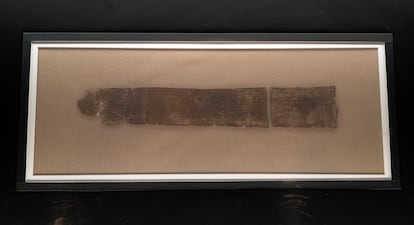

There are just over 1,000 of them, many of them fragmented, and they have been a puzzle for decades. Now, an artificial intelligence system has dated 100 of the Dead Sea Scrolls, the oldest texts in existence for both Jews and Christians. Trained with a few scrolls dated using the carbon-14 technique, the new machine has placed the date of their writing to between 50 and 150 years earlier than previously thought. In a paper published in the journal PLOS One, the creators of this AI believe that its combination of traditional paleography (the study of ancient texts) and radiocarbon dating could solve the puzzle and order the remaining hundreds, which would shed light on one of the founding moments of two of the great human cultures.
“Indeed, many scrolls are older than previously thought,” says Mladec Popović, director of the Qumran Institute at the University of Groningen (Netherlands) and co-author of this research, in an email. Enoch is the name given to the AI created by his colleagues at the Bernoulli Institute for Mathematics, Computer Science, and Artificial Intelligence at the same university. Popović has been studying the so-called Qumran Scrolls for decades, first with the help of paleographic tools, now with AI. “Enoch is mentioned in the Bible, Genesis 5, where it says that he walked with God and was no more,” Popović comments. Ancient Jewish authors wrote how the archangel Uriel showed them how the cosmos worked. “This literature is a kind of ancient science in Judaism. I thought it would be appropriate to name our prediction model after Enoch,” he adds.
Popović emphasizes that “the research doesn’t simply claim that all the manuscripts are 50 to 100 years older.” Even more relevant to him is “its ability to date individual manuscripts, which allows for details and nuances.” This greater chronological precision for individual scrolls, rather than the entire collection, “could change, for example, modern scholars’ perspective on the development of specific ideas during that period,” Popović concludes. Until now, the collection of manuscripts was considered to have been written between 250 BC and 60 AD.
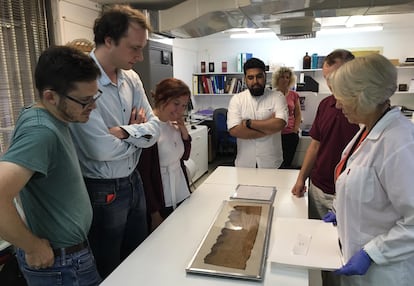
Enoch was trained by presenting it with copies of 25 manuscripts that had previously been carbon-dated. Written on lambskin (although there are a few papyri, of plant origin), seven milligrams were taken from each scroll to date them using the primary tool scientists have for determining the date of any biological material, be it a human bone or a stretched piece of animal hide. On that basis, the AI worked like an artificial paleographer, analyzing not the content, but the shape of the text, its stroke, or the form of the letter, whether written in Imperial Aramaic or Square Hebrew, also known as Ashuri (a script originating among the Jews of Babylon). It correctly placed 24 of the 25 chronologically.
Once trained, Enoch had to work with the digitalized copy of 135 of the more than 1,000 scrolls that have been found in the caves surrounding the Dead Sea since the first were discovered by Bedouins in the middle of the 20th century. After dating each one, it was able to place them chronologically. A group of human paleographers reviewed the results, finding that 79% of their dates were realistic. For the authors, AI brings objectivity to a discipline — paleography — that is highly subjective.
This isn’t the first time this group of researchers has used AI to study the Qumran Scrolls. In 2021, they published their work on the Great Isaiah Scroll, the largest scroll at six meters long, which contains the eponymous book of both the Jewish Tanakh and the Christian Bible. At that time, the AI discovered that the text had been written by two different scribes. “There are similarities between the two methods: The use of small details in the shape of the ink stroke is very similar. However, we used this information for Isaiah to find evidence of two possible writers, while for Enoch, we used a processing step (called regression) to estimate the position of the manuscripts along the timeline,” explains Lambert Schomaker, professor at the Bernoulli Institute and co-author of the work.
Another more obvious advantage of Enoch is that it doesn’t damage the scrolls. “We can now estimate the date of manuscripts without having to cut a precious piece of papyrus or sheepskin with scissors for the chemical treatment and physical experiment that constitutes carbon dating,” Schomaker notes. Furthermore, the AI works with digitized copies. “Pattern recognition, on the other hand, is non-destructive; we simply use the scanned images; no paper is needed, and it’s not destroyed.”
Enoch’s final great strength is that it’s available to other Dead Sea Scroll scholars. Popović reveals that they’ll use AI for the scrolls they have access to, “but the Enoch tool is already available to scholars around the world, so they can also work with it and date individual scrolls.”
Regarding the historical implications of his findings, Popović points out that it is still too early. “As a test, we applied the tool to 135 manuscripts out of more than 1,000 existing ones. Therefore, we cannot give a definitive answer as to how our findings change our understanding of the period.” But the veteran paleographer is convinced that combining AI, radiocarbon dating, and traditional human analysis could answer the question that has been asked for years: “The importance of these dating results is that they allow us to study the actual hands that wrote the Bible because it provides us with clues about the social context of the text’s production and dissemination.”
Sign up for our weekly newsletter to get more English-language news coverage from EL PAÍS USA Edition

 canisgallicus