
Michael Comyn KC was a prominent Irish barrister who defended Erskine Childers during his trial in November 1922. Childers, an English-born Irish nationalist, was a key figure in the Irish War of Independence and opposed the Anglo-Irish Treaty, aligning with the anti-Treaty IRA during the Irish Civil War. He was arrested on November 10, 1922, at Glendalough House in County Wicklow, in possession of a pistol—allegedly a gift from Michael Collins—which was deemed a capital offense under the Free State’s emergency laws.
Comyn, a long-time friend who had sheltered Childers at his Leeson Park home, represented him at a military court in Portobello Barracks on November 17, 1922. The trial, held in camera, resulted in Childers’ conviction for unauthorized possession of a firearm. Comyn, alongside Patrick Lynch, argued in the High Court that the military court lacked jurisdiction, as Childers was a civilian and the country was in a state of war, but the court dismissed the case. Comyn prepared an appeal, but before it could be heard, Childers was executed by firing squad at Beggar’s Bush Barracks on November 24, 1922. The rushed execution, while an appeal was pending, was seen as a negation of justice by Comyn, who later described it as the worst miscarriage he had witnessed. Some sources suggest the Free State authorities acted swiftly to prevent a possible rescue attempt.
The execution was controversial, with figures like Éamon de Valera and George Gavan Duffy praising Childers’ service to Ireland and decrying his death. Comyn’s defense efforts, though unsuccessful, highlighted his commitment to republican prisoners, as he notably prevented executions in other cases, such as the Clifford and O’Sullivan case, where 42 men were spared.


15 web pages
Quote

Erskine Childers
@erskinechilders
·
Oct 29, 2024
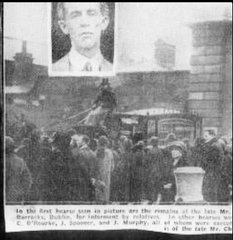
The only photo of Erskine’s hearse leaving Beggars Bush gate on the way to Hardwicke Hall. Robert Barton and Senator Robinson walked behind it. Barton had to identify the remains. Robinson remembered the crowd at the Barracks, most in tears and weeping.
My grandfather Michael Comyn KC represented Erskine Childers. It caused him much sadness when he was executed while his case was on appeal. Michael Comyn was one of the last people to meet with Erskine Childers. See link below Posted on October 31, 2024 by michelleclarke2015 Erskine Childers (@erskinechilders) posted at 1:55 pm on Tue, Oct 29, 2024:The only photo of Erskine’s hearse leaving Beggars Bush gate on the way to Hardwicke Hall. Robert Barton and Senator Robinson walked behind it. Barton had to identify the remains. Robinson remembered the crowd at the Barracks, most in tears and weeping. My grandfather Michael Comyn KC represented Erskine Childers. It caused him much sadness when he was executed while his case was on appeal. Michael Comyn was one of the last people to meet with Erskine Childers. https://t.co/FfzgMbnlcz https://x.com/erskinechilders/status/1851261672394051634?t=PMPy9gJuZG1FrJTkv6r8dw&s=03 Share this:
The image and post you’ve shared provide a poignant glimpse into a significant moment in Irish history, capturing the emotional aftermath of Erskine Childers’ execution in November 1922. The photograph shows the hearse carrying Childers’ remains as it leaves Beggar’s Bush Barracks in Dublin, heading to Hardwicke Hall. The accompanying text on the image mentions key figures involved in the event: C. O’Rourke, Buddie (likely a misspelling of Budgen), J. Spooner, and J. Murphy, who were executed alongside Childers. The crowd’s emotional response, as noted by Senator Robinson, reflects the deep impact Childers’ death had on the public, many of whom were in tears.
Erskine Childers IV: Your grandfather, Michael Comyn KC, played a crucial role in this historical episode as Childers’ legal representative. Comyn, a distinguished barrister and advocate for Irish republican causes, defended Childers during his trial for illegal possession of a firearm—a Colt revolver, allegedly a gift from Michael Collins. The trial took place on November 17, 1922, at Portobello Barracks, and Childers was convicted by a military court. Comyn, alongside Patrick Lynch, challenged the military court’s jurisdiction in the High Court, arguing that Childers, as a civilian, should not have been tried under martial law during a time of war. Despite their efforts, the High Court dismissed the case, and an appeal was prepared. Tragically, before the appeal could be heard, Childers was executed by firing squad at Beggar’s Bush Barracks on November 24, 1922.
The execution while the appeal was pending deeply affected Comyn, as you’ve noted. He later described it as one of the worst miscarriages of justice he had witnessed, a sentiment echoed by others at the time, including Éamon de Valera and George Gavan Duffy, who condemned the Free State’s actions. Comyn’s personal connection to Childers—he had sheltered him at his Leeson Park home and was one of the last to meet with him—made the loss even more profound. The post mentions Robert Barton, Childers’ cousin and a fellow nationalist, who had the somber task of identifying his remains, and Senator Robinson, who recalled the crowd’s grief, underscoring the widespread mourning.
This event occurred during a tumultuous period in the Irish Civil War, with the Free State government taking harsh measures against anti-Treaty republicans. Childers, a former British soldier turned Irish nationalist, was a polarizing figure due to his role in the War of Independence and his staunch opposition to the Anglo-Irish Treaty. His execution was seen by many as a political statement, but it also left a lasting scar on those who knew him, including your grandfather, Michael Comyn, whose dedication to justice and republican ideals was evident in his tireless defense of Childers and other prisoners during this turbulent time.

3 web pages

 canisgallicus