
1-minute video game distinguishes autistic from neurotypical kids
By Paul McClure
January 29, 2025
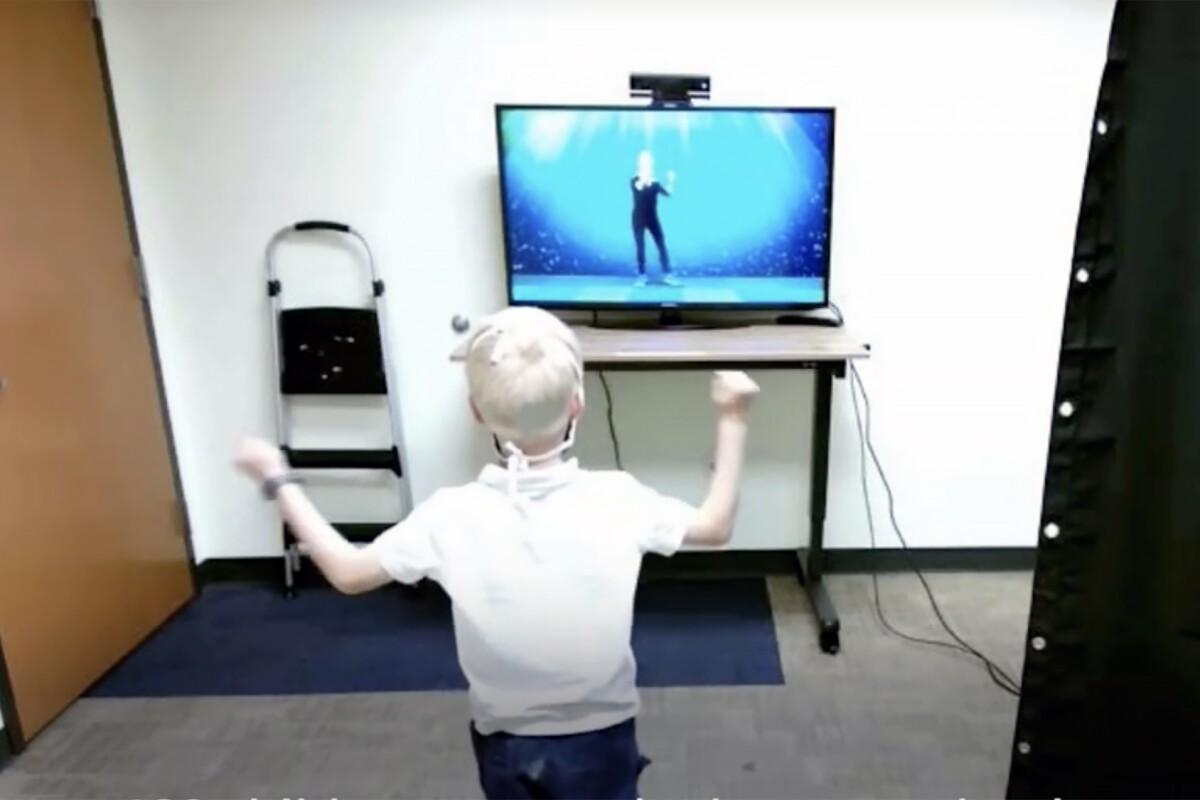
An innovative diagnostic tool distinguishes between kids with autism and ADHD
Kennedy Krieger Institute
View 1 Images
A low-cost tool accurately distinguishes neurotypical children from children with autism just by watching them copy the dance moves of an on-screen avatar for a minute. It can even tell autism from ADHD, conditions that commonly overlap.
Early diagnosis of autism spectrum disorder (ASD) is key to ensuring that effective interventions are put in place that, ultimately, improve a person’s quality of life. However, because ASD commonly co-exists with attention-deficit hyperactivity disorder (ADHD), its diagnosis can be tricky and may be missed or delayed. In addition, testing a child for ASD is time-consuming and expensive.
In a new study, researchers from the Kennedy Krieger Institute, an American non-profit organization, and Nottingham Trent University in the UK developed and tested a novel means of reliably and accurately diagnosing autism in children, even when it exists alongside ADHD: a one-minute motion-detecting video game.
“Diagnosing autism can be challenging, especially when children have overlapping traits with other conditions like ADHD,” said Dr Stewart Mostofsky, a pediatric neurologist, director of the Center for Neurodevelopmental and Imaging Research at the Kennedy Krieger Institute, and a co-author of the study. “If the condition is misdiagnosed, it can impact support and resources for the child.”
ASD is characterized by an impairment of social and communication skills that can be mild, moderate, or severe. Compared to neurotypical children, studies have shown that children with ASD struggle particularly with tasks like ball catching and motor imitation that require efficient visual-motor integration. Previous research has also found that children use imitation to form and maintain relationships with others and learn social norms and rituals. Those who can’t appropriately learn these social cues through imitation face exclusion from peers and the broader community.
Because it’s crucial for learning both social and motor skills, it follows that imitation could be a good biomarker for ASD. So, based on this and the aforementioned studies, the researchers developed the Computerized Assessment of Motor Imitation, or CAMI, to detect ASD by focusing on differences in motor imitation.
“Traditionally, autism is viewed as a disorder of social-communicative functioning,” said Dr Bahar Tunçgenç, an expert in social development from Nottingham Trent University’s Department of Psychology and the study’s corresponding author. “However, we have growing knowledge that autistic people have sensory-motor difficulties, like motor imitation, which may have knock-on effects on how they develop social interactions and communication skills in childhood. CAMI taps into these sensory-motor difficulties, showing that they are not shared with children with ADHD.”
The researchers recruited 183 seven-to-13-year-olds and divided them into four groups: those with ADHD but without ASD, those with ASD and co-occurring ADHD, ASD without ADHD (ASD only), and neurotypical children. Over two one-minute trials, the children were asked to stand and copy the whole-body, dance-like movements of a video avatar while two Kinect Xbox cameras recorded them. For each trial, CAMI calculated an imitation score that varied between zero (no imitation at all) and one (perfect imitation, such as that performed by a well-trained researcher). https://www.youtube.com/embed/69gOg8k0TrI?enablejsapi=1
1-minute video game can diagnose autism with 80% accuracy
The two trials featured different movement sequences. CAMI scores for each trial were averaged to give a composite CAMI score for each participant between zero and one, with a higher score indicating better imitation. CAMI showed 80% accuracy in distinguishing children with ASD from neurotypical children and 70% accuracy in distinguishing children with ASD from those with ADHD. The researchers said CAMI has significant potential in clinical settings as a diagnostic tool.
“What really makes CAMI exciting is its simplicity,” Tunçgenç said. “Video games are already so popular. It’s fun for kids and delivers fast results that are easy to interpret for clinicians. My hope is for CAMI to eventually be used in clinical practices everywhere.”
The researchers said that with further development, it could be adapted for use with younger children and those with more severe developmental challenges, which would further broaden its utility.
“This tool could transform autism diagnoses worldwide,” said Mostofsky. “By identifying autism as precisely as possible, we can connect children to interventions that improve their quality of life and long-term outcomes. We want to see CAMI used widely in clinics to support diagnosis as an alternative that is quick, low-cost, and requires minimal setup.”
The study was published in The British Journal of Psychiatry.
Sources: Kennedy Krieger Institute, Nottingham Trent University
We recommend
- Effect of assembly pressure on the performance of proton exchange membrane fuel cellEnergy Storage and Saving, 2023
- Analysis of discharge parameter prediction affected by electrode movement speed based on Attention-LSTM-XGBoostHE Xiusi, Chinese Journal of Radio Science
- Research on network planning technology for new generation railway mobile communicationDING Xun, Chinese Journal of Radio Science
- Visual labeling method of partial discharge source based on camera pose estimationChinese Journal of Radio Science
- Design of high-gain low-sidelobe wide-sector beam slotted ridge waveguide antenna arrayYAO Huafei, Chinese Journal of Radio Science
- CONSTRUCTION OF A PREDICTION PLATFORM FOR POLYCYSTIC OVARY SYNDROME BASED ON FEDERATED LEARNINGSUN Ye, Journal of Qingdao University (Medical Sciences)
Tags
ADHD & AutismAutism spectrum disorderDiagnostic toolsADHDKennedy Krieger InstituteNottingham Trent University

 canisgallicus