

How the Brain Processes Space and Time
FeaturedNeuroscienceVisual Neuroscience
·January 27, 2025
Summary: New research highlights a functional hierarchy in the brain’s processing of space and time. In posterior areas, like the occipital cortex, space and time are tightly linked and processed by the same neurons.
In anterior regions, such as the frontal cortex, space and time are processed independently, with distinct neural populations forming “time maps” for specific durations. Intermediate regions, like the parietal cortex, display mixed processing mechanisms, bridging spatial and temporal integration.
This study offers fresh insights into how the brain integrates two fundamental dimensions of human experience and reveals the unique coding strategies across cortical regions.
Key Facts:
- Posterior Cortex: Processes space and time together, using shared neural populations.
- Anterior Cortex: Separates space and time, forming distinct “time maps” for durations.
- Intermediate Cortex: Shows mixed processing, integrating space and time variably.
Source: SISSA
Imagine a swarm of fireflies, flickering lights on and off in the nighttime space. How does the human brain process and integrate information about duration and spatial position enabling this vision?
This was the question addressed by Valeria Centanino, Gianfranco Fortunato, and Domenica Bueti from SISSA’s Cognitive Neuroscience group in their research published in Nature Communications.
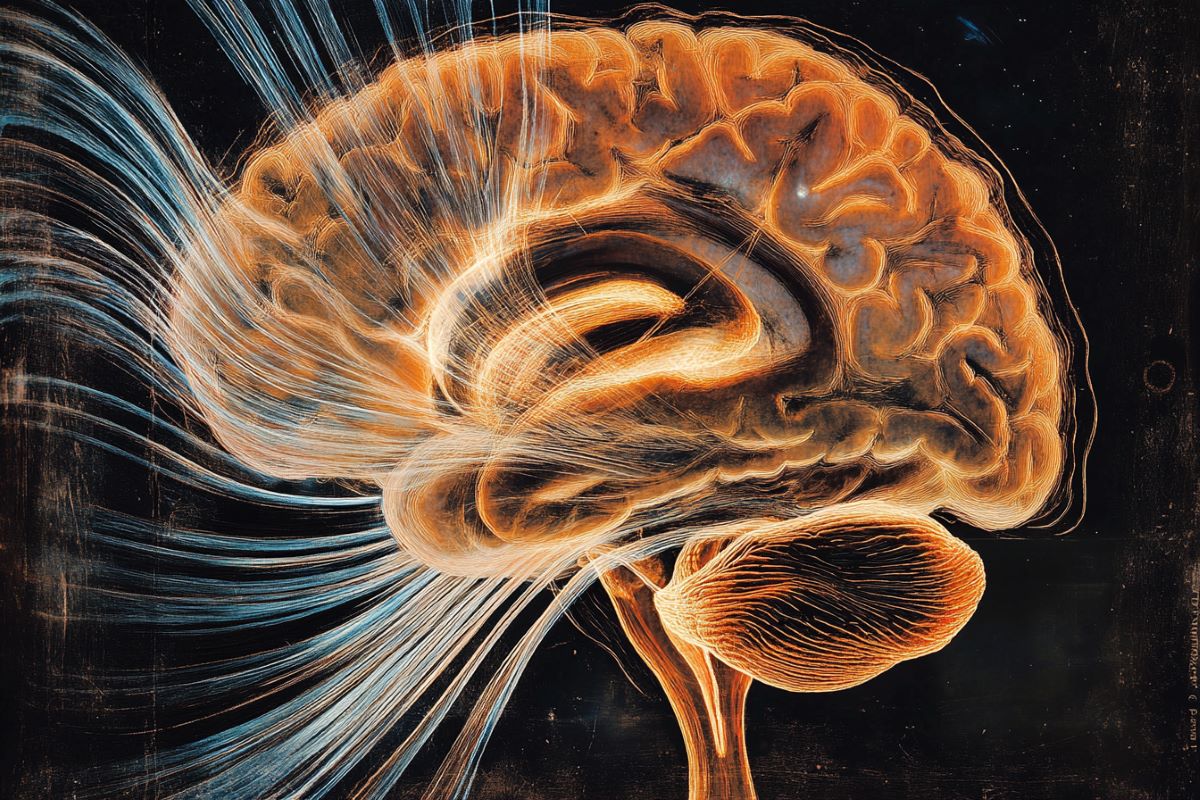
The study highlights the existence of a functional hierarchy in the human cerebral cortex, where posterior areas—those that first receive visual information— process space and time together.
In contrast, in parietal areas and even more so in frontal areas, engaged later in information processing, space and time gradually separate. Moreover, the way time is encoded differs across these brain regions.
In the occipital areas, where space and time are processed together, time is encoded in the activity of the same neural population, which becomes proportionally more active the longer the duration.
In parietal and frontal areas, instead, where the link between space and time becomes progressively weaker and eventually disappears, time is encoded by distinct neural populations, each of them responding selectively to specific durations.
In the parietal areas, in an intermediate position of this hierarchy, there is a coexistence of duration coding mechanisms and time and space are either processed toghether or independently.
The Experiment: Visual Stimuli in Different Screen Positions
“How does the human brain process visual information changing in both spatial position and duration?”
This was the question driving the research.
“We wanted to understand whether space and time are processed independently or not,” the authors of the study explain. To simulate what might occur in reality, they asked young healthy participants to judge the duration of a visual stimulus presented at different positions on a screen for varying amounts of time.
“During this task, neural responses were recorded using high-resolution spatial magnetic resonance imaging (fMRI).”
Different Brain Areas, Different Coding Strategies. Posterior Cortex: Space and Time Processed Together
“What we discovered is that the link between space and time in the human brain is not fixed but depends on the brain areas involved. In the posterior part of our brain, particularly in the occipital visual cortex, the connection is strong because space and time are processed by the same neurons.
“This region, specialized in receiving visual inputs,” explain Centanino, Fortunato, and Bueti, “responded to both the position and duration of the stimulus: the longer the viewing time, the greater the brain activity in these neuron populations.”
Anterior Cortex: Separate Neurons for Space and Time
In the anterior regions, however, this connection disappears. In the frontal premotor areas, involved in movement preparation, time is processed independently of the position of the visual stimulus.
Distinct populations of neurons process space and time. Furthermore, the authors add, “duration is encoded differently compared to the posterior areas.
Here, distinct neural populations preferentially respond to specific durations, and neural populations that prefer similar durations are contigous in the cortical surface, forming what we might call ‘time maps.’”
Intermediate Cortex: A Variety of Mechanisms
In an intermediate region of this cortical hierachy, specifically the parietal cortex, which is known for integrating various information sources and is functionally situated between the occipital and frontal premotor cortex, the relationship between space and time is multifaceted.
The three researchers explain: “Some neuronal populations responded to both the position and the duration of the stimulus, while others responded only to one of these dimensions.
“The response to time was, in some cases, monotonic like in the occipital cortex, while in others it showed selectivity for specific durations, similar to the anterior areas.”
A Functional Hierarchy in Time Processing
“This study,” conclude Centanino, Fortunato, and Bueti, “advances our understanding of how space and time, two fundamental aspects of our experience of the world, are processed and integrated in the human brain.
“Moreover, it sheds light on the presence of a functional hierarchy in time processing.
“The existence of multiple response profiles to stimulus duration, along with their specific relationship to spatial processing, suggests that different brain areas contribute distinctly to the processing and perception of time.”
About this neuroscience research news
Author: Donato Ramani
Source: SISSA
Contact: Donato Ramani – SISSA
Image: The image is credited to Neuroscience News
Original Research: Open access.
“The neural link between stimulus duration and spatial location in the human visual hierarchy” by Valeria Centanino et al. Nature Communications

 canisgallicus