

|
01-24-2025 WORK LIFE
How Mark Zuckerberg’s call for more masculine workplaces could stifle innovation
Based on research, it seems like promoting rigid masculinity in the workplace is not the best solution for an arguably already struggling Meta.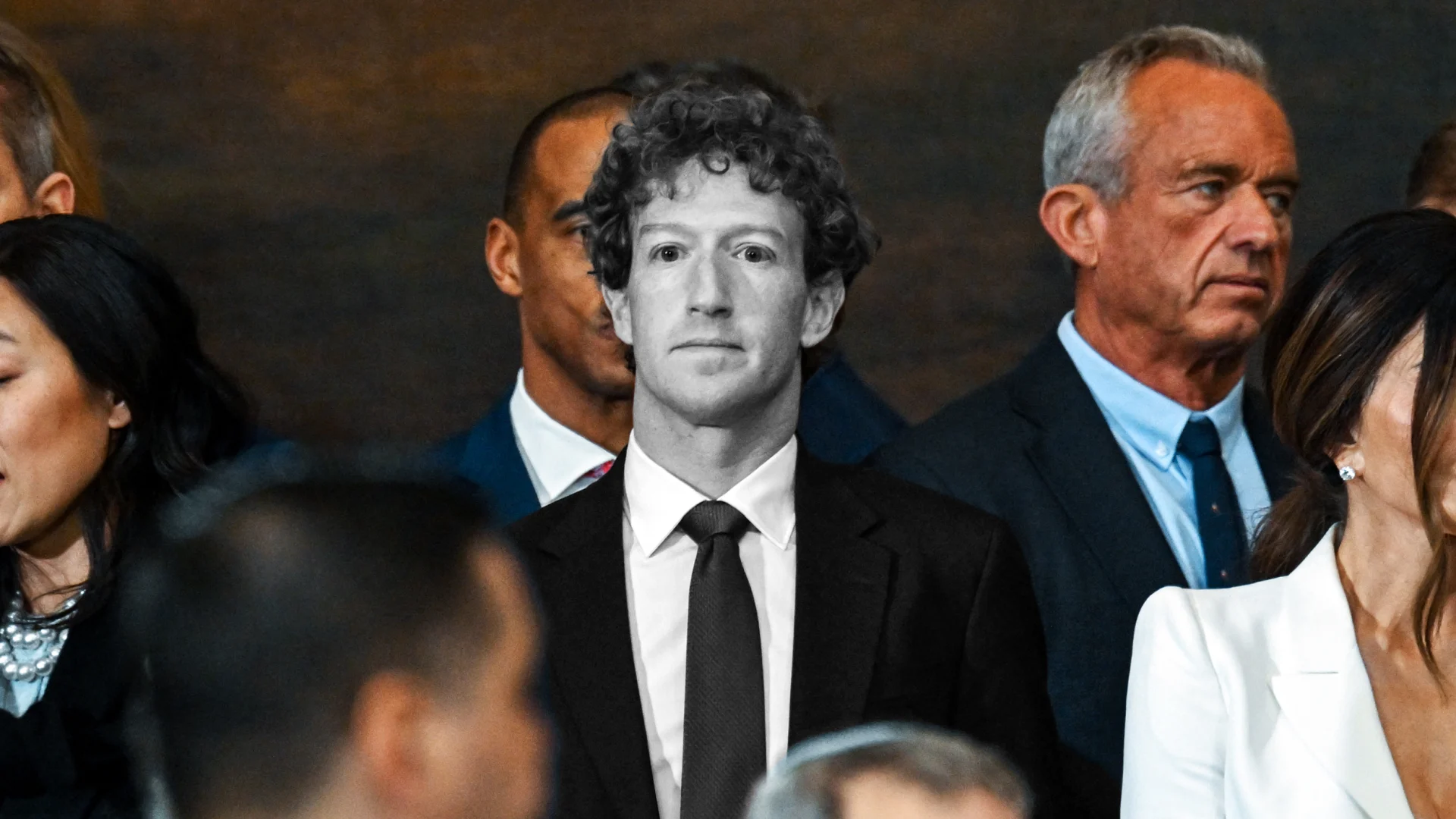
[Photo: KENNY HOLSTON/POOL/AFP via Getty Images]
BY The Conversation 4 minute read
When Meta CEO Mark Zuckerberg appeared on a January 10, 2025, episode of The Joe Rogan Experience, he lamented that corporate culture had become too “feminine,” suppressing its “masculine energy” and abandoning supposedly valuable traits such as aggression.
The workplace, he concluded, has been “neutered.”
Perhaps not surprisingly, Zuckerberg has also embraced stereotypically masculine pursuits in his personal life. He’s become a mixed martial arts aficionado and has shared his affinity for smoking meats. On his expansive Hawaii compound, he’s even taken up bow-and-arrow pig hunting.
He’s come a long way from the geeky image of his youth.

Subscribe to the Compass newsletter.Fast Company’s trending stories delivered to you daily
SIGN UP
But is Zuckerberg right? Do workplaces in the U.S. need to embrace a more diesel-fueled, street-fighting, meat-eating mentality?
As a social psychologist who studies masculinity and aggression, I think it’s important to evaluate what the science says about Zuckerberg’s claims—and to consider what it means for the future of workplace culture in the U.S.
Show no weakness
In 2018, sociologist Jennifer Berdahl and her colleagues coined the term “masculinity contest culture” to describe workplaces rife with cutthroat competition, toxic leadership, bullying, and harassment. Expand to continue reading ↓
============
Integrating decades of prior research on masculinity in the workplace, Berdahl and her collaborators were able to map how masculinity contest cultures operate, as well as show how they affect organizations and individual employees.
In her experiments, she had participants agree or disagree with statements such as “expressing any emotion other than anger or pride is seen as weak,” based on their perceptions of their own organization. Using advanced statistical techinques, Berdahl’s team was able to distill masculinity contest cultures down to four components: “showing no weakness,” “strength and stamina,” “putting work first,” and “dog eat dog.”
Then they were able to show how these cultures are tied to a host of negative outcomes for workers and companies, such as burnout, turnover, and poor well-being. And at the organization level, they can foment a dysfunctional office environment, toxic leadership, and even bullying and harassment.
An imagined grievance
Based on this research, then, it seems like promoting rigid masculinity in the workplace is not the best solution for an arguably already struggling Meta.
What, then, led Zuckerberg to claim that the workplace has been neutered and must be infused with masculine energy? Has the American office really gone full Legally Blonde?
Zuckerberg’s own company isn’t exactly a paragon of parity: Its total workforce, as of 2022, was nearly two-thirds male, while its tech workforce was three-quarters male. Furthermore, according to psychologists Sapna Cheryan and Hazel Markus, workplaces in the U.S. still reflect what they call “masculine defaults”—cultures that reward characteristics or behaviors generally associated with men.
This can range from how companies describe themselves—for example, as places that are “aggressive” and “unrestrained”—to hosting events catering to traditionally male pursuits, such as golf outings.
Although Cheryan and Markus’s analysis centers on how masculine defaults make it harder for women to carve out their professional paths, they can harm everybody, including men.
My research, for example, has shown that when men feel pressured to fulfill certain masculine expectations, they can develop fragile masculine identities, which are linked with aggression and anxiety.
Although the pervasiveness of masculinity norms can give men an upper hand in the workplace, I wonder whether men are contorting themselves to fit into outdated molds of who succeeds at work. Indeed, research shows that successful organizations promote a healthy mix of stereotypically masculine and feminine qualities.
In other words, it’s best when people of all genders feel comfortable showcasing traits such as cooperation and agency, qualities that don’t necessarily fall into one gender camp.
The rise of the fragile billionaire
If many workplaces still possess dog-eat-dog cultures and celebrate masculinity—with evidently poor outcomes—you might wonder why billionaire corporate leaders would advocate for them.
The most generous explanation is ignorance. Zuckerberg could simply be unaware that most offices in the U.S. still possess competitive environments and traits associated with traditional masculinity.
Although this could be the case, I think there could be two other explanations for Zuckerberg’s promotion of rigid masculinity norms.
There could be an economic motive. Perhaps Zuckerberg thinks that promoting his company as an arena of high-stakes competition and aggression is the best way to attract talent and spur innovation in a field already dominated by men. It’s often thought that competition drives innovation. So “Meta needs to be more masculine” could actually be code for “Meta needs to breed more internal competition, which will spur innovation and turn a profit.” This assumption is also misguided: Recent research has shown that internal competition may actually stifle innovation.
There could also be a psychological motive. I’ve found in my research that men are most likely to cling to notions of rigid masculinity when they feel pressure to “man up” and are insecure about themselves.
Perhaps Zuckerberg sees diversity efforts as a challenge to his power. Maybe he thinks aligning himself with President Donald Trump’s version of masculinity will help him gain and retain power, especially as he faces challenges from other tech giants. So his promotion of an aggressive workplace, along with his slashing of policies that could make him look “weak,” are moves to reinforce his status as a leader, as an innovator, and as a man.
This isn’t to say that activities such as hunting and mixed martial arts are inherently bad, or even inherently masculine: There are plenty of female hunters and UFC fighters. Nor is it to say that certain masculine characteristics in the workplace are inherently bad.
But when I see middle-aged billionaires—Zuckerberg isn’t the only one—exhibiting the signs of fragile masculinity that I’ve observed among young adult men and adolescent boys, I can’t help but wonder what the country’s future holds.
Adam Stanaland is an assistant professor of psychology at the University of Richmond.
This article is republished from The Conversation under a Creative Commons license. Read the original article.
ABOUT THE AUTHOR
The Conversation is a nonprofit, independent news organization dedicated to unlocking the knowledge of experts for the public good. More

 canisgallicus