
How Early Experiences Shape Genes, Brain Health, and Resilience
·December 31, 2024
Summary: New research in epigenetics reveals how early-life experiences influence gene expression and brain development. By bridging the gap between nature and nurture, this work shows that environmental factors leave lasting biological imprints, shaping long-term health and resilience.
Findings suggest early interventions can profoundly impact brain development and mental health. Current research focuses on using big data and computational tools to explore the complex interplay of genes and environment further.
Key Facts:
- Epigenetics Insights: Early-life experiences modify gene expression without altering DNA sequences, impacting brain health.
- Bridging Nature and Nurture: The work dissolves the outdated distinction between genetic and environmental influences.
- Policy Implications: Research supports early intervention programs to enhance brain development and resilience.
Source: Genomic Press
In a comprehensive Genomic Press Interview, renowned neuroscientist Dr. Michael Meaney reveals pivotal discoveries about the intricate relationship between genes and environment in shaping brain health.
As a James McGill Professor Emeritus and former Director of the Translational Neuroscience program at ASTAR Singapore, Dr. Meaney’s research has fundamentally altered our understanding of how early-life experiences influence genetic expression and brain development.
“I have always been genuinely fascinated by the search for the developmental origins of individual differences in brain development and function,” says Dr. Meaney, whose work has earned him election to the American Academy of Arts and Sciences and the Order of Canada.
“More broadly, and inspired by Hebb, I bore a profound dissatisfaction with the conceptually flawed distinction between the influences of ‘nature’ and ‘nurture’.”
Dr. Meaney’s research journey began with a simple question: what makes individuals different from one another?
This curiosity led him to groundbreaking discoveries in epigenetics – the study of how environmental factors can influence gene expression without changing DNA sequences.
His work at McGill University and later in Singapore with the GUSTO birth cohort study has provided crucial insights into how early-life experiences become biologically embedded, affecting long-term health outcomes.
“We too readily embrace narratives and technology that appeal to the general public, achieve headlines, and attract venture capital, but are far too simplistic to capture the complex reality of brain health truly,” Dr. Meaney observes, highlighting the need for nuanced understanding in neuroscience research.
The significance of Dr. Meaney’s work extends beyond the laboratory. His research has critical implications for public health policy, suggesting that early intervention programs could have lasting effects on brain development and mental health.
The findings raise intriguing questions about how society might better support child development: How can we translate these scientific insights into practical interventions? What role do different types of early experiences play in shaping resilience?
With over 650 publications to his name, Dr. Meaney’s work continues to influence how we think about human development. His current focus on applying novel computational approaches to ‘big data’ opens new avenues for understanding gene-environment interactions.
“The large data sets of the day are an ideal playground for one seeking to document gene x environment interactions on health and well-being,” he explains.
About this epigenetics and neuroscience research news
Author: Ma-Li Wong
Source: Genomic Press
Contact: Ma-Li Wong – Genomic Press
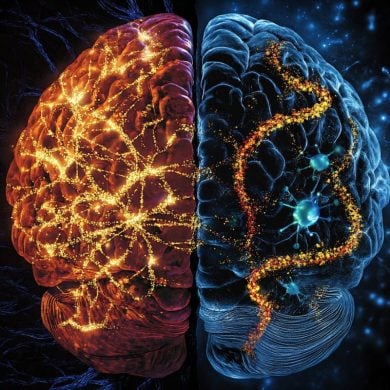
Image: The image is credited to Neuroscience News
Original Research: Open access.
“What is the biology that underlies the gene x environment interdependence that shapes brain health?” by Michael Meaney. Genomic Psychiatry
Abstract
What is the biology that underlies the gene x environment interdependence that shapes brain health?
As a distinguished James McGill Professor and now Professor Emeritus at McGill University, Michael Meaney’s scientific journey is a testament to the power of curiosity in science.
His fascination with how our environment shapes our genes, brain function, and mental health has led to discoveries that have changed how we think about human development.
After leading groundbreaking research at McGill, he took his expertise to Singapore, where, as Director of the Translational Neuroscience program at ASTAR, he helped shape the innovative GUSTO birth cohort study.
His profound impact on neuroscience is reflected not just in his impressive collection of honors – from the Order of Canada to his recent election to the American Academy of Arts and Sciences – but in how his work has touched lives.
With over 650 publications to his name, Meaney has helped bridge the gap between molecular biology and public health.
Join our Newsletter
I agree to have my personal information transferred to AWeber for Neuroscience Newsletter ( more information )
Sign up to receive our recent neuroscience headlines and summaries sent to your email once a day, totally free.
We hate spam and only use your email to contact you about newsletters. You can cancel your subscription any time.
Tags
brain developmentbrain researchdevelopmental neuroscienceepigeneticsGeneticsGenomic PressneurobiologyneurodevelopmentNeuroscience
ShareTweetShareShareSubmitEmail

Neuroscience News posts science research news from labs, universities, hospitals and news departments around the world. Science articles cover neuroscience, psychology, AI, robotics, neurology, brain cancer, mental health, machine learning, autism, Parkinson’s, Alzheimer’s, brain research, depression and other sciences.
Related
Gene Expression Drives Evolution of Human Brain Complexity

How Altered States of Consciousness Change Time Perception
Ancient Brain Reflex Develops Without Sensory Input
Leave a Reply
Your email address will not be published. Required fields are marked *
Comment *
Name *
Email *
Website
Notify me of follow-up comments by email.
Notify me of new posts by email.
Neuroscience Videos
Video Playerhttps://www.youtube.com/embed/NhxVuq6UimY?controls=0&rel=0&disablekb=1&showinfo=0&modestbranding=0&html5=1&iv_load_policy=3&autoplay=0&end=0&loop=0&playsinline=0&start=0&nocookie=false&enablejsapi=1&origin=https%3A%2F%2Fneurosciencenews.com&widgetid=1
00:00
02:40
Latest Neuro News
- Gene Expression Drives Evolution of Human Brain Complexity
- How Altered States of Consciousness Change Time Perception
- Ancient Brain Reflex Develops Without Sensory Input
- Link Between Cold Sore Herpes Virus and Alzheimer’s Discovered
- Poor Sleep Linked to Difficulty Controlling Unwanted Thoughts

Neuroscience News Sitemap
Neuroscience Graduate and Undergraduate Programs
Free Neuroscience MOOCs
About
Contact Us
Privacy Policy
Submit Neuroscience News
Subscribe for Emails
Neuroscience Research
Psychology News
Brain Cancer Research
Alzheimer’s Disease
Parkinson’s News
Autism / ASD News
Neurotechnology News
Artificial Intelligence News
Robotics News
Search Neuroscience News
Neuroscience News is an online science magazine offering free to read research articles about neuroscience, neurology, psychology, artificial intelligence, neurotechnology, robotics, deep learning, neurosurgery, mental health and more.
Neuroscience News


Update Privacy Settings
25

 canisgallicus