
CERN trains AI models to revolutionize cancer treatment
The advances developed at the European Organization for Nuclear Research have already been applied to 10,000 stroke patients in hospitals in Germany and Belgium
Lourdes Velasco
Geneva – OCT 05, 2024 – 06:05 CEST
The artificial intelligence-based innovations that CERN initially developed to improve the maintenance of its particle accelerator have revolutionary applications in the field of health. Reducing the size of radiotherapy machines and optimizing them for ease of use — especially in countries with fewer resources —, designing a smart program for breast cancer prevention and improving the monitoring of stroke patients are some of the promising projects that the European nuclear research laboratory is working on, in collaboration with European hospitals.
The European Organization for Nuclear Research — which is known as CERN — offers hospitals its experience in managing huge amounts of data in a secure and decentralized way, which is key to ensuring the privacy and security of the private patient information used to feed the algorithm. This institution — which is best known for building the Large Hardron Collider (LHC) — uses a system to process data locally without sending it to central storage. This helps protect privacy and make better use of resources when different hospitals work together to create reliable AI-based models for analyzing and predicting diseases.
“It is a new paradigm. Before, there was a huge amount of data that was centralized and stored. Now we do the processing at the place where the data is acquired, for example in a hospital. If we guarantee privacy, data protection and the robustness of the model, we have something that is of great interest for medical applications,” explains CERN scientist Luigi Serio during a visit to the laboratory’s facilities organized by the International Union for Cancer Control (UICC) on the occasion of the World Cancer Congress in Geneva.
Luigi Serio — responsible for developing AI applications in healthcare — acknowledges that the laboratory known for discovering antimatter — which also created the world’s first website — isn’t the only one using this data processing model. However, he emphasizes, “What sets us apart is the strength, expertise, and reputation of CERN, along with the assurance that our services are backed by our nonprofit, impartial status.”
How AI helps improve stroke patient monitoring
One of the applications based on this system is Truckstroke, which is already improving stroke treatment with artificial intelligence in around 10,000 patients in hospitals in Germany and Belgium and in the Vall d’Hebron Stroke Unit in Barcelona.
By comparing images of the brain of a stroke patient with models trained by CERN in the so-called Truststroke Project, the algorithm predicts how the patient might evolve, what therapy should be administered and the follow-up required. Most importantly, the tool predicts the risk of recurrence.
Every year, 1.1 million people in Europe have a stroke, half a million die, and there are almost 10 million survivors who need long-term care. “Professionals are overwhelmed by stroke patients and need ever more new tools to support their work,” explains Serio.
Hospitals have all the data configured locally, but by exchanging the parameters with the main server they obtain prediction models capable of measuring the severity of the stroke. “The doctor can use these models to decide what type of treatment to give to the patient. They also know the probable outcome and the follow-up required, how long the patient must remain in hospital, when they can be discharged, etc.,” explains the researcher.
The algorithm knows who should undergo a mammogram
CERN plans to complete a cancer detection program next year that promises to be 50% more accurate than the current screening model, GAIL. In addition to age factors and medical history, the CERN model will determine the risk of developing breast cancer by combining multiple factors, such as consumption of certain foods or alcohol, lifestyle and physical activity, the age of the woman at her first pregnancy or menopause, among other parameters.
The current screening system does not take into account all risk factors. “The idea is to have a tool that can analyze several factors beyond those currently taken into account to decide whether a mammogram should be done earlier, even if it can be delayed and for what reasons,” explains Serio.
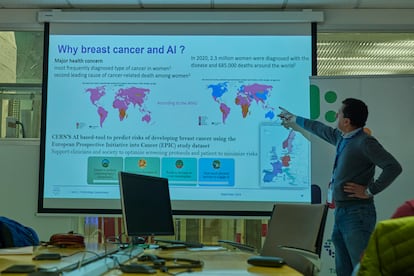
The data to train the tool comes from the European Prospective Study on Diet, Cancer and Health (EPIC), which contains information collected over more than 20 years. Once the model is finalized next year, it will need to be tested and regulated, so there are still steps to be taken before the promising breast cancer screening system replaces the current protocol.
CERN aims to enhance linear radiotherapy accelerators (LINACs) with artificial intelligence to make them easier to use and more accessible in low- and middle-income countries. In these regions, access is limited not only by the high cost, but also by a shortage of experts trained to operate the equipment. “The machines are difficult to acquire, install, operate and maintain,” explains Serio. The use of artificial intelligence in this field could significantly improve the quality of care, as it allows the machine to be operated and diagnoses to be made even in the absence of an expert, he explains.
New AI-based software will help predict failures, speed up maintenance and guide users, while reducing downtime at radiotherapy facilities, which are now often unused due to a lack of skilled personnel. This model could even open the door to automating treatment planning.
The project, called STELLA, is initially designed to improve radiation therapy treatment in some African countries, where there is one radiation therapy device for every 3.5 million people, compared with one for every 80,000 to 100,000 people in the U.S. and most European countries.
Predicting the evolution of tumors or Alzheimer’s
Another medical application developed by CERN is capable of determining defects, abnormalities or pathologies in the brain and indicating to doctors the exact point at which a pathology, for example a tumor, could be developing, thanks to a complex system based on the one CERN created to prevent failures in the operation of the particle accelerator.
“Interestingly, the brain is a complex system that can be modelled as a graph. You have neurons in different parts of the brain that are connected to each other, and you can set up a matrix of nodes and vectors that connect the different parts,” explains the CERN researcher. By processing images of the brain obtained by magnetic resonance imaging, the algorithm is able to detect with a certain degree of precision where a pathology might be present.
“The algorithm would extract the image saying that there is some irregularity, and it can even actually predict where the anomaly is and where it spreads,” explains Sergio. This technology is being tested clinically at the Kapodistrian University Hospital in Greece. For the moment, explains Serio, it has been used for tumors or strokes, but CERN also plans to use this system to monitor the evolution of Alzheimer’s or dementia.
Sign up for our weekly newsletter to get more English-language news coverage from EL PAÍS USA Edition
Sign up to EL PAÍS US Edition bulletin
More information
Gene editing, AI, an HIV vaccine and more: 11 clinical trials that will shape medicine in 2024
Enrique Alpañés | Madrid
Archived In
Adheres to

If you are interested in licensing this content, please contact ventacontenidos@prisamedia.com
Sponsored Content
Expert reveals: Solar panels are only worthwhile if your roof…The Eco Experts Solar Quotes|
Co-Founder of Google Brain, Andrew Ng, Recommends: 5 Books For Turning Your Life AroundBlinkist: Andrew Ng’s Reading List|
Play this game for 1 minute and see why everyone is addicted.CombatSiege|
And Also…
Terence Trent D’Arby’s downfall: How the singer tipped to be ‘the new Prince’ fell from graceEl País
These are the drugs found in Liam Payne’s body at the time of death: Toxicology test results publishedAS
Here’s what we know about Tiffany Trump and her mother Marla Maples: The former president’s “other” daughterAS
Últimas noticias
21:38
How Lovecraft found new fans thanks to a terrifying role-playing game
20:05
Percentage of women killed in armed conflicts doubles in one year
19:04
Kelly Lytle-Hernández, historian: ‘Immigration control is the perfect tool for an autocrat like Trump’
19:03
Florida’s Cuban-American voters: A story of Republican love and Trump fervor
Most viewed
- ‘Tragedy of absolutely incredible dimensions’: Death toll continues to rise after flash flooding in Spain
- El Chapo plays his last cards from prison: ‘The inefficiency of my lawyers cost me my freedom’
- The dead end of chips: Manufacturing semiconductors consumes as much energy as entire countries
- Eight short horror stories to enjoy a scary Halloween at home under the blankets
- Victims of Valencia flood: ‘I thought we would end up in the sea’

 canisgallicus