
Bye-Bye, Russian Gas!
Russia’s invasion of Ukraine sparked an energy revolution, forcing European states to reconsider their dependence on Russian oil imports.
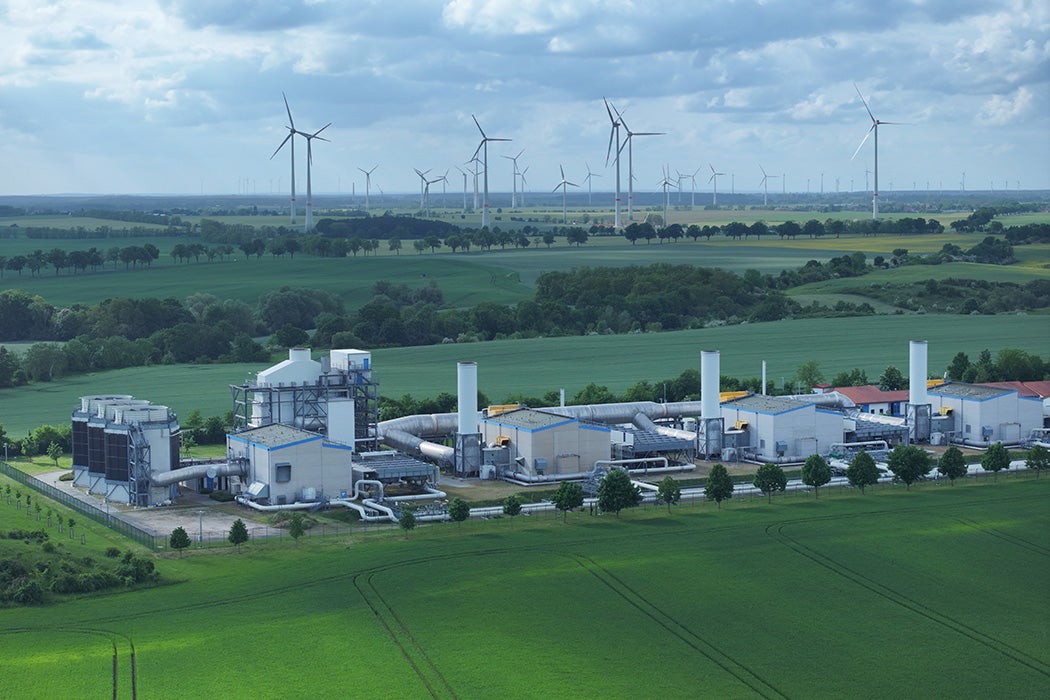
A compressor station of the Jagal natural gas pipeline stands as wind turbines spin behind on May 24, 2023 near Mallnow, Germany.
Getty
Share
By: Aissa Dearing and Michaela Rychetska
October 10, 2024
4 minutes
The icon indicates free access to the linked research on JSTOR.
Russia’s invasion of Ukraine has fundamentally altered Europe’s geopolitical landscape, with profound implications for its energy security. The invasion exposed Europe’s vulnerabilities, particularly its heavy reliance on Russian oil and natural gas. This has repositioned energy security as a central concern, with Russia seen as a significant threat to the stability and reliability of Europe’s energy supply chains. In response, Europe has taken decisive action to reduce its energy imports from Russia. In May 2022, the European Council agreed to ban almost 90 percent of Russian oil imports—with the notable exception of pipeline crude oil—complemented by stringent sanctions aimed at weakening Russia’s economic leverage. Does this shift suggest that the European Union’s transition to renewable energy is accelerating, not solely for climate reasons, but to achieve energy sovereignty amidst a geopolitical crisis?

The ongoing conflict in Ukraine has indeed catalyzed a unified European reassessment of energy dependence on Russia, prompting collective efforts to diversify energy sources and bolster energy security. As security studies scholar Marc Ozawa notes, Western European countries historically framed their reliance on Russian energy within the context of market transactions and economic interests, a legacy of the oil shocks during the 1970s OPEC crisis. In this light, reliance on Russian energy was, in some respects, a strategic response to earlier crises.
In 2022, Europe’s reorientation didn’t initially lead to an immediate surge in renewable energy adoption. Instead, Europe increasingly turned to alternative suppliers, such as the United States, Norway, and North African states, for liquefied natural gas (LNG). With gas reserves critically low, coal production was temporarily ramped up to meet immediate energy demands. By the winter of 2022, Europe had largely mitigated the energy crisis through timely gas deliveries and the rapid construction of offshore LNG terminals. Nevertheless, blackouts and energy price spikes plagued Central and Eastern Europe, raising concerns about the reliability of renewable energy to meet high winter demands. While there have been efforts to deploy renewable technologies in alignment with the European Union’s Green Deal, greater emphasis should be placed on upgrading ageing energy infrastructure and enhancing the interconnectedness of national grids, enabling greater regional cooperation.
The transition to an energy sovereign economy cannot solely focus on implementing renewable energy—it requires more than technological advancements—it necessitates profound socioeconomic shifts and a reevaluation of the traditional monopolistic energy business model. A just transition, as scholars Elianor Gerrard and Peter Westoby emphasize, is “the idea that the burdens of decarbonization—such as job losses from the closing of the fossil fuel industry or the high costs of clean technologies—should not unfairly impact any one group.” Achieving this transition involves developing policies that are both pragmatic and ethically sound, ensuring that the shift to a low-carbon economy goes beyond labor market adjustments. At its core, a just transition seeks to reconcile environmental protection with the need to protect vulnerable communities long reliant on fossil fuels. The decarbonization process cannot succeed without prioritizing these communities, providing workforce development for fossil fuel workers, and supporting decentralized, community-owned renewable technologies with adequate storage capacities. Existing electric technologies and grid infrastructure shouldn’t become stranded in this process but be retrofitted to ensure efficiency and multilateral grid cooperation.
Weekly Newsletter
Get your fix of JSTOR Daily’s best stories in your inbox each Thursday.
Privacy Policy Contact Us
You may unsubscribe at any time by clicking on the provided link on any marketing message.
Moreover, a just transition must ensure not only environmental sustainability but also equitable access to reliable energy, especially during periods of peak demand, such as in the winter months in Europe. If renewable energy sources alone are unable to meet these demands, and if the high costs of necessary infrastructure—such as battery storage, grid expansion, and green hydrogen technologies—are underestimated, energy inequalities may worsen. Therefore, assuming that renewables alone can drive a just transition requires careful scrutiny, as it risks overlooking the broader socioeconomic challenges of ensuring energy security and affordability for all.
Looking ahead, geopolitical and climatic pressures are likely to reshape international alliances. The energy sovereignty crisis triggered by Russia’s war on Ukraine offers crucial lessons for the future of global energy security and climate policy. Proactively advancing a just transition will be essential to navigate these unfolding challenges.
Support JSTOR Daily! Join our membership program on Patreon today.
Have a correction or comment about this article?
Please contact us.


 canisgallicus