
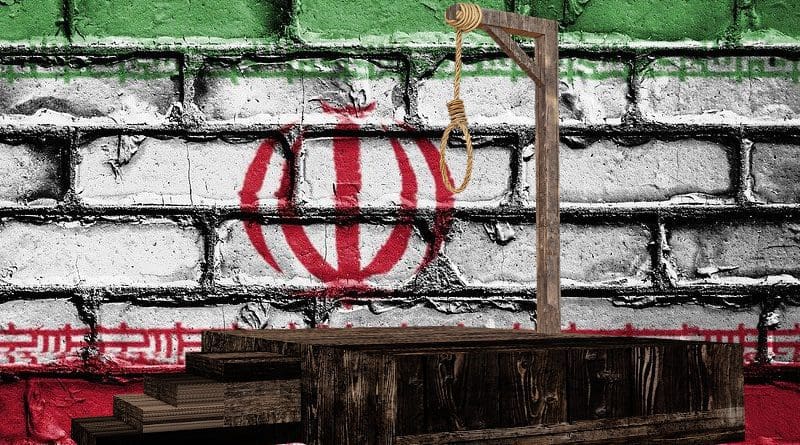
Iran’s Execution Crisis: A Global Call For Justice On World Day Against The Death Penalty – OpEd
By Mahin Horri
Twenty-two years ago, several global human rights organizations declared October 10 as “World Day Against the Death Penalty.” However, for the people of Iran, “No to Execution” is synonymous with “No to the regime of mass murder ruling Iran” and “No” to a regime whose survival and rule are dependent on executions and massacres. Thus, the World Day of “No to Execution” is a symbol of rage and disgust against Supreme Leader Ali Khamenei and the religious dictatorship ruling Iran, which breathes with every execution and holds the highest number of executions per capita.
In tandem with its warmongering in the region, the regime has been waging a campaign of executions in Iran. On the eve of the World Day Against the Death Penalty, regime authorities hanged seven people in Karaj and Zahedan. Since Massoud Pezeshkian became the regime’s president in July, the number of executions has reached 267. On October 8, Pezeshkian, in defense of these brutal executions, mockingly said that those who “talk about human rights ask why you execute a murderer.”
On Tuesday, October 8, the 37th campaign of “No to Execution Tuesdays” was held in 22 different prisons across the country. In a statement, the participating prisoners declared: “The execution regime in Iran, to prevent public protests, executed 30 people in various prisons across the country on the 1st and 2nd of October, three of whom were women.”
The statement from the striking prisoners also noted: “As we approach the ‘World Day Against the Death Penalty,’ we are witnessing the most extreme violence by the backward regime, which executes prisoners in public and ranks first in the world in executions. Since the start of the Persian year 1403 (March 2024), nearly 450 people have been executed.”
The support of figures, parliaments, human rights organizations, and free Iranians across the globe for the prisoners’ protest in the “No to Execution Tuesdays” campaign has extended the “No to Execution” movement beyond Iran’s borders, awakening the conscience of the world to stand with the prisoners and their campaign.
In a message for the World Day Against the Death Penalty, Mai Sato, the UN Special Rapporteur on Human Rights in Iran, said: “This year, the World Day Against the Death Penalty holds particular significance for the Islamic Republic of Iran, where we continue to witness an alarming increase in the use of the death penalty, with over 500 executions reportedly carried out this year.”
The Special Rapporteur added: “In the face of this, the courage of the Iranian people shines through. The ‘No to Execution Tuesdays’ campaign, a prisoner-led initiative, in which prisoners go on a hunger strike every Tuesday against the death penalty, demonstrates the unwavering commitment to human rights and justice.”
Simultaneously with the 57th session of the UN Human Rights Council in Geneva, a conference titled “Human Rights Violations and the Wave of Executions in Iran” was held at the European headquarters of the UN in Geneva, attended by political, legal, and human rights figures. In his speech, Antonio Stango, President of the Italian Federation for Human Rights, recalled the federation’s support for the international campaign to stop executions in Iran and the “No to Execution Tuesdays” campaign. He said: “In in only in the first nine months of 2024, there have been more than 450 executions in Iran and they are continuing and this trend is constantly growing.”
Mr. Stango added: “Somebody said that, that the Iranian regime is the head of the snake of the evil in the region. I do share that opinion, and that is the reason why I think that all the international community has to strongly support the Iranian people in their struggle for freedom. They bravely, every day, are challenging the regime.”
Last week, in a speech at the Parliamentary Assembly of the Council of Europe, Mrs. Maryam Rajavi, the president-elect of the National Council of Resistance of Iran (NCRI), said: “I stand before you today under circumstances where the Iranian regime’s killing machine is operating at full force. The number of executions has reached 223, including eight women, in the two months since Pezeshkian took office as the regime’s president. Eighteen years ago, in 2006, I announced the Iranian Resistance’s Ten-Point Plan for the future of Iran, right here, in this same place. One of the key points of this plan emphasizes the abolition of the death penalty. Once again, on the verge of the World Day against the Death Penalty, I urge the Council of Europe and the Parliamentary Assembly that are committed to human rights, to support the international campaign to halt executions in Iran.”
FacebookTwitterEmailFlipboardMastodonLinkedInShare

Mahin Horri
Mahin Horri writes for the People’s Mojahedin Organization of Iran (PMOI/MEK).

 canisgallicus