
Select:

100 years of Jimmy Carter: The centennial president’s legacy
The politician from Plains, Georgia is known for his concept of moral leadership, with which he governed the United States for four years
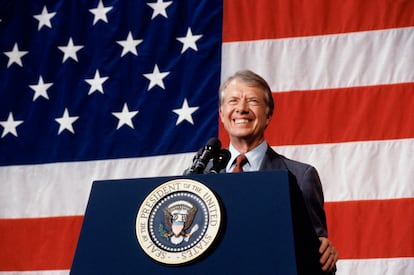

Jimmy Carter, the 39th President of the United States, has left an important legacy marked by both his time in office and his extensive activities after leaving the White House. As a one-term president from 1977 to 1981, the Carter Administration faced significant challenges, but his commitment to human rights, diplomacy and environmental issues shaped his administration. After leaving office, he emerged as one of the most active and respected former presidents in U.S. history, devoting himself to humanitarian efforts, conflict resolution and public health through The Carter Center. As he becomes the first U.S. president to reach the age of 100 on October 1, we look back at some of the key moments in his life.
Presidency
Carter’s time in the White House was defined by a number of ambitious policies, many of which were based on his belief in the importance of moral leadership. One of his major domestic initiatives was to address the country’s energy crisis, which was a problem during the 1970s due to the oil embargo caused by tensions in the Middle East. He implemented a national energy policy aimed at reducing dependence on foreign oil, encouraging energy conservation and exploring renewable energy sources. Although his proposals faced resistance from Congress and the public, they laid the groundwork for future energy policies, particularly his push for energy efficiency and alternative energy sources, which remain relevant in modern environmental discussions.
Economy
On the economic front, Carter inherited a country struggling with stagflation, a combination of high inflation and unemployment, and his administration had difficulty stabilizing the economy. His efforts to reduce inflation through restrictive monetary policies met with mixed results, causing short-term recessions and leading to negative political consequences. At the end of his term, inflation and interest rates were still high, which contributed to national frustration and played a major role in his defeat by the Republican candidate Ronald Reagan in the 1980 election. Despite these economic difficulties, Carter was able to claim some accomplishments, such as the creation of nearly eight million jobs during his tenure and improvements in the federal deficit.

Foreign policy
The politician’s legacy is best remembered for his focus on human rights and diplomacy. Early in his presidency, he made human rights a pillar of U.S. foreign policy, often pressuring authoritarian governments to improve their treatment of their citizens. This approach was innovative at the time, although it strained relations with some U.S. allies, especially in the context of the Cold War. His dedication to human rights was most evident in his handling of relations with Latin America and his push for the Panama Canal treaties, which successfully transferred control of the canal to Panama, ending a contentious chapter in U.S.-Panama relations.
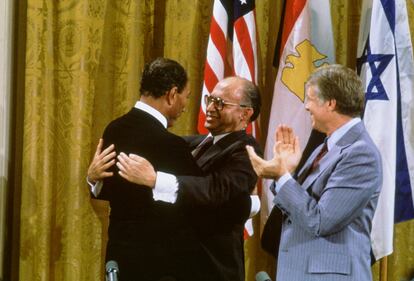
One of his most important foreign policy achievements was the Camp David Accords, which brought peace between Egypt and Israel after years of hostility. Through intense negotiations over 12 days in 1978, Carter achieved an agreement between Egyptian President Anwar Sadat and Israeli Prime Minister Menachem Begin, resulting in the first peace treaty between Israel and an Arab country. This agreement remains one of the most important diplomatic successes in the Middle East, although it did not lead to a broader peace in the region, as Carter had hoped. Still, it won him international praise and cemented his reputation as a mediator.
However, Carter’s foreign policy also faced serious setbacks. The Iranian Revolution of 1979, followed by the Iran hostage crisis, proved to be a turning point in his presidency. After Iranian revolutionaries seized the U.S. Embassy in Tehran and captured 52 Americans, the Carter Administration struggled to secure their release. A failed rescue mission in April 1980, in which eight U.S. servicemen were killed, further damaged his administration’s credibility. The hostages were finally released on the day Carter left office in January 1981, which was perceived as a symbolic end to his complex presidency.
After the presidency
Despite the challenges he faced in office, Carter’s later life is considered one of the most active and impactful in American history. In 1982, Carter and his wife Rosalynn founded The Carter Center, a nonprofit organization focused on human rights, conflict resolution and public health. Through this organization, Carter became a global advocate for democracy and human rights, serving as a mediator in international conflicts and promoting fair elections in developing countries. According to official data, The Carter Center has overseen more than 100 elections worldwide, helping to ensure transparency and fairness in countries in transition to democracy.
One of The Carter Center’s most recognized achievements has been its effort to eradicate guinea worm disease, a parasitic disease that has affected millions in developing countries. Carter took a personal interest in this cause and, through the center’s health initiatives, guinea worm disease has come close to being eradicated, with fewer than 100 cases reported annually by the 2020s.
Carter also continued his diplomatic efforts after leaving the White House, serving as an unofficial envoy in several global conflicts. He played key roles in mediating disputes in countries such as North Korea, Haiti and Sudan, and was often sought out by foreign leaders for his ability to negotiate and resolve complex international issues. His willingness to engage in dialogue with controversial figures and regimes, though sometimes criticized, demonstrated his belief in dialogue rather than confrontation as a path to peace.

In addition to his work at the Carter Center, Carter became involved with Habitat for Humanity, a nonprofit organization dedicated to building affordable housing for those in need. He and Rosalynn spent many years volunteering with the organization, personally helping to build homes for low-income families in the United States and around the world.
Carter’s commitment to his faith and moral principles have also defined his later years. He remained an active member of Maranatha Baptist Church in Plains, Georgia, and taught Sunday school well into his 90s. His books, including several memoirs and reflections on faith, reaffirm his belief that public service is a form of moral duty. In 2002, Carter received the Nobel Peace Prize in recognition of his decades of efforts to promote peace and human rights, a rare honor for a former president.

Sign up for our weekly newsletter to get more English-language news coverage from EL PAÍS USA Edition

 canisgallicus