
‘World-first’ indoor vertical farm to produce 4M pounds of berries a year
September 25, 2024
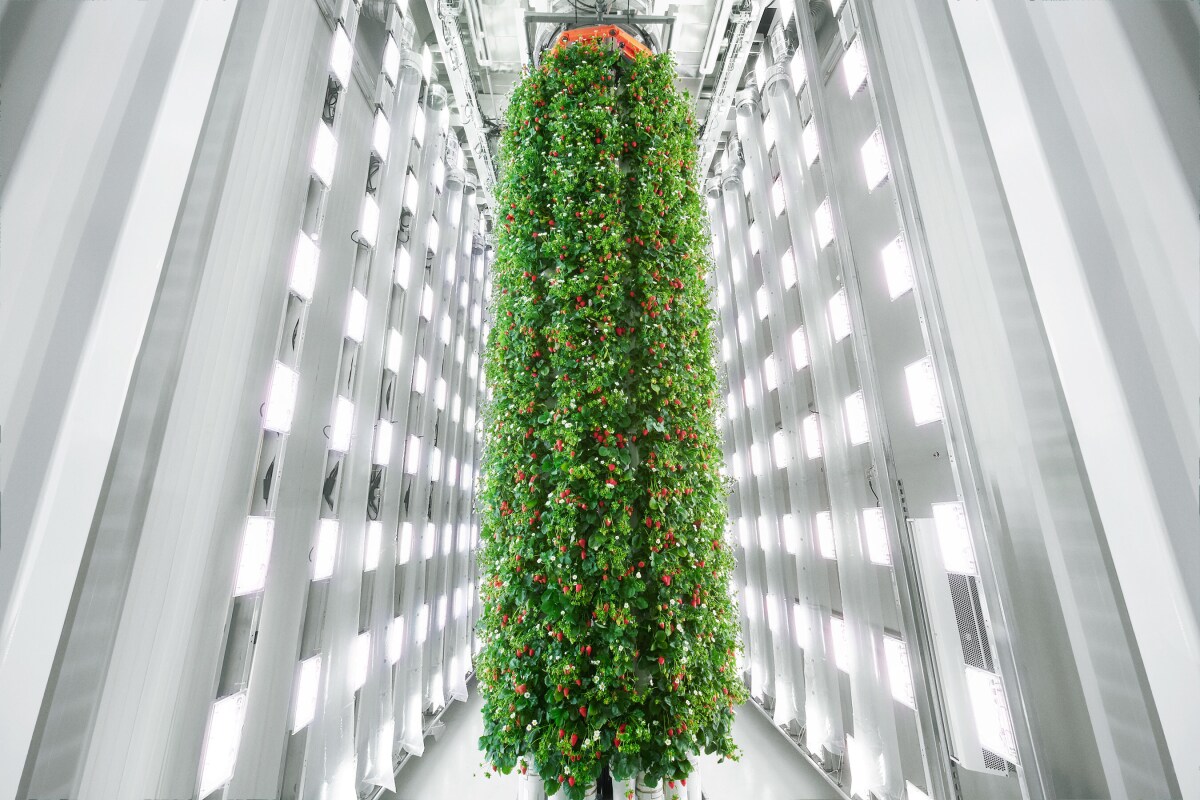
Plenty’s 30-ft vertical indoor towers of strawberries
Plenty
View 2 Images
Major steps towards better, sustainable and affordable food production free of environmental challenges have been taken, with the “world’s first farm to grow indoor, vertically farmed berries at scale” opening in Richmond, VA. It’s backed by an international team of scientists that see this new phase of agriculture as a way to ease global food demands.
The Plenty Richmond Farm is designed to produce more than four million pounds (1.8M kg) of strawberries grown indoors vertically in 30-ft-tall (9-m) towers, using up less than 40,000 square feet – or less than a single acre. This is a fraction of the land needed in traditional strawberry production, which is also subject to seasonal and environmental factors that limit yield.
The company says the strawberries, from global company Driscoll’s, will be on grocery store shelves in early 2025.
“Plenty’s farm will boost local agriculture production and drive economic development, all while diversifying against risks and protecting the environment,” said Virginia Governor Glenn Youngkin. “We look forward to supporting their innovative approaches to revolutionizing the industry.”
To date, plant-based commercial vertical farming has mostly been limited to the production of lettuce crops, but this latest technological advancement has broadened the scope of what can be grown upwards. With temperature, light and humidity controlled across 12 growing ‘rooms,’ pollination of plants has also been engineered to be more efficient than bees. Ultimately, the company believes this will result in more uniformity in fruit and result in less waste.
“This farm is a model for the positive impact climate-agnostic agriculture can have, and proof that vertical farming can deliver the crop diversity, scaled and local production needed to future-proof the global food system,” said Arama Kukutai, Plenty CEO. “The Plenty Richmond Farm is the culmination of 200 research trials over the past six years to perfect growing strawberries with consistent peak-season flavor indoors year-round. Driscoll’s sets an incredibly high bar for the quality of its berries and we’re excited to join forces to consistently deliver an ultra-premium Driscoll’s strawberry year-round.”
This video, from a year ago, shows the company’s early work in establishing the vertical-farming model that could enable this sort of small-area, high-yield and year-round production of food.https://www.youtube.com/embed/clDlTVwWZ1I?enablejsapi=1
Plenty—Creating the Future of Farming in Compton
The opening of this first vertical farm is the culmination of years of scientific research into the model, with work undertaken by a global team from organizations including The University of Queensland, Macquarie University, Wageningen University, University of Florida, University of the Basque Country, CAS Center for Excellence in Molecular Plant Sciences and Shanghai Institute of Plant Physiology and Ecology.
“Vertical farms grow crops indoors in stacked layers and provide consistent yield and crop quality but they use a tremendous amount of costly energy for light and air flow,” said Paul Gauthier, Professor of Protected Cropping at the University of Queensland, Australia. “If we create a more dynamic environment that turns lights and sensors on and off during the day in line with the cycles of photosynthesis rather than leaving them on all the time, we could tap into cheaper energy at off peak times and still maximize the advantages of vertical farming.
“I managed to get strawberries to produce 6 kg (13 lb) per plant when everybody was saying that the maximum you could produce in a greenhouse was 2 kg (4.4 lb),” he added. “I multiplied the strawberry yield by three by modifying the environment and pushing them to the limit.”
The Richmond farm uses 97% less land and up to 90% less water than conventional farming, eradicates the use of pesticides, and the controlled environment and shorter supply chain will also lower pathogenic risk to crops.
“I would like to see protected cropping or controlled environment agriculture treated as a separate discipline of plant science,” added Gauthier. “If we are to increase food production by as much as 70% by 2050, we need to look at things differently.
“That is what vertical farming allows us to do – we didn’t have this possibility before,” he added.
“By combining our 100 years of farming expertise and proprietary varieties along with Plenty’s cutting-edge technology, we can deliver the same consistent flavor and quality our customers love – now grown locally,” said Soren Bjorn, Driscoll’s CEO. “This new innovative farm is a powerful step forward in continuing to drive category growth in new ways for our customers and consumers.”
The research has been published in the journal Frontiers in Science.
Source: The University of Queensland, Plenty, PR Newswire
We recommend
- The first AsiaEvo conference, connecting Asian evolutionary biologists to the worldGuojie Zhang, National Science Review, 2018
- Can crop science really help us to produce more better-quality food while reducing the world-wide environmental footprint of agriculture?William J. DAVIES, Susan E. WARD, Alan WILSON, INTEGRATING CROP AND LIVESTOCK PRODUCTION SYSTEMS – FASE, 2020
- Can crop science really help us to produce more better-quality food while reducing the world-wide environmental footprint of agriculture?William J. DAVIES, Frontiers of Agricultural Science and Engineering, 2020
- Can crop science really help us to produce more better-quality food while reducing the world-wide environmental footprint of agriculture?William J. DAVIES, Frontiers of Agricultural Science and Engineering-3, 2020
- Multi-year analyses on three populations reveal the first stable QTLs for tolerance to rain-induced fruit cracking in sweet cherry (Prunus avium L.)José Quero-García, Horticulture Research-1, 2021
- Agriculture green development in China: insights and advancesJianbo SHEN, Frontiers of Agricultural Science and Engineering, 2024
Tags
Manufacturingsustainable designFood technologyBiotechnologyEnvironmentalProduction

Bronwyn has always loved words and animals, and she has the journalism and zoology degrees to prove it. After more than 20 years as a writer and editor, the former music journalist went back to university to build on her passion for wildlife and conservation with a Bachelor of Zoology, which unlocked two new loves: sharing animal facts at any opportunity and getting others excited about science. Particularly interested in neuroscience, genetics, animal behavior and evolutionary biology, Bronwyn has found a happy home at New Atlas, coming on board in February 2023.

 canisgallicus