
Surgery-free Neuralink rival enables thought-controlled smart home
September 17, 2024
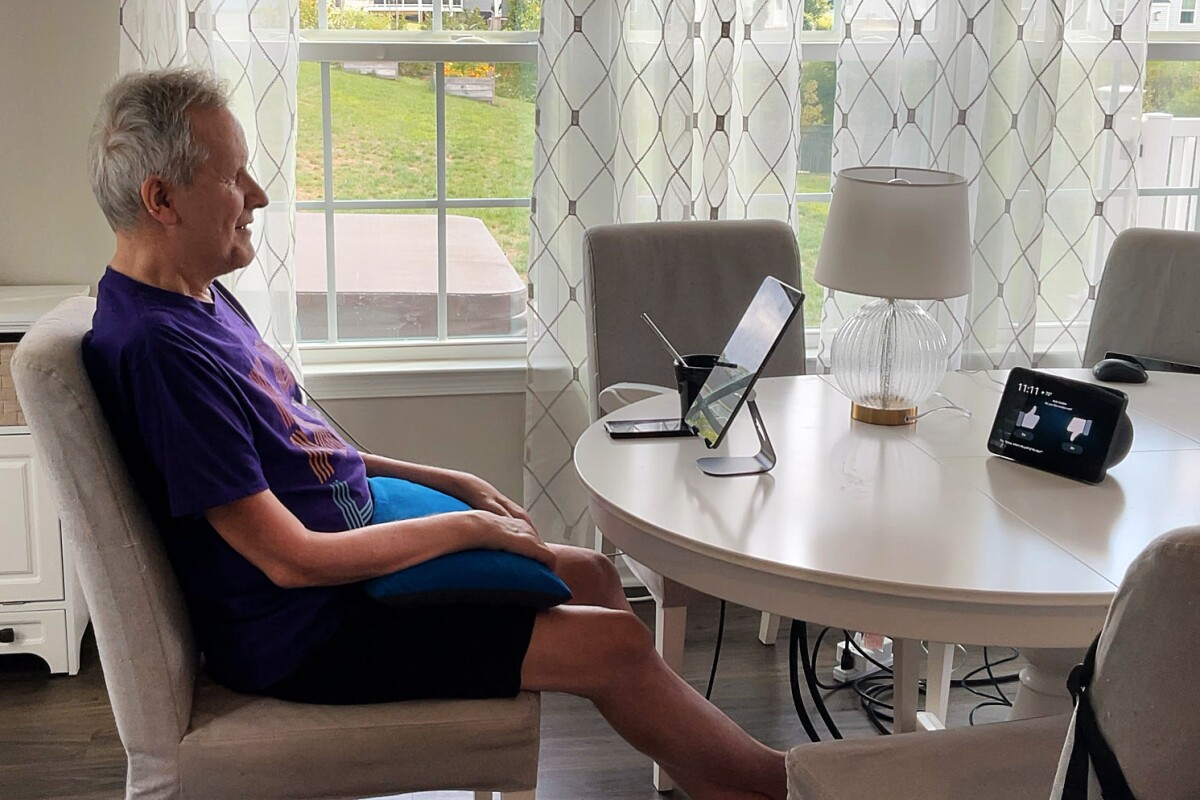
A Synchron trial participant controlling Alexa just by thinking about which interface buttons to press
Neurotech company Synchron has been making massive strides over the past couple of years. It’s just announced that a trial participant has used its brain-computer interface (BCI) to turn on the lights in his home, see who is at the door, and choose what to watch on the TV – hands-free and without even a voice command.
That’s thanks to Synchron’s interface translating his thoughts into commands relayed to Amazon’s Alexa service. The virtual assistant is set up on his tablet and connected to his smart home devices. The trial participant, who is living with amyotrophic lateral sclerosis (ALS) and can’t use his hands, can simply think about navigating through options displayed on the tablet to engage them.

Squid-skin-inspired screen displays encrypted images using only magnets
A ‘Stentrode’ embedded in a blood vessel on the surface of his brain houses electrodes that detect motor intent. The participant uses his thoughts to select which tiles to press on the interface and perform actions via Alexa. Watch him use the system in the video below. https://www.youtube.com/embed/3ADYQj90GmI?enablejsapi=1
Synchron BCI x Amazon Alexa
Synchron told us in an interview last year about this potential application of its tech, so it’s heartening to see that become a reality.
“Synchron’s BCI is bridging the gap between neurotechnology and consumer tech, making it possible for people with paralysis to regain control of their environment,” said Tom Oxley, Synchron’s CEO and founder. “While many smart home systems rely on voice or touch, we are sending control signals directly from the brain, bypassing the need for these inputs.”
You’re probably wondering how this positions Synchron against the likes of Neuralink. The former has a major advantage in that its BCI can be implanted without having to open up your skull, and by a wider range of clinics.
Instead, Synchron deploys a self-expanding stent with electrodes embedded in it to the brain’s surface via the jugular vein. According to the company, the implant can safely remain there indefinitely, unlike some FDA-approved trial BCIs that need to be removed after a short period of time.
The company has also had several trial participants test out its tech. Last year, Synchron noted it had 10 people fitted with Stentrodes. Meanwhile, Neuralink revealed only last month that it had implanted its BCI in a second participant.
In terms of capabilities, Neuralink may be more ambitious: the company says its implants feature 1,024 electrodes to capture a large number of signals from the brain for potentially more complex actions. The device has enabled its first trial patient to play video games, move a cursor on a computer, and browse the web. Meanwhile, Synchron works with a 16-electrode array that’s designed for more specific tasks with custom-built interfaces.
What comes next?
Earlier this year, Synchron had a trial participant use an Apple Vision Pro mixed reality headset to type text messages and play Solitaire, without the need for hand gestures. It used a combination of eye tracking and thought-controlled selection to make that happen.
While this marks an impressive step forward for Synchron’s platform, the company – which is backed by Bill Gates and Jeff Bezos – has likely got plenty of work ahead to bring it to the mainstream. For one thing, FDA protocols typically require years-long trials before such things are approved for commercial release.
Until then, we’ll follow Synchron closely to see how it progresses. As co-founder and CTO Professor Nicholas Opie told us last year: “Anything that can be controlled with a computer can be controlled with this.”
Source: Synchron via Business Wire
We recommend
- COBALT: A Confirmatory Trial of Obeticholic Acid in Primary Biliary Cholangitis With Placebo and External ControlsThe American Journal of Gastroenterology
- Articles in the TrendMD network enjoy an enduring citation increase over 36 months, according to a recent follow-up study.Other
Tags
TechnologyBrain-computer interfaceBrainComputer Human InterfaceParalysisAssistive Technologies

Abhimanyu has been a trusted voice in the science, technology, transport innovations, startup and AI spaces for more than a decade at several global outlets, including three and a half years as the managing editor at TNW. He holds a Bachelor of Arts in Economics, Psychology and Sociology. When he’s not writing about breakthroughs in science and tech, he’s usually out motorcycling around South India.

 canisgallicus