
Dyslexia: German researchers find cause in the brain
15th September 2024
Einstein had dyslexia. Hemmingway had it, too. It can affect people their whole lives. New findings may lead to a fresh approach to the learning difficulty.
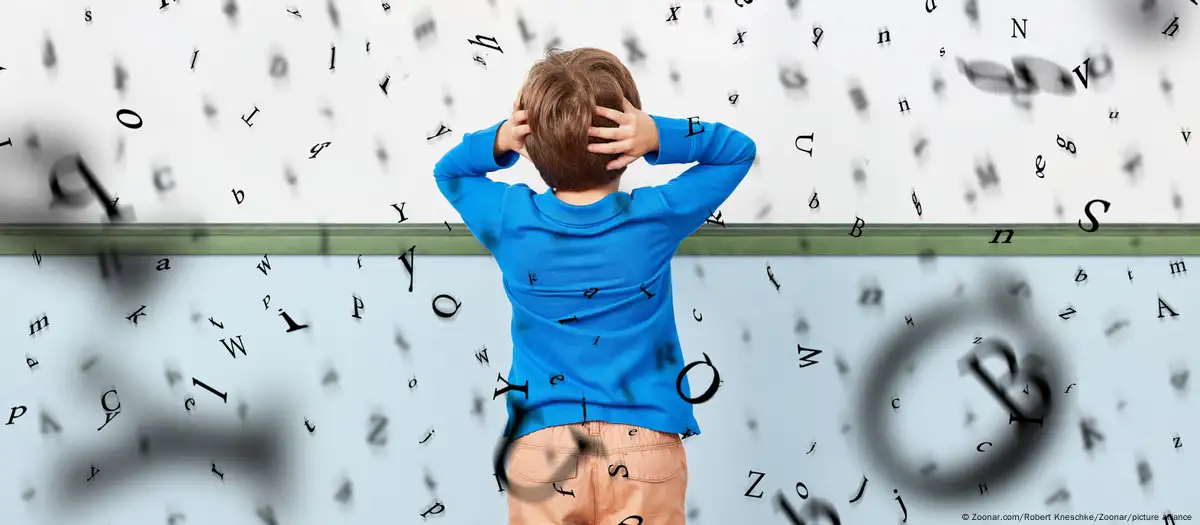
You may know the feeling: You find it difficult to place sounds and signs.
When you read, the flow can feel halting and monotonous, the sounds fail to blend together.
You read the letters as individual sounds, not the words and meanings they make.
You might even omit letters, syllables or whole words, or swap and add them when you read and write. Or miss mistakes when you write and find it hard to write legibly.
Learning difficulties that can last a lifetime
Dyslexia occurs in about 5%-10% of people worldwide, making it the most common learning disorder.
The symptoms can present as early as in infancy. Boys are affected two to three times more often than girls.
At school, kids with dyslexia may find it difficult to reproduce or describe the content of texts in a language class — such as a text they have just read.
The difficulties can occur in any school subject, where reading and writing are required, including in mathematics, or when an exercise is presented as a text.
Above all, people with reading and spelling difficulties struggle with prejudices they face because dyslexia accompanies many throughout their lives. First at school, then at work, and in everyday life.
However, dyslexia says nothing about the intellect (or creative talent) of the people who have it. Famous dyslexics include Albert Einstein, Ludwig van Beethoven, Charles Darwin, Ernest Hemingway, Agatha Christie and Whoopi Goldberg… and the list goes on.


Researchers locate the cause of dyslexia
The causes of dyslexia are not yet fully understood. However, researchers based in Dresden, Germany, say they have been able to show, for the first time, that dyslexia is linked to changes in the function and structure of a specific part of the human brain called the visual thalamus.
The visual thalamus is a key brain region that connects the eyes with the cerebral cortex, which is important to our ability for reasoning, emotion, thought, memory, language and consciousness.
Visual information from the eyes is processed in two separate parts with different tasks: One part is larger than the other and primarily processes colors. The other, smaller part recognizes movements and rapidly changing images.
Structures in the visual thalamus are very difficult to examine using conventional magnetic resonance imaging (MRI) because the visual thalamus lies deep in the brain and is tiny. Its smaller part, the one described above, is the size of a peppercorn.
How researchers spotted changes in the visual thalamus
Thanks to a special MRI system at the Max Planck Institute for Human Cognitive and Brain Sciences in Leipzig, researchers were able to study the visual thalamus in unprecedented detail in living humans.
The researchers found that people with dyslexia show changes in the function and structure of the movement-sensitive part of the visual thalamus. These changes are particularly evident in male dyslexics.
Their study, which was published in the journal Brain, involved 25 people with dyslexia and 24 control subjects.
The researchers say it’s given them a better understanding of this key brain region.
“[It] paves the way for further research aimed at gaining a more comprehensive understanding of the brain mechanisms underlying dyslexia,” said Katharina von Kriegstein, chair of Cognitive and Clinical Neuroscience at TU Dresden, and one of the study authors.
https://www.dw.com/webapi/iframes/widget/en/68339716
Study shows potential for new dyslexia treatment
The findings could lead to new treatments and therapies, said Christa Müller-Axt, a research associate at TU Dresden, who also worked on the study.
“This could open up possibilities for non-invasive neurostimulation techniques as a promising therapeutic method to modulate the activity of these brain structures and thereby alleviate some dyslexia symptoms,” Müller-Axt told the hosts of DW’s Science Unscripted podcast.
A dyslexia breakthrough
Müller-Axt said it was crucial that we now know where in the brain dyslexia develops — a “new target directly linked to reading difficulties in dyslexia. And if we target this area and modulate its activity, it could actually help these people in the future.”
But it will be some time before new, effective and sustainable therapeutic approaches are developed, said Müller-Axt.
Primary sources:
Thalamic brain dysfunction in dyslexia: A breakthrough in understanding the most common learning disorder (Dresden University of Technology) https://tu-dresden.de/tu-dresden/newsportal/news/thalamic-brain-dysfunction-in-dyslexia-a-breakthrough-in-understanding-the-most-common-learning-disorder
Dysfunction of the magnocellular subdivision of the visual thalamus in developmental dyslexia. Published by Christa Müller-Axt, Louise Kauffmann, Cornelius Eichner, Katharina von Kriegstein in the journal Brain (August 2024) https://doi.org/10.1093/brain/awae235
This article was originally published in German.

 canisgallicus