

- NEWS
- 29 August 2024
Humanity’s newest brain gains are most at risk from ageing
The large prefrontal cortex provides evolutionary and cognitive advantages over non-human primates — but there’s a cost.
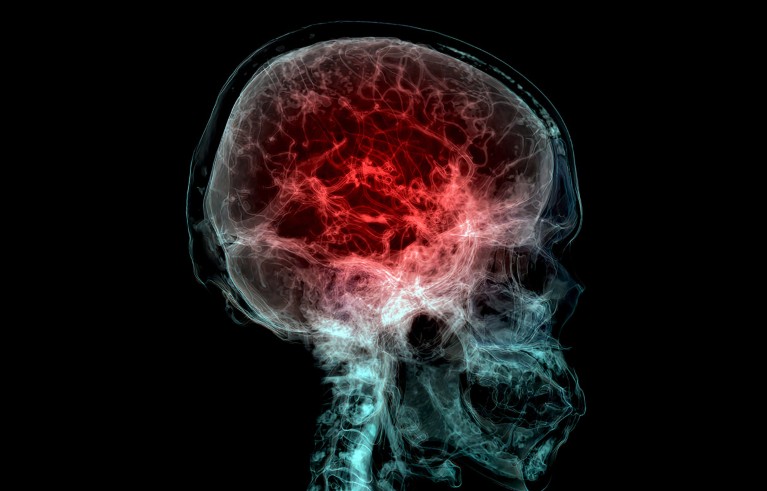
In the more than six million years since people and chimpanzees split from their common ancestor, human brains have rapidly amassed tissue that helps decision-making and self-control. But the same regions are also the most at risk of deterioration during ageing, finds a study1 that compared images of chimp brains with scans of human brains.
Previous studies have shown that regions of the human brain that are the last to mature, such as parts of the frontal lobe, are the first to show signs of ageing2, a theory known as ‘last in, first out’. The latest study shows that some of those regions that mature later, and are most susceptible to ageing, also evolved most recently in humans.
The results tend to support the “important hypothesis that our cortical expansion came at the price of age-related decline”, says Rogier Mars, a neuroscientist at the University of Oxford, UK. The results were published in Science Advances on 28 August.
Mind maps
Researchers created data-driven maps of human and chimp (Pan troglodytes) brains using noninvasive magnetic resonance imaging (MRI) scans. They analysed scans from 189 chimps between the ages of 9 and 50, and 480 people between the ages of 20 and 74.
Overall, they found that the brains of the two species were generally symmetrical across both hemispheres and had many similar clusters of anatomical structures, especially in areas of the prefrontal cortex. This region is involved in complex cognitive functions, such as language, working memory, time perception and decision-making, says study co-author Felix Hoffstaedter, a big-data neuroscientist at the Research Centre Jülich, who is based in Bonn, Germany. Damage to this region is linked to Alzheimer’s disease and several types of dementia, he says.
The researchers then measured how much grey matter in the brain shrank over time — a sign of ageing — in chimps up to the age of 50, and in humans up to the equivalent age of 58. In humans, they found the largest declines in the frontal cortex, including the prefrontal cortex, whereas chimps experienced the largest declines in a central structure involved in habit-forming and reward behaviours, called the striatum. Regions of the brain involved with visual processing and motor skills were less susceptible to ageing in both species.
Rapid growth
Finally, the researchers assessed which regions of the human brain had expanded most compared with the chimp brain and compared scans of human and chimp brains of equivalent age and sex. The speediest evolutionary growth had occurred in areas of the prefrontal cortex — one of the regions most susceptible to ageing. A structure hidden deep in the brain and involved in processing emotions and bodily signals, called the insula, also showed rapid evolutionary growth and increased risk from ageing.
“Evolutionarily, the latest, greatest changes”, says Hoffstaedter, are “where the ageing is happening the most”.
The researchers also compared chimps with olive baboons (Papio anubis) and rhesus macaques (Macaca mulatta). Here, they found no such link between the areas of the brain that had experienced rapid evolutionary expansion and those that went through accelerated ageing, suggesting that this feature could be unique to human brain evolution.
Mars says it would be interesting to look at age-related changes beyond grey-matter decline, including changes in the connections between brain regions and gene expression profiles.
doi: https://doi.org/10.1038/d41586-024-02784-w
References
- Vickery, S. et al. Sci. Adv. 10, eado2733 (2024).Article Google Scholar
- Douaud, G. et al. PNAS 111, 17648-17653 (2014).Article PubMed Google Scholar

 canisgallicus