
Automatic Translator Breaks Language Barrier For Doctors & Patients
By Sara Miller, NoCamels August 26, 2024 4 minutes
(Photo: Pexels)
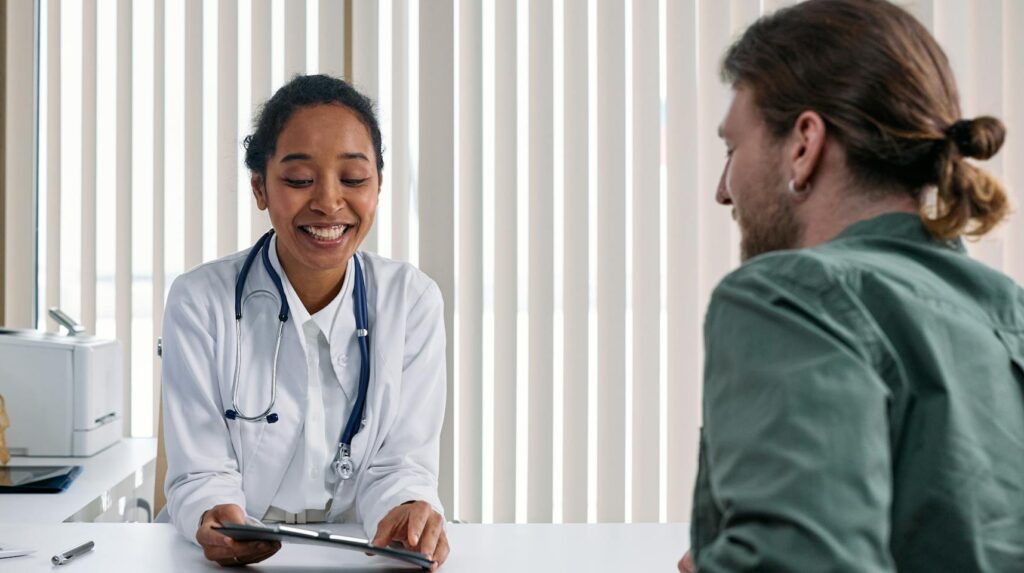
For many people around the world, a doctor’s visit can be exceptionally fraught due to a language barrier in a scenario where accuracy and the ability to understand and be understood are of utmost importance.
But four former and current students of the Technion – Israel Institute of Technology in Haifa have developed a new tool that could mean an end to such situations, with an automatic translation platform that is designed specifically for encounters between patients and their physicians.
“It is a simultaneous translator between doctors and patients who have both language and cultural challenges,” explains CommU CEO Hadar Eliad, MD.
“The objective of CommU is to offer free communication between patient and doctor,” she tells NoCamels.
Israel is a melting pot of citizens from a multitude of countries, and while Hebrew is the primary language, more than 20 percent of the population is Arab and another 15 percent are native Russian speakers.
The startup was established by Eliad along with CFO Efrat Ordan, CTO Hanna Ben-Yehuda and COO Ella Fainitsky. Eliad and Fainitsky were both medical students, while Ben-Yehuda was studying computer science and Ordan electrical engineering.
Crucially, the CommU platform takes into account cultural differences that could both hamper diagnosis and adherence to a treatment regimen.
Eliad gives the example of a Russian-speaking patient who told her doctor that she had pain in her left side.
In Russian, explains Eliad, there is a specific word for the area around the ribs, but which in Hebrew became a more general reference to the left side. Because of this, the doctor did not initially understand that the patient was referring to a specific area on the left side of her body.
The tool comes in the form of an app that can be installed on any device that a doctor uses – phone, tablet or computer – and provides text and voice-based translation.
It is designed primarily for family physicians and emergency room doctors, the two places where patients born in foreign countries are most likely to interact with medical staff.
The four began to work on the translator about a year and half ago, after Eliad had an encounter during an oncology rotation, when the doctor she was with had to inform a patient that her breast cancer had returned.
The patient spoke only Arabic, which the doctor did not speak, Eliad says. As a result, the physician was forced to address her remarks to the patient’s husband, while the patient played no part.
“The patient sat there completely uninvolved in the conversation,” she says. “They were talking about her cancer and she was completely disconnected.”
Eliad asked the patient’s husband if his wife understood anything that was being discussed and he replied that she did not but he could explain it to her later at home.
Sign up for our free weekly newsletter
“It pained me that he had to give this bad news to his wife at home, when it was the job of the doctor, who could also answer any questions she had,” Eliad recalls.
Eliad then brought in a colleague who speaks Arabic as her mother tongue to help translate.
“Suddenly the patient became very engaged,” she says, “asking questions about her treatment and her prognosis and other things she wanted to know.”
Eliad discussed this experience with her co-founders and they decided to create a platform to solve this problem.
They built the app using a number of different AI machine learning models in order to maximize the individual strengths of the various formats.
The four then further adapted the new platform to their own needs by adding medical vocabulary and terms.
They worked extensively with anthropologists at the University of Haifa in order to incorporate more than 100 relevant cultural references, and collaborated with the Israeli Ministry of Health and three of the four national health maintenance organizations.
The app supports Hebrew, Arabic, Russian and English – the four most commonly spoken languages in Israel – as well as most European languages. They are working on adding more languages, the four say, but want to ensure that the translation is of the same high standard before making them available.
The startup came through BizTec, the Technion’s entrepreneurship program, and was this summer in the 2024 cohort for MassChallenge Israel’s Early Stage Accelerator Program, a four-month intensive course in Jerusalem that helps entrepreneurs advance their nascent companies.
The team recently completed the development of the app, working with several clinics that treat patients from a wide variety of backgrounds, including Ukrainian refugees.
“The last time I was [at one of the clinics],” says Fainitsky, “there were six patients from six different countries.”
Now, says Eliad, the app is at the “exciting” stage of actually being used by the first adopters, including staff at a neurological rehabilitation center in Haifa, and they hope to expand their reach quickly.
After all, she says, “the patient is the most important thing.”

 canisgallicus